
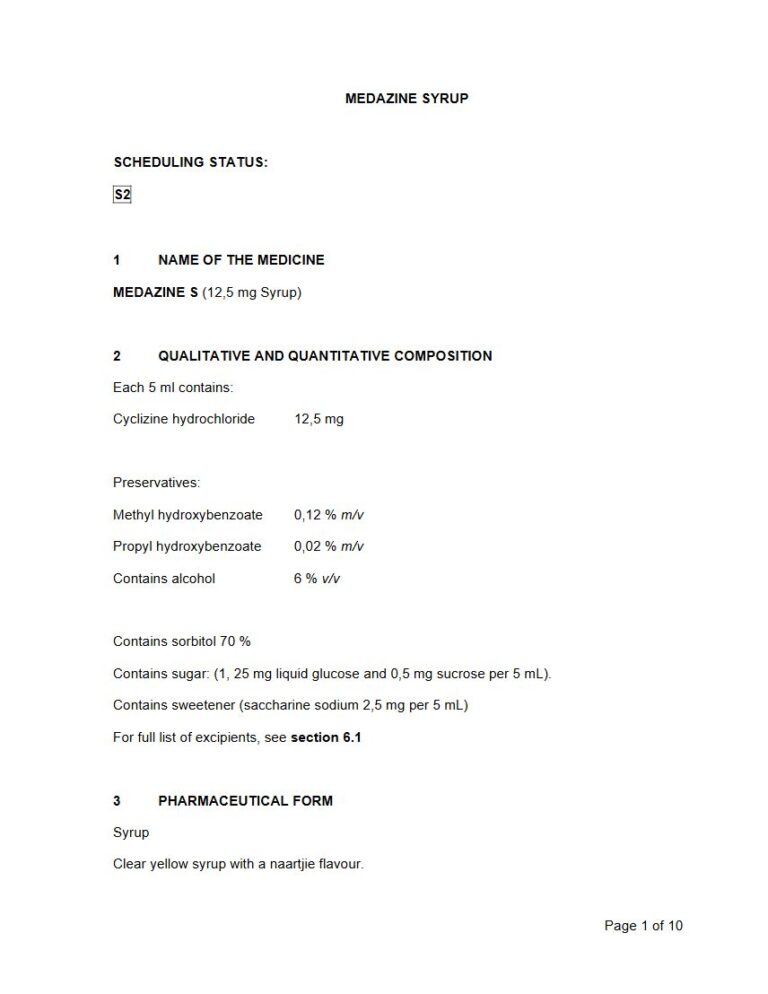
Medazine S 5 ml Syrup
PDF Leaflet Revision Date: 20 February 2023
Clinical Summary
Quick overview from the medicine insert
Indication
Prevention and treatment of nausea and vomiting, especially motion sickness.
Dosage (summary)
Adults: 12.5 mg (5 ml) before travel; Children 6-12 years: 10 ml, 2-5 years: 5 ml, up to 3 times daily.
Onset of Action / Duration
Onset: 30 mins, Duration: Not specified
Special Populations
- Elderly patients
Pregnancy & Breastfeeding
Safety during pregnancy and lactation not established.
Key Drug Interactions
- CNS depressants
- Atropine
- Monoamine oxidase inhibitors
Contraindications
- Previous adverse reaction to cyclizine
- Acute asthma
- Narrow angle glaucoma
- Urinary retention
- Prostatic hypertrophy
Common side effects
- Drowsiness
- Dizziness
- Dry mouth
- Blurred vision
- Tinnitus
Counselling Points
- Avoid driving or operating machinery
- Take before travel for motion sickness
- Report any unusual side effects
Serious warnings
- May cause drowsiness
- Avoid alcohol
- Risk of seizures in predisposed patients
Important Disclaimer
The Medazine S 5 ml Syrup professional information leaflet below is the property of Cipla Medpro and is provided on Medinsert exactly as issued, with no.. alterations or editorial changes. We make every effort to keep content current by updating documents as soon as new versions become available. Medinsert serves as a trusted access point for healthcare professionals, but does not replace official sources or clinical judgement. For more details, please read our full disclaimer. read more>>
 Healthcare Professionals Only
This content is for registered healthcare professionals
Sign in or create a free account to read the full package insert.
Free for HPCSA-registered professionals. Powered by Medinsert.
Clinical Particulars
Section 4 of the official insert — extracted exactly as issued, no alterations
4.1 Therapeutic indications
MEDAZINE S is indicated for the prevention and treatment of nausea and vomiting, particularly motion sickness and labyrinthine disorders (Meniereu2019s Syndrome).
4.2 Posology and method of administration
Posology
To prevent motion sickness MEDAZINE S Syrup should be taken about half an hour before the journey.
Children 6 to 12 years: 10 mL (2 medicine measures), may be repeated up to three times daily.
Children 2 to 5 years: 5 mL (1 medicine measure), may be repeated up to three times daily.
Special populations
Elderly patients There have been no specific studies of MEDAZINE S in the elderly.
Method of administration
MEDAZINE S is for oral administration.
4.3 Contraindications
MEDAZINE S is contraindicated in:
u2022 Individuals who have previously reacted adversely to cyclizine or to any of the inactive ingredients of MEDAZINE S, listed in section 6.1.
u2022 The safety of MEDAZINE S during pregnancy and lactation has not been established.
u2022 Antihistamines are contraindicated in acute asthma attacks due to the anticholinergic effects of this class of medicines.
u2022 Anticholinergics should not be used in conditions such as narrow angle glaucoma, urinary retention, prostatic hypertrophy, emphysema, chronic pulmonary disease, shortness of breath, and difficulty in breathing, unless directed by a medical practitioner.
4.4 Special warnings and precautions for use
This medicine may lead to drowsiness and impaired concentration, which may be aggravated by simultaneous intake of alcohol or other central nervous system depressants. Patients should be advised, particularly at the initiation of therapy, against taking charge of vehicles or machinery or performing potentially hazardous tasks where loss of concentration may lead to accidents. Antihistamines may precipitate epileptiform seizures in patients with focal lesions of the cerebral cortex. Antihistamines may suppress positive skin test results. MEDAZINE S Syrup may affect the metabolism of drugs in the liver.
Paediatric population
Paradoxical central nervous system stimulation may occur, especially in children, with insomnia, nervousness, tachycardia, tremors and convulsions.
4.5 Interaction with other medicines and other forms of interaction
Patients are warned that MEDAZINE S Syrup may enhance the sedative effect of central nervous system depressants including alcohol, barbiturates, hypnotics, narcotic analgesics, sedatives and tranquilizers.
Since MEDAZINE S Syrup has anticholinergic properties, it should be used with care in conditions liable to be exacerbated or otherwise adversely affected by atropine, such as glaucoma and prostatic hypertrophy. The side effects of anticholinergic medicines such as atropine and tricyclic antidepressants may be enhanced by the concomitant administration of MEDAZINE S Syrup. MEDAZINE S may mask the warning symptoms of damage caused by ototoxic medicines. Restlessness, dizziness and tachycardia may occur if atropine and MEDAZINE S Syrup are used together. Monoamine oxidase inhibitors may enhance the anti-muscarinic effects of antihistamines. MEDAZINE S enhances the soporific effect of pethidine.
4.6 Fertility, pregnancy and lactation
The safety of MEDAZINE S during pregnancy and lactation has not been established.
4.7 Effects on ability to drive and use machines
MEDAZINE S may lead to drowsiness and impaired concentration, which may be aggravated by simultaneous intake of alcohol or other central nervous system depressants. Patients should be warned against taking charge of vehicles or machinery or performing potentially hazardous tasks where loss of concentration may lead to accidents.
4.8 Undesirable effects
Blood and lymphatic system disorders: The following side effects have been reported and frequencies are unknown: Blood disorders, including agranulocytosis and haemolytic anaemia.
Immune system disorders: The following side effects have been reported and frequencies are unknown: Fixed drug eruptions, generalised chorea, and hypersensitivity hepatitis have been reported.
Psychiatric disorders: The following side effects have been reported and frequencies are unknown: Drowsiness, inability to concentrate, lassitude, dizziness, incoordination, headache, elation or depression, irritability, nightmares, and tingling, heaviness and weakness of the hands as well as generalised chorea. In children MEDAZINE S may have the same effect as a central stimulant.
Eye disorders: The following side effects have been reported and frequencies are unknown: Blurred vision.
Ear and labyrinth disorders: The following side effects have been reported and frequencies are unknown: Tinnitus.
Vascular disorders: The following side effects have been reported and frequencies are unknown: Hypotension.
Respiratory, thoracic and mediastinal disorders: The following side effects have been reported and frequencies are unknown: Tightness of the chest.
Gastrointestinal disorders: The following side effects have been reported and frequencies are unknown: Dryness of mouth, nose and throat, diarrhoea or constipation, epigastric pain, and anorexia.
4.9 Overdose
Symptoms of acute overdosage arise from effects of the preparation on the central nervous system and include drowsiness, dizziness, incoordination, weakness, convulsions, hyperpyrexia and respiratory depression. Agitation, ataxia and hallucinations may occur. Treatment is symptomatic and supportive.
