
Aranesp Injection
PDF Leaflet Revision Date: 07 October 2020
Clinical Summary
Quick overview from the medicine insert
Indication
Treatment of symptomatic anaemia in chronic renal failure and cancer patients receiving chemotherapy.
Dosage (summary)
Initial dose: 0.45 u03bcg/kg once weekly or 0.75 u03bcg/kg every two weeks; adjust based on haemoglobin response.
Special Populations
- Renal impairment
- Hepatic impairment
Pregnancy & Breastfeeding
Caution in pregnancy; unknown if excreted in breast milk.
Key Drug Interactions
- Ciclosporin
- Tacrolimus
Contraindications
- Hypersensitivity
- Poorly controlled hypertension
Common side effects
- Hypertension
- Stroke
- Thromboembolic events
- Convulsions
- Allergic reactions
Counselling Points
- Monitor for signs of allergic reactions
- Rotate injection sites
- Report any unusual symptoms immediately
Serious warnings
- Increased risk of death and serious cardiovascular events
- Monitor blood pressure
- Avoid haemoglobin > 12 g/dl
Important Disclaimer
The Aranesp Injection professional information leaflet below is the property of Amgen South Africa and is provided on Medinsert exactly as issued, with no.. alterations or editorial changes. We make every effort to keep content current by updating documents as soon as new versions become available. Medinsert serves as a trusted access point for healthcare professionals, but does not replace official sources or clinical judgement. For more details, please read our full disclaimer. read more>>
 Healthcare Professionals Only
This content is for registered healthcare professionals
Sign in or create a free account to read the full package insert.
Free for HPCSA-registered professionals. Powered by Medinsert.
Clinical Particulars
Section 4 of the official insert — extracted exactly as issued, no alterations
4.1 Therapeutic Indications
Treatment of symptomatic anaemia associated with chronic renal failure (CRF) in adults and paediatric subjects (see section 4.2).
Treatment of symptomatic anaemia in adult cancer patients with non-myeloid malignancies receiving chemotherapy.
4.2 Posology and Method of Administration
ARANESP u00ae treatment should be initiated by medical practitioners experienced in the above mentioned indications.
Posology: Treatment of symptomatic anaemia in adult and paediatric chronic renal failure patients Anaemia symptoms and sequelae may vary with age, gender, and overall burden of disease; a medical practitioner su2019 evaluation of the individual patientu2019s clinical course and condition is necessary.
ARANESP u00ae should be administered either subcutaneously or intravenously in order to increase haemoglobin to not greater than 12 g/dl (7,5 mmol/l). Subcutaneous use is preferable in patients who are not receiving haemodialysis to avoid the puncture of peripheral veins.
Patients should be monitored closely to ensure that the lowest approved effective dose of ARANESP u00ae is used to provide adequate control of the symptoms of anaemia whilst maintaining a haemoglobin concentration below or at 12 g/dl (7,5 mmol/l). Caution should be exercised with escalation of ARANESP u00ae doses in patients with chronic renal failure. In patients with a poor haemoglobin response to ARANESP u00ae, alternative explanations for the poor response should be considered (see sections 4.4 and 5.1).
Due to intra-patient variability, occasional individual haemoglobin values for a patient above and below the desired haemoglobin level may be observed. Haemoglobin variability should be addressed through dose management, with consideration for the haemoglobin target range of 10 g/dl (6,2 mmol/l) to 12 g/dl (7,5 mmol/l). A sustained haemoglobin level of greater than 12 g/dl (7,5 mmol/l) should be avoided; guidance for appropriate dose adjustment for when haemoglobin values exceeding 12 g/dl (7,5 mmol/l) are observed are described below. A rise in haemoglobin of greater than 2 g/dl (1,25 mmol/l) over a four week period should be avoided. If it occurs, appropriate dose adjustment should be made as provided.
Treatment with ARANESP u00ae is divided into two stages, correction and maintenance phase. Guidance is given separately for adult and paediatric patients.
Adult patients with chronic renal failure Correction phase: The initial dose by subcutaneous or intravenous administration is 0,45 u03bcg/kg body weight, as a single injection once weekly. Alternatively, in patients not on dialysis, the following initial doses can also be administered subcutaneously as a single injection: 0,75 u03bcg/kg once every two weeks or 1,5 u03bcg/kg once monthly. If the increase in haemoglobin is inadequate (less than 1 g/dl (0,6 mmol/l) in four weeks) increase the dose by approximately 25 %. Dose increases must not be made more frequently than once every four weeks. If the rise in haemoglobin is greater than 2g/dl (1,25 mmol/l) in four weeks reduce the dose by approximately 25 %. If the haemoglobin exceeds 12 g/dl (7,5 mmol/l), a dose reduction should be considered. If the haemoglobin continues to increase, the dose should be reduced by approximately 25 %. If after a dose reduction, haemoglobin continues to increase, the dose should be temporarily withheld until the haemoglobin begins to decrease, at which point therapy should be reinitiated at approximately 25 % lower than the previous dose. The haemoglobin should be measured every one or two weeks until it is stable. Thereafter the haemoglobin can be measured at longer intervals.
Maintenance phase: In dialysis patients, ARANESP u00ae may continue to be administered as a single injection once weekly or once every two weeks. Dialysis patients converting from once weekly to once every other week dosing with ARANESP u00ae should initially receive a dose equivalent to twice the previous once weekly dose. In patients not on dialysis, ARANESP u00ae may continue to be administered as a single injection once weekly or once every two weeks or once monthly. For patients treated with ARANESP u00ae once every two weeks, after the target haemoglobin has been achieved, ARANESP u00ae may then be administered subcutaneously once monthly using an initial dose equal to twice the previous once every two week dose. Dosing should be titrated as necessary to maintain the haemoglobin target. If a dose adjustment is required to maintain haemoglobin at the desired level, it is recommended that the dose is adjusted by approximately 25 %. If the rise in haemoglobin is greater than 2 g/dl (1,25 mmol/l) in four weeks reduce the dose by approximately 25 %, depending on the rate of increase. If the haemoglobin exceeds 12 g/dl (7,5 mmol/l), a dose reduction should be considered. If the haemoglobin continues to increase, the dose should be reduced by approximately 25 %. If after a dose reduction, haemoglobin continues to increase, the dose should be temporarily withheld until the haemoglobin begins to decrease, at which point therapy should be reinitiated at approximately 25 % lower than the previous dose. After any dose or schedule adjustment the haemoglobin should be monitored every one or two weeks. Dose changes in the maintenance phase of treatment should not be made more frequently than every two weeks. When changing the route of administration the same dose must be used and the haemoglobin monitored every one or two weeks so that the appropriate dose adjustments can be made to keep the haemoglobin at the desired level.
Clinical studies have demonstrated that adult patients receiving recombinant human erythropoietin (r-HuEPO) one, two or three times weekly may be converted to once weekly or once every other week ARANESP u00ae. The initial weekly dose of ARANESP u00ae (u03bcg/week) can be determined by dividing the total weekly dose of r-HuEPO (IU/week) by 200. The initial every other week dose of ARANESP u00ae (u03bcg/every other week) can be determined by dividing the total cumulative dose of r-HuEPO administered over a two-week period by 200. Because of individual variability, titration to optimal therapeutic doses is expected for individual patients. When substituting ARANESP u00ae for r-HuEPO the haemoglobin should be monitored every one or two weeks and the same route of administration should be used.
Paediatric population with chronic renal failure Treatment of paediatric patients younger than 1 year of age has not been studied in randomised clinical trials (see section 5.1). Correction phase: For patients u2265 1 year of age, the initial dose by subcutaneous or intravenous administration is 0,45 u03bcg/kg body weight, as a single injection once weekly. Alternatively, in patients not on dialysis, an initial dose of 0,75 u03bcg/kg may be administered subcutaneously as a single injection once every two weeks. If the increase in haemoglobin is inadequate (less than 1 g/dl (0,6 mmol/l) in four weeks) increase the dose by approximately 25 %. Dose increases must not be made more frequently than once every four weeks. If the rise in haemoglobin is greater than 2 g/dl (1,25 mmol/l) in four weeks reduce the dose by approximately 25 %, depending on the rate of increase. If the haemoglobin exceeds 12 g/dl (7,5 mmol/l), a dose reduction should be considered. If the haemoglobin continues to increase, the dose should be reduced by approximately 25 %. If after a dose reduction, haemoglobin continues to increase, the dose should be temporarily withheld until the haemoglobin begins to decrease, at which point therapy should be reinitiated at approximately 25 % lower than the previous dose. The haemoglobin should be measured every one or two weeks until it is stable. Thereafter the haemoglobin can be measured at longer intervals.
Correction of anaemia in paediatric patients with once monthly ARANESP u00ae dosing frequency has not been studied Maintenance phase: For paediatric patients u2265 1 year of age, in the maintenance phase, ARANESP u00ae may continue to be administered as a single injection once weekly or once every two weeks. Patients < 6 years of age may need higher doses for maintenance of haemoglobin than patients above that age. Dialysis patients converting from once weekly to once every other week dosing with ARANESP u00ae should initially receive a dose equivalent to twice the previous once weekly dose. In patients u2265 11 years of age, not on dialysis, once the target haemoglobin has been achieved with once every two week dosing, ARANESP u00ae may be administered subcutaneously once monthly using an initial dose equal to twice the previous once every two week dose. Clinical data in paediatric patients has demonstrated that patients receiving r-HuEPO two or three times weekly may be converted to once weekly ARANESP u00ae, and those receiving r-HuEPO once weekly may be converted to once every other week ARANESP u00ae. The initial weekly paediatric dose of ARANESP u00ae (u03bcg/week) can be determined by dividing the total weekly dose of r-HuEPO (IU/week) by 240. The initial every other week dose of ARANESP u00ae (u03bcg/every other week) can be determined by dividing the total cumulative dose of r-HuEPO administered over a two week period by 240. Because of individual variability, titration to optimal therapeutic doses is expected for individual patients. When substituting ARANESP u00ae for r-HuEPO the haemoglobin should be monitored every one or two weeks and the same route of administration should be used. Dosing should be titrated as necessary to maintain the haemoglobin target. If a dose adjustment is required to maintain haemoglobin at the desired level, it is recommended that the dose is adjusted by approximately 25 %. If the rise in haemoglobin is greater than 2 g/dl (1,25 mmol/l) in four weeks reduce the dose by approximately 25 %, depending on the rate of increase. If the haemoglobin exceeds 12 g/dl (7,5 mmol/l), a dose reduction should be considered. If the haemoglobin continues to increase, the dose should be reduced by approximately 25%. If after a dose reduction, haemoglobin continues to increase, the dose should be temporarily withheld until the haemoglobin begins to decrease, at which point therapy should be reinitiated at approximately 25 % lower than the previous dose. Patients starting dialysis during treatment with ARANESP u00ae should be closely monitored for adequate control of their haemoglobin. After any dose or schedule adjustment the haemoglobin should be monitored every one or two weeks. Dose changes in the maintenance phase of treatment should not be made more frequently than every two weeks. When changing the route of administration the same dose must be used and the haemoglobin monitored every one or two weeks so that the appropriate dose adjustments can be made to keep the haemoglobin at the desired level.
Treatment of symptomatic chemotherapy-induced anaemia in Cancer patients ARANESP u00ae should be administered by the subcutaneous route to patients with anaemia (e.g. haemoglobin concentration u2264 10 g/dl (6,2 mmol/l)) in order to increase haemoglobin to not greater than 12 g/dl (7,5 mmol/l). Anaemia symptoms and sequelae may vary with age, gender, and overall burden of disease; a medical practitioneru2019s evaluation of the individual patientu2019s clinical course and condition is necessary. Due to intra-patient variability, occasional individual haemoglobin values for a patient above and below the desired haemoglobin level may be observed. Haemoglobin variability should be addressed through dose management, with consideration for the haemoglobin target range of 10 g/dl (6,2 mmol/l) to 12 g/dl (7,5 mmol/l). A sustained haemoglobin level of greater than 12 g/dl (7,5 mmol/l) should be avoided; guidance for appropriate dose adjustments for when haemoglobin values exceeding 12 g/dl (7,5 mmol/l) are observed are described below.
The recommended initial dose is 500 u03bcg (6,75 u03bcg/kg) given once every three weeks, or once weekly dosing can be given at 2,25 u03bcg/kg body weight. If the clinical response of the patient (fatigue, haemoglobin response) is inadequate after nine weeks, further therapy may not be effective. ARANESP u00ae therapy should be discontinued approximately four weeks after the end of chemotherapy. Once the therapeutic objective for an individual patient has been achieved, the dose should be reduced by 25 to 50 % in order to ensure that the lowest approved dose of ARANESP u00ae is used to maintain haemoglobin at a level that controls the symptoms of anaemia. Appropriate dose titration between 500 u03bcg, 300 u03bcg, and 150 u03bcg should be considered. Patients should be monitored closely, if the haemoglobin exceeds 12 g/dl (7,5 mmol/l), the dose should be reduced by approximately 25 to 50 %. Treatment with ARANESP u00ae should be temporarily discontinued if haemoglobin levels exceed 13 g/dl (8,1 mmol/l). Therapy should be reinitiated at approximately 25 % lower than the previous dose after haemoglobin levels fall to 12 g/dl (7,5 mmol/l) or below. If the rise in haemoglobin is greater than 2 g/dl (1, 25 mmol/l) in 4 weeks, the dose should be reduced by 25 to 50 %.
Method of Administration Aranesp may be administered subcutaneously by the patient or a carer after being trained by a doctor, nurse or pharmacist. ARANESP u00ae 10, 15, 20, 30, 40, 50, 60, 80, 100, 150, 300, 500 micrograms solution for injection in pre-filled syringe ARANESP u00ae is administered either subcutaneously or intravenously as described in the posology. Rotate the injection sites and inject slowly to avoid discomfort at the site of injection. ARANESP u00ae is supplied ready for use in a pre-filled syringe.
ARANESP u00ae 10, 15, 20, 30, 40, 50, 60, 80, 100, 150, 300, 500 micrograms solution for injection in pre-filled pen ARANESP u00ae in a pre-filled pen is only for subcutaneous administration. Rotate the injection sites to avoid discomfort at the site of injection. ARANESP u00ae is supplied ready for use in a pre-filled pen. The instructions for use, handling and disposal are given in section 6.6.
4.3 Contraindications
Hypersensitivity to the active substance or to any of the excipients listed in section 6.1.
Poorly controlled hypertension.
4.4 Special Warnings and Precautions for Use
General In order to improve the traceability of erythropoiesis-stimulating medicines (ESMs), the trade name of the administered ESM should be clearly recorded (or stated) in the patient file.
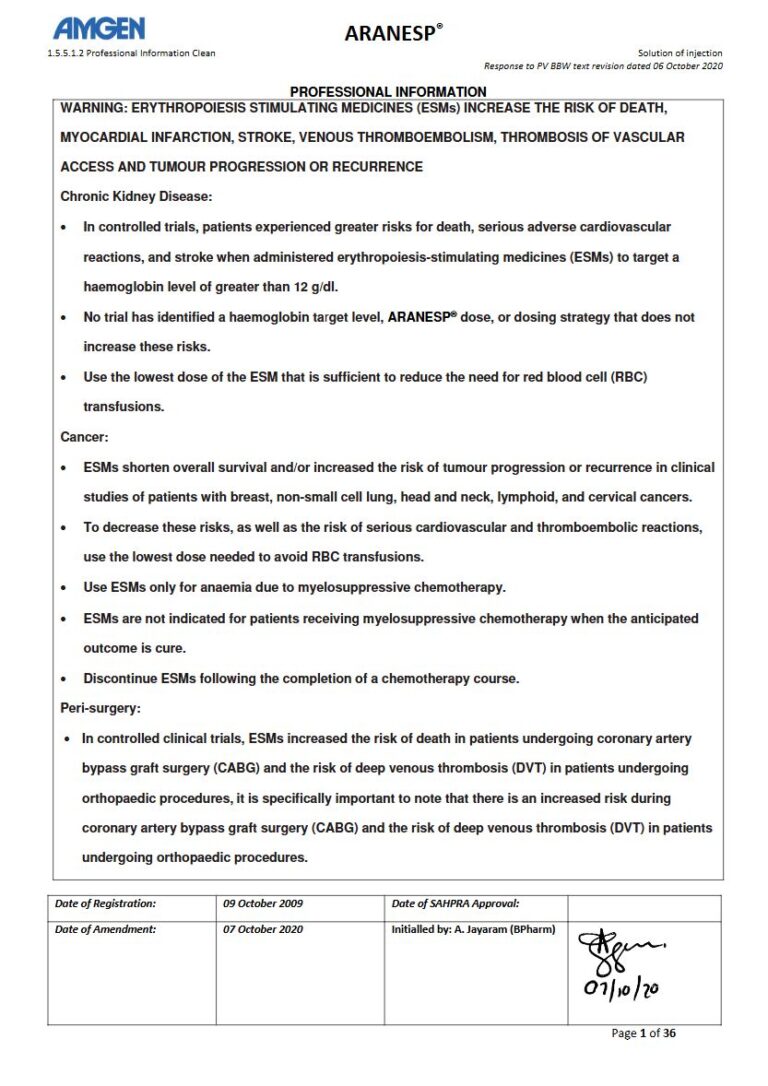
Class related adverse events associated with Erythropoiesis Stimulating Medicines (ESMs) ESMs increase the risk of death, myocardial infarction, stroke, venous thrombo-embolism, thrombosis of vascular access and tumour progression or recurrence. Blood pressure should be monitored in all patients, particularly during initiation of ARANESP u00ae therapy. If blood pressure is difficult to control by initiation of appropriate measures, the haemoglobin may be reduced by decreasing or withholding the dose of ARANESP u00ae (see section 4.2). Cases of severe hypertension, including hypertensive crisis, hypertensive encephalopathy, and seizures, have been observed in CRF patients treated with ARANESP u00ae. In order to ensure effective erythropoiesis, iron status should be evaluated for all patients prior to and during treatment and supplementary iron therapy may be necessary.
Non-response to therapy with ARANESP u00ae should prompt a search for causative factors. Deficiencies of iron, folic acid or vitamin B12 reduce the effectiveness of ESMs and should therefore be corrected. Intercurrent infections, inflammatory or traumatic episodes, occult blood loss, haemolysis, severe aluminium toxicity, underlying haematologic diseases, or bone marrow fibrosis may also compromise the erythropoietic response. A reticulocyte count should be considered as part of the evaluation. If typical causes of non-response are excluded, and the patient has reticulocytopenia, an examination of the bone marrow should be considered. If the bone marrow is consistent with pure red cell aplasia (PRCA), testing for anti-erythropoietin antibodies should be performed.
Severe cutaneous adverse reactions (SCARs) including Stevens-Johnson Syndrome (SJS) and toxic epidermal necrolysis (TEN), which can be life-threatening or fatal, have been reported in association with epoetin treatment. More severe cases have been observed with long-acting epoetins. At the time of prescription patients should be advised of the signs and symptoms and monitored closely for skin reactions. If signs and symptoms suggestive of these reactions appear, ARANESP u00ae should be withdrawn immediately and an alternative treatment considered. If the patient has developed a severe cutaneous skin reaction such as SJS or TEN due to the use of ARANESP u00ae, treatment with ARANESP u00ae must not be restarted in this patient at any time.
Pure red cell aplasia caused by neutralising anti-erythropoietin antibodies has been reported in association with ESMs, including ARANESP u00ae. This has been predominantly reported in patients with CRF treated subcutaneously. These antibodies have been shown to cross-react with all erythropoietic proteins, and patients suspected or confirmed to have neutralising antibodies to erythropoietin, should not be switched to ARANESP u00ae section 4.8). A paradoxical decrease in haemoglobin and development of severe anaemia associated with low reticulocyte counts should prompt to discontinue treatment with epoetin and perform anti-erythropoietin antibody testing. Cases have been reported in patients with hepatitis C treated with interferon and ribavirin, when epoetins are used concomitantly. Epoetins are not approved in the management of anaemia associated with hepatitis C.
Active liver disease was an exclusion criteria in all studies of ARANESP u00ae, therefore no data are available from patients with impaired liver function. Since the liver is thought to be the principal route of elimination of darbepoetin alfa and r-HuEPO, ARANESP u00ae should be used with caution in patients with liver disease. ARANESP u00ae should also be used with caution in those patients with sickle cell anaemia. Misuse of ARANESP u00ae by healthy persons may lead to an excessive increase in packed cell volume. This may be associated with life-threatening complications of the cardiovascular system. The needle cap of the pre-filled syringe or pre-filled pen contains dry natural rubber (a derivative of latex), which may cause allergic reactions. ARANESP u00ae should be used with caution in patients with epilepsy. Convulsions have been reported in patients receiving ARANESP u00ae. The reported risk of thrombotic vascular events (TVEs) should be carefully weighed against the benefits to be derived from treatment with darbepoetin alfa particularly in patients with pre-existing risk factors for TVE, including obesity and prior history of TVEs (e.g., deep venous thrombosis, pulmonary embolism, and cerebral vascular accident).
This medicinal product contains less than 1 mmol sodium (23 mg) per dose, i.e. essentially u2018sodium - freeu2019. Chronic renal failure patients In controlled trials, patients experienced greater risks for death, serious adverse cardiovascular reactions, and stroke when administered erythropoiesis-stimulating medicines (ESMs) to target a haemoglobin level of greater than 12 g/dl. No trial has identified a haemoglobin target level, ARANESP u00ae dose, or dosing strategy that does not increase these risks. Use the lowest dose sufficient to reduce the need for red blood cell (RBC) transfusions. In patients with chronic renal failure, maintenance haemoglobin concentration should not exceed the upper limit of the target haemoglobin concentration recommended in the section 4.2. In clinical studies, an increased risk of death, serious cardiovascular or cerebrovascular events including stroke, and vascular access thrombosis was observed when ESMs were administered to target a haemoglobin of greater than 12 g/dl (7,5 mmol/l). Caution should be exercised with escalation of ARANESP u00ae doses in patients with chronic renal failure, since high cumulative epoetin doses may be associated with an increased risk of mortality, serious cardiovascular and cerebrovascular events. In patients with a poor haemoglobin response to epoetins, alternative explanations for the poor response should be considered (see section 4.2 and 5.1). Controlled clinical trials have not shown significant benefits attributable to the administration of epoetins when haemoglobin concentration is increased beyond the level necessary to control symptoms of anaemia and to avoid blood transfusion. Supplementary iron therapy is recommended for all patients with serum ferritin values below 100 u03bcg/l or whose transferrin saturation is below 20 %. Serum potassium levels should be monitored regularly during ARANESP u00ae therapy. Potassium elevation has been reported in a few patients receiving ARANESP u00ae, though causality has not been established. If an elevated or rising potassium level is observed then consideration should be given to ceasing ARANESP u00ae administration until the level has been corrected.
Cancer patients ESMs shorten overall survival and/or increased the risk of tumour progression or recurrence in clinical studies of patients with breast, non-small cell lung, head and neck, lymphoid, and cervical cancers. To decrease these risks, as well as the risk of serious cardiovascular and thromboembolic reactions, use the lowest dose needed to avoid RBC transfusions. Use ESMs only for anaemia due to myelosuppressive chemotherapy. ESMs are not indicated for patients receiving myelosuppressive chemotherapy when the anticipated outcome is cure. Discontinue ESMs following the completion of a chemotherapy course. Effect on tumour growth Epoetins are growth factors that primarily stimulate red blood cell production. Erythropoietin receptors may be expressed on the surface of a variety of tumour cells. As with all growth factors, there is a concern that epoetins could stimulate the growth of tumours. In several controlled studies, epoetins have not been shown to improve overall survival or decrease the risk of tumour progression in patients with anaemia associated with cancer. In controlled clinical studies, use of ARANESP u00ae and other ESMs have shown: u2022 shortened time to tumour progression in patients with advanced head and neck cancer receiving radiation therapy when administered to target a haemoglobin of greater than 14 g/dl (8,7 mmol/l), ESMs are not indicated for use in this patient population. u2022 shortened overall survival and increased deaths attributed to disease progression at 4 months in patients with metastatic breast cancer receiving chemotherapy when administered to target a haemoglobin of 12-14 g/dl (7,5 - 8,7 mmol/l). u2022 increased risk of death when administered to target a haemoglobin of 12 g/dl (7, 5 mmol/l) in patients with active malignant disease receiving neither chemotherapy nor radiation therapy. ESMs are not indicated for use in this patient population. u2022 an observed 9 % increase in risk for PD or death in the epoetin alfa plus SOC group from a primary analysis and a 15 % increased risk that cannot be statistically ruled out in patients with metastatic breast cancer receiving chemotherapy when administered to achieve a haemoglobin concentration range of 10 to 12 g/dl (6,2 to 7,5 mmol/l). u2022 non-inferiority of darbepoetin alfa to placebo for overall survival and progression free survival in patients with advanced stage non-small cell lung cancer receiving chemotherapy when administered to a target haemoglobin of 12 g/dl (7,5 mmol/l) (see section 5.1). In view of the above, in some clinical situations blood transfusion should be the preferred treatment for the management of anaemia in patients with cancer. The decision to administer recombinant erythropoietins should be based on a benefit-risk assessment with the participation of the individual patient, which should take into account the specific clinical context. Factors that should be considered in this assessment should include the type of tumour and its stage; the degree of anaemia; life-expectancy; the environment in which the patient is being treated; and patient preference (see section 5.1). In patients with solid tumours or lymphoproliferative malignancies, if the haemoglobin value exceeds 12 g/dl (7,5 mmol/l), the dosage adaptation described in section 4.2 should be closely respected, in order to minimise the potential risk of thromboembolic events. Platelet counts and haemoglobin level should also be monitored at regular intervals.
Peri-surgery In controlled clinical trials, ESMs increased the risk of death in patients undergoing coronary artery bypass graft surgery (CABG) and the risk of deep venous thrombosis (DVT) in patients undergoing orthopaedic procedures, it is specifically important to note that there is an increased risk during coronary artery bypass graft surgery (CABG) and the risk of deep venous thrombosis (DVT) in patients undergoing orthopaedic procedures.
4.5 Interactions with other medicines
The clinical results obtained so far do not indicate any interaction of darbepoetin alpha with other substances. However, there is potential for an interaction with medicines that are highly bound to red blood cells e.g. ciclosporin, tacrolimus. If ARANESP u00ae is given concomitantly with any of these medicines, blood levels of these medicines should be monitored and the dosage adjusted as the haemoglobin rises.
4.6 Fertility, Pregnancy and Lactation
Pregnancy There are no adequate and well-controlled studies with ARANESP u00ae in pregnant women. Animal studies do not indicate direct harmful effects with respect to pregnancy, embryonal/foetal development, parturition or postnatal development. No alteration of fertility was detected. Caution should be exercised when prescribing ARANESP u00ae to pregnant women.
Lactation It is not known whether ARANESP u00ae is excreted in human milk. A risk to the suckling child cannot be excluded. A decision must be made whether to discontinue breastfeeding or to discontinue/abstain from ARANESP u00ae therapy taking into account the benefit of breastfeeding for the child and the benefit of therapy for the woman.
4.7 Effects on ability to drive and use machines
ARANESP u00ae has no or negligible influence on the ability to drive and use machines.
4.8 Undesirable effects
a) Summary of safety profile Identified adverse reactions associated with ARANESP u00ae are hypertension, stroke, thromboembolic events, convulsions, allergic reactions, rash/erythema and pure red cell aplasia (PRCA); see section 4.4. Injection site pain was reported as attributable to treatment in studies where ARANESP u00ae was administered via subcutaneous injection. The injection site discomfort was generally mild and transient in nature and occurred predominantly after the first injection.
b) Tabulated summary of adverse reactions Incidence of adverse reactions are listed below by system organ class and frequency. Frequencies are defined as: Very common (u2265 1/10); common (u2265 1/100, < 1/10); uncommon (u2265 1/1,000, < 1/100); rare (u2265 1/10,000, < 1/1,000); very rare (< 1/10,000), not known (cannot be estimated from the available data). Data are presented separately for CRF and cancer patients reflecting the different adverse reaction profile in these populations.
Chronic renal failure patients Data presented from controlled studies included 1,357 patients, 766 who received ARANESP u00ae and 591 patients who received r-HuEPO. In the ARANESP u00ae group, 83 % were receiving dialysis and 17 % were not receiving dialysis. Stroke was identified as an adverse reaction in an additional clinical study (TREAT, see section 5.1). Incidence of adverse reactions from controlled clinical studies and post-marketing experience are: MedDRA system organ class Frequency Adverse reaction Blood and lymphatic system disorders Not known 2 Pure red cell aplasia Immune system disorders Very common Hypersensitivity a Nervous system disorders Common Stroke b Uncommon 1 Convulsions Cardiac disorders Very common Hypertension Vascular disorders Uncommon Thromboembolic events c Uncommon 1 Dialysis vascular access thrombosis d Skin and subcutaneous tissue disorders Common Rash/erythema e Not known 2 SJS/TEN, erythema multiforme, blistering, skin exfoliation General disorders and administration site conditions Common Injection site pain Uncommon 1 Injection site bruising Injection site haemorrhage Source: Includes 5 randomised, double-blind, active-controlled studies (970200, 970235, 980117, 980202, and 980211) except for the adverse reaction of stroke which was identified as an adverse reaction in the TREAT study (study 20010184).
1 Adverse reactions identified in the post-marketing environment. Per the Guideline on Summary of Product Characteristics (Revision 2, September 2009), frequency of adverse reactions identified in the post-marketing setting was determined using the u201cRule of threeu201d. 2 Frequency cannot be estimated from the available data. a Hypersensitivity events includes all events under the hypersensitivity SMQ. b Stroke events includes PT haemorrhagic stroke, ischaemic stroke, cerebrovascular accident, and stroke in evolution. c Thromboembolic events adverse reaction includes PT embolism arterial, thrombophlebitis, thrombosis, venous thrombosis limb. d Dialysis vascular access thrombosis includes all adverse reactions under the dialysis vascular access thrombosis AMQ e Rash/erythema adverse reaction includes PT rash, rash pruritic, rash macular, rash generalised, erythema.
Cancer patients Adverse reactions were determined based on pooled data from eight randomised, double-blind, placebo-controlled studies of ARANESP u00ae with a total of 4,630 patients (ARANESP u00ae 2,888, placebo 1,742). Patients with solid tumours (e.g., lung, breast, colon, ovarian cancers) and lymphoid malignancies (e.g., lymphoma, multiple myeloma) were enrolled in the clinical studies. Incidence of adverse reactions from controlled clinical studies and post-marketing experience are: MedDRA system organ class Frequency Adverse reaction Immune system disorders Very common Hypersensitivity a Nervous system disorders Uncommon 1 Convulsions Cardiac disorders Common Hypertension Vascular disorders Common Thromboembolic events b, including pulmonary embolism Skin and subcutaneous tissue disorders Common Rash/erythema c Not known 2 SJS/TEN, erythema multiforme, blistering, skin exfoliation General disorders and administration site conditions Common Oedema d Common Injection site pain e Uncommon 1 Injection site bruising Injection site haemorrhage 1 ADRs identified in the post marketing environment. Per the Guideline on Summary of Product Characteristics (Revision 2, September 2009), frequency of ADRs identified in the post-marketing setting was determined using the u201cRule of threeu201d. 2 Frequency cannot be estimated from the available data. Source: includes 8 randomised, double-blind, placebo-controlled studies (980291-schedule 1 and 2, 980297, 990114, 20000161, 20010145, 20030232, and 20070782) a Hypersensitivity events includes all events under the hypersensitivity SMQ.
c) Description of selected adverse reactions Chronic renal failure patients Stroke was reported as common in CRF patients in TREAT (see section 5.1). In isolated cases, neutralising anti-erythropoietin antibody mediated pure red cell aplasia (PRCA) associated with ARANESP u00ae therapy have been reported predominantly in patients with CRF treated subcutaneously. In case PRCA is diagnosed, therapy with ARANESP u00ae must be discontinued and patients should not be switched to another recombinant erythropoietic protein (see section 4.4). The frequency of all hypersensitivity reactions was estimated from clinical trial data as very common in CRF patients. Hypersensitivity reactions were also very common in the placebo groups. There have been reports, from post-marketing experience, of serious hypersensitivity reactions including anaphylactic reaction, angioedema, allergic bronchospasm, skin rash and urticaria associated with darbepoetin alfa. Severe cutaneous adverse reactions (SCARs) including Stevens-Johnson syndrome (SJS) and toxic epidermal necrolysis (TEN), which can be life-threatening or fatal, have been reported (see section 4.4). Convulsions have been reported in patients receiving darbepoetin alfa (see section 4.4). The frequency is estimated from clinical trial data as uncommon in CRF patients.
Cancer patients Hypertension has been observed in cancer patients in post-marketing experience (see section 4.4). The frequency is estimated from clinical trial data as common in cancer patients and was also common in the placebo groups. Hypersensitivity reactions have been observed in cancer patients in post-marketing experience. The frequency of all hypersensitivity reactions was estimated from clinical trial data as very common in cancer patients. Hypersensitivity reactions were also very common in the placebo groups. There have been reports of serious hypersensitivity reactions including anaphylactic reaction, angioedema, allergic bronchospasm, skin rash and urticaria associated with darbepoetin alfa. Severe cutaneous adverse reactions (SCARs) including Stevens-Johnson syndrome (SJS) and toxic epidermal necrolysis (TEN), which can be life-threatening or fatal, have been reported (see section 4.4). Convulsions have been reported in patients receiving darbepoetin alfa in post-marketing experience (see section 4.4). The frequency is estimated from clinical trial data as uncommon in cancer patients. Convulsions were common in the placebo groups. Paediatric chronic renal failure population In all paediatric CRF studies, there were no additional adverse reactions identified for paediatric patients compared to those previously reported for adult patients (see section 5.1).
4.9 Overdose
The maximum amount of ARANESP u00ae that can be safely administered in single or multiple doses has not been determined. Therapy with ARANESP u00ae can result in polycythaemia if the haemoglobin is not carefully monitored and the dose appropriately adjusted. Cases of severe hypertension have been observed following overdose with ARANESP u00ae (see section 4.4). In the event of polycythaemia, ARANESP u00ae should be temporarily withheld (see section 4.2). If clinically indicated, phlebotomy may be performed.
