
Repatha 140 mg Solution for subcutaneous injection
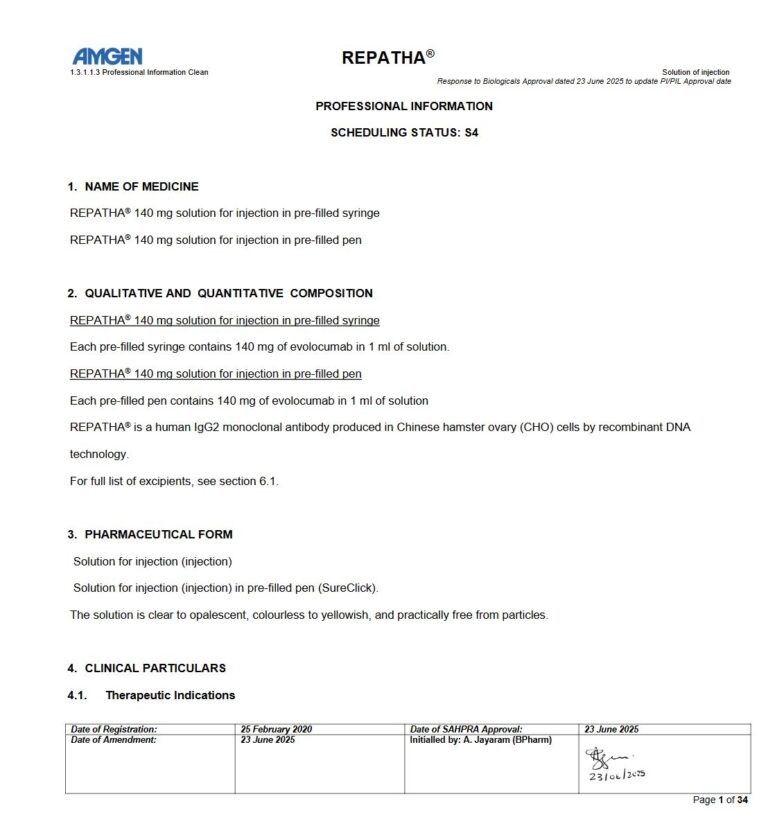
PDF Leaflet Revision Date: 23 June 2025
Clinical Summary
Quick overview from the medicine insert
Indication
Adjunct treatment for hypercholesterolaemia and mixed dyslipidaemia.
Dosage (summary)
140 mg every 2 weeks or 420 mg once monthly for adults and children 10 years and older.
Onset of Action / Duration
Onset: 4 hours, Duration: 14-21 days.
Special Populations
- Elderly
- Renal impairment
- Hepatic impairment
Pregnancy & Breastfeeding
Use only if necessary during pregnancy; unknown if excreted in breast milk.
Key Drug Interactions
- Statins (increased clearance of evolocumab)
Contraindications
- Hypersensitivity to evolocumab or excipients
Common side effects
- Nasopharyngitis
- Upper respiratory tract infection
- Back pain
- Arthralgia
- Injection site reactions
Counselling Points
- Rotate injection sites
- Monitor for allergic reactions
- Report any unusual symptoms
Serious warnings
- Caution in moderate to severe hepatic impairment
- Risk of allergic reactions due to latex
Important Disclaimer
The Repatha 140 mg Solution for subcutaneous injection professional information leaflet below is the property of Amgen South Africa and is provided on Medinsert exactly as issued, with no.. alterations or editorial changes. We make every effort to keep content current by updating documents as soon as new versions become available. Medinsert serves as a trusted access point for healthcare professionals, but does not replace official sources or clinical judgement. For more details, please read our full disclaimer. read more>>
 Healthcare Professionals Only
This content is for registered healthcare professionals
Sign in or create a free account to read the full package insert.
Free for HPCSA-registered professionals. Powered by Medinsert.
Clinical Particulars
Section 4 of the official insert — extracted exactly as issued, no alterations
4.1. Therapeutic Indications
Hypercholesterolaemia and mixed dyslipidaemia
REPATHA u00ae is indicated in adults with primary hypercholesterolaemia (heterozygous familial and nonfamilial) or mixed dyslipidaemia, and in paediatric patients aged 10 years and over with heterozygous familial hypercholesterolaemia, as an adjunct to diet:
- in combination with a statin or statin with other lipid-lowering therapies in patients unable to reach LDL-C goals with the maximum tolerated dose of a statin or,
- alone or in combination with other lipid-lowering therapies in patients who are statin-intolerant, or for whom a statin is contraindicated.
Homozygous familial hypercholesterolaemia
REPATHA u00ae is indicated in adults and paediatric patients aged 10 years and over with homozygous familial hypercholesterolaemia in combination with other lipid-lowering therapies.
Established atherosclerotic cardiovascular disease
REPATHA u00ae is indicated in adults with established atherosclerotic cardiovascular disease (myocardial infarction, stroke or peripheral arterial disease) to reduce cardiovascular risk by lowering LDL-C levels, as an adjunct to correction of other risk factors:
- in combination with the maximum tolerated dose of a statin with or without other lipid-lowering therapies or,
- alone or in combination with other lipid-lowering therapies in patients who are statin-intolerant, or for whom a statin is contraindicated.
For study results with respect to effects on LDL-C, cardiovascular events and populations studied see section 5.1.
4.2. Posology and Method of Administration
Prior to initiating evolocumab, secondary causes of hyperlipidaemia or mixed dyslipidaemia (e.g., nephrotic syndrome, hypothyroidism) should be excluded.
Posology
Primary hypercholesterolaemia and mixed dyslipidaemia (including heterozygous familial hypercholesterolaemia)
Adults and paediatric patients (aged 10 years and over)
The recommended dose for evolocumab is either 140 mg every 2 weeks or 420 mg once monthly; both doses are clinically equivalent.
Homozygous familial hypercholesterolaemia in adults and paediatric patients aged 10 years and over
The initial recommended dose is 420 mg once monthly. After 12 weeks of treatment, dose frequency can be up-titrated to 420 mg once every 2 weeks if a clinically meaningful response is not achieved. Patients on apheresis may initiate treatment with 420 mg every two weeks to correspond with their apheresis schedule.
Established atherosclerotic cardiovascular disease in adults
The recommended dose of evolocumab is either 140 mg every 2 weeks or 420 mg once monthly; both doses are clinically equivalent.
Special Populations
Elderly patients (age u2265 65 years)
No dose adjustment is necessary in elderly patients.
Patients with renal impairment
No dose adjustment is necessary in patients with renal impairment (see section 5.2).
Patients with hepatic impairment
No dose adjustment is necessary in patients with mild hepatic impairment (see section 4.4 for patients with moderate and severe hepatic impairment.
Paediatric population
The safety and effectiveness of REPATHA u00ae have not been established in paediatric patients with heterozygous familial hypercholesterolaemia (HeFH) or homozygous familial hypercholesterolaemia (HoFH) who are younger than 10 years old or in paediatric patients with other types of hyperlipidaemia.
Method of Administration
Subcutaneous use. Evolocumab is for subcutaneous injection into the abdomen, thigh or upper arm region. Injection sites should be rotated and injections should not be given into areas where the skin is tender, bruised, red, or hard.
Evolocumab must not be administered intravenously or intramuscularly.
REPATHA u00ae 140 mg solution for injection in pre-filled syringe
The 140 mg dose should be delivered using a single pre-filled syringe. The 420 mg dose should be delivered using three pre-filled syringes administered consecutively within 30 minutes.
REPATHA u00ae 140 mg solution for injection in pre-filled pen
The 140 mg dose should be delivered using a single pre-filled pen. The 420 mg dose should be delivered using three pre-filled pens administered consecutively within 30 minutes.
REPATHA u00ae is intended for patient self-administration after proper training. Administration of evolocumab can also be performed by an individual who has been trained to administer the product. For single use only.
4.3. Contraindications
Hypersensitivity to the active substance or to any of the excipients listed in section 6.1.
4.4. Special Warnings and Precautions for Use
Traceability
In order to improve the traceability of biological medicinal products, the name and the batch number of the administered product should be clearly recorded.
Hepatic impairment
In patients with moderate hepatic impairment, a reduction in total evolocumab exposure was observed that may lead to a reduced effect on LDL-C reduction. Therefore, close monitoring may be warranted in these patients.
Patients with severe hepatic impairment (Child-Pugh class C) have not been studied (see section 5.2). Evolocumab should be used with caution in patients with severe hepatic impairment.
Dry natural rubber
The needle cover of the glass pre-filled syringe is made from dry natural rubber (a derivative of latex), which may cause severe allergic reactions.
The needle cover of the pre-filled pen is made from dry natural rubber (a derivative of latex), which may cause severe allergic reactions.
Sodium content
This medicinal product contains less than 1 mmol sodium (23 mg) per dose, that is to say essentially u2018sodium-freeu2019.
4.5. Interaction with other Medicines and other forms of Interaction
No interaction studies have been performed. The pharmacokinetic interaction between statins and evolocumab was evaluated in the clinical trials. An approximately 20 % increase in the clearance of evolocumab was observed in patients co-administered with statins. This increased clearance is in part mediated by statins increasing the concentration of Proprotein Convertase Subtilisin Kexin Type 9 (PCSK9) which did not adversely impact the pharmacodynamic effect of evolocumab on lipids. No statin dose adjustments are necessary when used in combination with evolocumab.
No studies on pharmacokinetic and pharmacodynamics interaction between evolocumab and lipid-lowering medicinal products other than statins and ezetimibe have been conducted.
4.6. Fertility, Pregnancy and Lactation
Pregnancy
There are no or limited amount of data from the use of REPATHA u00ae in pregnant women. Animal studies do not indicate direct or indirect effects with respect to reproductive toxicity (see section 5.3). REPATHA u00ae should not be used during pregnancy unless the clinical condition of the woman requires treatment with evolocumab.
Breastfeeding
It is unknown whether evolocumab is excreted in human milk. A risk to breastfed newborns/infants cannot be excluded. A decision must be made whether to discontinue breastfeeding or discontinue/abstain from REPATHA u00ae therapy, taking into account the benefit of breastfeeding for the child and the benefit of therapy for the woman.
Fertility
No data on the effect of evolocumab on human fertility are available. Animal studies did not show any effects on fertility endpoints at area under the concentration time curve (AUC) exposure levels much higher than in patients receiving evolocumab at 420 mg once monthly (see section 5.3).
4.7. Effects on ability to drive and use machines
REPATHA u00ae has no or negligible influence on the ability to drive and use machines
4.8. Undesirable Effects
Summary of safety profile
The most commonly reported adverse reactions at the recommended doses are nasopharyngitis (7,4 %), upper respiratory tract infection (4,6 %), back pain (4,4 %), arthralgia (3,9 %), influenza (3,2 %), and injection site reactions (2,2 %). The safety profile in the homozygous familial hypercholesterolaemia population was consistent with that demonstrated in the primary hypercholesterolaemia and mixed dyslipidaemia population.
Tabulated list of adverse reactions
Adverse reactions reported in pivotal, controlled clinical studies, and spontaneous reporting, are displayed by system organ class and frequency in table 1 below using the following convention: very common (u2265 1/10), common (u2265 1/100 to < 1/10), uncommon (u2265 1/1,000 to <1/100), rare (u2265 1/10,000 to < 1/1,000), and very rare (< 1/10,000).
Table 1. Adverse reactions
MedDRA system organ class (SOC) Adverse reactions Frequency category Infections and infestations Influenza Common Nasopharyngitis Common Upper Respiratory Tract Infection Common Immune system disorders Hypersensitivity Common Rash Common Urticaria Uncommon Nervous system disorders Headache Common Gastrointestinal disorders Nausea Common Skin and subcutaneous tissue disorders Angioedema Rare Musculoskeletal and connective tissue disorders Back Pain Common Arthralgia Common Myalgia Common General disorders and administration site conditions Injection Site Reactions 1 Common Influenza-like illness Uncommon
1 See section Description of selected adverse reactions.
The safety profile was consistent between subjects with post-baseline LDL-C < 25 mg/dl (0,65 mmol/l) or < 40 mg/dl (1,03 mmol/l) compared to subjects with higher post-baseline LDL-C (u2265 40 mg/dl[1,03 mmol/l]), with median (Q1, Q3) REPATHA u00ae exposure of 84,2 (78,1; 89,8) months in subjects who continued on REPATHA u00ae and 59,8 (52,8; 60,3) months in subjects on placebo who switched to REPATHA u00ae in an open-label extension study.
Description of selected adverse reactions
Injection site reactions
The most frequent injection site reactions were injection site bruising, erythema, haemorrhage, injection site pain, and swelling.
Paediatric population
The safety and effectiveness of REPATHA u00ae have been established in paediatric patients with heterozygous and homozygous familial hypercholesterolaemia. A clinical study to evaluate the effects of REPATHA u00ae was conducted in 158 paediatric patients aged u2265 10 to < 18 years old with heterozygous familial hypercholesterolaemia. No new safety concerns were identified and the safety data in this paediatric population was consistent with the known safety profile of the product in adults with heterozygous familial hypercholesterolaemia. Twenty-six paediatric patients with homozygous familial hypercholesterolaemia have been treated with REPATHA u00ae in clinical studies conducted in patients aged u2265 10 to < 18 years. No difference in safety was observed between paediatric and adult patients with homozygous familial hypercholesterolaemia.
Elderly population
Of the 18 546 patients treated with evolocumab in double-blind clinical studies 7 656 (41,3 %) were u2265 65 years old, while 1 500 (8,1 %) were u2265 75 years old. No overall differences in safety or efficacy were observed between these patients and younger patients.
4.9. Overdose
No adverse effects were observed in animal studies at exposures up to 300-fold higher than those in patients treated with 420 mg evolocumab once monthly. There is no specific treatment for REPATHA u00ae overdose. In the event of an overdose, the patient should be treated symptomatically and supportive measures instituted as required.
