
Nubeqa 300mg FC tablets
PDF Leaflet Revision Date: 6 December 2024
Clinical Summary
Quick overview from the medicine insert
Indication
Treatment of non-metastatic castration-resistant prostate cancer and metastatic hormone-sensitive prostate cancer.
Dosage (summary)
600 mg (two 300 mg tablets) twice daily.
Special Populations
- Elderly
- Renal impairment
- Hepatic impairment
Pregnancy & Breastfeeding
Not indicated for women who are or may become pregnant; potential for fetal harm.
Key Drug Interactions
- Strong CYP3A4 and P-gp inducers
- Rosuvastatin
Contraindications
- Hypersensitivity to darolutamide or excipients
- Pregnant women
Common side effects
- Fatigue
- Rash
- Hypertension
Counselling Points
- Take with food
- Use effective contraception during treatment
Serious warnings
- Monitor for renal and hepatic impairment
- Risk of QT prolongation
Important Disclaimer
The Nubeqa 300mg FC tablets professional information leaflet below is the property of Bayer and is provided on Medinsert exactly as issued, with no.. alterations or editorial changes. We make every effort to keep content current by updating documents as soon as new versions become available. Medinsert serves as a trusted access point for healthcare professionals, but does not replace official sources or clinical judgement. For more details, please read our full disclaimer. read more>>
 Healthcare Professionals Only
This content is for registered healthcare professionals
Sign in or create a free account to read the full package insert.
Free for HPCSA-registered professionals. Powered by Medinsert.
Clinical Particulars
Section 4 of the official insert — extracted exactly as issued, no alterations
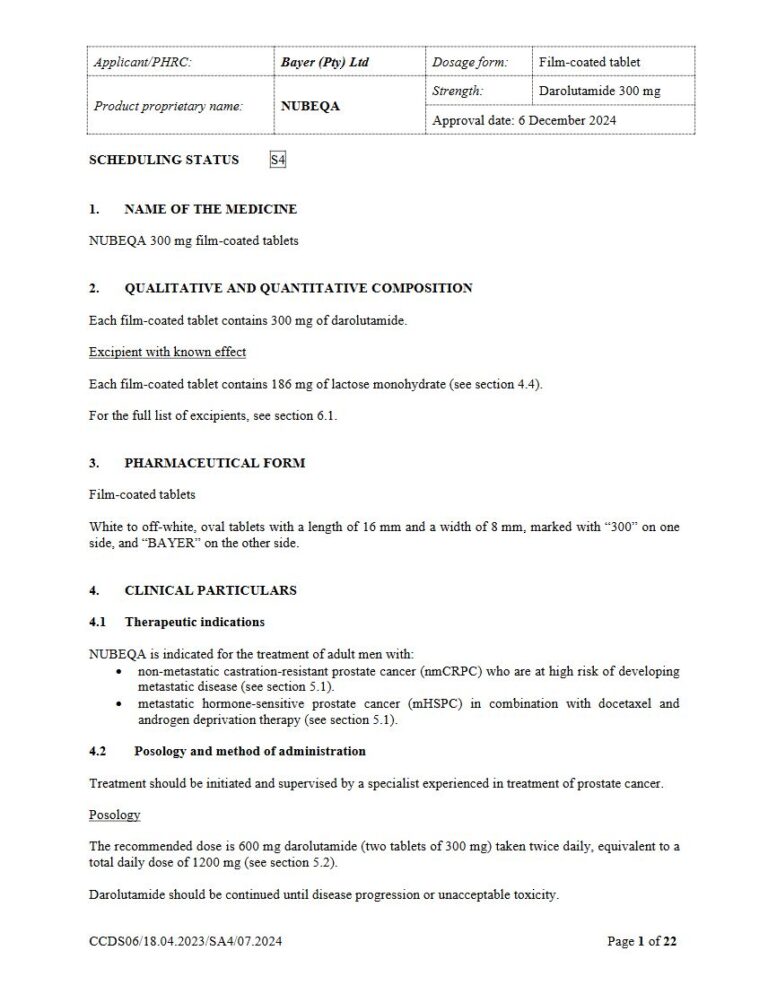
4.1 Therapeutic indications
NUBEQA is indicated for the treatment of adult men with:
- non-metastatic castration-resistant prostate cancer (nmCRPC) who are at high risk of developing metastatic disease (see section 5.1).
- metastatic hormone-sensitive prostate cancer (mHSPC) in combination with docetaxel and androgen deprivation therapy (see section 5.1).
4.2 Posology and method of administration
Treatment should be initiated and supervised by a specialist experienced in treatment of prostate cancer.
Posology
The recommended dose is 600 mg darolutamide (two tablets of 300 mg) taken twice daily, equivalent to a total daily dose of 1200 mg (see section 5.2). Darolutamide should be continued until disease progression or unacceptable toxicity.
Medical castration with a luteinising hormone-releasing hormone (LHRH) analogue should be continued during treatment of patients not surgically castrated.
Metastatic hormone sensitive prostate cancer (mHSPC)
mHSPC patients should start darolutamide in combination with docetaxel (see section 5.1). The first of 6 cycles of docetaxel should be administered within 6 weeks after the start of darolutamide treatment. The recommendation in the product information of docetaxel should be followed. Treatment with darolutamide should be continued until disease progression or unacceptable toxicity even if a cycle of docetaxel is delayed, interrupted, or discontinued.
Missed dose
If a dose is missed, the dose should be taken as soon as the patient remembers prior to the next scheduled dose. The patient should not take two doses together to make up for a missed dose.
Dose modification
If a patient experiences a u2265 Grade 3 toxicity or an intolerable adverse reaction related to darolutamide (see sections 4.4 and 4.8), dosing should be withheld or reduced to 300 mg twice daily until symptoms improve. Treatment may then be resumed at a dose of 600 mg twice daily. Dose reduction below 300 mg twice daily is not recommended, because efficacy has not been established.
Special populations
Elderly
No dose adjustment is necessary in elderly patients (see section 5.2).
Renal impairment
No dose adjustment is necessary for patients with mild or moderate renal impairment. For patients with severe renal impairment (eGFR 15 - 29 mL/min/1.73 mu00b2) not receiving haemodialysis, the recommended starting dose is 300 mg twice daily (see sections 4.4 and 5.2).
Hepatic impairment
No dose adjustment is necessary for patients with mild hepatic impairment. The available data on darolutamide pharmacokinetics in moderate hepatic impairment is limited. Darolutamide has not been studied in patients with severe hepatic impairment. For patients with moderate hepatic impairment (Child-Pugh B), the recommended starting dose is 300 mg twice daily (see sections 4.4 and 5.2).
Paediatric population
There is no relevant use of darolutamide in the paediatric population.
Method of administration
NUBEQA is for oral use. The tablets should be taken whole with food (see section 5.2).
4.3 Contraindications
- Hypersensitivity to the active substance or to any of the excipients listed in section 6.1.
- Women who are or may become pregnant (see section 4.6).
4.4 Special warnings and precautions for use
Renal impairment
The available data in patients with severe renal impairment (eGFR 15 - 29 ml/min/1.73 mu00b2) are limited. As exposure might be increased those patients should be closely monitored for adverse reactions (see sections 4.2 and 5.2).
Hepatic impairment
The available data in patients with moderate hepatic impairment are limited, and darolutamide has not been studied in patients with severe hepatic impairment. As exposure might be increased those patients should be closely monitored for adverse reactions (see sections 4.2 and 5.2).
Recent cardiovascular disease
Patients with clinically significant cardiovascular disease in the past 6 months including stroke, myocardial infarction, severe/unstable angina pectoris, coronary/peripheral artery bypass graft, and symptomatic congestive heart failure were excluded from the clinical studies. Therefore, the safety of darolutamide in these patients has not been established. If NUBEQA is prescribed, patients with clinically significant cardiovascular disease should be treated for these conditions according to established guidelines.
Hepatotoxicity
In case of liver function test abnormalities suggestive of idiosyncratic drug-induced liver injury, permanently discontinue treatment with darolutamide (see section 4.8).
Concomitant use with other medicines
Use of strong CYP3A4 and P-gp inducers during treatment with darolutamide may decrease the plasma concentration of darolutamide and is not recommended, unless there is no therapeutic alternative. Selection of an alternate concomitant medicines with less potential to induce CYP3A4 or P-gp should be considered (see section 4.5). Patients should be monitored for adverse reactions of BCRP, OATP1B1 and OATP1B3 substrates as co-administration with darolutamide may increase the plasma concentrations of these substrates. Co-administration with rosuvastatin should be avoided unless there is no therapeutic alternative (see section 4.5).
Androgen deprivation therapy may prolong the QT interval
In patients with a history of risk factors for QT prolongation and in patients receiving concomitant medicines that might prolong the QT interval (see section 4.5), medical practitioners should assess the benefit-risk ratio including the potential for Torsade de pointes prior to initiating NUBEQA.
Information about excipients
NUBEQA contains lactose. Patients with rare hereditary problems of galactose intolerance, total lactase deficiency or glucose-galactose malabsorption should not take this medicine.
4.5 Interaction with other medicines and other forms of interaction
Effects of other medicines on darolutamide
CYP3A4 and P-gp inducers
Darolutamide is a substrate of CYP3A4 and P-glycoprotein (P-gp). Use of strong and moderate CYP3A4 inducers and P-gp inducers (e.g. carbamazepine, phenobarbitone, St. John's Wort, phenytoin, and rifampicin) during treatment with darolutamide is not recommended, unless there is no therapeutic alternative. Selection of an alternate concomitant medicine, with no or weak potential to induce CYP3A4 or P-gp should be considered. Repeated administration of rifampicin (600 mg), a strong CYP3A4 and a P-gp inducer, with a single dose of darolutamide (600 mg) together with food, resulted in a decrease of 72 % in mean exposure (AUC 0 - 72) and a decrease of 52 % in C max of darolutamide.
CYP3A4, P-gp and BCRP inhibitors
Darolutamide is a substrate of CYP3A4, P-gp and breast cancer resistance protein (BCRP). No clinically relevant interaction is expected in case of CYP3A4, P-gp or BCRP inhibitor administration. Darolutamide may be given concomitantly with CYP3A4, P-gp or BCRP inhibitors. Concomitant use of darolutamide with a combined P-gp and strong CYP3A4 inhibitor increases darolutamide exposure which may increase the risk of darolutamide adverse reactions. It is recommended to monitor patients more frequently for darolutamide adverse reactions and modify darolutamide dose as needed. Administration of itraconazole (200 mg twice daily on day 1 and once daily on the following 7 days), a strong CYP3A4, P-gp and BCRP inhibitor, with a single dose of darolutamide (600 mg on day 5 together with food) resulted in a 1.7-fold increase in mean exposure (AUC 0 - 72) and a 1.4-fold increase of C max of darolutamide.
UGT 1A9 inhibitors
Darolutamide is a substrate of UGT1A9. No clinically relevant interaction is expected in case of UGT 1A9 inhibitor administration. Darolutamide may be given concomitantly with UGT 1A9 inhibitors. A population pharmacokinetic analysis showed that co-administration of UGT 1A9 inhibitors with darolutamide resulted in a 1.2-fold increase in exposure (AUC 0 - 72) of darolutamide.
Docetaxel
Administration of darolutamide in combination with docetaxel resulted in no clinically relevant changes in the pharmacokinetics of darolutamide in mHSPC patients (see section 5.1).
Effects of darolutamide on other medicines
BCRP, OATP1B1 and OATP1B3 substrates
Darolutamide is an inhibitor of breast cancer resistance protein (BCRP) and Organic Anion Transporting Polypeptides (OATP) 1B1 and 1B3. Co-administration of rosuvastatin should be avoided unless there is no therapeutic alternative. Selection of an alternative concomitant medicines with less potential to inhibit BCRP, OATP1B1 and OATP1B3 should be considered. Administration of darolutamide (600 mg twice daily for 5 days) prior to co-administration of a single dose of rosuvastatin (5 mg) together with food resulted in approximately 5-fold increase in mean exposure (AUC) and C max of rosuvastatin. Co-administration of darolutamide with other BCRP substrates should be avoided where possible. Co-administration of darolutamide may increase the plasma concentrations of other concomitant BCRP, OATP1B1 and OATP1B3 substrates (e.g. methotrexate, sulfasalazine, fluvastatin, atorvastatin). Therefore, it is recommended to monitor patients for adverse reactions of BCRP, OATP1B1 and OATP1B3 substrates. In addition, the related recommendation in the product information of these substrates should be followed when co-administered with darolutamide.
P-gp substrates
No clinically relevant interaction is expected in case of P-gp substrate administration. Darolutamide may be given concomitantly with P-gp substrates (e.g. digoxin, verapamil or nifedipine). Co-administration of darolutamide together with the sensitive P-gp substrate dabigatran etexilate did not reveal any increase in exposure (AUC and C max) of dabigatran.
CYP3A4 substrates
Darolutamide is a mild inducer of CYP3A4. No clinically relevant interaction is expected in case of CYP substrate administration. Darolutamide may be given concomitantly with CYP substrates (e.g. warfarin, L-thyroxine, omeprazole). Administration of darolutamide (600 mg twice daily for 9 days) prior to co-administration of a single dose of the sensitive CYP3A4 substrate midazolam (1 mg) together with food, decreased the mean exposure (AUC) and C max of midazolam by 29 % and 32 %, respectively. Darolutamide did not inhibit the metabolism of selected CYP substrates in vitro at clinically relevant concentrations.
Docetaxel
Administration of darolutamide in combination with docetaxel resulted in no clinically relevant changes in the pharmacokinetics of docetaxel in mHSPC patients (see section 5.1).
Medicines that prolong the QT interval
Since androgen deprivation treatment may prolong the QT interval, the co-administration with medicines known to prolong the QT interval or medicines able to induce Torsade de pointes should be carefully evaluated. These include medicines such as class IA (e.g., quinidine, disopyramide) or class III (e.g., amiodarone, sotalol, dofetilide, ibutilide) antidysrhythmic medicines, methadone, moxifloxacin, and antipsychotics (e.g. haloperidol).
4.6 Fertility, pregnancy and lactation
NUBEQA is not indicated in women of childbearing potential. It is not to be used in women who are, or may be, pregnant or breast-feeding (see sections 4.1 and 4.3).
Women of childbearing potential / contraception in males and females
It is not known whether darolutamide or its metabolites are present in semen. If the patient is engaged in sexual activity with a woman of childbearing potential, a highly effective contraceptive method (<1 % failure rate per year) should be used during and for 1 week after completion of treatment with NUBEQA to prevent pregnancy.
Pregnancy
Based on its mechanism of action, darolutamide may cause foetal harm. No non-clinical reproductive toxicity studies have been conducted (see section 5.3). It is not known whether darolutamide or its metabolites are present in semen. If the patient is engaged in sexual activity with a pregnant woman, a condom should be used during and for 1 week after completion of treatment with NUBEQA. Exposure of the foetus to an androgen receptor inhibitor through seminal transfer to the pregnant woman has to be avoided, as this could affect development of the foetus.
Breast-feeding
It is unknown whether darolutamide or its metabolites are excreted in human milk. No studies in animals have been conducted to evaluate the excretion of darolutamide or its metabolites into milk (see section 5.3). A risk to the breast-fed child cannot be excluded.
Fertility
There are no human data on the effect of darolutamide on fertility. Based on animal studies, NUBEQA may impair fertility in males of reproductive potential (see section 5.3).
4.7 Effects on ability to drive and use machines
NUBEQA has no or negligible influence on the ability to drive and use machines.
4.8 Undesirable effects
Summary of the safety profile
The most frequently observed adverse reactions in patients with:
- nmCRPC receiving darolutamide are fatigue/asthenic conditions (15.8 %)
- mHSPC receiving darolutamide in combinations with docetaxel are rash (16.6 %) and hypertension (13.8 %).
For additional safety information when darolutamide is administered in combination, refer to the product information of the individual medicines.
Tabulated list of adverse reactions
The adverse reactions observed in patients with nmCRPC treated with darolutamide are listed in Table 1. The adverse reactions observed in patients with mHSPC treated with darolutamide in combination with docetaxel are listed in Table 2. Adverse reactions are classified according to System Organ Class. They are grouped according to their frequencies. Frequency groups are defined by the following convention: very common (u2265 1/10); common (u2265 1/100 to < 1/10); uncommon (u2265 1/1 000 to < 1/100); rare (u2265 1/10 000 to < 1/1 000); very rare (< 1/10 000).
Within each frequency group, adverse reactions are presented in order of decreasing seriousness.
Table 1: Adverse reactions reported in the ARAMIS study
System organ class (MedDRA) Very common Common
- Cardiac disorders Ischaemic heart disease b Heart failure c
- Skin and subcutaneous tissue disorders Rash d
- Musculoskeletal and connective tissue disorders Pain in extremity Musculoskeletal pain Fractures
- General disorders and administration site conditions Fatigue/asthenic conditions e
- Investigations f Neutrophil count decreased Blood bilirubin increased AST increased
a The median duration of exposure was 14.8 months (range: 0.0 to 44.3 months) in patients treated with darolutamide and 11.0 months (range: 0.1 to 40.5 months) in patients treated with placebo.
b Includes arteriosclerosis coronary artery, coronary artery disease, coronary artery occlusion, coronary artery stenosis, acute coronary syndrome, acute myocardial infarction, angina pectoris, angina unstable, myocardial infarction, myocardial ischaemia.
c Includes cardiac failure, cardiac failure acute, cardiac failure chronic, cardiac failure congestive, cardiogenic shock.
d Includes rash, rash macular, rash maculo-papular, rash papular, rash pustular, erythema, dermatitis.
e Includes fatigue and asthenia, lethargy and malaise.
f Common Terminology Criteria for Adverse Events (CTCAE) version 4.03. The incidence is based on values reported as laboratory abnormalities.
Table 2: Adverse reactions reported in mHSPC patients treated with darolutamide in combination with docetaxel in the ARASENS study
System organ class (MedDRA) Very common Common
- Vascular disorders Hypertension c
- Skin and subcutaneous tissue disorders Rash d, e
- Musculoskeletal and connective tissue disorders Fractures
- Reproductive system and breast disorders Gynaecomastia
- Investigations f Neutrophil count decreased Blood bilirubin increased ALT increased AST increased
a The median duration of exposure was 41.0 months (range: 0.1 to 56.5 months) in patients treated with darolutamide+docetaxel and 16.7 months (range: 0.3 to 55.8 months) in patients treated with placebo+docetaxel.
b Adverse reactions incidences may not be attributable to darolutamide alone but may contain contributions from other medicines used in combination.
c Includes hypertension, blood pressure increased, hypertensive emergency.
d Includes rash, drug eruption, rash erythematous, rash follicular, rash macular, rash maculo-papular, rash papular, rash pruritic, rash pustular, rash vesicular, erythema, dermatitis.
e The incidence was highest during the first 6 months of treatment.
f Common Terminology Criteria for Adverse Events (CTCAE) version 4.03. The incidence is based on values reported as laboratory abnormalities.
Description of selected adverse reactions
Liver function tests Cases of idiosyncratic drug-induced liver injury with grade 3 and 4 increases in alanine aminotransferase (ALT) and/or aspartate aminotransferase (AST) to u2265 5 and u2265 20 x upper limit of normal (ULN) have been reported with darolutamide treatment including increased transaminases along with a simultaneous increase in total bilirubin to u2265 2 x ULN. Time to onset ranged from 1 month to 12 months after initiation of darolutamide. In many cases the ALT and AST elevations were reversible upon darolutamide discontinuation.
Non-metastatic castration resistant prostate cancer (nmCRPC)
Fatigue Fatigue/asthenic conditions were reported in 15.8 % of patients treated with darolutamide and in 11.4 % of patients treated with placebo. Events with worst grade of 3 were reported in 0.6 % of patients treated with darolutamide and in 1.1 % of patients treated with placebo. Fatigue (not including asthenia, lethargy or malaise) occurred in the majority of patients (12.1 % of patients treated with darolutamide and 8.7 % of patients treated with placebo).
Fractures Fractures occurred in 4.2 % of patients treated with darolutamide and in 3.6 % of patients treated with placebo.
Ischaemic heart disease and heart failure
Ischaemic heart disease occurred in 3.2 % of patients treated with darolutamide and in 2.5 % of patients treated with placebo. Grade 5 events occurred in 0.3 % of patients treated with darolutamide and 0.2 % of patients treated with placebo. Heart failure occurred in 1.9 % of patients treated with darolutamide and in 0.9 % of patients treated with placebo.
Neutrophil count decreased
Neutrophil count decreased was reported as a laboratory abnormality in 19.6 % of patients treated with darolutamide and in 9.4 % of patients treated with placebo. The median time to nadir was 256 days. The laboratory tests abnormalities manifested predominantly as grade 1 or 2 intensity. Neutrophil count decreased of grade 3 and 4 was reported in 3.5 % and 0.5 % of patients, respectively. Only one patient permanently discontinued darolutamide due to neutropenia. Neutropenia was either transient or reversible (88 % of patients) and were not associated with any clinically relevant signs or symptoms.
Blood bilirubin increased
Bilirubin increased was reported as a laboratory abnormality in 16.4 % of patients treated with darolutamide and in 6.9 % of patients treated with placebo. The episodes were predominantly of grade 1 or 2 intensity, not associated with any clinically relevant signs or symptoms, and reversible after darolutamide was discontinued. Bilirubin increased of grade 3 was reported in 0.1 % of patients treated with darolutamide and in 0 % of patients treated with placebo. In the darolutamide arm, the mean time to first onset of increased bilirubin was 153 days, and the mean duration of the first episode was 182 days. No patients were discontinued from treatment due to increase in bilirubin.
AST increased
AST increased was reported as a laboratory abnormality in 22.5 % of patients treated with darolutamide and in 13.6 % of patients treated with placebo. The episodes were predominantly of grade 1 or 2 intensity, not associated with any clinically relevant signs or symptoms, and reversible after darolutamide was discontinued. AST increased of grade 3 was reported in 0.5 % of patients treated with darolutamide and in 0.2 % of patients treated with placebo. In the darolutamide arm, the mean time to first onset of increased AST was 258 days, and the mean duration of the first episode was 118 days. No patients were discontinued from treatment due to increase in AST.
Metastatic hormone-sensitive prostate cancer (mHSPC)
Hypertension In the ARASENS study hypertension was reported in 13.8 % of patients treated with darolutamide+docetaxel and 9.4 % of patients treated with placebo+docetaxel. Grade 3 hypertension was reported in 6.4 % of patients treated with darolutamide+docetaxel compared to 3.5 % of patients treated with placebo+docetaxel. One patient had grade 4 hypertension in each treatment arm. One case was reported as grade 5 hypertension with grade 5 arteriosclerosis in the darolutamide+docetaxel arm. This patient had a long-standing history of hypertension and smoking and the case occurred more than 3 years after starting darolutamide treatment. Events of hypertension were reported more commonly in patients with no medical history of hypertension in both treatment arms.
Fractures Fractures occurred in 7.5 % of patients treated with darolutamide+docetaxel and in 5.1 % of patients treated with placebo+docetaxel.
4.9 Overdose
The highest dose of darolutamide studied clinically was 900 mg twice daily, equivalent to a total daily dose of 1800 mg. No dose limiting toxicities were observed with this dose. Considering the saturable absorption (see section 5.2) and the absence of evidence for acute toxicity, an intake of a higher than recommended dose of darolutamide is not expected to lead to toxicity. In the event of intake of a higher than recommended dose, treatment with darolutamide can be continued with the next dose as scheduled. There is no specific antidote for darolutamide and symptoms of overdose are not established.
