
Voxidex 5mg/1mg Eye drops solution
PDF Leaflet Revision Date: 18 September 2024
Clinical Summary
Quick overview from the medicine insert
Indication
Prevention and treatment of inflammation and infection associated with cataract surgery.
Dosage (summary)
One drop into the conjunctival sac every 6 hours for 7 days post-surgery.
Special Populations
- Elderly population
- Renal impairment
- Hepatic impairment
Pregnancy & Breastfeeding
Not recommended during pregnancy or breastfeeding due to lack of safety data.
Key Drug Interactions
- Probenecid
- Cimetidine
- Ciclosporin
- Topical steroids
- Topical NSAIDs
- CYP3A4 inhibitors
Contraindications
- Hypersensitivity to levofloxacin or dexamethasone
- Herpes simplex
- Mycobacterial infections
- Fungal diseases
- Untreated purulent infection
Common side effects
- Ocular burning
- Increased intraocular pressure
- Eye irritation
- Blurred vision
Counselling Points
- Wash hands before use
- Avoid contact of dropper with eye
- Report any visual disturbances
- Do not use if allergic reactions occur
Serious warnings
- Prolonged use may induce antibiotic resistance
- Risk of ocular hypertension/glaucoma
- Potential for tendon inflammation and rupture
Important Disclaimer
The Voxidex 5mg/1mg Eye drops solution professional information leaflet below is the property of Aspen Pharmacare and is provided on Medinsert exactly as issued, with no.. alterations or editorial changes. We make every effort to keep content current by updating documents as soon as new versions become available. Medinsert serves as a trusted access point for healthcare professionals, but does not replace official sources or clinical judgement. For more details, please read our full disclaimer. read more>>
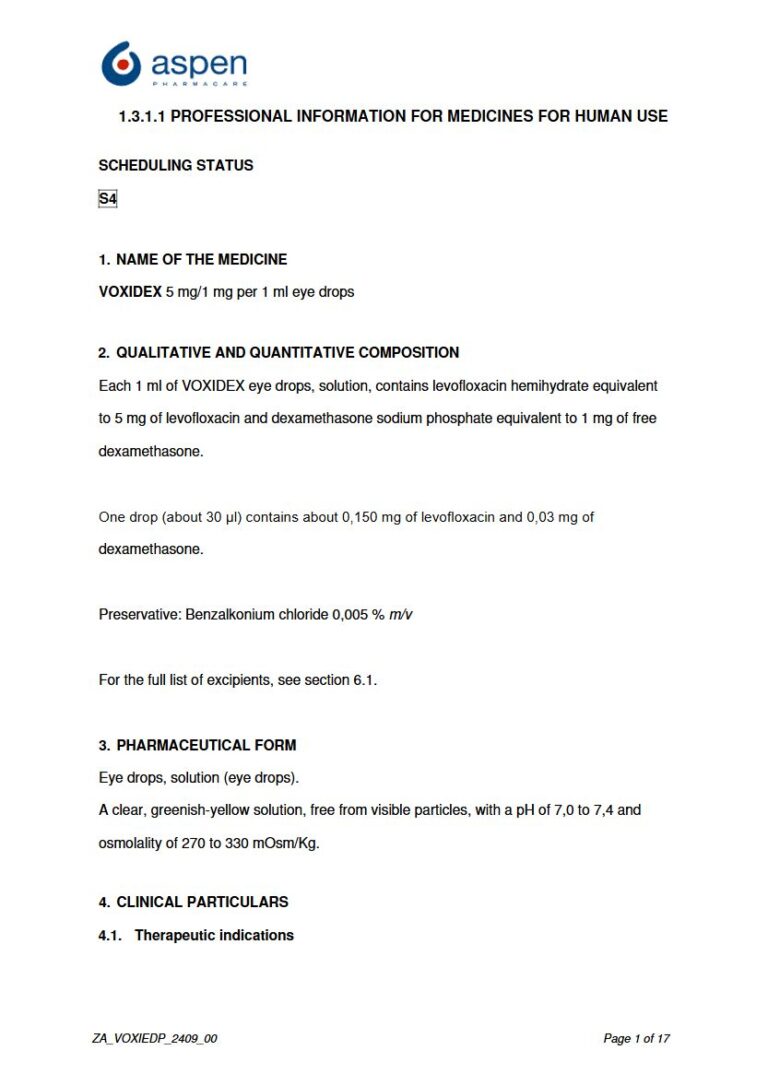 Healthcare Professionals Only
This content is for registered healthcare professionals
Sign in or create a free account to read the full package insert.
Free for HPCSA-registered professionals. Powered by Medinsert.
Clinical Particulars
Section 4 of the official insert — extracted exactly as issued, no alterations
4.1. Therapeutic indications
VOXIDEX is indicated in adults for prevention and treatment of inflammation, and prevention of infection associated with cataract surgery.
4.2. Posology and method of administration
Posology
Adults
One drop instilled into the conjunctival sac directly after surgery, then every 6 hours thereafter. Duration of treatment is 7 days. If one dose is missed, treatment should continue with the next dose as planned. Re-evaluation of the patient to assess the need to continue the administration of corticosteroid eye drops as monotherapy is recommended after the completion of one week of therapy with VOXIDEX. The length of this treatment can depend on the patientu2019s risk factors and outcome of surgery and must be determined by the doctor according to slit-lamp microscopic findings and depending on the severity of the clinical picture. A follow-up treatment with steroid eye drops should not normally exceed 2 weeks. However, care should be taken not to discontinue therapy prematurely.
Special populations
Elderly population
No dosage adjustment in elderly patients is necessary.
Renal impairment
VOXIDEX has not been studied in patients with renal impairment.
Hepatic impairment
VOXIDEX has not been studied in patients with hepatic impairment.
Paediatric population
The safety and efficacy of VOXIDEX in children and adolescents below the age of 18 years have not been established. No data are available.
Method of administration
Ocular use. Administer one drop in the affected eye. Patients should be instructed to wash their hands before use and avoid allowing the tip of the container to come into contact with the eye or surrounding structures as this could cause injury to the eye. Patients should also be instructed that ocular solutions, if handled improperly, can become contaminated by common bacteria known to cause ocular infections. Serious damage to the eye and subsequent loss of vision may result from using contaminated solutions.
4.3. Contraindications
- Hypersensitivity to levofloxacin or to other quinolones, to dexamethasone, or to other steroids, or to any of the excipients listed in section 6.1, e.g. benzalkonium.
- Herpes simples, keratitis, varicella and other viral disease of the cornea and conjunctiva.
- Mycobacterial infections of the eye caused by, but not limited to, acid-fast bacilli such as Mycobacterium tuberculosis, Mycobacterium leprae, or Mycobacterium avium.
- Fungal diseases of ocular structures.
- Untreated purulent infection of the eye.
4.4. Special warnings and precautions for use
Ocular effects
VOXIDEX is for ophthalmic use only. VOXIDEX must not be injected sub-conjunctively. The solution should not be introduced directly into the anterior chamber of the eye. Prolonged use may induce antibiotic resistance with result of overgrowth of non-susceptible organisms, including fungi. If infection develops, discontinue use and institute alternative therapy. Whenever clinical judgement dictates, the patient should be examined with the aid of magnification, such as slit-lamp biomicroscopy, and, where appropriate, fluorescein staining. Prolonged use of topical ophthalmic corticosteroids, as contained in VOXIDEX, may result in ocular hypertension/glaucoma. The intraocular pressure should be checked frequently while on treatment with VOXIDEX. The risk of corticosteroid-induced increase in the intraocular pressure is increased in predisposed patients (e.g. diabetes). Visual disturbance may be reported with systemic and topical corticosteroid use. If a patient presents with symptoms such as blurred vision and/or other visual disturbances, the patient should be considered for referral to an ophthalmologist for evaluation of possible causes which may be related to complications to cataract surgery, development of glaucoma and/or rare diseases such as central serous chorioretinopathy (CSCR) which have been reported after use of systemic and topical corticosteroids, as contained in VOXIDEX. Topical ophthalmic corticosteroids, as contained in VOXIDEX, may slow corneal wound healing. Topical ocular NSAIDs are also known to slow or delay healing. Concomitant use of topical ocular NSAIDs and steroids may increase the potential for healing problems. In those diseases causing thinning of the cornea or sclera, perforations have been reported to occur with the use of topical corticosteroids, as contained in VOXIDEX.
Systemic effects
Fluoroquinolones as contained in VOXIDEX have been associated with hypersensitivity reactions, even following a single dose. Discontinue VOXIDEX if an allergic reaction occurs. Tendon inflammation and rupture may occur with systemic fluoroquinolone therapy including levofloxacin, particularly in older patients and those treated concurrently with corticosteroids. Therefore, caution should be exercised and treatment with VOXIDEX should be discontinued at the first sign of tendon inflammation. Cushingu2019s syndrome and/or adrenal suppression associated with systemic absorption of ocular dexamethasone may occur after intensive or long-term continuous therapy in predisposed patients, including children and patients treated with CYP3A4 inhibitors (including ritonavir and cobicistat). In these cases, treatment should be progressively discontinued.
Effects on immune system
Prolonged use with VOXIDEX should be avoided as the immune system may be suppressed. No long-term safety data is available for VOXIDEX. Prolonged use (generally observed within 2 weeks of treatment) may also result in secondary ocular infections (bacterial, viral, or fungal) due to suppression of host response or to the delay of their healing. In addition, topical ocular corticosteroids may promote, aggravate or mask signs and symptoms of eye infections caused by opportunistic microorganisms. Occurrence of these conditions is limited in case of short term corticosteroid treatment such as the one suggested for VOXIDEX (see section 4.2).
Paediatric population
VOXIDEX should not be used in patients under 18 years of age.
Excipients
This medicine contains 0,0015 mg benzalkonium chloride in each drop (about 30 u03bcl) which is equivalent to 0,05 mg/ml. Benzalkonium chloride has been reported to cause eye irritation, symptoms of dry eyes and may affect the tear film and corneal surface. Should be used with caution in dry eye patients and in patients where the cornea may be compromised.
4.5. Interaction with other medicines and other forms of interaction
No medicine interaction studies have been performed, and concomitant eye drops should be avoided. The concomitant use of probenecid, cimetidine, or ciclosporin with levofloxacin altered some pharmacokinetic parameters of levofloxacin. Concomitant use of topical steroids and topical NSAIDs may increase the potential for corneal healing problems. CYP3A4 inhibitors (including ritonavir and cobicistat) may decrease dexamethasone clearance resulting in increased effects.
4.6. Fertility, pregnancy and lactation
The safety of VOXIDEX in pregnancy and lactation has not been established.
Pregnancy
VOXIDEX should not be used during pregnancy as there are no safety data.
Breastfeeding
Levofloxacin and dexamethasone, as contained in VOXIDEX, are excreted in human milk. VOXIDEX should not be used during breastfeeding.
Fertility
There are no data on potential effects of VOXIDEX on fertility.
4.7. Effects on ability to drive and use machines
No studies on the effects on the ability to drive and use machines have been performed. Temporarily blurred vision or other visual disturbances may affect the ability to drive or use machines. If blurred vision occurs, the patient must wait until the vision is clear before driving or using machines.
4.8. Undesirable effects
a) Summary of the safety profile
In clinical studies, 438 patients have been treated with VOXIDEX. Ocular disorders (e.g. corneal oedema, eye irritation, abnormal sensation in eye, lacrimation increased, asthenopia, corneal disorder, dry eye, eye pain, ocular discomfort, uveitis, visual brightness, conjunctivitis) have been reported. These reactions can also be linked to the cataract surgery itself. No serious adverse event was related to study treatment.
b) Tabulated list of adverse reactions
System organ class
Very common
Common
Uncommon
Rare
Very rare
Not known
Immune system disorders
Extra-ocular allergic reactions, including skin rash #
Anaphylaxis #
Endocrine disorders
Depression of adrenal function ~
Cushingu2019s syndrome ~, adrenal suppression ~
Nervous system disorders
Headache* #, dysgeusia*
Eye disorders
Ocular burning #, decreased vision and mucous strand #, increase of the intraocular pressure ~
Discomfort ~, irritation ~, burning ~, stinging ~, itching ~ and blurred vision ~
Eye irritation*, abnormal sensation in eye*, ocular hypertension *, lid matting #, chemosis #, conjunctival papillary reaction #, lid oedema #, ocular discomfort #, ocular itching #, ocular pain #, conjunctival injection #, conjunctival follicles #, ocular dryness #, lid erythema #, photophobia #, allergic and hypersensitivity reactions ~, delayed wound healing ~, posterior subcapsular cataract ~, opportunistic infections ~, glaucoma
Conjunctivitis ~, mydriasis ~, ptosis ~, corticosteroid-induced uveitis ~, corneal calcifications ~, crystalline keratopathy ~, changes in corneal thickness ~, corneal oedema ~, corneal ulceration ~, corneal perforation ~
Respiratory, thoracic and mediastinal disorders
Rhinitis #
Laryngeal oedema #
Gastrointestinal disorders
Nausea*, tongue disorder*
Skin and subcutaneous tissue disorders
Pruritis*
General disorders and administrative site conditions
Face oedema ~, administration site conditions ~
Investigations
Increased intraocular pressure*+ > 6 mmHg that means significant intraocular pressure increase.
* Reported with the combination of levofloxacin/dexamethasone.
# Reported with the use of levofloxacin.
~ Reported with the use of dexamethasone.
c) Description of selected adverse reactions
Increase of the intra-ocular pressure (IOP) and glaucoma may occur. The use of corticosteroid treatment may result in ocular hypertension/glaucoma (especially for patients with previous IOP induced by steroids or with pre-existing high IOP or glaucoma). Children and elderly patients may be particularly susceptible to steroid-induced IOP rise (see section 4.4). Diabetics are also more prone to develop subcapsular cataracts following prolonged topical steroid administration. Increase of the intra-ocular pressure induced by topical treatment with corticosteroids has been generally observed within 2 weeks of treatment (see section 4.4.).
Discomfort, irritation, burning, stinging, itching and blurred vision frequently may occur immediately after instillation. These events are usually mild and transient and have no consequences. In diseases causing thinning of the cornea, topical use of steroids could lead to cornea perforation in some cases (see section 4.4). Depression of adrenal function associated with systemic absorption of VOXIDEX may occur when the instillations are administered with a frequent dosing schedule. Cases of corneal calcification have been reported very rarely in association with the use of phosphate containing eye drops in some patients with significantly damaged corneas.
Reporting of suspected adverse reactions
Reporting suspected adverse reactions after authorisation of the medicine is important. It allows continued monitoring of the benefit/risk balance of the medicine. Health care providers are requested to report any suspected adverse drug reactions to SAHPRA via the Med Safety APP (Medsafety X SAHPRA) and eReporting platform (who-umc.org) found on SAHPRA website. Aspen Pharmacare: E-mail: [email protected] Tel: 0800 118 088
4.9. Overdose
Symptoms
The total amount of levofloxacin and dexamethasone 21-Phosphate in vial of VOXIDEX is too small to induce toxic effects after an accidental oral intake.
Treatment
In the case of topical overdose, the treatment should be stopped. In case of prolonged irritation, the eye(s) should be rinsed with sterile water. The symptomatology due to accidental ingestion is not known. The medical practitioner may consider emesis.
