
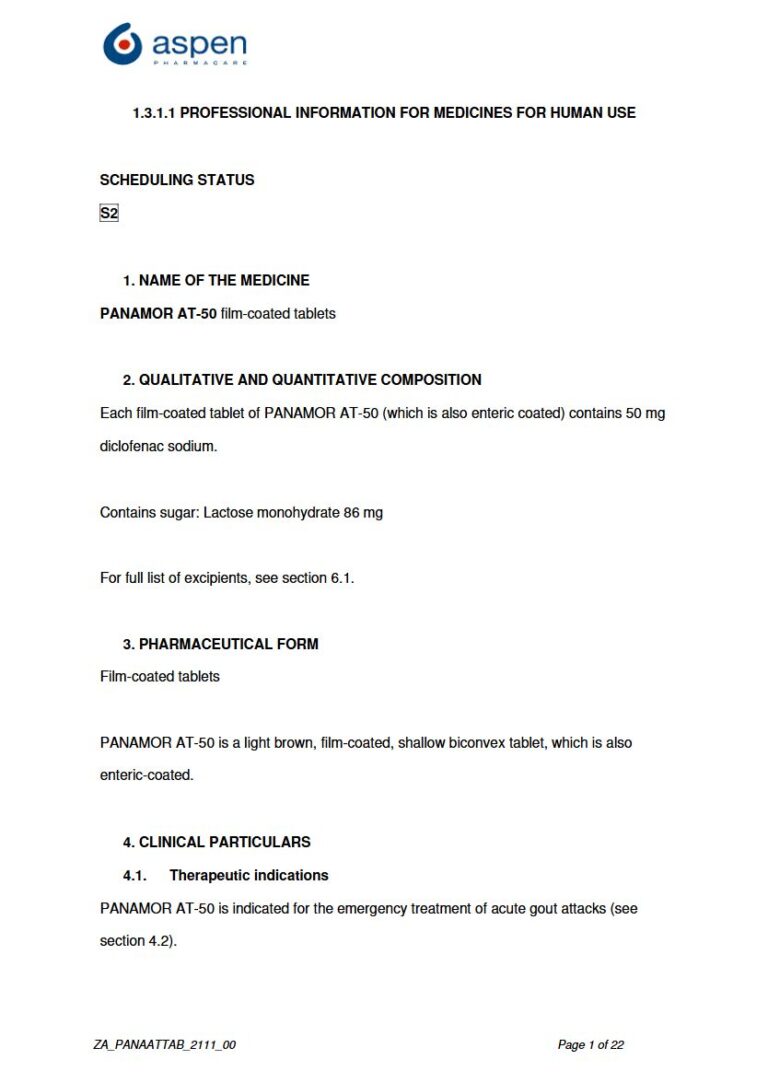
Panamor At-50 50 mg FC tablets
PDF Leaflet Revision Date: 28 November 2021
Clinical Summary
Quick overview from the medicine insert
Indication
Emergency treatment of acute gout attacks.
Dosage (summary)
1 tablet three times a day for a maximum of 3 days; do not exceed 150 mg/day.
Special Populations
- Elderly
- Renal impairment
- Hepatic impairment
Pregnancy & Breastfeeding
Avoid in pregnancy from 20 weeks; not recommended during breastfeeding.
Key Drug Interactions
- Anticoagulants
- Other NSAIDs
- Diuretics
Contraindications
- Hypersensitivity to diclofenac
- Porphyria
- Active gastrointestinal bleeding
- Hepatic or renal failure
Common side effects
- Gastrointestinal bleeding
- Nausea
- Headache
- Dizziness
Counselling Points
- Take with water
- Report unusual abdominal symptoms
- Avoid in late pregnancy
Serious warnings
- Risk of cardiovascular events
- Gastrointestinal ulceration
- Serious allergic reactions
Important Disclaimer
The Panamor At-50 50 mg FC tablets professional information leaflet below is the property of Pharmacare and is provided on Medinsert exactly as issued, with no.. alterations or editorial changes. We make every effort to keep content current by updating documents as soon as new versions become available. Medinsert serves as a trusted access point for healthcare professionals, but does not replace official sources or clinical judgement. For more details, please read our full disclaimer. read more>>
 Healthcare Professionals Only
This content is for registered healthcare professionals
Sign in or create a free account to read the full package insert.
Free for HPCSA-registered professionals. Powered by Medinsert.
Clinical Particulars
Section 4 of the official insert — extracted exactly as issued, no alterations
4.1. Therapeutic indications
PANAMOR AT-50 is indicated for the emergency treatment of acute gout attacks (see section 4.2).
4.2. Posology and method of administration
Posology
Adults
Use the lowest effective dose for the shortest possible duration of treatment. Take one PANAMOR AT-50 tablet three times a day, for a maximum treatment period of 3 days. Do not take more than 150 mg in a day (three PANAMOR AT-50 tablets in divided doses).
Paediatric population
PANAMOR AT-50 is not suitable for use in children and adolescents below 14 years of age (see section 4.3).
Method of administration
For oral administration. The tablets should be swallowed whole with a glass of water.
4.3. Contraindications
PANAMOR AT-50 is contraindicated in:
- Patients with hypersensitivity to diclofenac sodium or to any excipients in PANAMOR AT-50 (see section 6. 1).
- Patients with porphyria.
- Children and adolescents below 14 years of age.
- Patients with a history of active gastrointestinal bleeding, ulceration or perforation (PUBs) related to previous NSAIDs (see section 4.4).
- Patients with an active or history of recurrent ulcer/haemorrhage/perforations (see section 4.4).
- Patients with hepatic or renal failure.
- Aspirin hypersensitive patients, patients sensitive to any other non-steroidal anti-inflammatory medicine.
- In asthmatic patients in whom attacks of asthma, urticaria, or acute rhinitis are precipitated by acetylsalicylic acid or by other NSAIDs.
- Patients with heart failure; established ischaemic heart disease and/or cerebrovascular disease (stroke) and peripheral arterial disease.
- Lactation (see section 4.6).
- Pregnant women from around 20 weeks of gestation or later in pregnancy (see section 4.4 and 4.6).
4.4. Special warnings and precautions for use
General
Undesirable effects may be minimised by using the lowest effective dose for the shortest duration necessary to control symptoms (see section 4.2). As with other NSAIDs including diclofenac, as in PANAMOR AT-50, allergic reactions, including anaphylactic/anaphylactoid reactions, can also occur without earlier exposure to the medicine (see section 4.8). Hypersensitivity reactions can also progress to Kounis syndrome, a serious allergic reaction that can result in myocardial infarction. Presenting symptoms of such reactions can include chest pain occurring in association with an allergic reaction to PANAMOR AT-50.
Because of the possibility of cross-sensitivity due to structural relationships which exist among non-steroidal anti-inflammatory medicines, such as PANAMOR AT-50, acute allergic reactions may be more likely to occur in patients who have exhibited allergic reactions to these compounds. Diclofenac, as in PANAMOR AT-50, may mask the signs and symptoms of infection due to its pharmacodynamic properties.
The concomitant use of PANAMOR AT-50, with systemic NSAIDs including cyclooxygenase-2 selective inhibitors should be avoided due to the absence of any evidence demonstrating synergistic benefits and the potential for additive undesirable effects (see section 4.5). Serious interactions have been reported after the use of high dose methotrexate with diclofenac, as in PANAMOR AT-50 (see section 4.5).
Cardiovascular and cerebrovascular effects
Appropriate monitoring, advice and caution is required in patients with a history of hypertension and/or heart failure as fluid retention and oedema have been reported in association with diclofenac, as in PANAMOR AT-50, therapy. In view of PANAMOR AT-50u2019s inherent potential to cause fluid retention, heart failure may be precipitated in some compromised patients. Caution is required in patients with significant risk factors for cardiovascular events (e.g. hypertension, hyperlipidaemia, diabetes mellitus, smoking) and should only be treated with PANAMOR AT-50 after careful consideration. As the cardiovascular risks of PANAMOR AT-50 may increase with dose and duration of exposure, the shortest duration possible and the lowest effective daily dose should be used. The patient's need for symptomatic relief and response to therapy should be re-evaluated periodically.
Clinical trial and epidemiological data consistently point towards increased risk of arterial thrombotic events (for example myocardial infarction or stroke) associated with the use of diclofenac, as in PANAMOR AT-50, particularly at a high dose and in long term treatment. Patients should remain alert for the signs and symptoms of serious arteriothrombotic events (e.g. chest pain, shortness of breath, weakness, slurring of speech), which can occur without warnings. Patients should be instructed to see a medical practitioner immediately in case of such an event.
PANAMOR AT-50 should be given with care to patients with cardiovascular disease, bleeding disorders, and in patients with impaired hepatic or renal function.
Elderly
PANAMOR AT-50 should be used with care as the elderly has an increased frequency of adverse reactions to NSAIDs, including PANAMOR AT-50, especially gastrointestinal bleeding and perforation (PUBs) which may be fatal. Caution is indicated in the elderly on basic medical grounds. In particular, it is recommended that the lowest effective dose be used in frail elderly patients or those with a low body weight.
Gastrointestinal effects
Gastrointestinal bleeding (haematemesis, melaena), ulceration or perforation, which can be fatal has been reported with NSAIDs including diclofenac, as in PANAMOR AT-50, and may occur at any time during treatment, with or without warning symptoms or a previous history of serious gastrointestinal (GI) events. They generally have more serious consequences in the elderly. Close medical surveillance is imperative and particular caution should be exercised when prescribing PANAMOR AT-50 in patients with symptoms indicative of gastrointestinal disorders or with a history suggestive of gastric or intestinal ulceration, bleeding or perforation (see section 4.8).
The risk of gastrointestinal bleeding, ulceration or perforation (PUBs) is higher with increasing doses of PANAMOR AT-50, in patients with a history of ulcers, particularly if complicated with haemorrhage or perforation and the elderly (see section 4.3). When gastrointestinal bleeding or ulceration occurs in patients receiving PANAMOR AT-50, treatment with PANAMOR AT-50 should be stopped. To reduce the risk of GI toxicity in patients with a history of ulcer, particularly if complicated with haemorrhage or perforation, and in the elderly, the treatment should be initiated and maintained at the lowest effective dose. Combination therapy with protective medicines (e.g. misoprostol or proton pump inhibitors) should be considered for these patients, and also for patients requiring concomitant use of medicines containing low dose acetylsalicylic acid (aspirin), or other medicines likely to increase gastrointestinal risk (see section 4.5). Patients with a history of GI toxicity, particularly the elderly, should report any unusual abdominal symptoms (especially GI bleeding).
Caution is recommended in patients receiving concomitant medicines which could increase the risk of ulceration or bleeding, such as systemic corticosteroids, anticoagulants such as warfarin, selective serotonin-reuptake inhibitors (SSRIs) or anti-platelet medicines such as acetylsalicylic acid (see section 4.5). PANAMOR AT-50 should be given with caution to patients with a history of gastrointestinal disease (e.g. ulcerative colitis, Crohnu2019s disease, hiatus hernia, gastro-oesophageal reflux disease, angiodysplasia) as the condition may be exacerbated. PANAMOR AT-50 may be associated with increased risk of gastrointestinal anastomotic leak. Close medical surveillance and caution are recommended when using PANAMOR AT-50 after gastrointestinal surgery.
Hepatic impairment
Close medical surveillance is required when prescribing PANAMOR AT-50 to patients with impairment of hepatic function, as their condition may be exacerbated. As with diclofenac, as in PANAMOR AT-50, values of one or more liver enzymes may increase. During prolonged treatment with PANAMOR AT-50, regular monitoring of hepatic function is indicated as a precautionary measure. If abnormal liver function tests persist or worsen, if clinical signs or symptoms consistent with liver disease develop, or if other manifestations occur (eosinophilia, rash), PANAMOR AT-50 should be discontinued. Hepatitis may occur with PANAMOR AT-50 without prodromal symptoms.
Renal impairment
As fluid retention and oedema have been reported in association with NSAID therapy, including diclofenac, as in PANAMOR AT-50, particular caution is called for in patients with impaired cardiac or renal function, history of hypertension, the elderly, patients receiving concomitant treatment with diuretics or medicines that can significantly impact renal function, and in those patients with substantial extracellular volume depletion from any cause, e.g. before or after major surgery (see section 4.3). Monitoring of renal function is recommended as a precautionary measure when using PANAMOR AT-50 in such cases. Discontinuation of therapy is usually followed by recovery to the pre-treatment state.
Skin effects
Stevens-Johnson Syndrome and Toxic Epidermal Necrolysis Serious skin reactions, some of them fatal, including exfoliative dermatitis, Stevens-Johnson syndrome (SJS), and toxic epidermal necrolysis (TEN) have been reported. Patients appear to be at highest risk for these reactions early in the course of therapy; the onset of the reaction occurring in the majority of cases within the first month of treatment. PANAMOR AT-50 should be discontinued at the first appearance of skin rash, mucosal lesions, or any other sign of hypersensitivity (see section 4.8).
Drug reaction with eosinophillia and systemic symptoms
Drug reaction with eosinophillia and systemic symptoms (DRESS) has been reported in patients taking NSAIDs such as PANAMOR AT-50. Some of these events have been fatal or life-threatening. DRESS typically, although not exclusively, presents with fever, rash, lymphadenopathy, and/or facial swelling. Other clinical manifestations may include hepatitis, nephritis, haematological abnormalities, myocarditis, or myositis. Sometimes symptoms of DRESS may resemble an acute viral infection. Eosinophillia is often present. Because this disorder is variable in its presentation, other organ systems not noted here may be involved. It is important to note that early manifestations of hypersensitivity, such as fever or lymphadenopathy, may be present even though rash is not evident. If such signs or symptoms are present, discontinue PANAMOR AT-50 and evaluate the patient immediately.
SLE and mixed connective tissue disease
In patients with systemic lupus erythematosus (SLE) and mixed connective tissue disorders there may be an increased risk of aseptic meningitis (see section 4.8).
Pre-existing asthma
In patients with asthma, seasonal allergic rhinitis, swelling of the nasal mucosa (i.e. nasal polyps), chronic obstructive pulmonary diseases or chronic infections of the respiratory tract (especially if linked to allergic rhinitis-like symptoms), reactions to PANAMOR AT-50 such as asthma exacerbations (so-called intolerance to analgesics / analgesics-asthma), Quincke's oedema or urticaria are more frequent than in other patients, therefore, special precaution is recommended in such patients (readiness for emergency). This is applicable as well for patients who are allergic to other medicines, e.g. with skin reactions, pruritus or urticaria. Diclofenac sodium, as in PANAMOR AT-50, can precipitate bronchospasm if administered to patients suffering from, or with a previous history of bronchial asthma. Therefore, PANAMOR AT-50 should be used with caution in patients with asthma or bronchoconstriction.
Haematological effects
During prolonged treatment with PANAMOR AT-50 monitoring of the blood count is recommended. Diclofenac, as in PANAMOR AT-50, may reversibly inhibit platelet aggregation and decreased platelet aggregation with increased bleeding time may occur (see section 4.5). Patients with defects of haemostasis, bleeding diathesis or haematological abnormalities should be carefully monitored.
4.5. Interaction with other medicines and other forms of interaction
Diuretics and anti-hypertensive medicines
Concomitant use of PANAMOR AT-50 with diuretics or antihypertensive medicines (e.g. beta-blockers, angiotensin converting enzyme (ACE) inhibitors) may cause a decrease in their antihypertensive effect via inhibition of vasodilatory prostaglandin synthesis. Therefore, the combination should be administered with caution and patients, especially the elderly, should have their blood pressure periodically monitored. Patients should be adequately hydrated and consideration should be given to monitoring of renal function after initiation of concomitant therapy and periodically thereafter, particularly for diuretics and ACE inhibitors due to the increased risk of nephrotoxicity.
Medicines known to cause hyperkalemia
Concomitant treatment with potassium-sparing diuretics, ciclosporin, tacrolimus or trimethoprim may be associated with increased serum potassium levels, which should therefore be monitored frequently (see section 4.4).
Other NSAIDs including cyclo-oxygenase-2 selective inhibitors
Co-administration of PANAMOR AT-50 and other systemic NSAIDs may increase the risk of gastrointestinal bleeding or ulceration. Avoid concomitant use of two or more NSAIDs as concurrent use of two or more NSAIDs could result in an increase in side effects (see section 4.4).
Corticosteroids
Increased risk of gastrointestinal perforation, ulceration or bleeding (PUBs). Concomitant administration of glucocorticoids or other non-steroidal anti-inflammatory medicines may aggravate gastrointestinal side effects.
Anti-coagulants and anti-platelet medicines
PANAMOR AT-50 may enhance the effects of anti-coagulants such as warfarin, therefore PANAMOR AT-50 should be given with care to patients who are receiving coumarin anticoagulants. Caution is recommended since concomitant administration could increase the risk of bleeding and gastrointestinal bleeding (see section 4.4). Although clinical investigations do not appear to indicate that diclofenac, as in PANAMOR AT-50, affects the action of anticoagulants, there are reports of an increased risk of haemorrhage in patients receiving diclofenac, as in PANAMOR AT-50, and anticoagulants concomitantly (see section 4.4). Therefore, to be certain that no change in anticoagulant dosage is required, close monitoring of such patients is required. PANAMOR AT-50 in high dose can reversibly inhibit platelet aggregation.
Selective serotonin reuptake inhibitors (SSRIs)
Concomitant administration of SSRIs may increase the risk of gastrointestinal bleeding (see section 4.4).
Aspirin
Plasma concentrations are significantly decreased by the concomitant administration of therapeutic doses of aspirin. The bioavailability of PANAMOR AT-50 is reduced by acetylsalicylic acid, and that of acetylsalicylic acid by PANAMOR AT-50, when the two medicines are administered together.
Lithium
If used concomitantly, PANAMOR AT-50 may raise plasma concentrations of lithium. Monitoring of the serum lithium level is recommended.
Digoxin
If used concomitantly, PANAMOR AT-50 may raise plasma concentrations of digoxin. Monitoring of the serum digoxin level is recommended.
Probenecid
PANAMOR AT-50 may increase the half-life of probenecid.
Antidiabetics
Clinical studies have shown that diclofenac, as in PANAMOR AT-50, can be given together with oral antidiabetic medicines without influencing their clinical effect. However, there have been reports of hypoglycaemic and hyperglycaemic effects necessitating changes in the dosage of the antidiabetic medicines during treatment with diclofenac, as in PANAMOR AT-50. For this reason, monitoring of the blood glucose level is recommended as a precautionary measure during concomitant therapy.
Methotrexate
Diclofenac, as in PANAMOR AT-50 can inhibit the tubular renal clearance of methotrexate hereby increasing methotrexate levels. Caution is recommended when PANAMOR AT-50 is administered less than 24 hours before or after treatment with methotrexate, since blood concentrations of methotrexate may rise and the toxicity of PANAMOR AT-50 may be increased. Cases of serious toxicity have been reported when methotrexate and NSAIDs including diclofenac, as in PANAMOR AT-50, are given within 24 hours of each other. This interaction is mediated through accumulation of methotrexate resulting from impairment of renal excretion in the presence of the NSAID.
Ciclosporin
PANAMOR AT-50 may increase the nephrotoxicity of ciclosporin due to the effect on renal prostaglandins. Therefore, PANAMOR AT-50 should be given at doses lower than those that would be used in patients not receiving ciclosporin.
Tacrolimus
Possible increased risk of nephrotoxicity when NSAIDs, such as diclofenac as in PANAMOR AT-50, are given with tacrolimus. This might be mediated through renal antiprostaglandin effects of both NSAID and calcineurin inhibitor.
Quinolone antimicrobials
Convulsions may occur due to an interaction between quinolones and NSAIDs, such as diclofenac as in PANAMOR AT-50. This may occur in patients with or without a previous history of epilepsy or convulsions. Therefore, caution should be exercised when considering the use of a quinolone in patients who are already receiving PANAMOR AT-50.
Phenytoin
When using phenytoin concomitantly with PANAMOR AT-50, monitoring of phenytoin plasma concentrations is recommended due to an expected increase in exposure to phenytoin.
Colestipol and cholestyramine
These medicines can induce a delay or decrease in absorption of diclofenac, as in PANAMOR AT-50. Therefore, it is recommended to administer PANAMOR AT-50 at least one hour before or 4 to 6 hours after administration of colestipol/ cholestyramine.
Cardiac glycosides
Concomitant use of cardiac glycosides and NSAIDs, such as diclofenac as in PANAMOR AT-50, in patients may exacerbate cardiac failure, reduce GFR and increase plasma glycoside levels.
Mifepristone
NSAIDs, including diclofenac as in PANAMOR AT-50, should not be used for 8 to 12 days after mifepristone administration as NSAIDs can reduce the effect of mifepristone.
Potent CYP2C9 inhibitors
Caution is recommended when co-prescribing diclofenac, as in PANAMOR AT-50, with potent CYP2C9 inhibitors (such as sulfinpyrazone and voriconazole), which could result in a significant increase in peak plasma concentration and exposure to diclofenac due to inhibition of diclofenac metabolism.
Other protein-bound medicines
Use with care together with other protein-bound medicines e.g. tolbutamide, coumarin and hydantoin.
4.6. Fertility, pregnancy and lactation
Pregnancy
First trimester
Inhibition of prostaglandin synthesis may adversely affect the pregnancy and/or the embryo/foetal development. Data from epidemiological studies raise concern about an increased risk of miscarriage and of cardiac malformation and gastroschisis after use of a prostaglandin synthesis inhibitor in early pregnancy. The absolute risk for cardiovascular malformation was increased from less than 1 %, up to approximately 1,5 %. The risk is believed to increase with dose and duration of therapy. In animals, administration of a prostaglandin synthesis inhibitor has been shown to result in increased pre- and post- implantation loss and embryo-foetal lethality. In addition, increased incidences of various malformations, including cardiovascular, have been reported in animals given a prostaglandin synthesis inhibitor during the organogenetic period.
Second and Third trimester
During the third trimester of pregnancy, prostaglandin synthesis inhibitors, such as PANAMOR AT-50, may expose the foetus to:
- cardiopulmonary toxicity (with premature closure of the foetal ductus arteriosus in utero, and in persistent pulmonary hypertension of the newborn;
- renal dysfunction, which may progress to renal failure with oligo-hydramniosis (see section 4.4);
At the end of pregnancy, the mother and the neonate may be exposed to:
- possible prolongation of bleeding time, an anti-aggregating effect which may occur even at very low doses.
- inhibition of uterine contractions resulting in delayed or prolonged labour (see section 4.4).
It is recommended that PANAMOR AT-50 is avoided in pregnant women at 20 weeks or later in pregnancy (see section 4.3 and 4.4).
Breastfeeding
Diclofenac, as in PANAMOR AT-50, passes into the breastmilk in small amounts. Therefore, PANAMOR AT-50 should not be administered during breastfeeding in order to avoid undesirable effects in the infant (see section 4.3)
Fertility
PANAMOR AT-50 may impair female fertility and is not recommended in women attempting to conceive. In women who have difficulties conceiving or who are undergoing investigation of infertility, withdrawal of PANAMOR AT-50 should be considered (see section 4.4).
4.7. Effects on ability to drive and use machines
PANAMOR AT-50 has minor influence on the ability to drive or use machines. Since adverse reactions such as drowsiness, dizziness, blurred vision and other ocular reactions have been reported in patients receiving PANAMOR AT-50, patients should not drive, use machinery or perform any tasks that require concentration, until they are certain that PANAMOR AT-50 does not adversely affect their ability to do so (see section 4.8).
4.8. Undesirable effects
a) Summary of the safety profile
The most commonly observed adverse events are gastrointestinal in nature.
b) Tabulated list of adverse reactions
System organ class
Frequent
Less frequent
Frequency unknown (cannot be estimated from the available data)
Blood and the lymphatic system disorders
Thrombocytopenia, leucopoenia, anaemia (including haemolytic and aplastic anaemia), agranulocytosis.
Immune system disorders
Hypersensitivity, anaphylactic and anaphylactoid reactions (including hypotension and shock), angioneurotic oedema (including face oedema). Allergic reactions which include bronchospasm, urticaria.
Psychiatric disorders
Disorientation, depression, insomnia, nightmare, irritability, psychotic disorder. Drowsiness, nervousness, agitation.
Nervous system disorders
Headache, Dizziness. Somnolence, tiredness, paraesthesia, memory impairment, convulsion, anxiety, tremor, aseptic meningitis, taste disturbances, cerebrovascular accident, disturbances of sensation. Confusion, hallucinations, malaise.
Eye disorders
Blurred vision, visual disturbance, diplopia. Optic neuritis, other ocular reactions.
Ear and labyrinth disorders
Vertigo. Tinnitus, hearing impaired. Minor hearing disorders.
Cardiac disorders
Myocardial infarction, cardiac failure, palpitations, chest pain. Kounis syndrome.
Vascular disorders
Hypertension, hypotension, vasculitis.
Respiratory, thoracic and mediastinal disorders
Asthma (including dyspnoea), pneumonitis.
Gastrointestinal disorders
Peptic ulcers, perforation or gastrointestinal bleeding (sometimes fatal), nausea, vomiting, diarrhoea, flatulence, constipation, dyspepsia, abdominal pain, melaena, haematemesis, ulcerative stomatitis, exacerbation of colitis and Crohnu2019s disease, gastritis, anorexia. Diarrhoea haemorrhagic, gastrointestinal ulcer with or without bleeding or perforation (sometimes fatal particularly in the elderly), colitis (including haemorrhagic colitis), stomatitis, glossitis, oesophageal disorder, diaphragm-like intestinal strictures, pancreatitis. Ischaemic colitis.
Hepatobiliary disorders
Transaminases increased. Hepatitis, jaundice, liver disorder, fulminant hepatitis, hepatic necrosis, hepatic failure. Abnormalities of liver function tests.
Skin and subcutaneous tissue disorders
Rash. Urticaria, bullous reactions, eczema, erythema, erythema multiforme, Stevens-Johnson syndrome, toxic epidermal necrolysis (Lyell's syndrome), dermatitis exfoliative, loss of hair, photosensitivity reaction, purpura, allergic purpura, pruritus. Drug Reaction with Eosinophillia and Systemic Symptoms (DRESS) (see section 4.4).
Renal and urinary disorders
Acute renal failure, haematuria, proteinuria, nephrotic syndrome, interstitial nephritis, renal papillary necrosis. Impairment of renal function.
Reproductive system and breast disorders
Impotence
General disorders and administrative site conditions
Oedema.
Reporting of suspected adverse reactions
Reporting suspected adverse reactions after authorisation of the medicine is important. It allows continued monitoring of the benefit/risk balance of the medicine. Healthcare providers are asked to report any suspected adverse reactions to: SAHPRA: https://www.sahpra.org.za/health-products-vigilance/ Aspen Pharmacare: E-mail: [email protected] Tel: 0800 118 088
4.9. Overdose
Symptoms
There is no typical clinical picture resulting from PANAMOR AT-50 overdose. Overdose can cause symptoms such as headache, nausea, vomiting, epigastric pain, gastrointestinal haemorrhage, diarrhoea, dizziness, disorientation, excitation, coma, drowsiness, tinnitus, fainting or convulsions. In the case of significant poisoning acute renal failure and liver damage are possible. See section 4.4 and 4.8
Treatment
Management of acute poisoning with PANAMOR AT-50 essentially consists of supportive measures and symptomatic treatment. Supportive measures and symptomatic treatment should be given for complications such as hypotension, renal failure, convulsions, gastrointestinal disorder, and respiratory depression. Special measures such as forced diuresis, dialysis or haemo-perfusion are probably of no help in eliminating PANAMOR AT-50 due to the high protein binding and extensive metabolism. Activated charcoal may be considered after ingestion of a potentially toxic overdose.
