
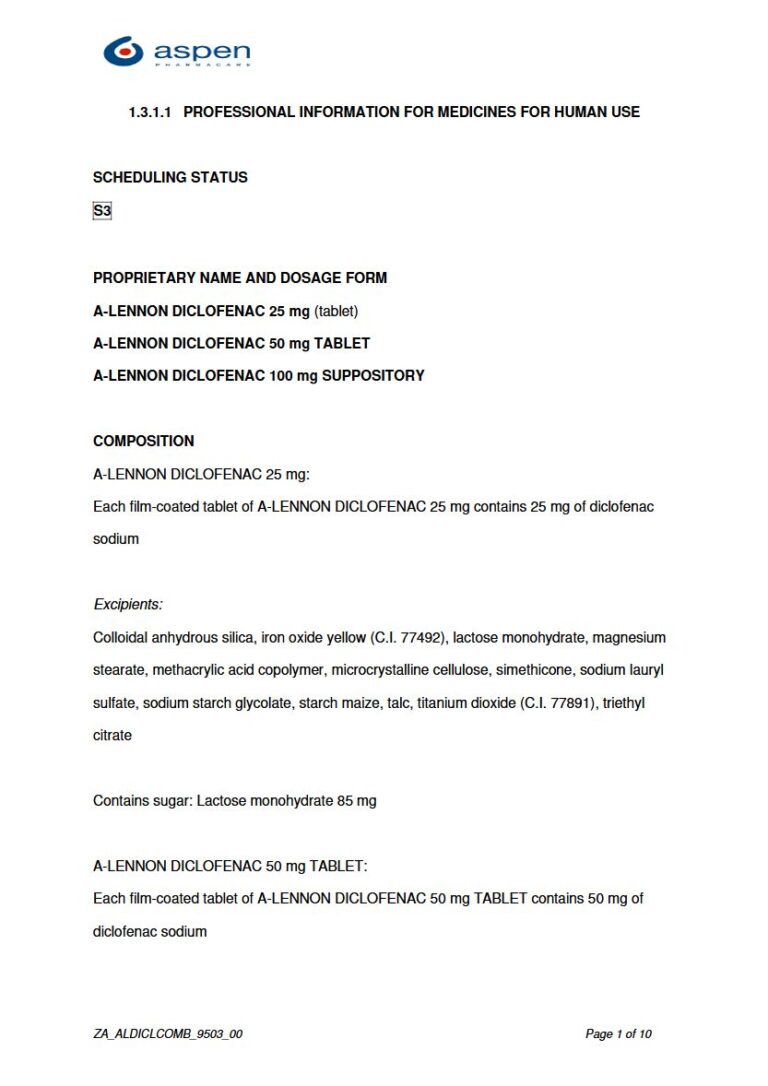
A-Lennon Diclofenac Tablets
PDF Leaflet Revision Date: 23 March 1995
Clinical Summary
Quick overview from the medicine insert
Indication
Management of pain and inflammation in various conditions.
Dosage (summary)
25-50 mg three times daily for adults; 100 mg suppository each evening.
Onset of Action / Duration
Onset: 1.5-2 hours, Duration: 1.2-1.8 hours
Special Populations
- Elderly
- Renal impairment
- Hepatic impairment
Pregnancy & Breastfeeding
Safety not established; use with caution.
Key Drug Interactions
- High dose methotrexate
- Aspirin
- Lithium
- Digoxin
- Glucocorticoids
Contraindications
- Porphyria
- Children under 2 years
- Active gastrointestinal bleeding
- Severe hepatic or renal impairment
Common side effects
- Gastrointestinal disorders
- Headache
- Skin rashes
- Drowsiness
- Nausea
Counselling Points
- Take with food
- Do not divide suppositories
- Monitor for gastrointestinal symptoms
Serious warnings
- Risk of renal dysfunction in certain patients
- Caution in cardiovascular disease
- Potential for fluid retention
Important Disclaimer
The A-Lennon Diclofenac Tablets professional information leaflet below is the property of Pharmacare and is provided on Medinsert exactly as issued, with no.. alterations or editorial changes. We make every effort to keep content current by updating documents as soon as new versions become available. Medinsert serves as a trusted access point for healthcare professionals, but does not replace official sources or clinical judgement. For more details, please read our full disclaimer. read more>>
 Healthcare Professionals Only
This content is for registered healthcare professionals
Sign in or create a free account to read the full package insert.
Free for HPCSA-registered professionals. Powered by Medinsert.
Clinical Particulars
Section 4 of the official insert — extracted exactly as issued, no alterations
4.1 Indications
Tablets
- Rheumatoid arthritis, osteo-arthritis and ankylosing spondylitis.
- Treatment of post-traumatic pain and inflammation.
- Symptomatic treatment of primary dysmenorrhoea.
Suppositories
- Rheumatoid arthritis, osteo-arthritis and ankylosing spondylitis.
- Treatment of post-traumatic pain and inflammation.
- For use as initial therapy for inflammatory and degenerative rheumatic diseases.
4.2 Posology and method of administration
A-LENNON DICLOFENAC 25 mg and A-LENNON DICLOFENAC 50 mg TABLET
In adults, the dosage is 25 mg to 50 mg three times daily depending on the severity of the condition. The maintenance dose should be adjusted to the minimum that will provide continuous therapeutic control. The tablets should be swallowed whole, with or after a meal. The dose in children is 2 mg per kilogram body mass per day in three divided doses.
A-LENNON DICLOFENAC 100 mg SUPPOSITORY
Suppositories should never be divided for administration as the active substance may be distributed unevenly. The average adult dose is 100 mg each evening.
4.3 Contraindications
Patients with porphyria.
Children under the age of two years.
Patients with a history of active gastrointestinal bleeding or peptic ulceration.
Severe hepatic or renal impairment.
Contraindicated in aspirin sensitive patients, patients sensitive to any other non-steroidal anti-inflammatory agent and in patients sensitive to any of the ingredients in these products.
The use of suppositories is contraindicated in proctitis.
4.4 Special warnings and precautions for use
Patients with congestive heart failure, cirrhosis, diuretic-induced volume depletion or renal insufficiency are at a greater risk of developing renal dysfunction due to non-steroidal anti-inflammatory medicine-induced inhibition of renal prostaglandin synthesis.
It is advisable to perform blood counts in patients undergoing prolonged treatment.
A-LENNON DICLOFENAC should be given with care to patients with cardiovascular disease, bleeding disorders, in those who are receiving coumarin anti-coagulants and in patients with impaired hepatic or renal function.
Should be used with caution in patients with asthma or bronchoconstriction.
Use with care in elderly patients.
In view of the productu2019s inherent potential to cause fluid retention, heart failure may be precipitated in some compromised patients.
Excipients Lactose warning: A-LENNON DICLOFENAC tablets contains lactose which may have an effect on the glycaemic control of patients with diabetes mellitus.
Patients with the rare hereditary conditions of galactose intolerance e.g. galactosaemia, Lapp lactase deficiency, glucose-galactose malabsorption or fructose intolerance should not take A-LENNON DICLOFENAC tablets.
4.5 Interactions with other medicines
Serious interactions have been reported after the use of high dose methotrexate with diclofenac.
Plasma concentrations are significantly decreased by the concomitant administration of therapeutic doses of aspirin.
When given together with preparations containing lithium or digoxin, diclofenac sodium may raise their plasma concentrations.
Concomitant administration of glucocorticoids or other non-steroidal anti-inflammatory agents may aggravate gastro-intestinal side effects.
Concomitant administration with two or more non-steroidal anti-inflammatory agents may promote the occurrence of side effects.
May increase the half-life of probenecid.
Use with care with other protein-bound medicines e.g. tolbutamide, coumarin and hydantoin.
4.6 Fertility, pregnancy and lactation
Safety during pregnancy and lactation has not yet been established.
4.7 Effects on ability to drive and use machines
Not specified in the provided text.
4.8 Undesirable effects
Gastrointestinal disorders, including epigastric pain, eructation, nausea and vomiting may occur. Peptic ulceration and gastrointestinal bleeding have been reported.
Other side effects include vertigo, headache, skin rashes, pruritus, tinnitus, depression, drowsiness, nervousness, insomnia, irritability, agitation, minor hearing disorders, oedema, palpitations, blurred vision and other ocular reactions.
Hypersensitivity reactions may occur and include fever and rashes. Hepatotoxicity and aseptic meningitis which occur less frequently may also be hypersensitivity reactions.
Diclofenac may cause cystitis and haematuria, as well as acute renal failure, interstitial nephritis and nephrotic syndrome.
Other adverse effects include anaemia, thrombocytopenia, neutropenia, eosinophilia, agranulocytosis and abnormalities in liver function tests.
Allergic reactions which include angio-oedema, bronchospasm, urticaria and anaphylactic reactions have occurred. Because of the possibility of cross-sensitivity due to structural relationships which exist among non-steroidal anti-inflammatory medicines, acute allergic reactions may be more likely to occur in patients who have exhibited allergic reactions to these compounds.
Decreased platelet aggregation with increased bleeding time may occur.
4.9 Overdose
Symptoms: See SIDE EFFECTS and WARNINGS AND SPECIAL PRECAUTIONS.
Treatment: Treatment is symptomatic and supportive.
