
Panamor Eye Drops 1 mg/ml Ophthalmic solution.
PDF Leaflet Revision Date: 02 November 2021
Clinical Summary
Quick overview from the medicine insert
Indication
Alleviation of post-operative inflammation and ocular surface pain.
Dosage (summary)
Pre-op: up to 5 drops 3 hours before surgery; Post-op: 3 drops after surgery, then 1 drop 4-5 times daily.
Onset of Action / Duration
Onset: rapid, Duration: several hours
Special Populations
- Elderly
- Paediatric population
Pregnancy & Breastfeeding
Avoid in pregnancy from 20 weeks; not recommended during breastfeeding.
Key Drug Interactions
- Topical steroids
- Other NSAIDs
- Anticoagulants
- SSRIs
Contraindications
- Hypersensitivity to diclofenac
- Soft contact lens wearers
- History of gastrointestinal issues
- Pregnancy after 20 weeks
Common side effects
- Burning sensation
- Stinging
- Blurred vision
- Gastrointestinal bleeding
Counselling Points
- Avoid driving until effects are known
- Report any skin reactions
- Use with caution in patients with bleeding tendencies
Serious warnings
- Corneal toxicity
- Increased bleeding time
- Fluid retention
- Serious skin reactions
Important Disclaimer
The Panamor Eye Drops 1 mg/ml Ophthalmic solution. professional information leaflet below is the property of Pharmacare and is provided on Medinsert exactly as issued, with no.. alterations or editorial changes. We make every effort to keep content current by updating documents as soon as new versions become available. Medinsert serves as a trusted access point for healthcare professionals, but does not replace official sources or clinical judgement. For more details, please read our full disclaimer. read more>>
 Healthcare Professionals Only
This content is for registered healthcare professionals
Sign in or create a free account to read the full package insert.
Free for HPCSA-registered professionals. Powered by Medinsert.
Clinical Particulars
Section 4 of the official insert — extracted exactly as issued, no alterations
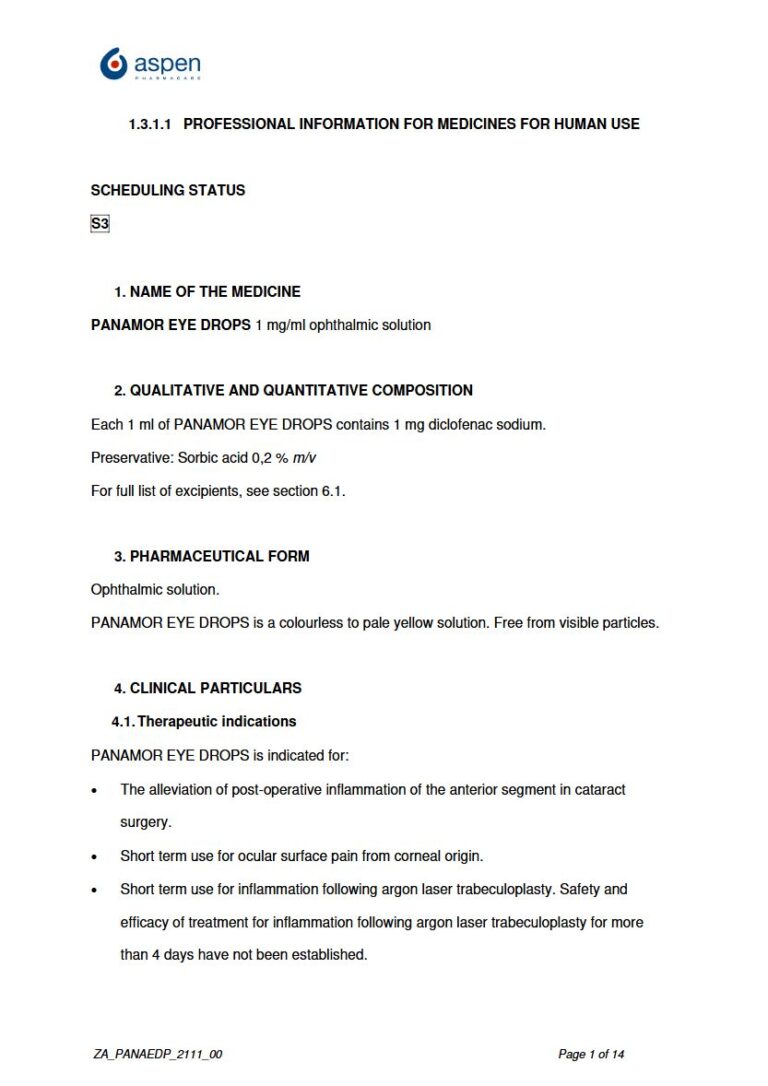
4.1. Therapeutic indications
PANAMOR EYE DROPS is indicated for:
- The alleviation of post-operative inflammation of the anterior segment in cataract surgery.
- Short term use for ocular surface pain from corneal origin.
- Short term use for inflammation following argon laser trabeculoplasty. Safety and efficacy of treatment for inflammation following argon laser trabeculoplasty for more than 4 days have not been established.
4.2. Posology and method of administration
Posology
Adults
The dose is governed by the severity of the condition.
Pre-operatively: up to 5 drops during 3 hours before surgery.
Post-operatively: 3 drops after surgery. Thereafter, instil one drop into the conjunctival sac, 4 to 5 times daily.
Other indications: 1 drop 4 to 5 times daily depending on the severity of the condition.
Paediatric population
The use of PANAMOR EYE DROPS has not been studied in young children.
Method of administration
Instillation into the conjunctival sac (see section 4.4).
4.3. Contraindications
PANAMOR EYE DROPS is contraindicated in:
- Patients with hypersensitivity to diclofenac sodium or to any excipients in PANAMOR EYE DROPS (see section 6.1).
- In patients wearing soft contact lenses.
- In patients hypersensitive to aspirin, NSAIDs or other prostaglandin synthetase inhibitors.
- In patients in whom attacks of asthma, urticaria or acute rhinitis are precipitated by aspirin or by other medicines with prostaglandin synthetase inhibiting activity.
- In young children.
- Intraocular use of PANAMOR EYE DROPS during surgical procedures.
- In patients with heart failure, established ischaemic heart disease and/or cerebrovascular disease (stroke) and peripheral arterial disease.
- In patients with a history of gastrointestinal perforation, ulceration or bleeding (PUBs) related to previous NSAIDs, including PANAMOR EYE DROPS.
- In patients with an active or a history of recurrent ulcer/ haemorrhage/ perforations.
- Lactation (see section 4.6).
- Pregnant women from around 20 weeks of gestation or later in pregnancy (see section 4.4 and 4.6).
4.4. Special warnings and precautions for use
Ocular effects
Diclofenac, as in PANAMOR EYE DROPS, has been implicated in reports of corneal toxicity. Ulceration of the conjunctiva or cornea, corneal or scleral melts and perforations have been reported, particularly after cataract surgery.
Caution is advised in patients with risk factors to corneal ulceration and thinning, such as with corticosteroid use or with concomitant diseases, such as infections or rheumatoid arthritis.
Diclofenac sodium, as in PANAMOR EYE DROPS, has been associated with corneal ulcer or thinning. Most patients were treated for a prolonged period of time.
Following instillation of PANAMOR EYE DROPS, nasolacrimal occlusion or closing the eyes for 3 minutes may reduce the systemic absorption. This may result in a decrease in systemic side effects and an increase in local activity.
An interval of at least five minutes between the application of PANAMOR EYE DROPS and the different medicines must be allowed.
The anti-inflammatory action of PANAMOR EYE DROPS may mask the onset and/or progression of ocular infections. In the presence of infection, or if there is a risk of infection, appropriate therapy should be given concurrently with PANAMOR EYE DROPS.
Haematological effects
With some non-steroidal anti-inflammatory medicines (NSAIDs), there exists the potential for increased bleeding time due to interference with thrombocyte aggregation. There have been reports that ocularly applied non-steroidal anti-inflammatory medicines (of which class PANAMOR EYE DROPS belongs to), may cause increased bleeding of ocular tissues (including hyphemas) in conjunction with ocular surgery.
It is recommended that PANAMOR EYE DROPS be used with caution in patients with known haemostatic defects or bleeding tendencies, or who are receiving other medicines which may prolong bleeding time (see section 4.5).
Use with topical steroids
Caution should be exercised when topical NSAIDs such as diclofenac, as in PANAMOR EYE DROPS, are used concomitantly with topical steroids (see section 4.5).
Cardiovascular effects
Caution is required in patients with a history of hypertension and/or heart failure as fluid retention and oedema have been reported in association with diclofenac sodium, as in PANAMOR EYE DROPS therapy. In view of PANAMOR EYE DROPS inherent potential to cause fluid retention, heart failure may be precipitated in some compromised patients.
Caution is required in patients with significant risk factors for cardiovascular events (e.g., hypertension, hyperlipidaemia, diabetes mellitus, smoking).
Gastrointestinal effects
The risk of gastrointestinal perforation, ulceration or bleeding (PUBs) is higher with increasing doses of PANAMOR EYE DROPS, in patients with a history of ulcers, and the elderly.
When gastrointestinal bleeding or ulceration occurs in patients receiving PANAMOR EYE DROPS, treatment with PANAMOR EYE DROPS should be stopped.
PANAMOR EYE DROPS should be given with caution to patients with a history of gastrointestinal disease (e.g., ulcerative colitis, Crohnu2019s disease, hiatus hernia, gastro - oesophageal reflux disease, angiodysplasia) as the condition may be exacerbated.
Elderly
The elderly has an increased frequency of adverse reactions to NSAIDs including diclofenac sodium, as in PANAMOR EYE DROPS, especially gastrointestinal perforation, ulceration and bleeding (PUBs) which may be fatal.
Skin reactions
Stevens-Johnson Syndrome and Toxic Epidermal Necrolysis
Serious skin reactions, some of them fatal, including exfoliative dermatitis, Stevens-Johnson Syndrome (SJS), and Toxic Epidermal Necrolysis (TEN) have been reported. PANAMOR EYE DROPS should be discontinued at the first appearance of skin rash, mucosal lesions, or any other sign of hypersensitivity.
Drug reaction with eosinophillia and systemic symptoms
Drug reaction with eosinophillia and systemic symptoms (DRESS) has been reported in patients taking NSAIDs such as PANAMOR EYE DROPS. Some of these events have been fatal or life-threatening. DRESS typically, although not exclusively, presents with fever, rash, lymphadenopathy, and/or facial swelling. Other clinical manifestations may include hepatitis, nephritis, haematological abnormalities, myocarditis, or myositis. Sometimes symptoms of DRESS may resemble an acute viral infection. Eosinophillia is often present. Because this disorder is variable in its presentation, other organ systems not noted here may be involved. It is important to note that early manifestations of hypersensitivity, such as fever or lymphadenopathy, may be present even though rash is not evident. If such signs or symptoms are present, discontinue PANAMOR EYE DROPS and evaluate the patient immediately.
4.5. Interaction with other medicines and other forms of interaction
Topical steroids
Concomitant use of PANAMOR EYE DROPS and topical steroids in patients with significant pre-existing corneal inflammation may increase the risk of developing corneal complications, therefore caution should be used (see section 4.4).
All topical NSAIDs, such as PANAMOR EYE DROPS, may slow or delay healing. Topical corticosteroids may also slow or delay healing. Concomitant use of PANAMOR EYE DROPS together with a topical steroid may increase the potential for healing problems.
Other NSAIDs
Use of two or more NSAIDs, such as PANAMOR EYE DROPS, concomitantly could result in an increase in side effects.
Corticosteroids
Increased risk of gastrointestinal perforation, ulceration or bleeding (PUBs).
Anti-coagulants
PANAMOR EYE DROPS may enhance the effects of anti-coagulants such as warfarin.
Anti-platelet medicines
Increased risk of gastrointestinal bleeding. It is recommended that PANAMOR EYE DROPS be used with caution in patients with known bleeding tendencies or who are receiving other medicines which may prolong bleeding time (see section 4.4).
Acetylcholine and carbachol ophthalmic preparations
There have been reports that acetylcholine and carbachol ophthalmic preparations have been ineffective when used in patients treated with ophthalmic NSAIDs, such as PANAMOR EYE DROPS.
Selective serotonin reuptake inhibitors (SSRIs)
Increased risk of gastrointestinal bleeding.
4.6. Fertility, pregnancy and lactation
Pregnancy
It is recommended that PANAMOR EYE DROPS is avoided in pregnant women at 20 weeks or later in pregnancy (see section 4.3 and 4.4).
Breastfeeding
Diclofenac, as in PANAMOR EYE DROPS, is excreted in breastmilk. However, at therapeutic doses of PANAMOR EYE DROPS no effects on the suckling child are anticipated. Use of PANAMOR EYE DROPS is not recommended during breastfeeding (see section 4.3).
Fertility
There is no data available regarding PANAMOR EYE DROPS and fertility.
4.7. Effects on ability to drive and use machines
PANAMOR EYE DROPS has minor influence on the ability to drive or use machines. Since adverse reactions such as blurred vision and other ocular reactions have been reported in patients receiving PANAMOR EYE DROPS, patients should not drive, use machinery or perform any tasks that require concentration, until they are certain that PANAMOR EYE DROPS does not adversely affect their ability to do so (see section 4.4).
4.8. Undesirable effects
a) Summary of the safety profile
The most frequently observed adverse events for NSAIDs, such as diclofenac sodium, as in PANAMOR EYE DROPS, are gastrointestinal in nature.
b) Tabulated list of adverse reactions
System organ class Frequent Less frequent Frequency unknown (cannot be estimated from the available data)
Immune system disorders Systemic hypersensitivity reactions such as urticaria, rash, eczema, erythema, pruritus, cough, rhinitis.
Eye disorders Mild transient burning sensation and stinging, Hypersensitivity reactions with eye itching, reddening, photosensitivity, ocular hyperaemia, blurred vision immediately after installation of the eye drop. Ulceration of the conjunctiva or cornea, corneal or sclera melts and perforations, corneal disorders, punctuate keratitis, corneal thinning, corneal epithelium defect, corneal oedema, transient eye pain, mild to moderate eye irritation. allergic conditions for ocular reactions such as conjunctival hyperaemia, allergic conjunctivitis, eyelid erythema, oedema and pruritus.
Cardiac disorders Oedema, hypertension, cardiac failure.
Respiratory, thoracic and mediastinal disorders Dyspnoea, exacerbation of asthma.
Gastrointestinal disorders Peptic ulcers, perforation or gastrointestinal bleeding, sometimes fatal; nausea, vomiting, diarrhoea, flatulence, constipation, dyspepsia, abdominal pain, melaena, haematemesis, ulcerative stomatitis, exacerbation of colitis and Crohnu2019s disease, gastritis.
Skin and subcutaneous tissue disorders Bullous reactions, including Stevens-Johnson syndrome and toxic epidermal necrolysis, Drug Reaction with Eosinophillia and Systemic Symptoms (DRESS) (see section 4.4).
c) Description of selected adverse reactions
Eye disorders Punctate keratitis or corneal disorders have been observed, usually after frequent application. In patients with risk factors of corneal disorders such as during the use of corticosteroids or with concomitant diseases such as infections or rheumatoid arthritis, diclofenac, as in PANAMOR EYE DROPS, has been associated with ulcerative keratitis, corneal thinning, punctuate keratitis, corneal epithelium defect and corneal oedema, which might become sight-threatening. Patients were treated for a prolonged period of time (see section 4.4).
Reporting of suspected adverse reactions
Reporting suspected adverse reactions after authorisation of the medicine is important. It allows continued monitoring of the benefit/risk balance of the medicine. Healthcare providers are asked to report any suspected adverse reactions to: SAHPRA: https://www.sahpra.org.za/health-products-vigilance/ Aspen Pharmacare: E-mail: [email protected] Tel: 0800 118 088
4.9. Overdose
Symptoms
Overdosage will not ordinarily cause acute problems. There is practically no risk of adverse effects due to accidental oral ingestion, since a 5 ml bottle of PANAMOR EYE DROPS contains only 5 mg of diclofenac sodium, corresponding to about 3 % of the recommended maximum daily adult dose of diclofenac sodium after oral administration. By way of comparison, the maximum oral daily dose for diclofenac sodium recommended in children is 2 mg/kg body weight.
Treatment
If PANAMOR EYE DROPS are accidently ingested, fluids should be taken to dilute the medicine. Treatment is supportive and symptomatic.
