
Dobutamine Fresenius 250 Mg/20 Ml Solution
PDF Leaflet Revision Date: 19 April 2022
Clinical Summary
Quick overview from the medicine insert
Indication
Inotropic support in heart failure.
Dosage (summary)
IV infusion: 2.5 to 10 u03bcg/kg/min, adjust based on response.
Onset of Action / Duration
Onset: 1-2 mins, Duration: 2 mins
Special Populations
- Pregnancy
- Lactation
- Children
Pregnancy & Breastfeeding
Not established; use with caution.
Key Drug Interactions
- Beta-blockers
- Halogenated anaesthetics
- Entacapone
Contraindications
- Hypersensitivity
- Marked obstruction of cardiac ejection
- Phaeochromocytoma
Common side effects
- Tachycardia
- Anginal pain
- Headache
- Hypokalaemia
Counselling Points
- Report any allergic reactions
- Monitor heart rate and blood pressure
- Gradually discontinue treatment
Serious warnings
- May exacerbate ventricular dysrhythmias
- Caution in myocardial infarction
- Monitor blood pressure closely
Important Disclaimer
The Dobutamine Fresenius 250 Mg/20 Ml Solution professional information leaflet below is the property of Fresenius Kabi South Africa and is provided on Medinsert exactly as issued, with no.. alterations or editorial changes. We make every effort to keep content current by updating documents as soon as new versions become available. Medinsert serves as a trusted access point for healthcare professionals, but does not replace official sources or clinical judgement. For more details, please read our full disclaimer. read more>>
 Healthcare Professionals Only
This content is for registered healthcare professionals
Sign in or create a free account to read the full package insert.
Free for HPCSA-registered professionals. Powered by Medinsert.
Clinical Particulars
Section 4 of the official insert — extracted exactly as issued, no alterations
4.1 Therapeutic indications
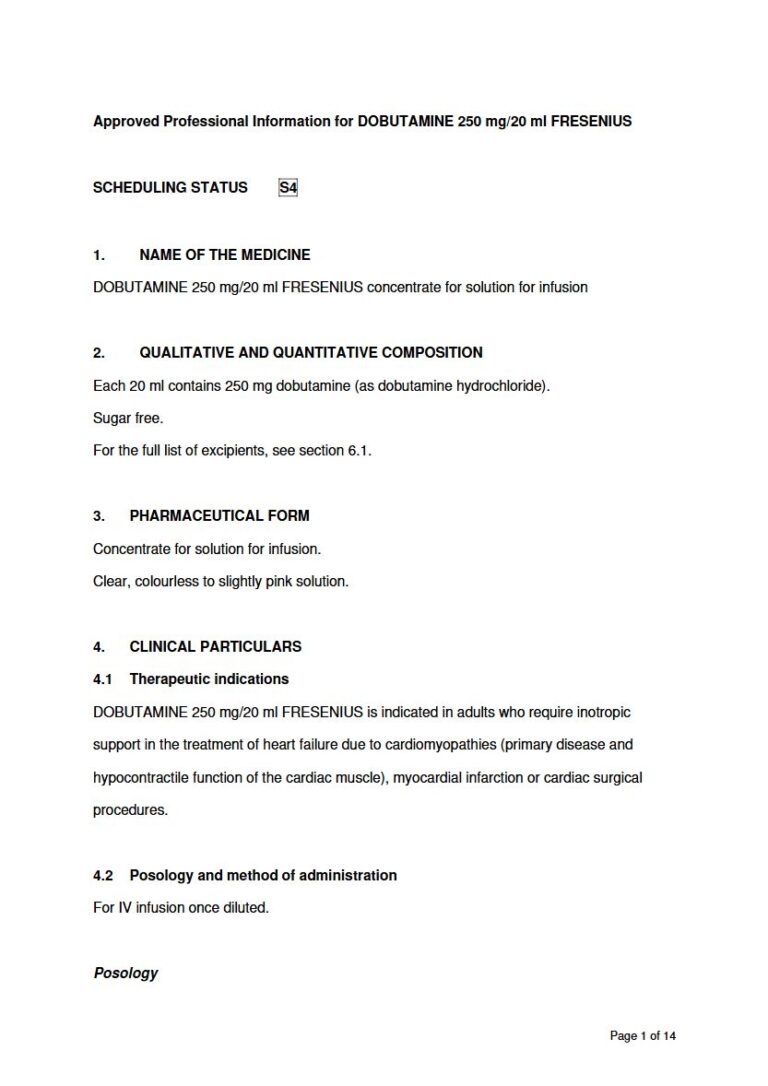
DOBUTAMINE 250 mg/20 ml FRESENIUS is indicated in adults who require inotropic support in the treatment of heart failure due to cardiomyopathies (primary disease and hypocontractile function of the cardiac muscle), myocardial infarction or cardiac surgical procedures.
4.2 Posology and method of administration
For IV infusion once diluted. Posology The usual rate is 2,5 to 10 u03bcg per kg body weight per minute, according to the patientu2019s heart rate, blood pressure, cardiac output, and urine output. A range of 0,5 up to 40 u03bcg per kg per minute has occasionally been required. It is recommended that treatment with DOBUTAMINE 250 mg/20 ml FRESENIUS should be discontinued gradually. DOBUTAMINE 250 mg/20 ml FRESENIUS is administered by intravenous infusion as a dilute solution in:
- glucose 5 %
- glucose 5 % with sodium chloride 0,45 % or 0,9 %
- sodium chloride 0,9 %
- sodium lactate 1,85 %
Note: Do not add DOBUTAMINE 250 mg/20 ml FRESENIUS to 5 % sodium bicarbonate injection or any other strong alkaline solutions. DOBUTAMINE 250 mg/20 ml FRESENIUS should not be used other agents or diluents containing sodium metabisulphite and ethanol.
Method of administration DOBUTAMINE 250 mg/20 ml FRESENIUS must be further diluted with sterile water for injection or 5 % dextrose injection to at least 50 ml prior to administration using the media as listed above. Intravenous solutions for administration should be used within 24 hours. Discard any unused portion. Solutions containing DOBUTAMINE 250 mg/20 ml FRESENIUS may exhibit a slightly pink colour which, if present, will increase in time. This colour change is due to slight oxidation, but there is no significant loss of potency during the periods of reconstitution stated above.
4.3 Contraindications
- Hypersensitivity to dobutamine, sodium metabisulphite or to any of the other excipients (see section 6.1).
- Patients with marked obstruction of cardiac ejection, such as idiopathic hypertrophic subaortic stenosis.
- Pregnancy, lactation and children.
- Phaeochromocytoma.
4.4 Special warnings and precautions for use
Dobutamine may precipitate or exacerbate ventricular ectopic activity; rarely, it has caused ventricular tachycardia or fibrillation. DOBUTAMINE 250 mg/20 ml FRESENIUS acts primarily on u03b2 1 receptors and may produce hypertension, tachycardia and ectopic heartbeats. Dysrhythmias may be precipitated; it is claimed that dobutamine causes a lower incidence of dysrhythmias compared with isoprenaline and dopamine. If rapid ventricular rates occur in the presence of obstructive coronary artery disease, ischaemia may be induced and worsened. Dobutamine may cause a marked increase in heart rate or systolic blood pressure. Reduction of dosage usually reverses these effects promptly. Because dobutamine facilitates atrioventricular conduction, patients with atrial fibrillation may be at risk of developing a rapid ventricular response. If DOBUTAMINE 250 mg/20 ml FRESENIUS should cause serious ventricular dysrhythmia, uncontrolled by lidocaine, its infusion should be reduced or temporarily stopped. The infusion should be reduced or temporarily stopped if an undue rise in sinus rate or systolic blood pressure occurs. Particular care should be exercised when DOBUTAMINE 250 mg/20 ml FRESENIUS is used in patients with acute myocardial infarction, especially with widespread coronary artery disease, because any significant increases in heart rate that occur may intensify ischaemia and cause anginal pain and ST segment elevation. DOBUTAMINE 250 mg/20 ml FRESENIUS does not improve haemodynamics in most patients with mechanical obstruction that hinders either ventricular filling or outflow, or both. Inotropic response may be inadequate in patients with markedly reduced ventricular compliance. Such conditions are present in cardiac tamponade, valvular aortic stenosis, and idiopathic hypertrophic subaortic stenosis. Minimal vasoconstriction has been observed, most notably in patients recently treated with u03b2 -blocking agents. Because the inotropic effect of DOBUTAMINE 250 mg/20 ml FRESENIUS stems from stimulation of cardiac u03b21 receptors, this effect is prevented by u03b2 - blocking agents. However, dobutamine has been shown to counteract the cardiodepressive effects of u03b2 - blockers. Conversely, adrenergic blockade may make the u03b21 and u03b22 effects apparent, resulting in tachycardia and vasodilatation. During the administration of DOBUTAMINE 250 mg/20 ml FRESENIUS, as with any parenteral catecholamine, heart rate and rhythm, arterial blood pressure and infusion rate should be monitored closely. When initiating therapy, electrocardiographic monitoring is advisable until a stable response is achieved. Precipitous decreases in blood pressure have occasionally been described in association with DOBUTAMINE 250 mg/20 ml FRESENIUS therapy. Decreasing the dose or discontinuing the infusion typically results in rapid return of blood pressure to base-line values, but rarely intervention may be required, and reversibility may not be immediate. DOBUTAMINE 250 mg/20 ml FRESENIUS should be used with caution in the presence of severe hypotension complicating cardiogenic shock (mean arterial pressure less than 70 mm Hg). DOBUTAMINE 250 mg/20 ml FRESENIUS may exacerbate pre-existing tachycardia and hypertension; patients with arterial fibrillation should be given digoxin before dobutamine treatment to reduce the risk of enhanced atrioventricular conduction leading to ventricular fibrillation. DOBUTAMINE 250 mg/20 ml FRESENIUS should be used with caution during anaesthesia with halogenated anaesthetics. The inotropic effects of dobutamine on the heart are reversed by concomitant administration of u03b2 -blockers. DOBUTAMINE 250 mg/20 ml FRESENIUS may be ineffective or may have a slight vasoconstricting effect in patients who have recently received u03b2 -blockers. Hypovolaemia, if present, should be corrected with suitable volume expanders before patients receive DOBUTAMINE 250 mg/20 ml FRESENIUS. If arterial blood pressure remains low or decreases progressively during administration of DOBUTAMINE 250 mg/20 ml FRESENIUS despite adequate ventricular filling pressure and cardiac output, consideration may be given to the concomitant use of a peripheral vasoconstrictor agent, such as dopamine or noradrenaline. DOBUTAMINE 250 mg/20 ml FRESENIUS contains sodium metabisulphite, which may cause allergic-type reactions, including anaphylactic symptoms and life-threatening or less severe asthmatic episodes in susceptible patients. Sulphite sensitivity occurs more frequently in asthmatic than non-asthmatic people.
4.5 Interaction with other medicines and other forms of interaction
Halogenated anaesthetics Although it is less likely than adrenaline to cause ventricular dysrhythmias, DOBUTAMINE 250 mg/20 ml FRESENIUS should be used with great caution during anaesthesia with cycloproprane, halothane and other halogenated anaesthetics.
Entacapone The effects of DOBUTAMINE 250 mg/20 ml FRESENIUS may be enhanced by entacapone.
Beta-blockers The inotropic effect of dobutamine, as in DOBUTAMINE 250 mg/20 ml FRESENIUS, stems from stimulation of cardiac u03b2 1 receptors; this effect is reversed by concomitant administration of u03b2 -blockers. Dobutamine has been shown to counteract the effect of u03b2 -blockers. In therapeutic doses, dobutamine has mild u03b1 1- and u03b2 2-agonist properties. Concurrent administration of a non-selective u03b2 -blocker such as propranolol can result in elevated blood pressure, due to u03b1 -mediated vasoconstriction, and reflex bradycardia. u03b2 -blockers that also have u03b1 -blocking effects, such as carvedilol, may cause hypotension during concomitant use of dobutamine due to vasodilatation caused by u03b2 2 predominance (see section 4.4).
4.6 Fertility, pregnancy and lactation
Safety and/or efficacy has not been established in pregnancy and breastfeeding.
4.7 Effects on ability to drive and use machines
Not applicable in view of the indications for use and the short half-life of dobutamine.
4.8 Undesirable effects
Since the half-life of dobutamine is only about 2 minutes, most adverse effects can be corrected by discontinuing or reducing the rate of infusion.
Blood and lymphatic system disorders Frequent: Eosinophilia, inhibition of thrombocyte aggregation (only when continuing infusion over a number of days).
Immune system disorders Frequency unknown: Hypersensitivity reactions, including rash, fever, eosinophilia and bronchospasm. Anaphylactic reactions and severe life-threatening asthmatic episodes may be due to sulphite sensitivity (see section 4.4).
Metabolism and nutrition disorders Less frequent: Hypokalaemia.
Psychiatric disorders Frequency unknown: Restlessness, feeling of heat and anxiety.
Nervous system disorders Frequent: Headache. Frequency unknown: Paraesthesia, tremor, myoclonic spasm. Myoclonus in patients suffering from severe renal failure.
Cardiac disorders Frequent: Increase of the heart rate by u2265 30 beats/min. Anginal pain, non-specific chest pain, palpitations. Less frequent: Ventricular tachycardia or ectopic heartbeats, increased ventricular rate (in patients with pre-existing atrial fibrillation), ventricular fibrillation, bradycardia, myocardial ischaemia, myocardial infarction, cardiac arrest. Frequency unknown: Electrocardiogram ST segment elevation, decrease in pulmonary capillary pressure, eosinophilic myocarditis.
Vascular disorders Frequent: Blood pressure increase of u2265 50 mm Hg (patients suffering from arterial hypertension are more likely to have a higher blood pressure increase). Blood pressure decrease, ventricular dysrhythmia, dose-dependent ventricular extrasystoles. Increased ventricular frequency in patients with atrial fibrillation. These patients should be digitalised prior to dobutamine infusion. Vasoconstriction in particular in patients who have previously been treated with u03b2 -receptor blockers. Less frequent: Hypotension. Frequency unknown: Patients with pre-existing hypertension may exhibit an exaggerated pressor response.
Respiratory, thoracic and mediastinal disorders Frequent: Shortness of breath.
Gastrointestinal disorders Frequency unknown: Nausea, vomiting.
Musculoskeletal and connective tissue disorders Less frequent: Leg cramps.
Renal and urinary disorders Frequency unknown: Urinary urgency.
Reporting of suspected adverse reactions Healthcare providers are asked to report any suspected adverse drug reactions to the Holder of the Certificate of Registration at the following email address: [email protected] and to the relevant medicineu2019s regulatory authority in the country where the product is marketed. Reporting suspected adverse reactions after authorisation of DOBUTAMINE 250 mg/20 ml FRESENIUS is important. It allows continued monitoring of the benefit/risk balance of DOBUTAMINE 250 mg/20 ml FRESENIUS. Healthcare providers are asked to report any suspected adverse reactions via the u201cAdverse Drug Reaction Reporting Formu201d, found online under SAHPRAu2019s publications: https://www.sahpra.org.za/Publications/Index/8.
4.9 Overdose
Symptoms Overdoses of dobutamine have been reported rarely. The symptoms of toxicity may include anorexia, nausea, vomiting, tremor, anxiety, palpitations, headache, shortness of breath and anginal and non-specific chest pain. The positive inotropic and chronotropic effects of dobutamine may cause hypertension, tachydysrhythmias, myocardial ischaemia and ventricular fibrillation. Hypotension may result from vasodilatation.
Treatment Treatment is symptomatic and supportive. The duration of action of dobutamine is generally short (half-life approximately 2 minutes). DOBUTAMINE 250 mg/20 ml FRESENIUS should be temporarily discontinued until the patient's condition stabilises. The patient should be monitored, and any appropriate resuscitative measures initiated promptly. Forced diuresis, peritoneal dialysis, haemodialysis, or charcoal haemoperfusion have not been established as beneficial. If DOBUTAMINE 250 mg/20 ml FRESENIUS is ingested, unpredictable absorption may occur from the mouth and gastrointestinal tract.
