
Zepanalz 5 mg or 10 mg Tablet
PDF Leaflet Revision Date: 26/02/2021
Clinical Summary
Quick overview from the medicine insert
Indication
Symptomatic treatment of mild to moderate dementia in Alzheimer's disease.
Dosage (summary)
5 mg once daily, may increase to 10 mg after 4-6 weeks.
Onset of Action / Duration
Onset: 3-4 hours, Duration: Steady-state in 3 weeks.
Special Populations
- Renal impairment
- Hepatic impairment
Pregnancy & Breastfeeding
Safety not established; use with caution.
Key Drug Interactions
- CYP3A4 inhibitors
- Anticholinergics
- Cholinomimetics
Contraindications
- Hypersensitivity to donepezil
- Children
Common side effects
- Nausea
- Diarrhea
- Dizziness
- Insomnia
Counselling Points
- Monitor weight
- Assess driving ability
- Take with or without food
Serious warnings
- Monitor for therapeutic benefit
- Risk of bradycardia
- Potential for gastrointestinal bleeding
Important Disclaimer
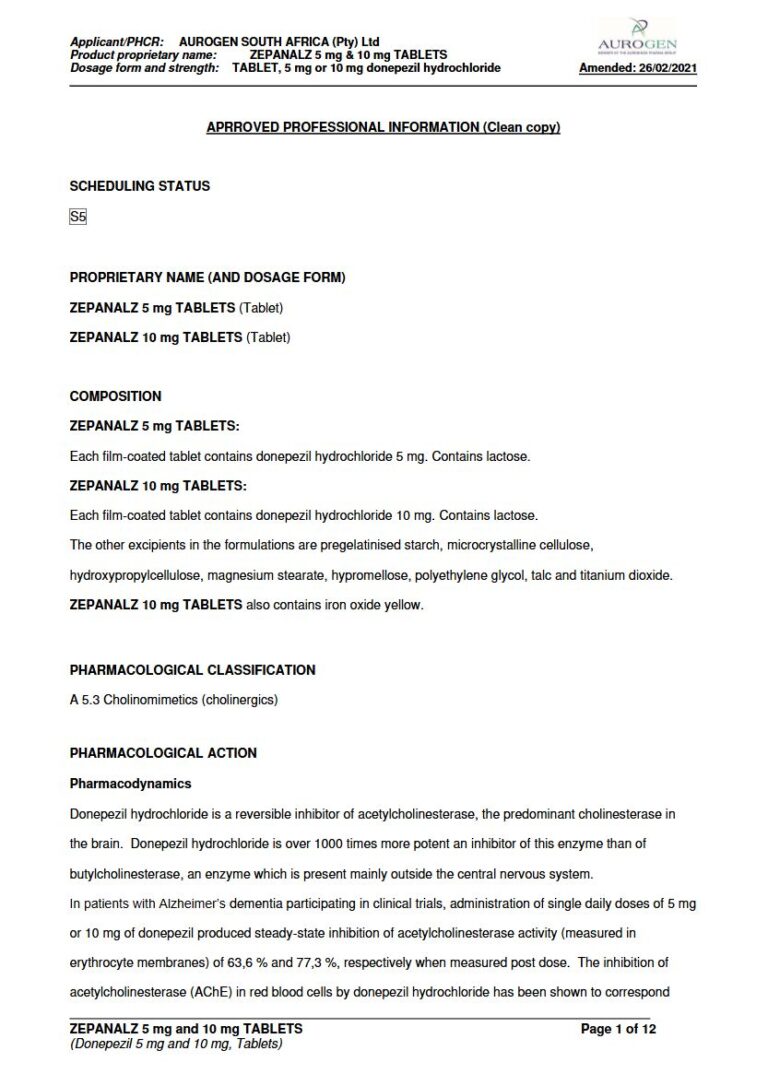
The Zepanalz 5 mg or 10 mg Tablet professional information leaflet below is the property of Aurogen South Africa and is provided on Medinsert exactly as issued, with no.. alterations or editorial changes. We make every effort to keep content current by updating documents as soon as new versions become available. Medinsert serves as a trusted access point for healthcare professionals, but does not replace official sources or clinical judgement. For more details, please read our full disclaimer. read more>>
 Healthcare Professionals Only
This content is for registered healthcare professionals
Sign in or create a free account to read the full package insert.
Free for HPCSA-registered professionals. Powered by Medinsert.
Clinical Particulars
Section 4 of the official insert — extracted exactly as issued, no alterations
4.1 Therapeutic indications
ZEPANALZ TABLETS are indicated for the symptomatic treatment of mild or moderate dementia in Alzheimeru2019s disease.
4.2 Posology and method of administration
Adults/Elderly: The recommended dosages of ZEPANALZ TABLETS are 5 mg and 10 mg administered once daily. Although there is no statistically significant evidence that a greater treatment effect is obtained from the use of the 10 mg dose, there is a suggestion, based on analysis of group data that some additional benefits may accrue to some patients from the use of the higher dose. Treatment is initiated at 5 mg/day (once-a-day dosing). The 5 mg/day dose should be maintained for at least 4 u2013 6 weeks in order to allow the earliest clinical responses to treatment to be assessed and to allow steady-state concentrations of donepezil hydrochloride to be achieved. Following a one-month clinical assessment of treatment at 5 mg/day, the dose of ZEPANALZ TABLETS can be increased to 10 mg/day (once-a-day dosing). The maximum recommended daily dose is 10 mg. Doses greater than 10 mg/day have not been studied in clinical trials. Upon discontinuation of treatment, a gradual abatement of the beneficial effects of ZEPANALZ TABLETS is seen. After abrupt discontinuation of therapy, there is no evidence of a rebound effect.
Renal and Hepatic Impairment: A similar dose schedule can be followed for patients with renal or mild to moderate hepatic impairment as clearance of donepezil hydrochloride is not affected by these conditions.
4.3 Contraindications
ZEPANALZ TABLETS is contra-indicated in patients with a known hypersensitivity to donepezil hydrochloride, piperidine derivatives, or to any excipients used in the formulation. The safety and efficacy of ZEPANALZ TABLETS has not been established in children; therefore it is not recommended for use in children.
4.4 Special warnings and precautions for use
Treatment should be initiated by a doctor experienced in the treatment of Alzheimeru2019s dementia. Maintenance treatment can be continued for as long as a therapeutic benefit for the patient exists. Therefore, the clinical benefit of ZEPANALZ TABLETS should be reassessed on a regular basis. When evidence of a therapeutic effect is no longer present, discontinuation should be considered. Individual response to ZEPANALZ TABLETS cannot be predicted.
The use of ZEPANALZ TABLETS in patients with severe dementia, other types of dementia or other types of memory impairment (e.g. age related cognitive decline), has not been established.
Anaesthesia: ZEPANALZ TABLETS, as a cholinesterase inhibitor, is likely to exaggerate succinylcholine-type muscle relaxation during anaesthesia.
Cardiovascular Conditions: Due to their pharmacological action, ZEPANALZ TABLETS may have vagotonic effects on heart rate (e.g. bradycardia). The potential for this action may be particularly important to patients with u201csick sinus syndromeu201d or other supraventricular cardiac conduction conditions such as sinoatrial or atrioventricular block. Syncopal episodes have been reported in association with the use of donepezil.
Gastrointestinal Conditions: Gastric acid production may be promoted by ZEPANALZ TABLETS. Therefore patients should be monitored closely for symptoms of active or occult gastrointestinal bleeding, especially those at increased risk of developing ulcers e.g. those with a history of ulcer disease or those receiving concurrent non-steroidal anti-inflammatory drugs (NSAIDs). Donepezil, as a predictable consequence of its pharmacological properties, has been shown to produce diarrhoea, nausea and vomiting. These effects, when they occur, appeared more frequently with the 10 mg/day dose than with the 5 mg/day dose. In most cases, these effects have been mild and transient, sometimes lasting one to three weeks, and have resolved during continued use of donepezil.
Genitourinary: ZEPANALZ TABLETS may cause bladder outflow obstruction.
Neurological Conditions: ZEPANALZ TABLETS are believed to have some potential to cause generalised convulsions. However, seizure activity may also be a manifestation of Alzheimeru2019s disease.
Pulmonary Conditions: Due to their cholinomimetic actions, ZEPANALZ TABLETS should be prescribed with care to patients with a history of asthma or obstructive pulmonary disease. The administration of ZEPANALZ TABLETS concomitantly with other inhibitors of acetylcholinesterase, agonists or antagonists of the cholinergic system should be avoided.
Patients recovering from bladder or gastrointestinal surgery: ZEPANALZ TABLETS use is not recommended in patients recovering from bladder or gastrointestinal surgery.
4.5 Interactions with other medicines
Medicines Highly Bound to Plasma Proteins: Medicine displacement studies have been performed in vitro between this highly bound medicine (96 %) and other medicines such as furosemide, digoxin and warfarin. ZEPANALZ TABLETS at concentrations of 0,3 - 10 u03bcg/ml does not affect the binding of furosemide (5 u03bcg/ml), digoxin (2 u03bcg/ml), and warfarin (3 u03bcg/ml) to human albumin. Similarly, the binding of ZEPANALZ TABLETS to human albumin is not affected by furosemide, digoxin and warfarin.
Effect of ZEPANALZ TABLETS on the Metabolism of Other Medicines: No in vivo clinical trials have investigated the effect of ZEPANALZ TABLETS on the clearance of medicines metabolised by CYP3A4 (e.g. cisapride) or by CYP2D6 (e.g. imipramine). However, in vitro studies show a low rate of binding to these enzymes (mean Ki about 50 - 130 u03bcM), that, given the therapeutic plasma concentrations of donepezil (164 nM), indicates little likelihood of interference. Whether ZEPANALZ TABLETS has any potential for enzyme induction is not known. Donepezil hydrochloride and/or any of its metabolites do not inhibit the metabolism of theophyline, warfarin, cimetidine, digoxin, thioridazine, risperidone and sertraline in humans. In a study of Parkinsonu2019s disease patients on optimal treatment with L-dopa/carbidopa, administration of donepezil for 21 days had no effects on L-dopa or carbidopa blood levels. In this study, no effects on motor activity were observed.
Effects of Other Medicines on the Metabolism of ZEPANALZ TABLETS: Ketoconazole and quinidine, inhibitors of CYP450, 3A4 and 2D6, respectively, inhibit donepezil metabolism in vitro. Therefore these and other CYP3A4 inhibitors, such as itraconazole and erythromycin, and CYP2D6 inhibitors, such as fluoxetine could inhibit the metabolism of donepezil. Whether there is a clinical effect of these inhibitors is not known. In a study in healthy volunteers, ketoconazole increased mean donepezil concentrations by 30 %. These increases are smaller than those produced by ketoconazole for other agents sharing the CYP-3A4 pathway and are not likely to be clinically relevant. Administration of donepezil had no effect on the pharmacokinetics of ketoconazole.
Inducers of CYP2D6 and CYP3A4 (e.g. phenytoin, carbamazepine, alcohol, dexamethasone, rifampicin and phenobarbital) could increase the rate of elimination of ZEPANALZ TABLETS. Formal pharmacokinetic studies demonstrated that the metabolism of donepezil is not significantly affected by concurrent administration of digoxin, cimetidine, thioridazine, risperidone or sertraline.
Use with anticholinergics: ZEPANALZ TABLETS have the potential to interfere with the activity of anticholinergic medications, because of their mechanism of action.
Use with Cholinomimetics and other Cholinesterase Inhibitors: A synergistic effect may be expected when ZEPANALZ TABLETS are given concurrently with succinylcholine, similar neuromuscular blocking agents or cholinergic agonists such as bethanechol or beta blocking agents which have an effect on cardiac conduction, but an in vitro study showed that donepezil hydrochloride had minimal effects on hydrolysis of succinylcholine.
4.6 Fertility, pregnancy and lactation
The safety of ZEPANALZ TABLETS in pregnancy and lactation has not been established.
4.7 Effects on ability to drive and use machines
Dementia may cause impairment of driving performance or compromise the ability to use machinery. Furthermore, ZEPANALZ TABLETS can induce fatigue, dizziness and muscle cramps, mainly when initiating or increasing the dose. The treating doctor should routinely evaluate the ability of patients on ZEPANALZ TABLETS to continue driving or operating complex machines.
4.8 Undesirable effects
Side-effects: Infections and infestations: Frequent: Common cold, influenza
Metabolism and nutrition disorders: Less frequent: Dehydration, hyponatraemia
Psychiatric disorders: Frequent: Insomnia, abnormal dreams, agitation, delusions, depression, hallucinations Less frequent: Abnormal crying, aggressive behaviour, increased libido, irritability, nervousness, restlessness, confusion
Nervous system disorders: Frequent: Dizziness, headache, somnolence Less frequent: Aphasia, ataxia, paraesthaesia, syncope, tremor, seizure, extrapyramidal symptoms
Eye disorders: Less frequent: Cataract, eye irritation, blurred vision
Ear and labyrinth disorders: Less frequent: Vertigo
Cardiac disorders: Less frequent: Atrioventricular block, bradycardia, sinoatrial block, angina
Vascular disorders: Less frequent: Hot flushes, hypertension, hypotension, vasodilation
Respiratory, thoracic and mediastinal disorders: Less frequent: Dyspnoea, sore throat, bronchitis
Gastrointestinal disorders: Frequent: Diarrhoea, nausea, vomiting, anorexia, pancreatitis, faecal incontinence, abdominal disturbance Less frequent: Gastrointestinal haemorrhage, epigastric pain, bloating, toothache, duodenal ulcer, gastric ulcer
Hepato-biliary disorders: Less frequent: Hepatitis
Skin and subcutaneous tissue disorders: Less frequent: Diaphoresis, ecchymosis, pruritus, urticaria, rash
Musculoskeletal, connective tissue and bone disorders: Frequent: Muscle cramps, arthritis
Renal and urinary disorders: Frequent: Frequent urination Less frequent: Nocturia, urinary incontinence, urinary tract infection
General disorders and administrative site conditions: Frequent: Fatigue, pain Less frequent: Chest pain
Investigations: Frequent: Weight decrease Less frequent: Minor increases in serum concentrations of creatine kinase, increased liver transaminases
Injury and poisoning: Less frequent: Accident, bone fracture
Special Precautions: The use of donepezil is associated with weight loss. Patientsu2019 weight should be monitored during treatment with ZEPANALZ TABLETS. Female patients are more susceptible to nausea, vomiting, anorexia and weight loss. ZEPANALZ TABLETS contains lactose and should not be given to patients with rare hereditary problems, or a history of galactose intolerance, Lapp-lactose deficiency or glucose-galactose malabsorption.
4.9 Overdose
Known symptoms of overdosage and particulars of its treatment: Dose-related signs of cholinergic stimulation were observed in animals and included reduced spontaneous movement, prone position, staggering gait, lacrimation, clonic convulsions, depressed respiration, salivation, miosis, fasciculation and lower body surface temperature. Overdosage with ZEPANALZ TABLETS can result in cholinergic crisis characterised by severe nausea, vomiting, salivation, sweating, bradycardia, hypotension, respiratory depression, collapse and convulsions. Increasing muscle weakness is a possibility and may result in death if respiratory muscles are involved. General supportive measures should be utilised. Tertiary anticholinergics such as atropine may be used as an antidote for ZEPANALZ TABLETS overdosage. Intravenous atropine sulphate titrated to effect is recommended: an initial dose of 1,0 to 2,0 mg IV with subsequent doses based upon clinical response. Atypical responses in blood pressure and heart rate have been reported with other cholinomimetics when co-administered with quaternary anticholinergics such as glycopyrrolate. It is not known whether donepezil hydrochloride and/or its metabolites can be removed by dialysis (hemodialysis, peritoneal dialysis, or hemofiltration).
