
Gencetyl 600 Mg/200 mg Tablets
PDF Leaflet Revision Date: 19 September 2023
Clinical Summary
Quick overview from the medicine insert
Indication
Mucolytic for non-infective secretions in cystic fibrosis and respiratory conditions.
Dosage (summary)
Adults: 1 effervescent tablet 2-3 times daily (200 mg) or u00bd tablet twice daily (600 mg).
Special Populations
- Children under 2 years
- History of ulcer
Pregnancy & Breastfeeding
Not established for safety in pregnancy; not recommended during breastfeeding.
Key Drug Interactions
- Antitussives
- Activated charcoal
- Nitroglycerin
- Carbamazepine
Contraindications
- Hypersensitivity to acetylcysteine
- Active peptic ulceration
- Pregnancy
Common side effects
- Nausea
- Vomiting
- Diarrhoea
- Headache
- Bronchospasm
Counselling Points
- Dissolve in water before use
- Do not use continuously for more than 14 days without consulting a doctor
- Monitor for allergic reactions
Serious warnings
- Severe skin reactions
- Bronchospasm in asthma patients
Important Disclaimer
The Gencetyl 600 Mg/200 mg Tablets professional information leaflet below is the property of Aurogen South Africa and is provided on Medinsert exactly as issued, with no.. alterations or editorial changes. We make every effort to keep content current by updating documents as soon as new versions become available. Medinsert serves as a trusted access point for healthcare professionals, but does not replace official sources or clinical judgement. For more details, please read our full disclaimer. read more>>
 Healthcare Professionals Only
This content is for registered healthcare professionals
Sign in or create a free account to read the full package insert.
Free for HPCSA-registered professionals. Powered by Medinsert.
Clinical Particulars
Section 4 of the official insert — extracted exactly as issued, no alterations
4.1. Therapeutic indications
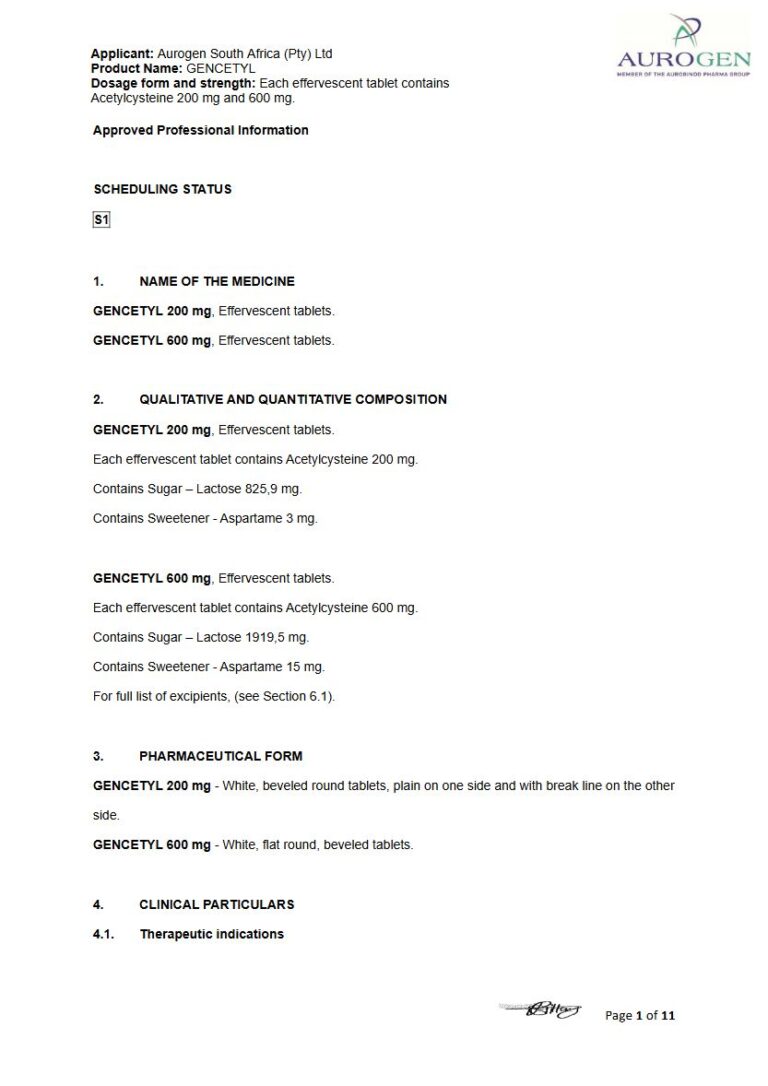
GENCETYL is used as a mucolytic, of non-infective secretions in cystic fibrosis and in respiratory conditions.
4.2. Posology and method of administration
Posology: Children from 2 to 5 years of age: GENCETYL 200 mg: u00bd (half) an effervescent tablet 2 to 3 times daily (equivalent to 200 to 300 mg acetylcysteine/day). Children from 6 to 14 years of age: GENCETYL 200 mg: 1 effervescent tablet twice daily (equivalent to 400 mg acetylcysteine/day). Adults and adolescents from 14 years of age: GENCETYL 200 mg: 1 effervescent tablet 2 to 3 times daily (equivalent to 400 to 600 mg acetylcysteine/day). GENCETYL 600 mg: u00bd effervescent tablet twice daily or 1 effervescent tablet once daily (equivalent to 600 mg acetylcysteine per day). Do not use continuously for more than 14 days without consulting a doctor.
Method of administration: Oral use. GENCETYL should be dissolved in a glass of water before use.
4.3. Contraindications
- Hypersensitivity to acetylcysteine or any of the other ingredients of GENCETYL effervescent tablets (see section 6.1).
- Safety in pregnancy has not been established. GENCETYL effervescent tablets should not be used during pregnancy (see section 4.6).
- Active peptic ulceration.
- GENCETYL is contraindicated in children below 2 years of age.
4.4. Special warnings and precautions for use
The occurrence of severe skin reactions such as Stevens-Johnson syndrome and Lyell's syndrome has very rarely been reported in temporal connection with the use of acetylcysteine, as contained in GENCETYL. If cutaneous and mucous membrane changes appear, medical advice should be sought immediately and the use of GENCETYL be stopped (see also section 4.8).
Patients with bronchial asthma should be closely monitored during therapy. If bronchospasm occurs, GENCETYL should be stopped immediately and appropriate treatment must be instituted.
Caution is advised with the use of GENCETYL in patients with a history of ulcer, especially if, in addition, other medicines are taken that are irritating to the mucous membranes of the Gastrointestinal tract. Medicine-induced nausea and vomiting may occur and may increase the risk of gastrointestinal haemorrhage in patients predisposed to the condition. Mucolytics, including GENCETYL may disrupt the gastric mucosal barrier.
Caution should be exercised in patients with histamine intolerance. Long-term therapy of these patients should be avoided as acetylcysteine affects histamine metabolism and may lead to symptoms of intolerance (e.g. headache, runny nose, itching).
Use of GENCETYL, especially at the beginning of treatment, can cause a liquefaction and thus lead to an increase in the volume of the bronchial secretion. If the patient is unable to cough this up sufficiently, appropriate measures should be taken (e.g. postural drainage and suction).
Children under 2 years of age GENCETYL must not be used in children under 2 years of age (see section 4.3).
GENCETYL contains sodium hydrogen bicarbonate 85 mg in GENCETYL 200 mg and 240 mg in GENCETYL 600 mg, corresponding to 4,25 % and 12 % of the WHO recommended maximum daily sodium intake with food of 2 g. This should be taken into account in people taking controlled sodium (low-sodium / low-sodium) diet.
GENCETYL contains aspartame. Aspartame is a source of phenylalanine and can be harmful to patients with phenylketonuria.
GENCETYL contains lactose monohydrate. Patients with rare hereditary problems of galactose intolerance, total lactase deficiency or glucose-galactose malabsorption should not take GENCETYL.
4.5 Interaction with other medicines and other forms of interaction
Interaction studies have only been conducted in adults. With the combined use of mucolytic medicines such as acetylcysteine with antitussives (cough suppressants), a dangerous accumulation of secretion can arise due to the restricted cough reflex. An especially careful diagnosis is required for this combination treatment.
The use of activated charcoal can reduce the effects of acetylcysteine. Reports of inactivation of antibiotics (tetracycline with exception of doxycycline, aminoglycosides, penicillins) by acetylcysteine has so far only concerned in-vitro experiments in which the relevant substances were mixed directly. Oral antibiotics should be administered separately from GENCETYL and at least two hours apart.
Acetylcysteine / nitroglycerin: Concomitant administration of GENCETYL can possibly increase the vasodilatory effect of glycerol trinitrate (nitroglycerin). If co-treatment with nitroglycerin and GENCETYL is considered necessary, the patient should be monitored for the development of hypotension that may be severe and be advised that headache may occur.
Simultaneous intake of acetylcysteine and carbamazepine can result in sub-therapeutic carbamazepine concentrations.
Changes in the determination of laboratory parameters: Acetylcysteine can influence the colorimetric determination of salicylates. During urine tests, acetylcysteine can affect the results of the determination of ketone bodies. Dissolving GENCETYL with other medicines is not recommended.
4.6 Fertility, pregnancy and lactation
Pregnancy: Safety and efficacy of acetylcysteine in pregnancy and lactation have not been established (see section 4.3). For acetylcysteine there are insufficient clinical data on exposed pregnant women. Animal studies of reproductive toxicology do not indicate direct or indirect harmful effects. GENCETYL should not be used during pregnancy.
Breastfeeding: No information is available on the excretion of acetylcysteine or its metabolites into breast milk. A risk to the breast-fed child cannot be excluded. The use of GENCETYL during breastfeeding is not recommended.
Fertility: There are no data on the influence of acetylcysteine on human fertility. In animal studies, no harmful effects on fertility were observed for therapy-relevant doses of acetylcysteine.
4.7. Effects on ability to drive and use machines
GENCETYL has no known influence on the ability to drive or use machinery.
4.8. Undesirable effects
The most common side effects associated with oral use of GENCETYL affect the gastrointestinal tract. Hypersensitivity reactions, including anaphylactic shock, anaphylactic / anaphylactoid reactions, bronchospasm, angioedema, rash and itching were reported less frequently.
Tabulated list of adverse reactions:
System Organ Class Frequency Category
- Immune system disorders: Hypersensitivity reactions, angioedema, Anaphylactic shock, Anaphylactic / anaphylactoid reactions - Less frequent
- Nervous system disorders: Headache, convulsions, syncope - Less frequent
- Ear and labyrinth disorders: Tinnitus - Less frequent
- Eye disorders: Blurred vision - Less frequent
- Cardiac disorders: Tachycardia - Less frequent
- Vascular disorders: Haemorrhage, Hypertension - Less frequent
- Respiratory, thoracic and mediastinal disorders: Bronchial spasm, predominantly in patients with hyperactive reactive bronchial system in association with bronchial asthma. Dyspnoea - Less frequent
- Gastrointestinal disorders: Vomiting, Diarrhoea, Stomach pain, Stomatitis, Nausea, Dyspepsia - Frequency unknown
- Skin and subcutaneous tissues disorders: Stevens - Johnson syndrome (see section 4.4), toxic epidermal necrolysis, exanthema, pruritus, flushing, Urticaria, Rash, Itching (pruritis) - Less frequent
- General disorders and administration site conditions: Fever, Hypotension - Less frequent, Facial oedema - Frequency unknown
Various studies have confirmed a decrease in platelet aggregation during the use of acetylcysteine. The clinical significance of this is so far unclear.
Reporting of suspected adverse reactions: Reporting suspected adverse reactions after authorisation of the medicine is important. It allows continued monitoring of the benefit/risk balance of the medicine. Healthcare professionals are asked to report any suspected adverse reactions to SAHPRA via The u20186.04 Adverse Reactions Reporting Formu2019. Found under SAHPRAu2019s publications: https://www/sahpra.org.za/Publications/Index/8.
4.9. Overdose
Overdoses may lead to gastrointestinal symptoms, such as nausea, vomiting and diarrhoea. Infants are at risk of hypersecretion. Treatment of overdose is supportive and symptomatic.
