
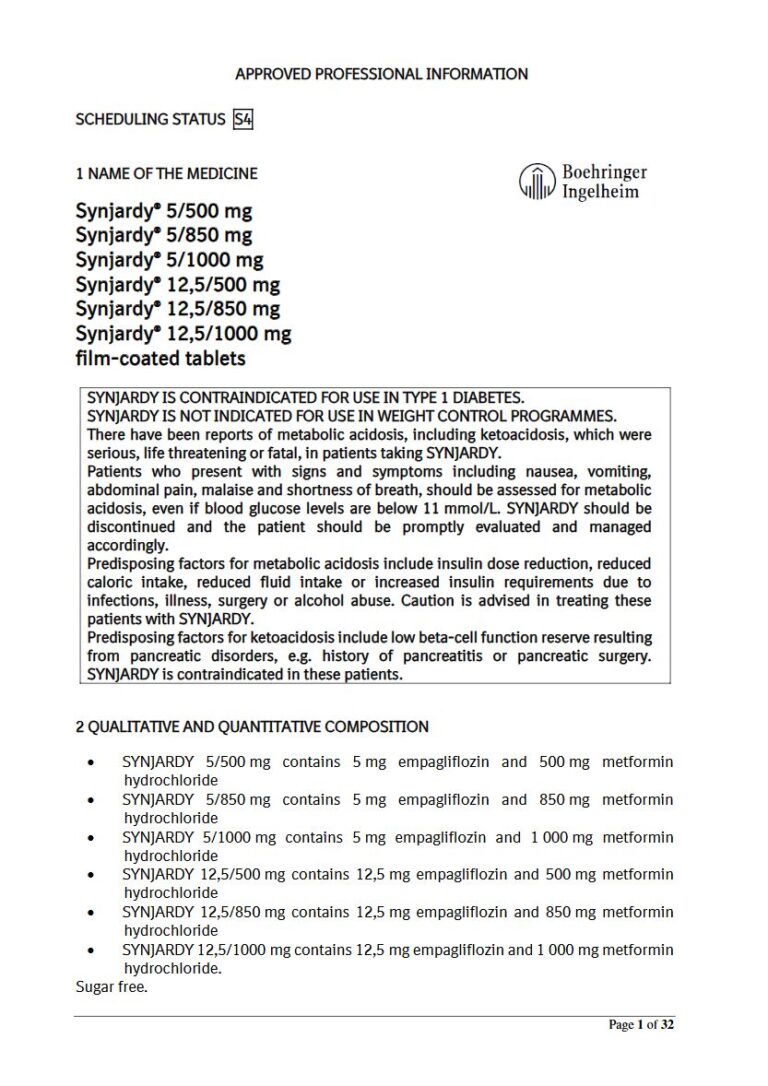
Synjardy 500 mg/850 mg/1000 mg Film-Coated Tablets
PDF Leaflet Revision Date: 10 October 2025
Clinical Summary
Quick overview from the medicine insert
Indication
Adjunct to diet and exercise for glycaemic control in type 2 diabetes.
Dosage (summary)
One tablet twice daily; max 25 mg empagliflozin and 2000 mg metformin.
Special Populations
- Elderly
- Renal impairment
- Hepatic impairment
Pregnancy & Breastfeeding
Contraindicated in pregnancy and breastfeeding.
Key Drug Interactions
- Diuretics
- Insulin
- Lithium
Contraindications
- Type 1 Diabetes
- Severe renal failure
- Hepatic impairment
- Metabolic acidosis
Common side effects
- Hypoglycaemia
- Nausea
- Increased urination
- Genital infections
Counselling Points
- Take with meals
- Monitor for signs of lactic acidosis
- Stay hydrated
Serious warnings
- Risk of lactic acidosis
- Risk of ketoacidosis
- Volume depletion
Important Disclaimer
The Synjardy 500 mg/850 mg/1000 mg Film-Coated Tablets professional information leaflet below is the property of Ingelheim Pharmaceuticals and is provided on Medinsert exactly as issued, with no.. alterations or editorial changes. We make every effort to keep content current by updating documents as soon as new versions become available. Medinsert serves as a trusted access point for healthcare professionals, but does not replace official sources or clinical judgement. For more details, please read our full disclaimer. read more>>
 Healthcare Professionals Only
This content is for registered healthcare professionals
Sign in or create a free account to read the full package insert.
Free for HPCSA-registered professionals. Powered by Medinsert.
Clinical Particulars
Section 4 of the official insert — extracted exactly as issued, no alterations
4.1 THERAPEUTIC INDICATIONS
Glycaemic control
SYNJARDY is indicated as an adjunct to diet and exercise to improve glycaemic control in adults with type 2 diabetes mellitus who have been stabilised on co-administration of the two component medicines. (See Sections 4.2 and 5.1 Clinical trials.)
Prevention of cardiovascular events
SYNJARDY is indicated in patients with type 2 diabetes mellitus and high cardiovascular risk to reduce the risk of cardiovascular death or hospitalisation for heart failure. (See Section 5.1 Clinical trials.)
4.2 POSOLOGY AND METHOD OF ADMINISTRATION
Life threatening lactic acidosis can occur due to accumulation of metformin. Risk factors include renal impairment, old age and the use of high doses of metformin above 2 000 mg per day. Empagliflozin may also induce metabolic acidosis including ketoacidosis. It is not known if the combination of metformin and empagliflozin increases this risk.
The recommended dose is one SYNJARDY tablet twice daily.
Adults with normal renal function (GFR u2265 90 mL/min)
The dosage should be individualised on the basis of the patientu2019s current regimen, effectiveness, and tolerability. The maximum recommended daily dose of SYNJARDY is 25 mg of empagliflozin and 2 000 mg of metformin (see Table 1 for additional dosing information). SYNJARDY should be given with meals to reduce the gastrointestinal undesirable effects associated with metformin.
Treatment nau00efve patients
The recommended starting dose is 5/500 mg twice daily. If additional glycaemic control is required, adjust dosing based on effectiveness and tolerability while not exceeding the maximum recommended daily dose of 25 mg empagliflozin and 2 000 mg metformin.
Patients switching from separate tablets of empagliflozin and metformin
Patients switching from separate tablets of empagliflozin (10 mg or 25 mg total daily dose) and metformin to SYNJARDY, should receive the same daily dose of empagliflozin and metformin already being taken or the nearest therapeutically appropriate dose of metformin.
Patients not adequately controlled on the maximal tolerated dose of metformin alone or in combination with other medicines, including insulin
The recommended starting dose of SYNJARDY should provide empagliflozin 5 mg twice daily (10 mg total daily dose) and the dose of metformin similar to the dose already being taken. In patients tolerating a total daily dose of empagliflozin 10 mg, the dose can be increased to a total daily dose of empagliflozin 25 mg.
Combination use
When SYNJARDY is used in combination with a sulphonylurea and/or insulin, a lower dose of sulphonylurea and/or insulin may be required to reduce the risk of hypoglycaemia (see Sections 4.5 and 4.8).
Renal impairment
No dose adjustment is recommended for patients with mild renal impairment. SYNJARDY is contraindicated for use in patients with severe renal impairment (creatinine clearance <30 mL/min) (see Section 4.3). Renal function should be assessed before initiation of treatment with SYNJARDY and at least annually thereafter. In patients at an increased risk of further progression of renal impairment and in the elderly, renal function should be assessed more frequently, e.g. every 3-6 months (see Section 4.4).
Table 1 Posology for renally impaired patients *
eGFR mL/min
Metformin
Empagliflozin
60 - 89
Maximum daily dose is 3 000 mg.* Dose reduction may be considered in relation to declining renal function.
Maximum daily dose is 25 mg. No dose adjustment is required.
45 - 59
Maximum daily dose is 2 000 mg. The starting dose is at most half of the maximum dose.
No dose adjustment is required.**
30 - 44
Maximum daily dose is 1 000 mg.* No dose adjustment is required.**
<30
Metformin is contraindicated. Empagliflozin is contraindicated
* If no adequate strength of SYNJARDY is available, individual monocomponents should be used instead of the fixed dose combination.
** More intensive monitoring of renal function is recommended.
Hepatic impairment
SYNJARDY is contraindicated in patients with hepatic impairment due to the metformin component (see Section 4.3).
Elderly patients
Patients aged 75 years and older may be at an increased risk of volume depletion, therefore, SYNJARDY should be prescribed with caution in these patients. Therapeutic experience in patients aged 85 years and older is limited. Initiation of treatment in this population is not recommended (see Section 4.4 Use in the elderly).
Pediatric population
SYNJARDY is not recommended for use in children below 18 years due to lack of data on safety and efficacy.
4.3 CONTRAINDICATIONS
- Hypersensitivity to active ingredients empagliflozin and/or metformin hydrochloride or to any of the excipients.
- Type 1 Diabetes Mellitus.
- Any type of metabolic acidosis (such as lactic acidosis, diabetic ketoacidosis).
- Diabetic pre-coma.
- Severe renal failure (creatinine clearance <30 mL/min or eGFR <30 mL/min/1,73m2), which may also result from conditions such as cardiovascular collapse (shock), acute myocardial infarction, and septicaemia (see Section 4.4).
- Acute conditions with the potential to alter renal function such as: dehydration, severe infection, shock, intravascular administration of iodinated contrast agents (see Section 4.4).
- Acute or chronic disease which may cause tissue hypoxia such as: cardiac or respiratory failure, recent myocardial infarction, shock, pulmonary embolism, acute significant blood loss, sepsis, gangrene, pancreatitis (see Section 4.4).
- During or immediately following surgery where insulin is essential, elective major surgery.
- Hepatic impairment, acute alcohol intoxication, alcoholism (due to the metformin component).
- Pregnancy and lactation (see Section 4.6).
SYNJARDY must be temporarily discontinued in patients undergoing radiologic studies involving intravascular administration of iodinated contrast materials because use of such products may result in acute alteration of renal function (see Section 4.4 u2018Administration of iodinated contrast agentu2019).
4.4 SPECIAL WARNINGS AND PRECAUTIONS FOR USE
General
SYNJARDY should not be used in patients with type 1 diabetes (see Section 4.3).
Diabetic ketoacidosis
SYNJARDY should not be used for the treatment of diabetic ketoacidosis. Cases of diabetic ketoacidosis (DKA), a serious life threatening condition requiring urgent hospitalisation, have been reported in post-marketing surveillance in patients treated with SGLT2 inhibitors, including empagliflozin. Fatal cases of ketoacidosis have been reported in patients taking empagliflozin. Patients treated with SYNJARDY who present with signs and symptoms consistent with severe metabolic acidosis should be assessed for ketoacidosis regardless of presenting blood glucose levels as ketoacidosis associated with SYNJARDY may be present even if blood glucose levels are less than 13,8 mmol/L. Signs and symptoms of ketoacidosis may include excessive thirst, nausea, vomiting, abdominal pain, generalised malaise, and shortness of breath. If ketoacidosis is suspected, SYNJARDY should be discontinued, the patient should be evaluated and prompt treatment should be instituted. Treatment of ketoacidosis generally requires insulin, fluid, potassium and carbohydrate replacement. Restarting SGLT2 inhibitor treatment in patients with previous DKA while on SGLT2 inhibitor treatment is not recommended unless another clear precipitating factor is identified and resolved. Before initiating SYNJARDY, consider factors in the patient history that may predispose to ketoacidosis. Factors that predispose patients to ketoacidosis include a low carbohydrate diet, dehydration, acute illness, surgery (see Section u2018Surgeryu2019), a previous ketoacidosis, insulin deficiency from any cause (including insulin pump failure, history of pancreatitis, or pancreatic surgery), malnourishment/reduced caloric intake or increased insulin requirements due to infections, and alcohol abuse. SYNJARDY should be used with caution in these patients. When reducing the insulin dose in patients requiring insulin, caution should be taken (see Section 4.2). Consider monitoring for ketoacidosis and temporarily discontinuing SYNJARDY in clinical situations known to predispose to ketoacidosis. In these situations, consider monitoring of ketones, even if SYNJARDY treatment has been interrupted. Treatment should be interrupted in patients who are hospitalised for acute serious medical illnesses.
Lactic acidosis
Lactic acidosis a serious metabolic complication, that most often occurs at in association with acute worsening of renal function or cardiorespiratory illness or sepsis. Metformin accumulation occurs at acute worsening of renal function and increases the risk of lactic acidosis. In case of dehydration (severe diarrhoea or vomiting, fever or reduced fluid intake), metformin, as contained in SYNJARDY should be temporarily discontinued. Medicinal products that can acutely impair renal function (such as antihypertensives, diuretics and NSAIDs) should be initiated with caution in metformin-treated patients. Other risk factors for lactic acidosis are excessive alcohol intake, hepatic insufficiency, inadequately controlled diabetes, ketosis, prolonged fasting, and any conditions associated with hypoxia, as well as concomitant use of medicinal products that may cause lactic acidosis (see Sections 4.3 and 4.5).
Patients and/or caregivers should be informed of the risk of lactic acidosis. Lactic acidosis is characterised by acidotic dyspnoea, abdominal pain, muscle cramps, asthenia and hypothermia followed by coma. In case of suspected symptoms, the patient should stop taking metformin, as contained in SYNJARDY and be hospitalised immediately. Diagnostic laboratory findings are decreased blood pH (5 mmol/L), and an increased anion gap and lactate/pyruvate ratio.
Cardiac function
Patients with heart failure are more at risk of hypoxia and renal insufficiency. In patients with stable chronic heart failure, SYNJARDY may be used with a regular monitoring of cardiac and renal function. For patients with acute and unstable heart failure, SYNJARDY is contraindicated due to the metformin component (see Section 4.3).
Use in patients at risk for volume depletion
Based on the mode of action of SGLT2 inhibitors, osmotic diuresis accompanying therapeutic glucosuria may lead to a modest decrease in blood pressure. Therefore, caution should be exercised in patients for whom an empagliflozin-induced drop in blood pressure could pose a risk, such as patients with known cardiovascular disease, patients on antihypertensive therapy with a history of hypotension or patients aged 75 years and older. In case of conditions that may lead to fluid loss (e.g. gastrointestinal illness), careful monitoring of volume status (e.g. physical examination, blood pressure measurements, laboratory tests including haematocrit) and electrolytes is recommended for patients receiving empagliflozin. Temporary interruption of treatment with SYNJARDY should be considered until the fluid loss is corrected.
Urosepsis and Pyelonephritis
There have been post-marketing reports of serious urinary tract infections including urosepsis and pyelonephritis requiring hospitalisation in patients receiving SGLT2 inhibitors, including empagliflozin. Treatment with SGLT2 inhibitors increases the risk for urinary tract infections. Evaluate patients for signs and symptoms of urinary tract infections and treat promptly, if indicated (see Section 4.8). Discontinuation of SYNJARDY may be considered in cases of recurrent urinary tract infections.
Genital infections including life threatening necrotising fasciitis
SGLT2 inhibitors, such as contained in SYNJARDY, have been associated with an increased risk of genital infection in both males and females caused by bacteria and/or fungi. Genital fungal infections appear to be more common in females. Balanoposthitis in males may result in phimosis. Post-marketing cases of necrotising fasciitis of the perineum (also known as Fournieru2019s gangrene), a serious and life threatening necrotising infection, have been reported in female and male patients with diabetes mellitus treated with SGLT2 inhibitors, including empagliflozin. Serious outcomes have included hospitalisation, multiple surgeries, and death. Patients treated with SYNJARDY who present with pain or tenderness, erythema, swelling in the genital or perineal area, fever, malaise should be evaluated for necrotising fasciitis. If suspected, SYNJARDY should be discontinued and prompt treatment should be instituted (including broad-spectrum antibiotics and surgical debridement if necessary).
Lower limb amputations
An increase in cases of lower limb amputation (primarily of the toe) has been observed in a long-term clinical study with another SGLT2 inhibitor. The medicine in that study is not empagliflozin. However, it is unknown whether this constitutes a class effect. In a pooled safety analysis of 12 620 patients with T2DM the frequency of patients with lower limb amputations was similar between empagliflozin and placebo. In the largest placebo controlled trial in 7 020 patients (EMPA-REG OUTCOME trial), in which 88 % of all the cases of amputations were reported, lower limb amputations occurred in 1,8 % of patients treated with empagliflozin 10 mg, in 2,0 % of patients treated with empagliflozin 25 mg, and in 1,8 % of patients in the placebo arm. It is important to regularly examine the feet and counsel all diabetic patients on routine preventative foot care.
Administration of iodinated contrast agent
Intravascular administration of iodinated contrast agents may lead to contrast induced nephropathy, resulting in metformin accumulation and an increased risk of lactic acidosis. Metformin as contained in SYNJARDY, should be discontinued prior to or at the time of the imaging procedure and not restarted until at least 48 hours after, provided that renal function has been re-evaluated and found to be stable (see Sections 4.2 and 4.5).
Surgery
Treatment with SYNJARDY should be ceased at least 48 hours prior to major surgery (see Sections u2018Diabetic ketoacidosisu2019 and u2018Lactic acidosisu2019). An increase in other glucose lowering agents may be required during this time. Patients scheduled for non-urgent surgery who have not ceased SYNJARDY should be assessed and consideration should be given to postponing the procedure. Treatment with SYNJARDY may be restarted not earlier than 48 hours following surgery once the patient's condition has stabilised, oral intake is normal and only after renal function has been re-evaluated and found to be normal.
Vitamin B12 levels
In controlled clinical trials of metformin of 29 weeks duration, a decrease to subnormal levels of previously normal serum Vitamin B12 levels, without clinical manifestations, was observed in approximately 7 % of patients. Such decrease, possibly due to interference with B12 absorption from the B12-intrinsic factor complex, is, however, very rarely associated with anaemia and appears to be rapidly reversible with discontinuation of metformin or Vitamin B12 supplementation. Measurement of haematologic parameters on an annual basis is advised in patients on SYNJARDY and any apparent abnormalities should be appropriately investigated and managed. Certain individuals (those with inadequate Vitamin B12 or calcium intake or absorption) appear to be predisposed to developing subnormal Vitamin B12 levels. In these patients, routine serum Vitamin B12 measurements at two- to three-year intervals may be useful.
Use in patients with renal impairment
Empagliflozin increases serum creatinine and decreases eGFR (see Section 4.8). Renal function abnormalities can occur after initiating empagliflozin. Patients with hypovolaemia may be more susceptible to these changes. There have been post-marketing reports of acute kidney injury, some requiring hospitalisation and dialysis, in patients receiving SGLT2 inhibitors, including empagliflozin; some reports involved patients younger than 65 years of age. Due to the mechanism of action, decreased renal function will result in reduced efficacy of empagliflozin. GFR should be assessed before treatment initiation and regularly thereafter, see section 4.2. Patients treated with empagliflozin can experience an initial fall in eGFR. More intensive monitoring of renal function is recommended, particularly following treatment initiation, if empagliflozin is used in patients with an eGFR <60 mL/min/1,73 m2, especially if the eGFR is <45 mL/min/1,73 m2. SYNJARDY is contraindicated in patients with GFR <30 mL/min and should be temporarily discontinued in the presence of conditions that alter renal function, see section 4.3.
Hypoglycaemia
SYNJARDY alone does not cause hypoglycaemia under usual circumstances of use, but hypoglycaemia could occur when caloric intake is deficient, when strenuous exercise is not compensated by caloric supplementation, or during concomitant use with other glucose-lowering agents (such as sulphonylureas and insulin) or ethanol.
Use in the elderly
Patients aged 75 years and older may be at an increased risk of volume depletion, therefore, SYNJARDY should be prescribed with caution in these patients (see Section 4.8). Therapeutic experience in patients aged 85 years and older is limited. Initiation of treatment in this population is not recommended. As metformin is excreted by the kidney, SYNJARDY should be used with caution as age increases. Monitoring of renal function is necessary to aid in prevention of metformin-associated lactic acidosis, particularly in elderly patients.
Pediatric Use
Safety and effectiveness of SYNJARDY in paediatric patients under 18 years have not been established.
4.5 INTERACTIONS WITH OTHER MEDICINES
General
Co-administration of multiple doses of empagliflozin (50 mg once daily) and metformin hydrochloride (1 000 mg twice daily) did not meaningfully alter the pharmacokinetics of either empagliflozin or metformin in healthy volunteers. Pharmacokinetic interaction studies with SYNJARDY have not been performed; however, such studies have been conducted with empagliflozin and metformin alone.
Empagliflozin
Pharmacodynamic Interactions
Diuretics
Empagliflozin may add to the diuretic effect of thiazide and loop diuretics and may increase the risk of dehydration and hypotension.
Insulin and insulin secretagogues
Insulin and insulin secretagogues, such as sulphonylureas, may increase the risk of hypoglycaemia. Therefore, a lower dose of insulin or an insulin secretagogue may be required to reduce the risk of hypoglycaemia when used in combination with empagliflozin (see Sections 4.2 and 4.8).
Pharmacokinetic Interactions
Lithium
Empagliflozin may increase renal lithium excretion and the blood lithium levels may be decreased. Serum concentration of lithium should be monitored more frequently after empagliflozin initiation and dose changes. Please refer the patient to the lithium prescribing doctor in order to monitor serum concentration of lithium.
In vitro assessment of medicine interactions
Empagliflozin does not inhibit, inactivate, or induce CYP450 isoforms. In vitro data suggest that the primary route of metabolism of empagliflozin in humans is glucuronidation by the uridine 5'-diphospho-glucuronosyltransferases UGT1A3, UGT1A8, UGT1A9, and UGT2B7. Empagliflozin does not notably inhibit UGT1A1, UGT1A3, UGT1A8, UGT1A9, or UGT2B7. At therapeutic doses, the potential for empagliflozin to reversibly inhibit or inactivate the major CYP450 and UGT isoforms is remote. Interactions involving the major CYP450 and UGT isoforms with empagliflozin and concomitantly administered substrates of these enzymes are therefore considered unlikely.
Empagliflozin is a substrate for P-glycoprotein (P-gp) and breast cancer resistance protein (BCRP), but it does not inhibit these efflux transporters at therapeutic doses. Based on in vitro studies, empagliflozin is considered unlikely to cause interactions with medicines that are P-gp substrates.
Empagliflozin is a substrate of the human uptake transporters OAT3, OATP1B1, and OATP1B3, but not OAT1 and OCT2. Empagliflozin does not inhibit any of these human uptake transporters at clinically relevant plasma concentrations and, as such, interactions with substrates of these uptake transporters are considered unlikely.
In vivo assessment of medicine interactions
No clinically meaningful pharmacokinetic interactions were observed when empagliflozin was co-administered with other commonly used medicines. Based on results of pharmacokinetic studies no dose adjustment of empagliflozin is recommended when co-administered with commonly prescribed medicines. Empagliflozin pharmacokinetics were similar with and without co-administration of glimepiride, pioglitazone, sitagliptin, linagliptin, warfarin, verapamil, ramipril, simvastatin, in healthy volunteers and with or without co-administration of torasemide and hydrochlorothiazide in patients with T2DM. Increases in overall exposure (AUC) of empagliflozin were seen following co-administration with gemfibrozil (59 %), rifampicin (35 %), or probenecid (53 %). These changes were not considered to be clinically meaningful. Empagliflozin had no clinically relevant effect on the pharmacokinetics of glimepiride, pioglitazone, sitagliptin, linagliptin, warfarin, digoxin, ramipril, simvastatin, hydrochlorothiazide, torasemide and oral contraceptives when co-administered in healthy volunteers.
Metformin hydrochloride
Contraindicated combinations
Iodinated contrast materials
SYNJARDY must be discontinued prior to, or at the time of the imaging procedure and not be restarted until at least 48 hours after, provided that renal function has been re-evaluated and found to be stable. (see Sections 4.3 and 4.4).
Inadvisable combinations
Alcohol
There is increased risk of lactic acidosis in acute alcohol intoxication (particularly in the case of fasting, malnutrition or hepatic impairment) due to the metformin component of SYNJARDY (see Section 4.4 u2018Lactic acidosisu2019). Consumption of alcohol and medicines containing alcohol should be avoided. Alcohol may make the signs of hypoglycaemia less clear, and delayed hypoglycaemia can occur. The CNS depressant effects of alcohol plus hypoglycaemia can make driving or the operation of dangerous machinery much more hazardous.
Combinations requiring precautions for use
Some medicinal products can adversely affect renal function which may increase the risk of lactic acidosis, e.g. NSAIDs, including selective cyclo-oxygenase (COX) II inhibitors, ACE inhibitors, angiotensin II receptor antagonists and diuretics, especially loop diuretics. When starting or using such products in combination with metformin as contained in SYNJARDY, close monitoring of renal function is necessary.
Medicines with intrinsic hyperglycaemic activity e.g. glucocorticoids and tetracosactides (systemic and local routes), beta-2-agonists, danazol, chlorpromazine at high dosages of 100 mg per day and diuretics
More frequent blood glucose monitoring may be required, especially at the beginning of treatment. If necessary, adjust the metformin dosage during therapy with the respective medicinal product and upon discontinuation.
Diuretics, especially loop diuretics
May increase the risk of lactic acidosis due to their potential to decrease renal function.
ACE-inhibitors
ACE-inhibitors may decrease the blood glucose levels. Therefore, dose adjustment of SYNJARDY may be necessary when such medicines are added or discontinued.
Calcium channel blockers
Calcium channel blockers may affect glucose control in diabetic patients; regular monitoring of glycaemic control is recommended.
Beta-blockers
Co-administration of metformin and beta-blockers may result in a potentiation of the anti-hyperglycaemic action. In addition, some of the premonitory signs of hypoglycaemia, in particular tachycardia, may be masked. Monitoring of blood glucose should be undertaken during dosage adjustment of either medicine.
Cimetidine
Reduced clearance of metformin has been reported during cimetidine therapy, so a dose reduction should be considered.
Anticoagulants
Metformin increases the elimination rate of vitamin K antagonists. Consequently, the prothrombin time should be closely monitored in patients in whom metformin and vitamin K antagonists are being co-administered. Cessation of metformin in patients receiving vitamin K antagonists can cause marked increases in the prothrombin time.
Nifedipine
A single-dose, metformin-nifedipine medicine interaction study in normal healthy volunteers demonstrated that co-administration of metformin and nifedipine increased plasma metformin Cmax and AUC by 20 % and 9 %, respectively, and increased the amount of metformin excreted in the urine. Tmax and half-life of metformin were unaffected. Nifedipine appears to enhance the absorption of metformin. Metformin had minimal effects on the pharmacokinetics of nifedipine.
Organic cation transporters (OCT)
Metformin is a substrate of both transporters OCT1 and OCT2. Co-administration of metformin with:
- Substrates/inhibitors of OCT1 (such as verapamil) may reduce efficacy of metformin.
- Inducers of OCT1 (such as rifampicin) may increase gastrointestinal absorption and efficacy.
- Substrates/inhibitors of OCT2 (such as cimetidine, dolutegravir, crizotinib, olaparib, daclatasvir, vandetanib) may decrease the renal elimination of metformin and thus lead to an increase in metformin plasma concentration.
Carbonic anhydrase inhibitors
Topiramate or other carbonic anhydrase inhibitors (e.g., zonisamide, acetazolamide or dichlorphenamide) frequently cause a decrease in serum bicarbonate and induce non-anion gap, hyperchloraemic metabolic acidosis. Concomitant use of these medicines with metformin as contained in SYNJARDY may increase the risk for lactic acidosis. Consider more frequent monitoring of these patients.
NSAID
May increase the risk of lactic acidosis and adversely affect renal function. Therefore, caution is advised when these medicines are co-administered with metformin and a dose adjustment may be considered, particularly in patients with renal impairment.
4.6 FERTILITY, PREGNANCY AND LACTATION
Fertility
No studies on the effect on human fertility have been conducted with SYNJARDY or its individual components. Nonclinical studies in animals with the individual components do not indicate direct or indirect harmful effects with respect to fertility.
Pregnancy
SYNJARDY is contraindicated in pregnancy (see Section 4.3). In animal reproductive studies, both component medicines have shown foeto-toxicity at higher doses.
Breastfeeding
SYNJARDY is contraindicated in women who are breastfeeding their infants. Both component medicines are excreted in milk.
4.7 EFFECTS ON ABILITY TO DRIVE AND USE MACHINES
Hypoglycaemia may impair driving and machinery use capabilities. Low blood sugar may occur in patients who already take another medication to treat diabetes such as a sulphonylurea or insulin while taking SYNJARDY. The patientu2019s ability to concentrate and react may be impaired as a result of hypoglycaemia. This may constitute a risk in situations where these abilities are of special importance e.g. driving a car or operating machinery. People should be advised to take precautions to avoid hypoglycaemia whilst driving or operating machinery.
4.8 UNDESIRABLE EFFECTS
Adverse Reactions in Clinical Trials
A total of 12 245 patients with type 2 diabetes were treated in clinical studies to evaluate the safety of empagliflozin plus metformin, of which 8 199 patients were treated with empagliflozin plus metformin, either alone, or in addition to a sulphonylurea, pioglitazone, DPP4 inhibitors, or insulin. In these trials 2 910 patients received treatment with empagliflozin 10 mg plus metformin and 3 699 patients treatment with empagliflozin 25 mg plus metformin for at least 24 weeks and 2 151 or 2 807 patients for at least 76 weeks. The overall safety profile of empagliflozin plus metformin for patients enrolled in the EMPA-REG OUTCOME study was comparable to the previously known safety profile. Placebo controlled double-blind trials of 18 to 24 weeks of exposure included 3 456 patients, of which 1 271 were treated with empagliflozin 10 mg plus metformin and 1 259 with empagliflozin 25 mg plus metformin. The most frequently reported adverse event in clinical trials was hypoglycaemia, which depended on the type of background therapy used in the respective studies (Table 2).
No additional side effects were identified in clinical trials with empagliflozin plus metformin compared to the side effects of the single components.
Tabulated list of adverse reactions
The adverse reactions are listed by absolute frequency. Frequencies are defined as very common (u2265 1/10), common (u2265 1/100 to <1/10), uncommon (u2265 1/1 000 to <1/100), rare (u2265 1/10 000 to <1/1 000), or very rare (<1/10 000), and not known (cannot be estimated from the available data).
Table 2 Adverse reactions reported in placebo controlled studies
System organ class
Very common
Common
Uncommon
Very rare
Infections and infestations
Vaginal moniliasis, vulvovaginitis, balanitis and other genital infection 1, 2
Urinary tract infection 1, 2
Metabolism and nutrition disorders
Hypoglycaemia (when used with sulphonylurea or insulin) 1
Vitamin B12 decrease/ deficiency 3, 4
Lactic acidosis 3
Nervous system disorders
Taste disturbance 3
Vascular disorders
Volume depletion 1, 2
Gastro-intestinal disorders
Gastro-intestinal symptoms 3, 5
Constipation
Hepatobiliary disorders
Liver function tests abnormalities 3, 6
Hepatitis 3, 6
Skin and sub-cutaneous tissue disorders
Pruritus 2,3 (generalised)
Erythema 3
Urticaria 3
Renal and urinary disorders
Increased urination 1, 2
Dysuria 2
General disorders and administration site conditions
Thirst 2
Investigations
Serum lipids increased 1,2
Glomerular filtration rate decreased 1
Blood creatinine increased 1
Haematocrit increased 1,2
1 See subsections below for additional information
2 Identified adverse reactions of empagliflozin monotherapy
3 Identified adverse reactions of metformin monotherapy
4 Decrease of vitamin B12 absorption with a decrease in serum levels has been observed in patients treated long-term with metformin. Consideration of such an aetiology is recommended if a patient presents with megaloblastic anaemia. Therefore, serum B12 levels should be appropriately monitored or periodic parenteral B12 supplementation should be considered (see Section 4.4 Vitamin B12 levels)
5 Gastrointestinal symptoms such as nausea, vomiting, diarrhoea, abdominal pain and loss of appetite occur most frequently during initiation of therapy and resolve spontaneously in most cases.
6 Isolated cases of liver function test abnormalities or hepatitis resolving upon metformin discontinuation have been reported.
4.9 OVERDOSE
For information on the management of overdose, contact the nearest poisons control centre or hospital.
Symptoms
An overdose may exacerbate and exaggerate the adverse events signs and symptoms of section 4.8. Hypoglycaemia has not been seen with the component medicines of SYNJARDY given alone, however co-administration with other antidiabetic medicines may cause hypoglycaemia. Hypoglycaemia must always be monitored for and treated appropriately. SYNJARDY may result in lactic acidosis and appropriate monitoring is required, with appropriate treatment. Potential pathology precipitating the lactic acidosis should be sought. Lactic acidosis is a medical emergency and must be treated in hospital.
Therapy
In the event of an overdose, supportive treatment should be initiated as appropriate to the patientu2019s clinical status. The most effective method to remove lactate and metformin hydrochloride is haemodialysis whereas removal of empagliflozin by haemodialysis has not been studied.
