
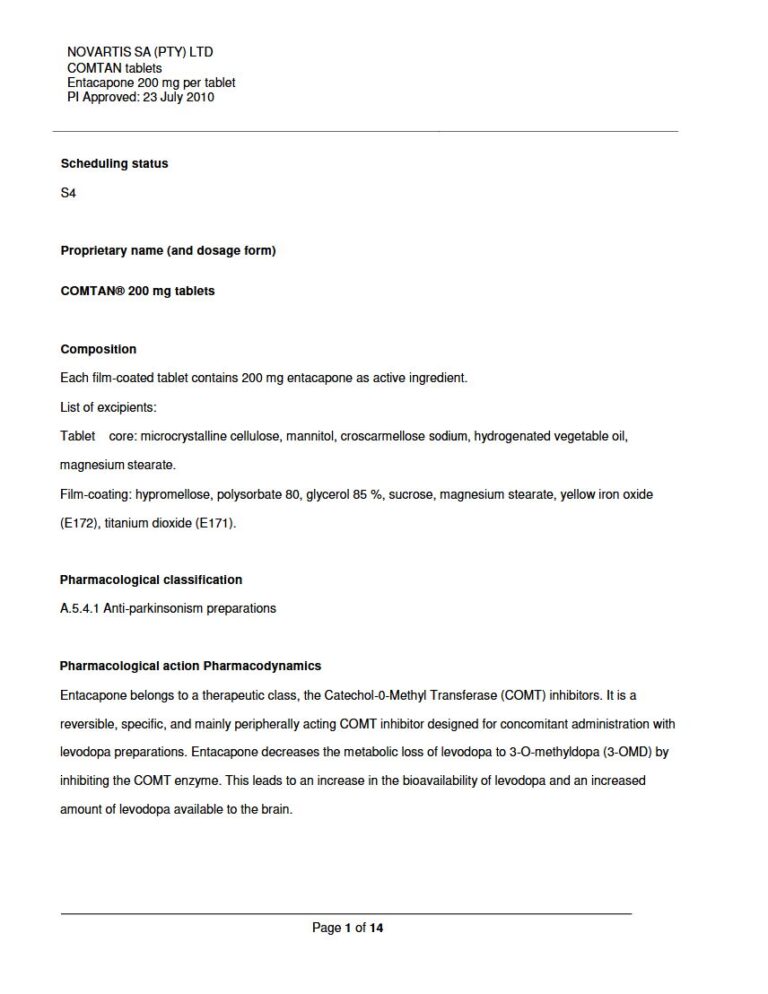
Comtan 200mg Tablet
PDF Leaflet Revision Date: 23 July 2010
Clinical Summary
Quick overview from the medicine insert
Indication
Adjunct to levodopa for Parkinson's disease with motor fluctuations.
Dosage (summary)
200 mg with each levodopa dose, max 2 g/day.
Onset of Action / Duration
Onset: 1 hour, Duration: 30 mins.
Special Populations
- Elderly
- Liver impairment
- Renal insufficiency
Pregnancy & Breastfeeding
Safety not established; avoid breastfeeding.
Key Drug Interactions
- MAO inhibitors
- Warfarin
- Catechol-containing drugs
Contraindications
- Hypersensitivity
- Liver impairment
- Pheochromocytoma
- History of NMS
Common side effects
- Dyskinesia
- Nausea
- Diarrhoea
- Abdominal pain
- Dry mouth
Counselling Points
- Monitor for weight loss
- Caution with driving
- Adjust levodopa dosage as needed
Serious warnings
- Risk of NMS
- Rhabdomyolysis
- Somnolence and sudden sleep onset
Important Disclaimer
The Comtan 200mg Tablet professional information leaflet below is the property of Novartis South Africa and is provided on Medinsert exactly as issued, with no.. alterations or editorial changes. We make every effort to keep content current by updating documents as soon as new versions become available. Medinsert serves as a trusted access point for healthcare professionals, but does not replace official sources or clinical judgement. For more details, please read our full disclaimer. read more>>
 Healthcare Professionals Only
This content is for registered healthcare professionals
Sign in or create a free account to read the full package insert.
Free for HPCSA-registered professionals. Powered by Medinsert.
Clinical Particulars
Section 4 of the official insert — extracted exactly as issued, no alterations
4.1 Therapeutic indications
COMTAN is indicated as an adjunct to standard preparations of levodopa/benserazide or levodopa/carbidopa for use in patients with Parkinson's disease and end-of-dose motor fluctuations, who cannot be stabilised on those combinations.
4.2 Posology and method of administration
COMTAN should only be used in combination with levodopa/benserazide or levodopa/carbidopa. The prescribing information for these levodopa preparations is applicable to their concomitant use with COMTAN.
COMTAN is administered orally and simultaneously with each levodopa/carbidopa or levodopa/benserazide dose. COMTAN can be taken with or without food (see Pharmacokinetics). One 200 mg tablet is taken with each levodopa/dopa decarboxylase inhibitor dose. The maximum recommended dose is 200 mg ten times daily, i.e. 2 g of entacapone. COMTAN enhances the effects of levodopa. Hence, to reduce levodopa-related dopaminergic adverse reaction, e.g. dyskinesias, nausea, vomiting and hallucinations, it is often necessary to adjust levodopa dosage within the first few days to first few weeks after initiating treatment with COMTAN. The daily dose of levodopa should be reduced by about 10 to 30 % by extending the dosing intervals and/or by reducing the amount of levodopa per dose according to the clinical condition of the patient. If COMTAN treatment is discontinued, it is necessary to adjust the dosing of other antiparkinsonian treatments, especially levodopa, to achieve a sufficient level of control of the parkinsonian symptoms. COMTAN increases the bioavailability of levodopa from standard levodopa/benserazide preparations slightly (5-10 %) more than from standard levodopa/carbidopa preparations. Hence, patients who are taking standard levodopa/benserazide preparations may need a larger reduction of levodopa dose when COMTAN is initiated.
4.3 Contraindications
Hypersensitivity to COMTAN or to any of the excipients of the medicinal product. Liver impairment. Patients with pheochromocytoma due to the increased risk of hypertensive crisis. Concomitant use of COMTAN and non-selective monoamine oxidase (MAO-A and MAO-B) inhibitors (e.g. phenelzine, tranylcypromine). Concomitant use of a selective MAO-A inhibitor plus a selective MAO-B inhibitor and COMTAN (see Interactions). A previous history of Neuroleptic Malignant Syndrome (NMS) and/or non-traumatic rhabdomyolysis.
4.4 Special warnings and precautions for use
Rhabdomyolysis secondary to severe dyskinesias or neuroleptic malignant syndrome (NMS) has been observed rarely in patients with Parkinson's disease. Isolated cases of rhabdomyolysis have been reported with COMTAN treatment. NMS, including rhabdomyolysis and hyperthermia, is characterized by motor symptoms (rigidity, myoclonus, tremor), mental status changes (e.g. agitation, contusion, coma), hyperthermia, autonomic dysfunction (tachycardia, labile blood pressure) and elevated serum creatine phosphokinase (CPK). In individual cases, only some of these symptoms and/or findings may be evident.
Isolated cases of NMS have been reported, especially following abrupt reduction or discontinuation of COMTAN and other dopaminergic medications. When considered necessary, withdrawal of COMTAN and other dopaminergic treatment should proceed slowly, and if signs and/or symptoms occur despite a slow withdrawal of COMTAN, an increase in levodopa dosage may be necessary.
Because of its mechanism of action, COMTAN may interfere with the metabolism of medicinal products containing a catechol group and potentiate their action. Thus, COMTAN should be administered cautiously to patients being treated with medicinal products metabolised by COMT, e.g. rimiterol, isoprenaline, adrenaline, noradrenaline, dopamine, dobutamine, alpha-methyldopa, and apomorphine (see Interactions).
COMTAN is always given as an adjunct to levodopa treatment. Hence, the precautions valid for levodopa treatment should also be taken into account for COMTAN treatment. COMTAN increases the bioavailability of levodopa from standard levodopa/benserazide preparations 5-10 % more than from standard levodopa/carbidopa preparations. Consequently, undesirable dopaminergic effects may be more frequent when COMTAN is added to levodopa/benserazide treatment (see Side-effects). To reduce levodopa-related dopaminergic adverse effects, it is often necessary to adjust levodopa dosage within the first days to first weeks after initiating COMTAN treatment, according to the clinical condition of the patient (see Dosage and Directions for use and Side-effects).
COMTAN may aggravate levodopa-induced orthostatic hypotension. COMTAN should be given cautiously to patients who are taking other medicinal products which may cause orthostatic hypotension.
In clinical studies, undesirable dopaminergic effects, e.g. dyskinesia, were more common in patients who received COMTAN and dopamine agonists (such as bromocriptine), selegiline or amantadine compared to those who received placebo with this combination. The doses of other antiparkinsonian medications may need to be adjusted when COMTAN treatment is initiated.
Isolated cases of hepatitis with cholestatic features have been reported. COMTAN used in combination with levodopa has been associated with somnolence and episodes of sudden sleep onset in patients with Parkinson's disease and caution should therefore be exercised when driving or operating machines.
For patients experiencing diarrhoea, monitoring of weight is recommended in order to avoid potential excessive weight decrease. For patients who experience progressive anorexia, asthenia and weight decrease within a relatively short period of time, a general medical evaluation including liver function should be considered.
COMTAN tablets contain sucrose. Therefore, patients with rare hereditary problems of fructose intolerance, glucose-galactose malabsorption or sucrase-isomaltase insufficiency should not take this medicine.
Pathological gambling, increased libido and hypersexuality have been reported in Parkinson's disease patients treated with COMTAN in association with levodopa.
4.5 Interactions with other medicines
No interaction of COMTAN with carbidopa has been observed with the recommended treatment schedule. Pharmacokinetic interaction with benserazide has not been studied. In single-dose studies in healthy volunteers, no interactions were observed between COMTAN and imipramine, or between COMTAN and moclobemide. Similarly, no interactions were observed between COMTAN and selegiline in repeated-dose studies in parkinsonian patients. However, experience of the clinical use of COMTAN with several drugs, including MAO-A inhibitors, tricyclic antidepressants, noradrenaline reuptake inhibitors such as desipramine, maprotiline and venlafaxine, and medicinal products that are metabolised by COMT (e.g. catechol-structured compounds: rimiterole, isoprenaline, adrenaline, noradrenaline, dopamine, dobutamine, alpha-methyldopa, apomorphine and paroxetine is still limited. Caution should be exercised when these medicinal products are used concomitantly with COMTAN (see Contra-indications and Warnings).
COMTAN may be used with selegiline (a selective MAO-B inhibitor), but the daily dose of selegiline should not exceed 10 mg. COMTAN may form chelates with iron in the gastrointestinal tract. COMTAN and iron preparations should be taken at least 2-3 hours apart (see Side-effects). COMTAN binds to human albumin binding site II which also binds several other medicinal products, including diazepam and ibuprofen. Clinical interaction studies with diazepam and non-steroidal anti-inflammatory drugs have not been carried out. According to in vitro studies, significant displacement is not anticipated at therapeutic concentrations of the medicinal products.
Due to its affinity to cytochrome P450 2C9 in vitro (see Pharmacokinetics), COMTAN may potentially interfere with drugs whose metabolism is dependent on this isoenzyme, such as S-warfarin. However, in an interaction study in healthy volunteers, COMTAN did not change the plasma levels of S-warfarin, while the AUC for R-warfarin increased on average by 18 % [Cl 90 11-26 %]. The INR values increased on average by 13% [Cl 90 6-19 %]. Thus, more frequent monitoring of INR is recommended when COMTAN treatment is initiated for patients receiving warfarin.
4.6 Fertility, pregnancy and lactation
Pregnancy: Safety in pregnancy and lactation has not been established.
Lactation: In animal studies entacapone was excreted in milk. The safety of COMTAN in infants is unknown. Women should not breast-feed during treatment with COMTAN.
4.7 Effects on ability to drive and use machines
COMTAN in association with levodopa may have major influence on the ability to drive and use machines. COMTANu00ae 200 mg may, together with levodopa cause dizziness and symptomatic orthostatism. Therefore, caution should be exercised when driving or using machines. Patients being treated with COMTAN in association with levodopa and presenting with somnolence and/or sudden sleep onset episodes must be instructed to refrain from driving or engaging in activities where impaired alertness may put themselves or others at risk of serious injury or death (e.g. operating machines) until such recurrent episodes have resolved.
4.8 Undesirable effects
Most of the undesirable effects caused by COMTAN relate to the increased dopaminergic activity and occur most commonly at the beginning of the treatment. Reduction of levodopa dosage may decrease the severity and frequency of these events. Usually undesirable effects caused by COMTAN are mild to moderate. The most common undesirable effects leading to discontinuation of COMTAN treatment have been gastrointestinal symptoms (e.g. diarrhoea 2,5 %) and dopaminergic symptoms (e.g dyskinesias 1,7 %). Dyskinesias (27 %), nausea (11 %), diarrhoea (8 %), abdominal pain (7 %) and dry mouth (4,2 %) were reported significantly more often with COMTAN than with placebo in clinical studies. Some of the adverse reactions, such as dyskinesia, nausea, and abdominal pain, may be more common with the higher doses (1,4 to 2 g per day) than with the lower doses of COMTAN.
The following adverse drug reactions, listed below in Table 1, have been effects found in double-blind placebo-controlled phase III studies. Adverse reactions are ranked under headings of frequency, the most frequent first, using the following convention: Very common (u2265 1/10); common (u2265 1/100, <1/10); rare including isolated cases (u2265 1/10,000, <1/1,000); not known (cannot be estimated from the available data, since no valid estimate can be derived from clinical studies or epidemiological studies).
Table 1
Psychiatric disorders
- Common Insomnia, hallucinations, confusion, paroniria
Nervous system disorders
- Very common Dyskinesia
- Common Parkinsonism aggravated, dizziness, dystonia, hyperkinesia, headache, tremor
Ear and labyrinth disorders
- Common I Vertigo
Musculoskeletal, connective tissue and bone disorders
- Common I Leg cramps
Gastrointestinal disorders
- Very common Nausea
- Common Diarrhoea, abdominal pain, mouth dry, constipation, vomiting
- Very rare Anorexia
Hepato-biliary disorders
- Rare I Hepatic function tests abnormal
Vascular disorders
- Common I Postural hypotension
Renal and urinary disorders
- Very common I Urine discolouration
General disorders and administration site conditions
- Common I Fatigue, sweating increased, fall
Slight decreases in haemoglobin, erythrocyte count and haematocrit have been reported during COMTAN treatment. The underlying mechanism may involve decreased absorption of iron from the gastrointestinal tract. During long-term treatment (6 months) with COMTAN a clinically significant decrease in haemoglobin has been observed in 1.5 % of patients.
The following adverse drug reactions, listed below in Table 2, have been accumulated since the introduction of COMTAN into the market.
Table 2
Psychiatric disorders
- Agitation
Gastrointestinal disorders
- Anorexia, colitis
Hepato-biliary disorders
- Hepatitis mainly with cholestatic features.
Skin and subcutaneous tissue disorders
- Erythematous or maculopapular rash, urticaria, skin, hair, beard and nail discolouration.
General disorders and administration site conditions
- Weight decrease
COMTAN used in combination with levodopa has been associated with isolated cases of excessive daytime somnolence and sudden sleep onset episodes (see Warnings). Isolated cases of neuroleptic malignant syndrome (NMS) have been reported especially following abrupt reduction or discontinuation of COMTAN and other dopaminergic medications. Isolated cases of rhabdomyolysis have been reported. Parkinson's disease patients treated with dopamine agonists and other dopaminergic treatments such as COMTAN in association with levodopa, especially at high doses, have been reported as exhibiting signs of pathological gambling, increased libido and hypersexuality, generally reversible upon reduction of the dose or treatment discontinuation. (See 'Warnings')
4.9 Overdose
The post-marketing data includes isolated cases of overdose in which the reported highest daily dose of COMTAN has been 16,000 mg. The acute symptoms and signs in these cases of overdose included confusion, decreased activity, somnolence, hypotonia, skin discolouration and urticaria. Management of acute overdosing is symptomatic.
