
Xzalu 40 mg Capsule
PDF Leaflet Revision Date: 14 March 2023
Clinical Summary
Quick overview from the medicine insert
Indication
Treatment of metastatic castration-resistant prostate cancer in adult men.
Dosage (summary)
160 mg (four 40 mg capsules) orally once daily.
Special Populations
- Elderly
- Hepatic impairment
- Renal impairment
Pregnancy & Breastfeeding
Contraindicated in women; potential reproductive toxicity.
Key Drug Interactions
- CYP2C8 inhibitors/inducers
- Warfarin
- CYP3A4 inhibitors/inducers
Contraindications
- Hypersensitivity to enzalutamide
- Women
Common side effects
- Asthenia/fatigue
- Hot flush
- Headache
- Fractures
- Hypertension
Counselling Points
- Swallow capsules whole with water.
- Use contraception during and for 3 months after treatment.
- Monitor for signs of seizures.
Serious warnings
- Risk of seizure
- Posterior reversible encephalopathy syndrome
Important Disclaimer
The Xzalu 40 mg Capsule professional information leaflet below is the property of Cipla Medpro and is provided on Medinsert exactly as issued, with no.. alterations or editorial changes. We make every effort to keep content current by updating documents as soon as new versions become available. Medinsert serves as a trusted access point for healthcare professionals, but does not replace official sources or clinical judgement. For more details, please read our full disclaimer. read more>>
 Healthcare Professionals Only
This content is for registered healthcare professionals
Sign in or create a free account to read the full package insert.
Free for HPCSA-registered professionals. Powered by Medinsert.
Clinical Particulars
Section 4 of the official insert — extracted exactly as issued, no alterations
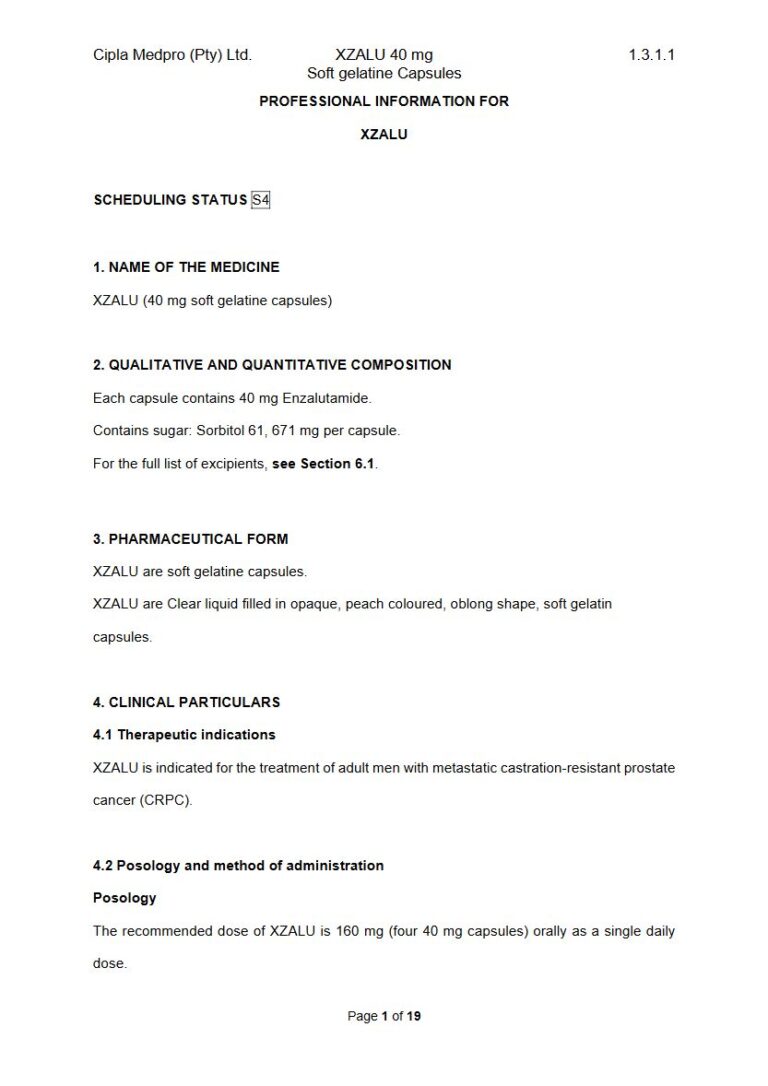
4.1 Therapeutic indications
XZALU is indicated for the treatment of adult men with metastatic castration-resistant prostate cancer (CRPC).
4.2 Posology and method of administration
Posology
The recommended dose of XZALU is 160 mg (four 40 mg capsules) orally as a single daily dose.
Special populations
Elderly patients
No dosage adjustment is necessary for elderly patients ( see section 5.2 ).
Hepatic impairment
No dosage adjustment is necessary for patients with mild to moderate hepatic impairment (Child-Pugh Class A or B u2013 See section 5.2 ). Caution is advised in patients with severe hepatic impairment (Child-Pugh class C u2013 See section 4.4 ).
Renal impairment
No dosage adjustment is necessary for patients with mild or moderate renal impairment ( See section 5.2 ). Caution is advised in patients with severe renal impairment or end stage renal disease ( see section 4.4 ).
Paediatric population
There is no relevant use of this medicine in the paediatric population, as prostate cancer is not present in children and adolescents.
Method of administration:
XZALU soft gelatine capsules should be swallowed whole with water and can be taken with or without food. If a patient miss taking XZALU at the usual time, the prescribed dose should be taken as close as possible to the usual time. If a patient misses a dose for a whole day, treatment should be resumed the following day with the usual daily dose.
4.3 Contraindications
XZALU is contra-indicated in:
u2022 Patients with known hypersensitivity to enzalutamide or any of the excipients of XZALU listed in section 6.1 .
u2022 Women.
4.4 Special warnings and precautions for use
Risk of seizure
Caution should be used when administering XZALU to patients with a history of seizures or other predisposing factors including, but not limited to, underlying brain injury, stroke, primary brain tumours or brain metastases, or alcoholism. In addition, the risk of seizures may be increased in patients receiving concomitant medicines that lower the seizure threshold. The decision to continue treatment in patients who develop seizure should be taken case by case.
Posterior reversible encephalopathy syndrome
There have been rare reports of posterior reversible encephalopathy syndrome (PRES) in patients receiving enzalutamide ( see section 4.8 ). PRES is a rare, reversible, neurological disorder which can present with rapidly evolving symptoms including seizure, headache, confusion, blindness, and other visual and neurological disturbances, with or without associated hypertension. A diagnosis of PRES requires confirmation by brain imaging, preferably magnetic resonance imaging (MRI). Discontinuation of XZALU in patients who develop PRES is recommended.
Concomitant use with other medicines
Enzalutamide is a potent enzyme inducer and may lead to loss of efficacy of many commonly used medicines ( see section 4.5 ). A review of concomitant medicines should therefore be conducted when initiating XZALU treatment. Concomitant use of XZALU with medicines that are sensitive substrates of many metabolising enzymes or transporters ( see section 4.5 ) should generally be avoided if their therapeutic effect is of large importance to the patient, and if dose adjustments cannot easily be performed based on monitoring of efficacy or plasma concentrations.
Co-administration with warfarin and coumarin-like anticoagulants should be avoided. If XZALU is co-administered with an anticoagulant metabolised by CYP2C9 (such as warfarin), additional International Normalised Ratio (INR) monitoring should be conducted ( see section 4.5 ).
Renal impairment
Caution should be exercised in patients with severe renal impairment as XZALU has not been studied in this patient population.
Hepatic impairment
An increased half-life of enzalutamide has been observed in patients with severe hepatic impairment, possibly related to increased tissue distribution. The clinical relevance of this observation remains unknown. A prolonged time to reach steady state concentrations is however anticipated, and the time to maximum pharmacological effect as well as time for onset and decline of enzyme induction ( see section 4.5 ) may be increased.
Androgen deprivation therapy may prolong the QT interval
In patients with a history of or risk factors for QT prolongation and in patients receiving concomitant medicines that might prolong the QT interval ( see section 4.5 ), medical practitioners should assess the benefit risk ratio including the potential for Torsade de pointes prior to initiating XZALU.
Use with chemotherapy
The safety and efficacy of concomitant use of XZALU with cytotoxic chemotherapy has not been established. Co-administration of enzalutamide has no clinically relevant effect on the pharmacokinetics of intravenous docetaxel ( see section 4.5 ); however, an increase in the occurrence of docetaxel-induced neutropenia cannot be excluded.
Hypersensitivity reactions
Hypersensitivity reactions manifested by symptoms including, but not limited to, rash, or face, tongue, lip, or pharyngeal oedema, have been observed with enzalutamide ( see section 4.8 ).
Excipients
XZALU contains glycerol which may cause headache, stomach upset and diarrhoea. XZALU contains sorbitol, patients with hereditary fructose intolerance (HFI) should not take/be given this medicine. Sorbitol may also cause gastrointestinal discomfort and a mild laxative effect.
4.5 Interactions with other medicines
Potential for other medicines to affect enzalutamide exposure
CYP2C8 inhibitors and inducers
CYP2C8 plays an important role in the elimination of enzalutamide and in the formation of its active metabolite. Following oral administration of the strong CYP2C8 inhibitor gemfibrozil (600 mg twice daily) to healthy male subjects, the AUC of enzalutamide increased 4,26-fold while the C max decreased by 18 %; the AUC and C max of the active metabolite decreased by 25 % and-44 % respectively. Strong inhibitors (e.g. gemfibrozil) or inducers (e.g. rifampicin) of CYP2C8 are to be avoided or used with caution during XZALU treatment. If co-administration of the strong CYP2C8 inhibitor is discontinued, the enzalutamide dose should be returned to the dose used prior to initiation of the strong CYP2C8 inhibitor.
CYP3A4 inhibitors and inducers
CYP3A4 plays a minor role in the metabolism of enzalutamide. Following oral administration of the strong CYP3A4 inhibitor itraconazole (200 mg once daily) to healthy male subjects, the AUC of enzalutamide increased by 1,41-fold while the C max was essentially unaffected (decreased by 2 %); the AUC of the active metabolite increased by 1,21 fold while the C max decreased by 14 %. No dose adjustment is necessary when XZALU is co-administered with inhibitors or inducers of CYP3A4.
CYP2C8 and CYP3A4 inducers
Following oral administration of the moderate CYP2C8 and strong CYP3A4 inducer rifampicin (600 mg once daily) to healthy male subjects, the AUC of enzalutamide plus the active metabolite decreased by 37 % while C max remained unchanged. No dose adjustment is necessary when XZALU is co-administered with inducers of CYP2C8 or CYP3A4.
Potential for XZALU to affect exposure to other medicines
Enzyme induction
Enzalutamide is a potent enzyme inducer and increases the synthesis of many enzymes and transporters; therefore, interaction with many common medicinal products that are substrates of enzymes or transporters is expected. The reduction in plasma concentrations can be substantial, and lead to lost or reduced clinical effect. There is also a risk of increased formation of active metabolites. Enzymes that may be induced include CYP3A in the liver and gut, CYP2B6, CYP2C9, CYP2C19, and uridine 5'-diphospho glucuronosyltransferase (UGTs - glucuronide conjugating enzymes). The transport protein P-gp may also be induced, and probably other transporters as well, e.g. multidrug resistance-associated protein 2 (MRP2), breast cancer resistance protein (BCRP) and the organic anion transporting polypeptide 1B1 (OATP1B1).
XZALU is a strong inducer of CYP3A4 and a moderate inducer of CYP2C9 and CYP2C19. Co-administration of XZALU (160 mg daily) with single oral doses of sensitive CYP substrates in prostate cancer resulted in an 86 % decrease in the AUC of midazolam (CYP3A4 substrate), a 56 % decrease in the AUC of S-warfarin (CYP2C9 substrate), and a 70 % decrease in the AUC of omeprazole (CYP2C19) substrate. Uridine 5u2019-diphospho-gluccuronosyltransferase (UGT1A1) may have been induced as well. In a clinical study in patients with metastatic CRPC, enzalutamide (160 mg once daily) had no clinically relevant effect on the pharmacokinetics of intravenously administered docetaxel (75 mg/m2 by infusion every 3 weeks). The AUC of docetaxel decreased by 12 % [geometric mean ratio (GMR) = 0,882 (90 % CI: 0,767, 1,02)] while C max decreased by 4 % [GMR = 0,963 (90 % CI: 0,834, 1,11)]. Taken together, these results suggest that enzalutamide causes enzyme induction via activation of the nuclear pregnane receptor (PXR). Medicines with a narrow therapeutic range that are substrates of CYP3A4, CYP2C9, CYP2C19, and UGT1A1 should be used with caution when administered concomitantly with XZALU and may require dose adjustment to maintain therapeutic plasma concentrations. Such substrates include, but are not limited to:
u2022 Analgesics (e.g. fentanyl, tramadol).
u2022 Antibiotics (e.g. clarithromycin, doxycycline).
u2022 Anticancer medicines (e.g. cabazitaxel).
u2022 Antiepileptics (e.g. phenobarbitone, carbamazepine, clonazepam, phenytoin, primidone, valproic acid).
u2022 Antipsychotics (e.g. haloperidol).
u2022 Antithrombotics (e.g. acenocoumarol, warfarin, clopidogrel).
u2022 Betablockers (e.g. bisoprolol, propranolol).
u2022 Calcium channel blockers (e.g. diltiazem, felodipine, nicardipine, nifedipine, verapamil).
u2022 Cardiac glycosides (e.g. digoxin).
u2022 Corticosteroids (e.g. dexamethasone, prednisolone).
u2022 HIV antivirals (e.g. indinavir, ritonavir).
u2022 Hypnotics (e.g. diazepam, midazolam, zolpidem).
u2022 Immunosuppressant (e.g. tacrolimus).
u2022 Proton pump inhibitor (e.g. omeprazole).
u2022 Statins metabolised by CYP3A4 (e.g. atorvastatin, simvastatin).
u2022 Thyroid medicines (e.g. levothyroxine).
The full induction potential of enzalutamide may not occur until approximately 1 month after the start of treatment, when steady-state plasma concentrations of enzalutamide are reached, although some induction effects may be apparent earlier. Patients taking medicines that are substrates of CYP2B6, CYP3A4, CYP2C9, CYP2C19 or UGT1A1 should be evaluated for possible loss of pharmacological effects (or increase in effects in cases where active metabolites are formed) during the first month of enzalutamide treatment and dose adjustment should be considered as appropriate. In consideration of the long half-life of enzalutamide (5.8 days see section 5.2 ), effects on enzymes may persist for one month longer after stopping XZALU.
CYP1A2 and CYP2C8 substrates
XZALU (160 mg once daily) did not cause a clinically relevant change in the AUC or C max of caffeine (CYP1A2 substrate) or pioglitazone (CYP2C8 substrate) and no dose adjustment is indicated when a CYP1A2 or CYP2C8 substrate is co-administered with XZALU.
P-gp substrates
In vitro data indicate that enzalutamide may be an inhibitor of the efflux transporter P-gp. The effect of XZALU on P-gp substrates has not been evaluated in vivo; however, under conditions of clinical use, XZALU may be an inducer of P-gp via activation of PXR. Medicines with a narrow therapeutic range that are substrates of P-gp (e.g. colchicine, dabigatran etexilate, digoxin) should be used with caution when administered concomitantly with XZALU and may require dose adjustment to maintain optimal plasma concentrations.
BCRP, MRP2, OAT3 and OCT1 substrates
In vitro data indicate that enzalutamide may be an inhibitor of breast cancer resistant protein (BCRP), organic anion transporter 3 (OAT3) and organic cation transporter 1 (OCT1) (systemically), as well as multidrug resistance-associated protein 2 (MRP2) at clinically relevant concentrations in the gastrointestinal wall during absorption. Thus, XZALU may increase the plasma concentrations of co-administered medicines that are BCRP, OAT3, OCT1 or MRP2 substrates (e.g. methotrexate) should be used with caution when administered concomitantly with XZALU and may require dose adjustments to maintain optimal plasma concentrations.
Medicines which prolong the QT interval
Since androgen deprivation treatment may prolong the QT interval, the concomitant use of XZALU with medicines known to prolong the QT interval or medicines able to induce Torsade de pointes such as class IA (e.g. quinidine, disopyramide) or class III (e.g. amiodarone, sotalol, dofetilide, ibutilide) antiarrhythmic medicines, methadone, moxifloxacin, antipsychotics, etc. should be carefully evaluated ( see section 4.4 ).
Effect of food on XZALU exposure
Food has no clinically significant effect on the extent of exposure to enzalutamide.
4.6 Fertility, pregnancy and lactation
XZALU is contraindicated for use in women.
Contraception in males and females
It is not known whether XZALU or its metabolites are present in semen. A condom is required during and for 3 months after treatment with XZALU if the patient is engaged in sexual activity with a pregnant woman. If the patient engages in sexual intercourse with a woman of childbearing potential, a condom and another form of birth control must be used during and for 3 months after treatment. Studies in animals have shown reproductive toxicity.
Pregnancy
Considering the pharmacological consequences of androgen receptor signalling inhibition, maternal use of XZALU is expected to produce changes in hormone levels that could affect development of the foetus.
Breastfeeding
XZALU is not for use in women. It is unknown whether XZALU or its metabolites are excreted in human milk.
Fertility
Animal studies showed that enzalutamide affected the reproductive system in male rats and dogs.
4.7 Effects on ability to drive and use machines
XZALU has moderate influence on the ability to drive and use machines as psychiatric and neurologic events including seizure have been reported ( see section 4.8 ). Patients should be advised of the potential risk of experiencing a psychiatric or neurological event while driving or operating machines. No studies to evaluate the effects of enzalutamide on the ability to drive and use machines have been conducted.
4.8 Undesirable effects
Summary of the safety profile
The most common adverse reactions are asthenia/fatigue, hot flush, headache, fractures, and hypertension. Other important adverse reactions include fall, non-pathologic fractures, cognitive disorder, and neutropenia. Seizure occurred in 0.4 % of enzalutamide-treated patients, 0.1 % of placebo-treated patients and 0.3 % in bicalutamide-treated patients.
Rare cases of posterior reversible encephalopathy syndrome have been reported in enzalutamide-treated patients ( see section 4.4 ). The following adverse effects have been classified as either being frequent, less frequent, or of an unknown frequency.
Blood and lymphatic system disorders
Less frequent: leukopenia, neutropenia. Frequency unknown: thrombocytopenia.
Immune system disorders
Frequency unknown: face oedema, tongue oedema, lip oedema, pharyngeal oedema.
Psychiatric disorders
Frequent: anxiety. Less frequent: visual hallucination.
Nervous system disorders
Frequent: headache, memory impairment, amnesia, disturbance in attention, restless legs syndrome. Less frequent: cognitive disorder, seizure u00a5 . Frequency unknown: posterior reversible encephalopathy syndrome.
Cardiac disorders
Frequent: ischemic heart disease u2020 . Frequency unknown: QT-prolongation ( see sections 4.4 and 4.5 ).
Vascular disorders
Frequent: hot flush, hypertension.
Gastrointestinal disorders
Frequency unknown: nausea, vomiting, diarrhoea.
Skin and subcutaneous tissue disorders
Frequent: dry skin, pruritus. Frequency unknown: rash.
Musculoskeletal and connective tissue disorders
Frequent: fractures u2021 . Frequency unknown: myalgia, muscle spasms, muscular weakness, back pain.
Reproductive system and breast disorder
Frequent: gynaecomastia.
General disorders and administration site conditions
Frequent: asthenia, fatigue.
Injury, poisoning and procedural Complications
Frequent: fall.
Adverse reactions identified post-marketing
Musculoskeletal and connective tissue disorders: **Fractures *myalgia, muscle spasms, muscular weakness, back pain.
Nervous System Disorders
*posterior reversible encephalopathy syndrome * Spontaneous reports from post-marketing experience ** Includes all fractures with the exception of pathological fractures u00a5 As evaluated by narrow Standardised MedDRA Queries (SMQs) of 'Convulsions' including convulsion, grand mal convulsion, complex partial seizures, partial seizures, and status epilepticus. This includes rare cases of seizure with complications leading to death.
u2020 As evaluated by narrow SMQs of 'Myocardial Infarction' and 'Other Ischemic Heart Disease' including the following preferred terms observed in at least two patients in randomized placebo-controlled phase 3 studies: angina pectoris, coronary artery disease, myocardial infarctions, acute myocardial infarction, acute coronary syndrome, angina unstable, myocardial ischaemia, and arteriosclerosis coronary artery.
u2021 Includes all preferred terms with the word 'fracture' in bones.
Description of selected adverse reactions
Seizure
Dose appears to be an important predictor of the risk of seizure. The mechanism by which XZALU may lower the seizure threshold is not known but could be related to data from in vitro studies showing that enzalutamide and its active metabolite bind to and can inhibit the activity of the GABA-gated chloride channel.
Ischemic Heart Disease
In randomized placebo-controlled clinical studies, ischemic heart disease occurred in 2,5% of patients treated with enzalutamide plus ADT compared to 1,3 % patients treated with placebo plus ADT.
4.9 Overdose
There is no antidote for XZALU. In the event of an overdose, treatment with XZALU should be stopped and general supportive measures initiated taking into consideration the half-life of 5,8 days. Patients may be at increased risk of seizures following an overdose.
