
Abexem 1g Injection
PDF Leaflet Revision Date: 04.2023
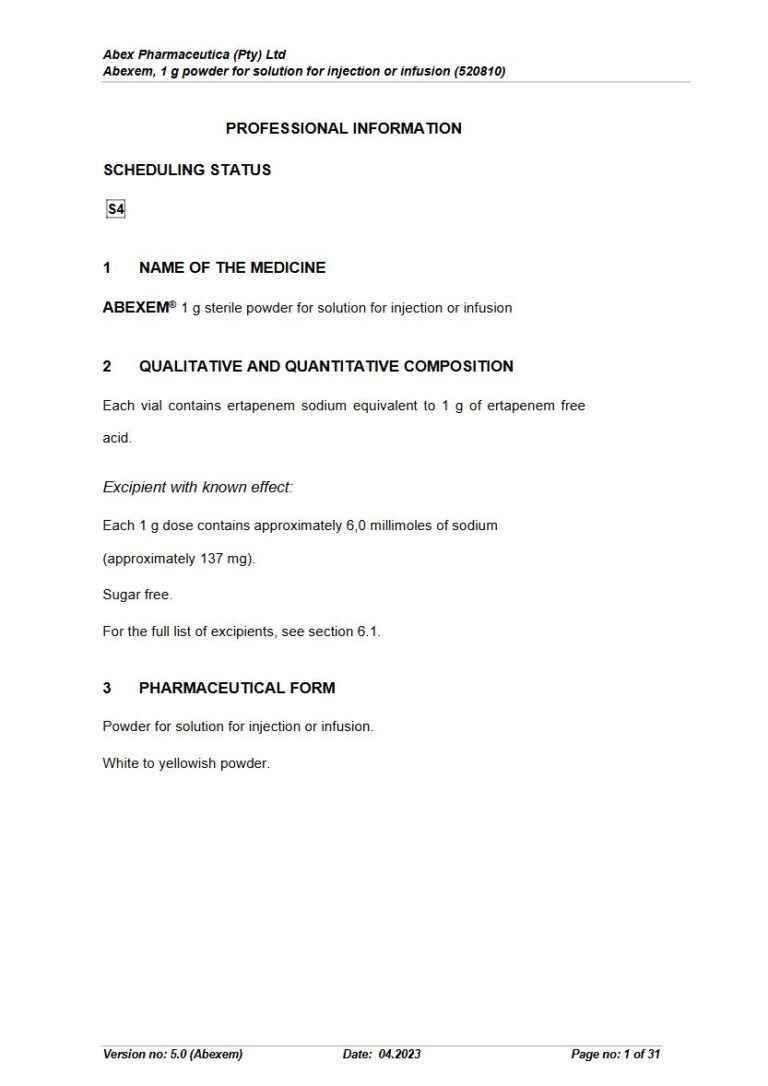
Clinical Summary
Quick overview from the medicine insert
Indication
Treatment of moderate to severe infections in adults and children.
Dosage (summary)
Adults: 1 g once daily; Children 3 months-12 years: 15 mg/kg twice daily (max 1 g/day).
Special Populations
- Renal impairment
- Hepatic impairment
Pregnancy & Breastfeeding
Safety in pregnancy and lactation not established.
Key Drug Interactions
- Valproic acid
- Probenecid
Contraindications
- Hypersensitivity to ertapenem
- Hypersensitivity to beta-lactam antibiotics
- Known bacterial meningitis
- Infants under 3 months
Common side effects
- Diarrhoea
- Nausea
- Headache
- Infused vein complication
Counselling Points
- Report any allergic reactions
- Avoid driving if affected by dizziness
- Complete the full course of therapy
Serious warnings
- Serious hypersensitivity reactions
- Risk of seizures
- Antibiotic-associated colitis
Important Disclaimer
The Abexem 1g Injection professional information leaflet below is the property of Abex Pharmaceutica and is provided on Medinsert exactly as issued, with no.. alterations or editorial changes. We make every effort to keep content current by updating documents as soon as new versions become available. Medinsert serves as a trusted access point for healthcare professionals, but does not replace official sources or clinical judgement. For more details, please read our full disclaimer. read more>>
 Healthcare Professionals Only
This content is for registered healthcare professionals
Sign in or create a free account to read the full package insert.
Free for HPCSA-registered professionals. Powered by Medinsert.
Clinical Particulars
Section 4 of the official insert — extracted exactly as issued, no alterations
4.1 Therapeutic indications
Adult patients
ABEXEM is indicated for the treatment of adult patients with the following moderate to severe infections, caused by susceptible strains of the designated microorganisms (see section 4.2):
- Complicated intra-abdominal infections due to Escherichia coli, Clostridium clostridioforme, Eubacterium lentum, Peptostreptococcus species, Bacteroides fragilis, Bacteroides distasonis, Bacteroides ovatus, Bacteroides thetaiotaomicron, or Bacteroides uniformis.
- Complicated skin and skin structure infections including diabetic lower extremity and diabetic foot infections due to Staphylococcus aureus (methicillin susceptible strains only), Streptococcus agalactiae, Streptococcus pyogenes, Escherichia coli, Klebsiella pneumoniae, Proteus mirabilis, Porphyromonas asaccharolytica or Peptostreptococcus species.
- Community acquired pneumonia due to Streptococcus pneumonia (penicillin susceptible strains only) including cases with concurrent bacteraemia, Moraxella catarrhalis. If community acquired pneumonia is caused by Haemophilus influenzae, ABEXEM should be used only after confirmation of culture and sensitivity results.
- Complicated urinary tract infections including pyelonephritis due to Escherichia coli, including cases with concurrent bacteraemia, or Klebsiella pneumoniae.
- Acute pelvic infections including postpartum endomyometritis, septic abortion and post-surgical gynaecologic infections due to Streptococcus agalactiae, Escherichia coli, Bacteroides fragilis, Porphyromonas asaccharolytica, Peptostreptococcus species or Prevotelia bivia.
Paediatric patients
ABEXEM is indicated in paediatric patients 3 months to 17 years of age with the following infections (see u201cAdult patientsu201d above for susceptible organisms):
- Complicated intra-abdominal infections
- Complicated skin and skin structure infections
- Community acquired pneumonia
- Complicated urinary tract infections
- Acute pelvic infections.
Appropriate specimens for bacteriological examination should be obtained in order to isolate and identify the causative organisms and to determine their susceptibility to ertapenem. Therapy with ABEXEM may be initiated empirically before results of these tests are known; once results become available, antimicrobial therapy should be adjusted accordingly.
4.2 Posology and method of administration
Posology
The usual dose of ABEXEM in patients 13 years of age and older is 1 gram (g) given once a day.
The usual dose of ABEXEM in patients 3 months to 12 years of age is 15 mg/kg twice daily (not to exceed 1 g/day).
Intramuscular administration of ABEXEM may be used as an alternative to intravenous administration in the treatment of those infections for which intramuscular therapy is appropriate.
Dosage guidelines for adults and paediatric patients with normal renal function* and body mass
Infection
- Daily dose (IV or IM) adults and paediatric patients 13 years of age and older
- Daily dose (IV or IM) paediatric patients 3 months to 12 years of age
- Recommended duration of total antimicrobial treatment
Complicated intra-abdominal infections
- 1 g
- 15 mg/kg twice daily
- 5 to 14 days
Complicated skin and skin structure infections including diabetic lower extremity and diabetic foot infections
- 1 g
- 15 mg/kg twice daily
- 7 to 14 days
Community acquired pneumonia
- 1 g
- 15 mg/kg twice daily
- 10 to 14 days
Complicated urinary tract infections including pyelonephritis
- 1 g
- 15 mg/kg twice daily
- 10 to 14 days
Acute pelvic infections including postpartum endomyometritis, septic abortion and post-surgical gynaecologic infections
- 1 g
- 15 mg/kg twice daily
- 3 to 10 days
* Defined as creatinine clearance greater than 90 ml/min/1,73 mu00b2.
u2020 Duration includes a possible switch to an appropriate oral therapy once clinical improvement has been demonstrated.
u00a7 Not to exceed 1 g/day.
u2551 Patients with diabetic foot infections received up to 28 days of treatment (parenteral or parenteral plus oral switch therapy).
Special populations
Patients with renal insufficiency
ABEXEM may be used for the treatment of infections in adult patients with renal insufficiency. In adult patients whose creatinine clearance is greater than 30 ml/min/1,73 mu00b2, no dosage adjustment is necessary. Adult patients with advanced renal insufficiency (creatinine clearance less than or equal to 30 ml/min/1,73 mu00b2), including those on haemodialysis, should receive 500 mg daily. There are no data in paediatric patients with renal insufficiency.
Patients on haemodialysis
Following a single 1 g IV dose of ertapenem given immediately prior to a haemodialysis session, approximately 30 % of the dose may be recovered in the dialysate. When adult patients on haemodialysis are given the recommended daily dose of 500 mg of ABEXEM within 6 hours prior to haemodialysis, a supplementary dose of 150 mg is recommended after the haemodialysis session. If ABEXEM is given at least 6 hours before haemodialysis, no supplementary dose is needed.
No data are available in patients undergoing peritoneal dialysis or haemofiltration. There are also no data in paediatric patients on haemodialysis.
When only the serum creatinine is available, the following formula** may be used to calculate creatinine clearance. The serum creatinine should represent a steady state of renal function.
Males: (weight in kg) x (140 - age in years) / (72 x serum creatinine (mg/100 ml))
Females: (0,85) x (value calculated for males)
** Cockcroft and Gault equation: Cockcroft DW, Gault MH. Prediction of creatinine clearance from serum creatinine. Nephron. 1976.
No dosage adjustment is recommended in patients with impaired hepatic function (see section 5.2, Hepatic insufficiency).
The recommended dose of ABEXEM may be administered without regard to age (13 years of age and older) or gender.
Method of administration
For instructions on the preparation of ABEXEM before administration, see section 6.6. ABEXEM may be administered by intravenous (IV) infusion or intramuscular (IM) injection. When administered intravenously, ABEXEM should be infused over a period of 30 minutes.
The usual duration of therapy with ABEXEM is 3 to 14 days, but it may vary according to the type of infection and causative pathogen(s). When clinically indicated, a switch to an appropriate oral antimicrobial medicine may be implemented if clinical improvement has been observed.
4.3 Contraindications
- Hypersensitivity to ertapenem or to any of the excipients of ABEXEM.
- Hypersensitivity to beta-lactam antibiotics.
- Patients with known bacterial meningitis, due to lack of sufficient cerebrospinal fluid (CSF) penetration.
- ABEXEM is not recommended in infants under 3 months of age, as no data are available.
- Due to the use of lidocaine (lignocaine) hydrochloride as a diluent, ABEXEM administered intramuscularly is contraindicated in patients with a known hypersensitivity to amide type local anaesthetics and in patients with severe shock or heart block. (Refer to the professional information for lidocaine (lignocaine) hydrochloride.)
4.4 Special warnings and precautions for use
Hypersensitivity
SERIOUS AND OCCASIONALLY FATAL HYPERSENSITIVITY (ANAPHYLACTIC) REACTIONS HAVE BEEN REPORTED IN PATIENTS RECEIVING THERAPY WITH BETA-LACTAM ANTIBIOTICS, INCLUDING ABEXEM. THESE REACTIONS ARE MORE LIKELY TO OCCUR IN INDIVIDUALS WITH A HISTORY OF SENSITIVITY TO MULTIPLE ALLERGENS. THERE HAVE BEEN REPORTS OF INDIVIDUALS WITH A HISTORY OF PENICILLIN HYPERSENSITIVITY WHO HAVE EXPERIENCED SEVERE HYPERSENSITIVITY REACTIONS WHEN TREATED WITH ANOTHER BETA-LACTAM. BEFORE INITIATING THERAPY WITH ABEXEM, CAREFUL INQUIRY SHOULD BE MADE CONCERNING PREVIOUS HYPERSENSITIVITY REACTIONS TO PENICILLINS, CEPHALOSPORINS, OTHER BETA-LACTAMS AND OTHER ALLERGENS. IF AN ALLERGIC REACTION TO ABEXEM OCCURS, DISCONTINUE ABEXEM IMMEDIATELY. SERIOUS ANAPHYLACTIC REACTIONS REQUIRE IMMEDIATE EMERGENCY TREATMENT WITH ADRENALINE (EPINEPHRINE), OXYGEN, INTRAVENOUS STEROIDS, AND AIRWAY MANAGEMENT, INCLUDING INTUBATION. OTHER THERAPY MAY ALSO BE ADMINISTERED AS INDICATED.
Prescribers must adhere to the principles of antibiotic stewardship.
Superinfection
Prolonged use of ABEXEM may result in overgrowth of non-susceptible organisms. Repeated evaluation of the patient's condition is essential. If superinfection occurs during therapy, appropriate measures should be taken. See u201cAntibiotic-associated colitisu201d below.
Antibiotic-associated colitis
Pseudomembranous colitis (antibiotic-associated colitis) has been reported with ertapenem (contained in ABEXEM) and may range in severity from mild to life-threatening. Therefore, it is important to consider this diagnosis in patients who present with diarrhoea subsequent to the administration of ABEXEM. Treatment with ABEXEM alters the normal flora of the colon and may permit overgrowth of clostridia. It has been demonstrated that a toxin produced by Clostridium difficile is a primary cause of u201cantibiotic-associated colitisu201d. After the diagnosis of pseudomembranous colitis has been established, therapeutic measures should be initiated. Mild cases of pseudomembranous colitis usually respond to discontinuation of ABEXEM. In moderate to severe cases, consideration should be given to management with fluids and electrolytes, parenteral nutrition and treatment with an antibacterial medicine clinically effective against Clostridium difficile colitis. Medicines that inhibit peristalsis should not be given.
Seizures
Seizures and other central nervous system (CNS) adverse experiences have been reported during treatment with ertapenem (as in ABEXEM); see section 4.8. Seizures occur more frequently in elderly patients and those with pre-existing CNS disorders (e.g., brain lesions or history of seizures) and/or compromised renal function. Close adherence to the recommended dosage regimen is urged, especially in patients with known factors that predispose to convulsive activity. Anticonvulsant therapy should be continued in patients with known seizure disorder. If focal tremors, myoclonus or seizures occur, patients should be evaluated neurologically and the dosage of ABEXEM re-examined to determine whether it should be decreased or discontinued.
Concomitant use with valproic acid
The concomitant use of ABEXEM and valproic acid or divalproex sodium results in a reduction in valproic acid concentrations. The valproic acid concentrations may drop below the therapeutic range as a result of this interaction, therefore increasing the risk of breakthrough seizures. Increasing the dose of valproic acid or divalproex sodium may not be enough to overcome this interaction. The concomitant use of ABEXEM and valproic acid or divalproex sodium is not recommended (see section 4.5). Antibacterials other than carbapenems should be considered to treat infections in patients whose seizures are well controlled on valproic acid or divalproex sodium. If administration of ABEXEM is necessary, supplemental anticonvulsant therapy should be considered (see section 4.5).
Sub-optimal exposure
In surgical interventions exceeding 4 hours, patients could be exposed to sub-optimal ertapenem concentrations and consequently to a risk of potential treatment failure. Therefore, caution should be exercised in such unusual cases.
Considerations for use in particular populations
Experience in the use of ABEXEM for severe infections is limited. Efficacy has not been established for the use of ABEXEM in the treatment of community acquired pneumonia due to penicillin-resistant Streptococcus pneumoniae, or for diabetic foot infections with concurrent osteomyelitis. Caution should be taken with IM administration of ABEXEM not to inject it inadvertently into a blood vessel (see section 4.2). Lidocaine (lignocaine) hydrochloride is the diluent for intramuscular administration of ABEXEM. Refer to the professional information for lidocaine hydrochloride. There is little experience with ertapenem (as in ABEXEM) in children less than two years of age. In this age group, particular care should be taken to establish the susceptibility of the infecting organism(s) to ertapenem. No data are available in children under 3 months of age, ABEXEM is therefore contraindicated in this age group (see section 4.3).
Information on the inactive ingredients
Each vial contains approximately 6,0 millimoles of sodium (approximately 137 mg) which should be taken into consideration by patients on a controlled sodium diet.
4.5 Interactions with other medicines and other forms of interaction
Ertapenem does not inhibit metabolism mediated by any of the six major cytochrome p450 (CYP) isoforms: 1A2, 2C9, 2C19, 2D6, 2E1 and 3A4.
Medicine interactions caused by inhibition of P-glycoprotein-mediated medicine clearance or CYP-mediated medicine clearance are unlikely (see section 5.2). Ertapenem does not inhibit P-glycoprotein-mediated transport of digoxin or vinblastine and is not a substrate for P-glycoprotein-mediated transport.
Valproic acid
Decreases in valproic acid levels that may fall below the therapeutic range have been reported when valproic acid or divalproex sodium was co-administered with carbapenem medicines, including ABEXEM. The lowered valproic acid levels may lead to inadequate seizure control; therefore, concomitant use of ABEXEM and valproic acid/sodium valproate is not recommended and alternative antibacterial or anticonvulsant therapies should be considered.
Probenecid
Probenecid inhibits the renal excretion of ertapenem, thereby increasing its plasma concentrations and prolonging its elimination half-life.
4.6 Fertility, pregnancy and lactation
Pregnancy
Safety in pregnancy has not been established.
Lactation
Ertapenem is excreted in human milk (see section 5.2). Safety in nursing mothers has not been established.
Fertility
There are no adequate and well controlled studies regarding the effect of ertapenem on fertility in men and women.
4.7 Effects on ability to drive and use machines
Dizziness and somnolence are possible undesirable effects of ABEXEM (see section 4.8). If affected, patients should be warned not to drive or operate machinery.
4.8 Undesirable effects
a. Summary of the safety profile
Adults
Most adverse experiences reported in clinical studies were described as mild to moderate in severity. Medicine-related adverse experiences were reported in approximately 20 % of patients treated with ertapenem. Ertapenem was discontinued due to adverse experiences thought to be medicine-related in 1,3 % of patients. The most frequent medicine-related adverse experiences reported during parenteral therapy in patients treated with ertapenem were diarrhoea (4,3 %), infused vein complication (3,9 %), nausea (2,9 %) and headache (2,1 %).
Paediatric population (3 months to 17 years of age): The overall safety profile is comparable to that in adult patients. In clinical trials, the most frequent medicine-related clinical adverse experiences reported during parenteral therapy were diarrhoea (5,5 %), infusion site pain (5,5 %) and infusion site erythema (2,6 %).
b. Tabulated list of adverse reactions
ADULTS 18 years of age and older
System organ class/ Adverse reactions Frequency
Infections and infestations
Less frequent: Oral candidiasis, candidiasis, fungal infection, pseudomembranous enterocolitis, vaginitis, pneumonia, dermatomycosis, postoperative wound infection, urinary tract infection, C. difficile-associated diarrhoea
Blood and lymphatic system disorders
Less frequent: Neutropenia, thrombocytopenia
Immune system disorders
Less frequent: Allergy
Frequency not known: Anaphylaxis including anaphylactoid reactions
Metabolism and nutrition disorders
Less frequent: Anorexia, hypoglycaemia
Psychiatric disorders
Less frequent: Insomnia, somnolence, confusion, agitation, anxiety, depression
Frequency unknown: Altered mental status (including aggression, delirium, disorientation, mental status changes), hallucinations
Nervous system disorders
Frequent: Headache
Less frequent: Dizziness, taste perversion, seizure (see section 4.4), tremor, syncope
Frequency not known: Depressed level of consciousness, dyskinesia, myoclonus, gait disturbance
Eye disorders
Less frequent: Scleral disorder
Cardiac disorders
Less frequent: Sinus bradycardia, dysrhythmia, tachycardia
Vascular disorders
Frequent: Infused vein complication, phlebitis/thrombophlebitis
Less frequent: Hypotension, extravasation, haemorrhage, increased blood pressure
Respiratory, thoracic and mediastinal disorders
Less frequent: Dyspnoea, pharyngeal discomfort, nasal congestion, cough, epistaxis, rales/rhonchi, wheezing
Gastrointestinal disorders
Frequent: Diarrhoea, nausea, vomiting
Less frequent: Constipation, acid regurgitation, dry mouth, dyspepsia, abdominal pain, dysphagia, faecal incontinence, pelvic peritonitis
Frequency not known: Stained teeth
Hepato-biliary disorders
Less frequent: Cholecystitis, jaundice, liver disorder
Skin and subcutaneous tissue disorders
Frequent: Rash
Less frequent: Erythema, urticaria, dermatitis, desquamation, pruritus
Frequency not known: Drug Rash with Eosinophilia and Systemic Symptoms (DRESS syndrome), toxic epidermal necrolysis, Stevens-Johnson syndrome, Acute Generalised Exanthematous Pustulosis (AGEP)
Musculoskeletal and connective tissue disorders
Less frequent: Muscle cramp, shoulder pain
Frequency not known: Muscular weakness
Renal and urinary disorders
Less frequent: Renal insufficiency, acute renal insufficiency
Pregnancy, puerperium and perinatal conditions
Less frequent: Abortion
Reproductive system and breast disorders
Less frequent: Genital bleeding, vaginal pruritus
General disorders and administration site conditions
Less frequent: Extravasation, asthenia/fatigue, fever, pain, oedema/swelling, chest pain, injection site induration, malaise
Investigations
Chemistry: Frequent: Elevations in alanine aminotransferase (ALT), aspartate aminotransferase (AST), alkaline phosphatase
Less frequent: Increases in total serum bilirubin, direct serum bilirubin, indirect serum bilirubin, serum creatinine, serum urea, serum glucose, decreases in serum bicarbonate, serum creatinine and serum potassium; increases in serum LDH, serum phosphorus, serum potassium
Haematology
Frequent: Elevation in platelet count
Less frequent: Decreases in white blood cells, platelet count, segmented neutrophils, haemoglobin and haematocrit; increases in eosinophils, activated partial thromboplastin time, prothrombin time (INR), segmented neutrophils and white blood cells, decrease in lymphocytes; increases in band neutrophils, lymphocytes, metamyelocytes, monocytes, myelocytes; atypical lymphocytes
Urinalysis
Less frequent: Increases in urine bacteria, urine white blood cells, urine epithelial cells and urine red blood cells; urine yeast present, increase in urobilinogen
CHILDREN AND ADOLESCENTS (3 months to 17 years of age)
System organ class/ Adverse reactions Frequency
Psychiatric disorders
Frequency not known: Altered mental status (including aggression), hallucinations
Nervous system disorders
Less frequent: Headache
Vascular disorders
Less frequent: Hot flush, hypertension
Gastrointestinal disorders
Frequent: Diarrhoea, vomiting
Less frequent: Faeces discoloured, melaena
Skin and subcutaneous tissue disorders
Frequent: Diaper dermatitis, rash
Less frequent: Erythema, rash, petechiae
General disorders and administration site conditions
Frequent: Infusion site pain, infusion site pruritus, infusion site erythema, infusion site swelling
Less frequent: Infusion site burning, injection site erythema, infusion site warmth
Investigations
Chemistry
Frequent: Elevations in ALT and AST
Haematology
Frequent: Decreases in neutrophil count
Less frequent: Increases in platelet count, activated partial thromboplastin time, prothrombin time (INR), decreases in haemoglobin, increase in eosinophils
Reporting of suspected adverse reactions
Reporting suspected adverse reactions after authorisation of the medicine is important. It allows continued monitoring of the benefit/risk balance of the medicine. Healthcare professionals are asked to report any suspected adverse reactions to SAHPRA via the online service for adverse drug reaction reporting by following the link: https://www.sahpra.org.za/Publications/Index/8
4.9 Overdose
No specific information is available on the treatment of overdosage with ABEXEM. In the event of an overdose, ABEXEM should be discontinued and general supportive treatment given until renal elimination takes place. ABEXEM can be removed by haemodialysis; however, no information is available on the use of haemodialysis to treat overdosage.
