
Cubact 500 mg POWDER FOR SOLUTION FOR INFUSION
PDF Leaflet Revision Date: May 2023
Clinical Summary
Quick overview from the medicine insert
Indication
Indicated for complicated skin infections and Staphylococcus aureus bloodstream infections.
Dosage (summary)
cSSSI: 4 mg/kg IV once daily; SAB: 6 mg/kg IV once daily.
Special Populations
- Renal impairment
- Hepatic impairment
- Elderly
Pregnancy & Breastfeeding
Safety in pregnancy and lactation not established.
Key Drug Interactions
- Increased risk of myopathy with statins
- Warfarin monitoring required
Contraindications
- Hypersensitivity to daptomycin
- Treatment of pneumonia
Common side effects
- Dizziness
- Nausea
- Rash
- Increased CPK
Counselling Points
- Monitor for muscle pain or weakness
- Avoid driving if dizzy
- Report any allergic reactions
Serious warnings
- Risk of myopathy
- Not effective for pneumonia
- Anaphylaxis possible
Important Disclaimer
The Cubact 500 mg POWDER FOR SOLUTION FOR INFUSION professional information leaflet below is the property of Abex Pharmaceutica and is provided on Medinsert exactly as issued, with no.. alterations or editorial changes. We make every effort to keep content current by updating documents as soon as new versions become available. Medinsert serves as a trusted access point for healthcare professionals, but does not replace official sources or clinical judgement. For more details, please read our full disclaimer. read more>>
 Healthcare Professionals Only
This content is for registered healthcare professionals
Sign in or create a free account to read the full package insert.
Free for HPCSA-registered professionals. Powered by Medinsert.
Clinical Particulars
Section 4 of the official insert — extracted exactly as issued, no alterations
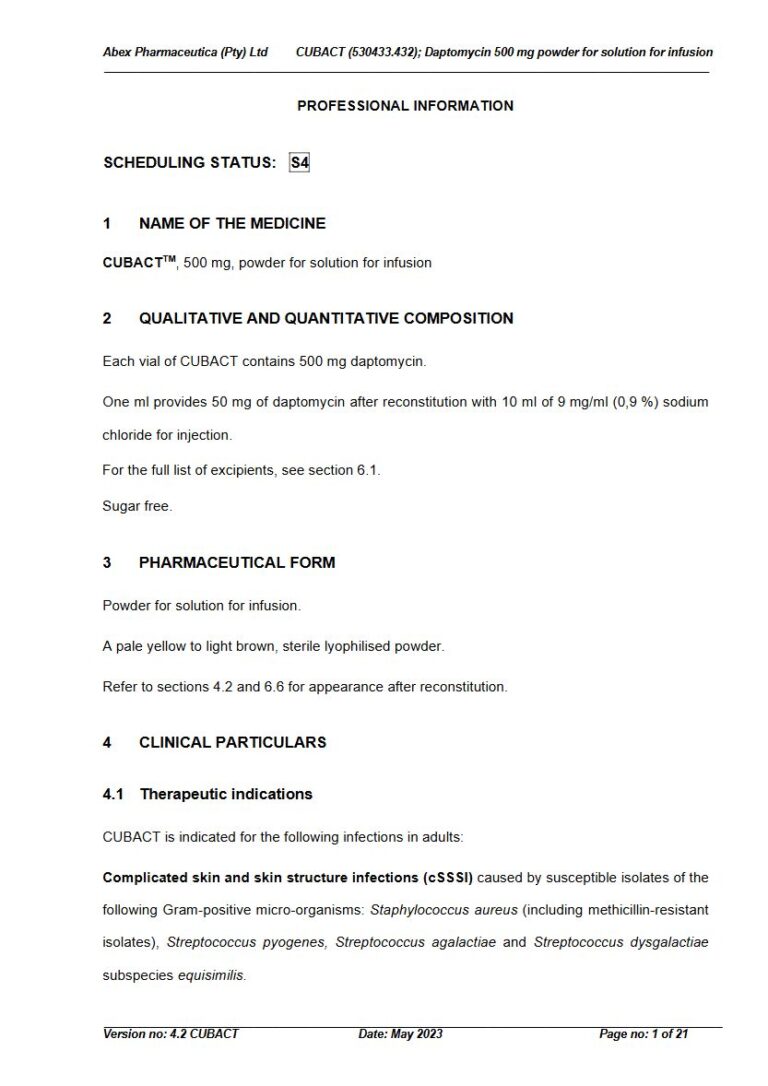
4.1 Therapeutic indications
CUBACT is indicated for the following infections in adults:
- Complicated skin and skin structure infections (cSSSI) caused by susceptible isolates of the following Gram-positive micro-organisms:
- Staphylococcus aureus (including methicillin-resistant isolates),
- Streptococcus pyogenes,
- Streptococcus agalactiae and
- Streptococcus dysgalactiae subspecies equisimilis.
- Staphylococcus aureus bloodstream (SAB) infections (bacteraemia), including those with right-sided infective endocarditis (RIE), caused by methicillin-susceptible and methicillin-resistant isolates. Combination therapy may be clinically indicated if the documented or presumed pathogens include Gram-negative or anaerobic organisms.
The efficacy of CUBACT in patients with left-sided infective endocarditis and in patients with artificial valve endocarditis due to Staphylococcus aureus has not been demonstrated. CUBACT is not indicated for the treatment of pneumonia (see section 4.4).
4.2 Posology and method of administration
Dosage and directions for use pertain to adults u2265 18 years.
Posology
Complicated skin and skin structure infections (cSSSI)
CUBACT 4 mg/kg is administered once daily over a 30-minute period by IV infusion in 0,9 % sodium chloride injection, every 24 hours, for 7 - 14 days. CUBACT should not be dosed more frequently than once a day.
S. aureus bloodstream infections (bacteraemia), including right-sided infective endocarditis (SAB/RIE)
CUBACT 6 mg/kg is administered once daily over a 30-minute period by IV infusion in 0,9 % sodium chloride injection, once every 24 hours, for a minimum of 2 - 6 weeks. The duration of therapy may need to be longer than 14 days in accordance with the perceived risk of complications in the individual patient. CUBACT should not be dosed more frequently than once a day.
Special populations
Renal impairment
Daptomycin is eliminated primarily by the kidney. CUBACT should only be used in patients with any degree of renal impairment (CrCL < 80 ml/min) when it is considered that the expected clinical benefit outweighs the potential risk. The response to treatment, renal function and creatine phosphokinase (CPK) levels should be closely monitored in all patients with any degree of renal impairment (see section 5.2, Special populations, Creatine phosphokinase and myopathy and section 4.4).
Hepatic impairment
No dose adjustment is necessary when administering CUBACT to patients with mild or moderate hepatic impairment (Child-Pugh Class B). Patients with severe hepatic impairment (Child-Pugh Class C) have not been investigated.
Obesity
No dose adjustment of CUBACT is required in moderately obese (Body Mass Index [BMI] 25 - 39,9 kg/m2) or extremely obese (BMI > 40 kg/m2) patients.
Elderly patients
No dose adjustment of CUBACT is warranted for the elderly with normal renal function.
Children and adolescents (< 18 years old)
Safety and efficacy of CUBACT in patients under the age of 18 have not been established (see section 4.4).
Method of administration
In adults, CUBACT is given by intravenous infusion and administered over a 30-minute period. See section 6.6 for instruction for preparation of the infusion solution. Because only limited data are available on the compatibility of CUBACT with other IV substances, additives or other medications should not be added to CUBACT single-use vials or infused simultaneously through the same IV line. If the same IV line is used for sequential infusion of several different medicines, the line should be flushed with a compatible infusion solution before and after infusion with CUBACT. See section 6.2. The reconstituted solution is dark yellow to light brown, free of visible particles. For instructions on dilution of the product before administration, see section 6.6.
4.3 Contraindications
CUBACT is contraindicated:
- in patients with known hypersensitivity to daptomycin or to any of the ingredients of CUBACT;
- for the treatment of pneumonia (see section 4.4).
4.4 Special warnings and precautions for use
If a focus of infection other than cSSTI or RIE is identified after initiation of treatment with CUBACT, it should be considered to institute alternative antibacterial therapy that has been demonstrated to be efficacious in the treatment of the specific type of infection(s) present.
Anaphylaxis/hypersensitivity reactions
Anaphylaxis/hypersensitivity reactions have been reported with CUBACT (see section 4.8). If an allergic reaction to CUBACT occurs, its use should be discontinued and appropriate therapy should be instituted.
Pneumonia
CUBACT is not effective in the treatment of pneumonia. CUBACT is therefore not indicated for the treatment of pneumonia (see section 4.3).
RIE due to Staphylococcus aureus
The efficacy of CUBACT in patients with prosthetic valve infections or with left-sided infective endocarditis due to Staphylococcus aureus has not been demonstrated (see section 4.1 and 5.1 Resistance).
Deep-seated infections
Patients with deep-seated infections should receive any required surgical interventions (e.g. debridement, removal of prosthetic devices, valve replacement surgery) without delay.
Enterococcal infections
There is insufficient evidence regarding the possible clinical efficacy of CUBACT against infections due to enterococci, including Enterococcus faecalis and Enterococcus faecium. Failures with daptomycin in the treatment of enterococcal infections that were mostly accompanied by bacteraemia have been reported. In some instances, treatment failure has been associated with the selection of organisms with reduced susceptibility or frank resistance to daptomycin (see section 5.1).
Non-susceptible micro-organisms
The use of antibiotics, including CUBACT, may promote the overgrowth of non-susceptible micro-organisms. If superinfection occurs during therapy, appropriate measures should be taken.
Clostridium difficile-associated diarrhoea (CDAD)
Clostridium difficile-associated diarrhoea (pseudomembranous colitis) has been reported with CUBACT (see section 4.8). If CDAD is suspected or confirmed, CUBACT may need to be discontinued and appropriate treatment instituted as clinically indicated.
Medicine/laboratory test interactions
False prolongation of prothrombin time (PT) and elevation of international normalised ratio (INR) have been observed when certain recombinant thromboplastin reagents are utilised for the assay (see section 4.5).
Creatine phosphokinase and myopathy
Increases in plasma creatine phosphokinase (CPK, MM isoenzyme) levels associated with muscular pains and/or weakness and cases of myositis, myoglobinaemia and rhabdomyolysis have been reported during therapy with CUBACT (see section 4.8). Therefore, it is recommended that:
- Plasma CPK should be measured at baseline and at regular intervals (at least once weekly) during therapy in all patients.
- CPK should be measured more frequently (e.g. every 2 - 3 days at least during the first two weeks of treatment) in patients who are at higher risk of developing myopathy. For example, patients with any degree of renal impairment (creatinine clearance < 80 ml/min; see section 4.2), including those on haemodialysis or CAPD, and patients taking other medicines known to be associated with myopathy (e.g. HMG-CoA reductase inhibitors, fibrates and ciclosporin).
- CUBACT should not be administered to patients who are also taking other medicines associated with myopathy, unless it is considered that the benefit to the patient outweighs the risk. It is recommended that other medicines associated with myopathy should if possible be temporarily discontinued during treatment with CUBACT. If co-administration cannot be avoided, CPK levels should be measured more frequently than once weekly and patients should be closely monitored for any signs or symptoms that might represent myopathy. See section 4.5 and 4.8.
- Patients with CPK greater than 5 times the upper limit of normal at baseline may be at increased risk of further increases during therapy with CUBACT. This should be considered when initiating therapy with CUBACT and, if it is given, these patients should be monitored more frequently than once weekly.
- Patients should be reviewed regularly while on therapy for any signs or symptoms that might represent myopathy.
- CPK levels should be monitored every 2 days in any patient that develops unexplained muscle pain, tenderness, weakness or cramps. CUBACT should be discontinued in the presence of unexplained muscle symptoms if the CPK level reaches greater than 5 times the upper limit of normal.
Peripheral neuropathy
Patients who develop signs or symptoms that might represent a peripheral neuropathy during therapy with CUBACT should be investigated and consideration should be given to discontinuation of CUBACT (see section 4.8).
Eosinophilic pneumonia
Eosinophilic pneumonia has been reported in patients receiving CUBACT (see section 4.8). In most cases fever, dyspnoea with hypoxic respiratory insufficiency, and diffuse pulmonary infiltrates have been reported in association with CUBACT. These symptoms mostly occur after more than 2 weeks of treatment with CUBACT. Recurrence of eosinophilic pneumonia upon re-exposure has been reported. Patients who develop these signs and symptoms while receiving CUBACT should undergo prompt medical evaluation, including, if appropriate, bronchoalveolar lavage, to exclude other causes (e.g. bacterial infection, fungal infection, parasites, other medicines). CUBACT should be discontinued immediately and treatment with systemic steroids should be initiated when appropriate.
Renal impairment
Renal impairment has been reported during treatment with CUBACT. Severe renal impairment may increase the risk of development of myopathy (see Creatine phosphokinase and myopathy above). An adjustment of CUBACT dose interval is needed for patients whose creatinine clearance is < 30 ml/min (see Creatine phosphokinase and myopathy above, section 5.2 Renal impairment and section 4.2). The safety and efficacy of the dose interval adjustment have not been evaluated. CUBACT should only be used in such patients when it is considered that the expected clinical benefit outweighs the potential risk. Caution is advised when administering CUBACT to patients who already have some degree of renal impairment (creatinine clearance < 80 ml/min) before commencing therapy with CUBACT.
Regular monitoring of renal function is advised. Regular monitoring of renal function is also advised during concomitant administration of potentially nephrotoxic substances, regardless of the patient's pre-existing renal function (see section 4.5).
Paediatric population
Safety and efficacy of CUBACT have not been established in patients under the age of 18 years. CUBACT is therefore not recommended in this age group.
Obesity
The mean systemic exposure (AUC) is significantly increased in obese patients (see section 5.2, Special populations: Obesity). However, there is no evidence that a dose reduction is required.
4.5 Interaction with other medicines and other forms of interaction
Daptomycin undergoes little to no cytochrome P450 (CYP450)-mediated metabolism. It is unlikely that daptomycin will inhibit or induce the metabolism of medicines metabolised by the P450 system.
There may be an increased risk of myopathy if CUBACT is given concomitantly with other medicines known to have this side effect (e.g. HMG-CoA reductase inhibitors, fibrates and ciclosporin). It is recommended that other medicines associated with myopathy should if possible be temporarily discontinued during treatment with CUBACT unless the benefits of concomitant administration outweigh the risk. See sections 4.4 and 4.8.
Anti-inflammatory medicines
Daptomycin is mainly excreted by renal filtration and caution is advised if CUBACT is given with any other medicine known to reduce renal filtration (e.g. non-steroidal anti-inflammatory drugs (NSAIDs) and COX-2 inhibitors), since plasma levels of daptomycin may be increased.
Warfarin
Experience with the concomitant administration of CUBACT and warfarin is limited. Studies of daptomycin with anticoagulants other than warfarin have not been conducted. Anticoagulant activity in patients receiving CUBACT and warfarin should be monitored for the first several days after therapy with CUBACT is initiated.
Other antibiotics
In vitro synergistic interactions of daptomycin with aminoglycosides, beta-lactam antibiotics, and rifampicin have been shown against some isolates of staphylococci (including some methicillin-resistant isolates). During co-administration of CUBACT and tobramycin, changes in the pharmacokinetics of daptomycin and tobramycin may occur. The interaction between daptomycin and tobramycin with an approved dose of CUBACT is unknown. Caution is warranted when CUBACT is co-administered with tobramycin. The pharmacokinetics of daptomycin are not significantly altered by aztreonam.
Laboratory tests
Cases of interference between daptomycin and reagents used in some assays of prothrombin time/international normalised ratio (PT/INR) have been reported. This interference led to a false prolongation of PT and elevation of INR. If unexplained abnormalities of PT/INR are observed in patients taking CUBACT, consideration should be given to a possible in vitro interaction with the laboratory test. The possibility of erroneous results may be minimised by drawing samples for PT or INR testing near the time of trough plasma concentrations of daptomycin (see section 4.4).
4.6 Fertility, pregnancy and lactation
Pregnancy and lactation
Safety in pregnancy and lactation has not been established.
Fertility
No clinical data on fertility are available for daptomycin.
4.7 Effects on ability to drive and use machines
Dizziness is a frequent side effect of CUBACT. Patients should be advised not to drive or use machinery if they feel dizzy after being on treatment with CUBACT.
4.8 Undesirable effects
a. Summary of the safety profile
During clinical studies, adverse reactions (i.e. considered by the investigator to be possibly, probably, or definitely related to the medicine) were reported at similar frequencies for daptomycin and comparator regimens. The most frequently reported adverse reactions are: Fungal infections, urinary tract infection, candida infection, anaemia, anxiety, insomnia, dizziness, headache, hypertension, hypotension, gastrointestinal and abdominal pain, nausea, vomiting, constipation, diarrhoea, flatulence, bloating and distension, liver function tests abnormal (increased alanine aminotransferase (ALT), aspartate aminotransferase (AST) or alkaline phosphatase (ALP)), rash, pruritus, limb pain, serum creatine phosphokinase (CPK) increased, infusion site reactions, pyrexia, asthenia.
Less frequently reported, but more serious, adverse reactions include hypersensitivity reactions, eosinophilic pneumonia (occasionally presenting as organising pneumonia), DRESS (drug rash with eosinophilia and systemic symptoms), angioedema and rhabdomyolysis.
b. Tabulated summary of adverse reactions
System organ class Frequency Adverse reaction
Infections and infestations Frequent: Fungal infections, urinary tract infection, candida infection Less frequent: Fungaemia Frequency unknown: Clostridium difficile-associated diarrhoea (see section 4.4)
Blood and lymphatic system disorders Frequent: Anaemia Less frequent: Thrombocythaemia, eosinophilia, increased international normalised ratio (INR), leukocytosis, prolonged prothrombin time (PT), lymphadenopathy Frequency unknown: Thrombocytopaenia
Immune system disorders Frequency unknown: Hypersensitivity (including angioedema, DRESS, pulmonary eosinophilia, vesicobullous rash with mucous membrane involvement and sensation of oropharyngeal swelling, anaphylaxis) (see section 4.4), infusion reactions (including tachycardia, wheezing, pyrexia, rigors, systemic flushing, vertigo, syncope and metallic taste)
Metabolism and nutrition disorders Less frequent: Decreased appetite, hyperglycaemia, electrolyte imbalance
Psychiatric disorders Frequent: Anxiety, insomnia Less frequent: Hallucinations
Nervous system disorders Frequent: Dizziness, headache Less frequent: Paraesthesia, taste disorder, tremor, eye irritation Frequency unknown: Peripheral neuropathy (see section 4.4)
Ear and labyrinth disorders Frequency unknown: Vertigo
Cardiac disorders Frequency unknown: Supraventricular tachycardia, extrasystoles Less frequent: Atrial fibrillation, atrial flutter, cardiac arrest
Vascular disorders Frequent: Hypertension, hypotension Less frequent: Flushes
Respiratory, thoracic and mediastinal disorders Frequency unknown: Eosinophilic pneumonia (see section 4.4), cough
Gastrointestinal disorders Frequent: Gastrointestinal and abdominal pain, nausea, vomiting, constipation, diarrhoea, flatulence, bloating and distension Less frequent: Dyspepsia, glossitis
Hepatobiliary disorders Frequent: Abnormal liver function test results (increased alanine aminotransferase (ALT), aspartate aminotransferase (AST) or alkaline phosphatase (ALP)) Less frequent: Jaundice
Skin and subcutaneous tissue disorders Frequent: Rash, pruritus Less frequent: Urticaria Frequency unknown: Acute generalised exanthematous pustulosis
Musculoskeletal and connective tissue disorders Frequent: Limb pain, serum creatine phosphokinase (CPK) increased Less frequent: Myositis, myopathy, increased myoglobin, muscular weakness, muscle pain, arthralgia, serum lactate dehydrogenase (LDH) increased, muscle cramps Frequency unknown: Rhabdomyolysis (see section 4.4)
Renal and urinary disorders Less frequent: Renal impairment, including renal failure and renal insufficiency, increased serum creatinine, proteinuria
Reproductive system and breast disorders Less frequent: Vaginitis
General disorders and administration site conditions Frequent: Infusion site reactions, pyrexia, asthenia Less frequent: Fatigue, pain, oedema, weakness, chest pain
In some cases of myopathy involving raised CPK and muscle symptoms, the patients also presented with elevated transaminases. These transaminase increases were likely to be related to the skeletal muscle effects. Most transaminase elevations were of Grade 1-3 toxicity and resolved upon discontinuation of treatment.
When clinical information on the patients was available to make a judgement, approximately 50 % of the cases occurred in patients with pre-existing renal impairment, or in those receiving concomitant medicines known to cause rhabdomyolysis.
4.9 Overdose
Refer to section 4.8. In the event of overdose, supportive care is advised. Daptomycin is slowly cleared from the body by haemodialysis (approximately 15 % of the administered dose is removed over 4 hours) or by peritoneal dialysis (approximately 11 % of the administered dose is removed over 48 hours).
