
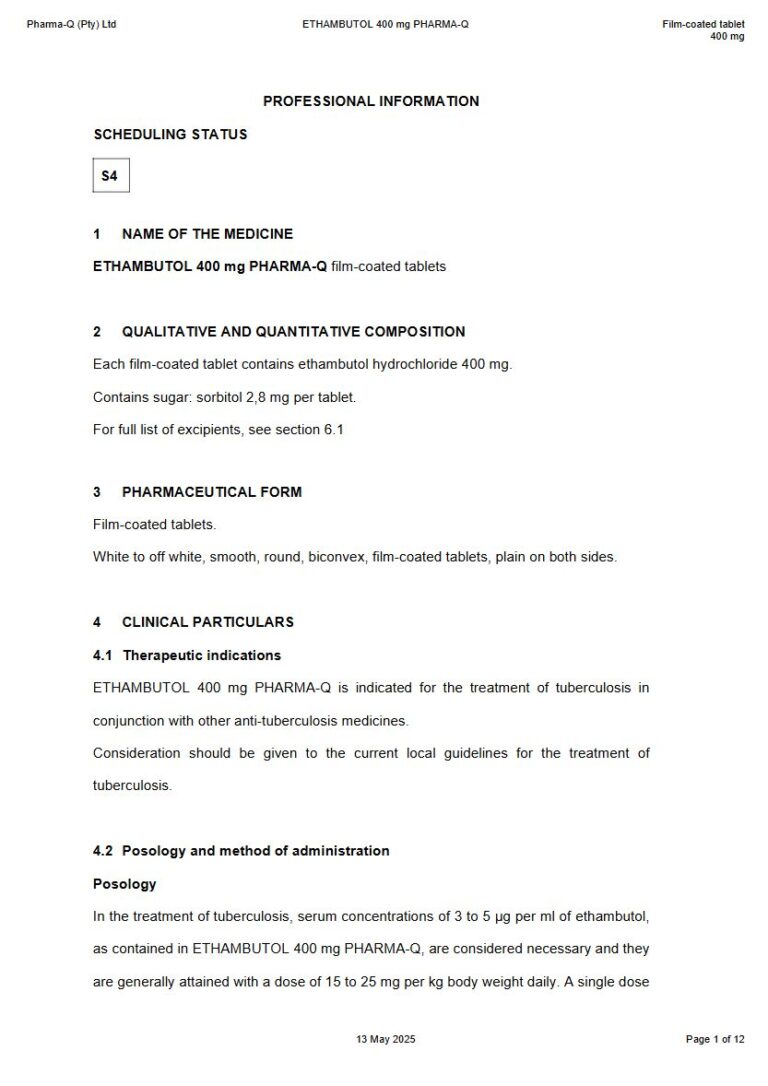
Ethambutol 400 Mg Film-Coated Tablets
PDF Leaflet Revision Date: 13 May 2025
Clinical Summary
Quick overview from the medicine insert
Indication
Treatment of tuberculosis with other anti-tuberculosis medicines.
Dosage (summary)
15 mg/kg daily for primary treatment; 25 mg/kg for first 60 days of re-treatment, then 15 mg/kg.
Special Populations
- Renal impairment
- Elderly
Pregnancy & Breastfeeding
Safety in pregnancy and lactation not established; breastfeeding not recommended during treatment.
Key Drug Interactions
- Aluminium hydroxide reduces absorption
Contraindications
- Hypersensitivity to ethambutol
- Severe renal impairment
- Optic neuritis
Common side effects
- Optic neuritis
- Hyperuricaemia
- Peripheral neuropathy
- Nausea
- Dizziness
Counselling Points
- Report any vision changes
- Avoid driving if vision impaired
- Regular ophthalmic examinations for high-risk patients
Serious warnings
- Risk of optic neuritis
- Monitor renal function
- Visual acuity tests recommended
Important Disclaimer
The Ethambutol 400 Mg Film-Coated Tablets professional information leaflet below is the property of Pharma-Q and is provided on Medinsert exactly as issued, with no.. alterations or editorial changes. We make every effort to keep content current by updating documents as soon as new versions become available. Medinsert serves as a trusted access point for healthcare professionals, but does not replace official sources or clinical judgement. For more details, please read our full disclaimer. read more>>
 Healthcare Professionals Only
This content is for registered healthcare professionals
Sign in or create a free account to read the full package insert.
Free for HPCSA-registered professionals. Powered by Medinsert.
Clinical Particulars
Section 4 of the official insert — extracted exactly as issued, no alterations
4.1 Therapeutic indications
ETHAMBUTOL 400 mg PHARMA-Q is indicated for the treatment of tuberculosis in conjunction with other anti-tuberculosis medicines. Consideration should be given to the current local guidelines for the treatment of tuberculosis.
4.2 Posology and method of administration
Posology
In the treatment of tuberculosis, serum concentrations of 3 to 5 u03bcg per ml of ethambutol, as contained in ETHAMBUTOL 400 mg PHARMA-Q, are considered necessary and they are generally attained with a dose of 15 to 25 mg per kg body weight daily. A single dose of 25 mg per kg may be given for 2 months and thereafter reduced to 15 mg per kg. It has been suggested that tests of visual acuity should be regularly performed on patients being treated with ethambutol, as contained in ETHAMBUTOL 400 mg PHARMA-Q (see section 4.8).
Adult dose: The dosage must be adjusted according to the body mass of the patient - refer to the table of dosages. For primary treatment: ETHAMBUTOL 400 mg PHARMA-Q should be administered in a single daily oral dose of 15 mg/kg with concomitant medicines being used at their recommended dosage levels. For re-treatment: For the first 60 days of treatment, ETHAMBUTOL 400 mg PHARMA-Q should be administered in a single daily dose of 25 mg/kg. Thereafter the dosage should be reduced to 15 mg/kg with concomitant medicines being maintained at their recommended dosage levels.
Paediatric population: Daily doses for children above three months are 20 (15-25) mg/kg per bodyweight daily. No dosing recommendation can be made in children less than three months due to lack of specific data. ETHAMBUTOL 400 mg PHARMA-Q is not recommended for children under 13 years of age.
4.3 Contraindications
ETHAMBUTOL 400 mg PHARMA-Q is contraindicated in patients with:
u2022 Hypersensitivity to ethambutol or to any of the excipients in ETHAMBUTOL 400 mg PHARMA-Q (see section 6.1).
u2022 Severe renal impairment (creatinine clearance GFR < 30 mL/min).
u2022 Optic neuritis and retrobulbar neuritis.
4.4 Special warnings and precautions for use
Consideration should be given to current local guidelines for the treatment of tuberculosis.
Optic neuritis
Ethambutol, as contained in ETHAMBUTOL 400 mg PHARMA-Q, can cause optic neuritis (ON), which may be unilateral or bilateral, and retrobulbar ON (normal appearing optic disc on presentation) is the most common form of ethambutol-induced optic neuritis (EON). EON is dose dependent with a prevalence ranging from < 1 % at u2264 15 mg/kg, to 5 % to 6 % at u2264 25 mg/kg. Other risk factors include patients on prolonged therapy, patients with renal impairment, the elderly and use with isoniazid. It is recommended that patients undergo a full ophthalmic examination before starting treatment. This should include visual acuity, colour vision, perimetry and ophthalmoscopy. Except for the high risk patients (see below), routine ophthalmological examination for adults is not thereafter necessary. Patients should be informed of the importance of reporting any change in vision and ETHAMBUTOL 400 mg PHARMA-Q should be withdrawn if vision deteriorates.
For patients with risk factors for development of EON, frequent ophthalmologic examination is recommended. Each eye should be tested separately as ocular toxicity can be unilateral or bilateral. Ophthalmologic examination should include tests for black-white/chromatic visual acuity (e.g. Snellen eye chart and 65-test) and ophthalmoscopy. Routine ophthalmological examinations may be considered when treating young children.
Prognosis
The vision impairment (optic neuritis) is generally reversible when administration of ethambutol, as in ETHAMBUTOL 400 mg PHARMA-Q, is discontinued promptly. Studies have shown that the recovery of visual acuity took weeks to months after the ethambutol, as contained in ETHAMBUTOL 400 mg PHARMA-Q, was discontinued. Ethambutol, as contained in ETHAMBUTOL 400 mg PHARMA-Q, was restarted in some patients at lower doses without toxicity. Recovery may be delayed for up to one year or more or the effects may be irreversible.
Renal impairment and hyperuricemia
Renal function, including uric acid levels, should be checked before treatment with ETHAMBUTOL 400 mg PHARMA-Q and appropriate dosage adjustments made. ETHAMBUTOL 400 mg PHARMA-Q should preferably be avoided in patients with renal impairment and hyperuricemia, but if used the dose should be reduced. Toxic effects and hyperuricemia are more common if renal function is impaired. ETHAMBUTOL 400 mg PHARMA-Q therapy results in an increased concentration of urate in the blood in about 50 % of patients, due to decreased renal excretion of uric acid. The effects may be detectable as early as 24 hours after a single dose or as late as 90 days after treatment is started. This untoward effect is possibly enhanced by isoniazid and pyridoxine.
Excipient warning
ETHAMBUTOL 400 mg PHARMA-Q contains sorbitol. Patients with hereditary fructose intolerance (HFI) should not take ETHAMBUTOL 400 mg PHARMA-Q.
4.5 Interaction with other medicines and other forms of interaction
Aluminium hydroxide reduces the absorption of ethambutol. It is recommended to avoid concurrent administration of ETHAMBUTOL 400 mg PHARMA-Q with aluminium hydroxide-containing antacids for at least 4 hours following ETHAMBUTOL 400 mg PHARMA-Q administration.
4.6 Fertility, pregnancy and lactation
Women of childbearing potential
There are no know adverse effects of ethambutol, as contained in ETHAMBUTOL 400 mg PHARMA-Q, on the reproductive potential of women of childbearing potential.
Pregnancy
The safety of ETHAMBUTOL 400 mg PHARMA-Q in pregnancy and lactation has not been established. The potential for risk in humans is unknown as there are no adequate and well controlled studies in pregnant women. Studies in animals have shown reproductive toxicity.
Breastfeeding
Ethambutol hydrochloride, as contained in ETHAMBUTOL 400 mg PHARMA-Q, is excreted into the breast milk. Ethambutol/metabolites have been identified in breastfed newborns/ infants of treated women. Breastfeeding is not recommended during treatment with ETHAMBUTOL 400 mg PHARMA-Q.
Fertility
No data available.
4.7 Effects on ability to drive and use machines
ETHAMBUTOL 400 mg PHARMA-Q has a moderate influence on the ability to drive and operate machinery. Patients whose vision is impaired during treatment with ETHAMBUTOL 400 mg PHARMA-Q should not drive or operate machinery. Patients should not drive or operate machinery if affected by possible side effects such as numbness, paraesthesia, dizziness and disorientation.
4.8 Undesirable effects
a. Summary of the safety profile
The most important side effect of ethambutol hydrochloride, as contained in ETHAMBUTOL 400 mg PHARMA-Q, is a dose dependant optic neuritis, resulting in decrease of visual acuity and loss of ability to perceive the colour green. This is quite uncommon (< 1 %) with a dose u2264 15 mg/kg per day, but increases to 5 % to 6 % with doses u2264 25 mg/kg per day.
b. Tabulated summary of adverse reactions
MedDRA system organ class
Frequency
Adverse reactions
Blood and lymphatic system disorders
Less frequent
Thrombocytopenia, leucopenia, neutropenia, eosinophilia
Immune system disorders
Less frequent
Hypersensitivity, anaphylactoid reactions, allergic reactions, anaphylaxis, allergic pneumonitis
Metabolism and nutrition disorders
Less frequent
Hyperuricaemia
Frequency unknown
Gout
Psychiatric disorders
Frequency unknown
Mental confusion, disorientation, hallucinations
Nervous system disorders
Less frequent
Peripheral neuropathy, paraesthesia (especially in the extremities), numbness, disorientation, dizziness, headache, burning pain, weakness (hands and feet), tremor
Eye disorders
Less frequent
Optic neuritis (decreased visual acuity, loss of vision, scotoma, colour blindness, visual disturbance, visual field defect, eye pain)
Respiratory, thoracic and mediastinal disorders
Less frequent
Pneumonitis, pulmonary infiltrates, with or without eosinophilia
Gastrointestinal disorders
Less frequent
Nausea, vomiting, anorexia, flatulence, abdominal pain, diarrhoea, metallic taste, loss of appetite, upset stomach
Hepato-biliary disorders
Less frequent
Hepatic reactions with hepatitis, jaundice, abnormal liver function test values, hepatic failure
Skin and subcutaneous tissue disorders
Less frequent
Rash, pruritus, urticaria, photosensitive lichenoid eruptions, bullous dermatitis, Stevens-Johnson syndrome, epidermal necrolysis
Musculoskeletal and connective tissue disorders
Less frequent
Joint pains
Renal and urinary disorders
Less frequent
Interstitial nephritis, nephrotoxocity
General disorders and administration site conditions:
Less frequent
Malaise, pyrexia
Reporting of suspected adverse reactions
Reporting suspected adverse reactions after authorisation of the medicine is important. It allows continued monitoring of the benefit/risk balance of the medicine. Health care providers are requested to report any suspected adverse drug reactions to SAHPRA via the Med Safety APP (Medsafety X SAHPRA) and eReporting platform (who- umc.org) found on SAHPRA website.
4.9 Overdose
Symptoms
Symptoms of overdosage may be any of those listed under section 4.8 above and in these cases the dosage should be reduced or the medicine discontinued. Changes in visual acuity should be carefully evaluated and if necessary the administration of the medicament should be discontinued.
Treatment
There is no specific antidote. Treatment is supportive and symptomatic.
