
B. Braun Etomidate 2 mg/ml Injection
PDF Leaflet Revision Date: 03 August 2023
Clinical Summary
Quick overview from the medicine insert
Indication
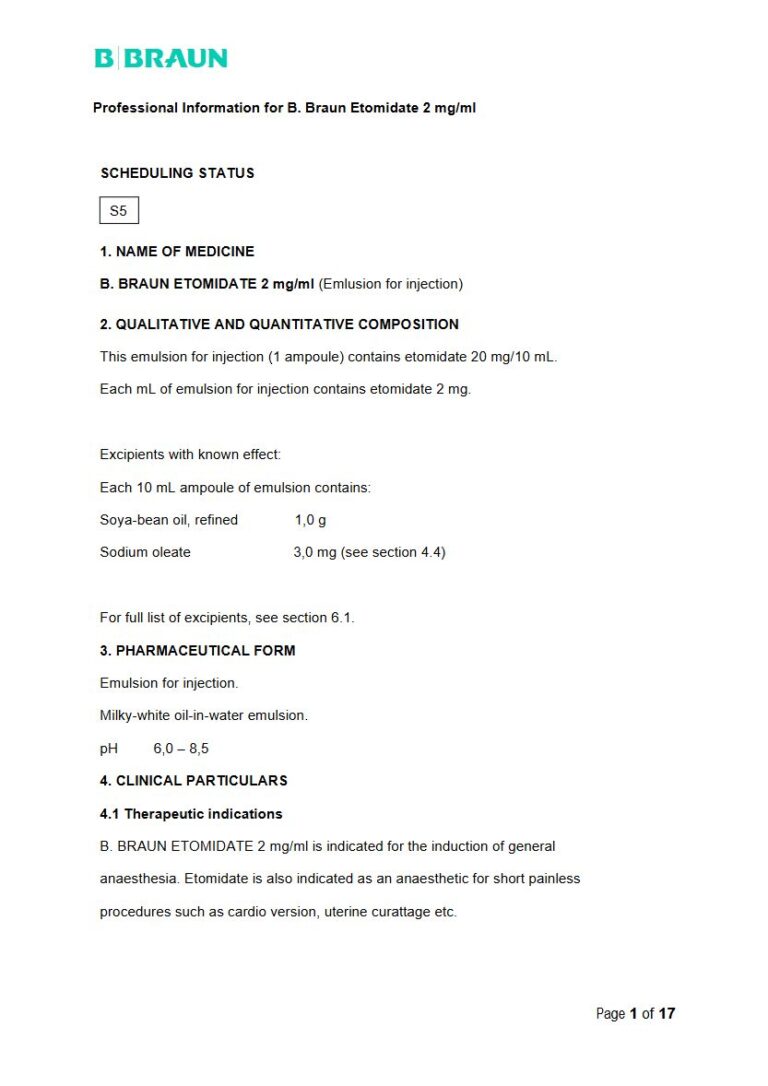
Induction of general anaesthesia.
Dosage (summary)
Adults: 0.2-0.3 mg/kg IV; max 3 ampoules.
Onset of Action / Duration
Onset: 30-60 secs, Duration: 3-5 mins
Special Populations
- Elderly
- Hepatic impairment
- Renal impairment
Pregnancy & Breastfeeding
Not established; caution in breastfeeding.
Key Drug Interactions
- Neuroleptics
- Opioids
- Sedatives
- Alcohol
Contraindications
- Hypersensitivity to etomidate or excipients
- Porphyria
- Pregnancy and lactation
- Neonates and infants under 6 months
Common side effects
- Hypotension
- Apnoea
- Myoclonus
- Nausea
- Vomiting
Counselling Points
- Avoid driving or operating machinery for 24 hours.
- Use analgesics as etomidate has no analgesic effect.
- Monitor for respiratory depression.
Serious warnings
- Adrenocortical suppression
- Risk of respiratory depression
- Use with caution in critically ill patients
Important Disclaimer
The B. Braun Etomidate 2 mg/ml Injection professional information leaflet below is the property of B Braun Medical and is provided on Medinsert exactly as issued, with no.. alterations or editorial changes. We make every effort to keep content current by updating documents as soon as new versions become available. Medinsert serves as a trusted access point for healthcare professionals, but does not replace official sources or clinical judgement. For more details, please read our full disclaimer. read more>>
 Healthcare Professionals Only
This content is for registered healthcare professionals
Sign in or create a free account to read the full package insert.
Free for HPCSA-registered professionals. Powered by Medinsert.
Clinical Particulars
Section 4 of the official insert — extracted exactly as issued, no alterations
4.1 Therapeutic indications
B. BRAUN ETOMIDATE 2 mg/ml is indicated for the induction of general anaesthesia. Etomidate is also indicated as an anaesthetic for short painless procedures such as cardio version, uterine curattage etc. Because B. BRAUN ETOMIDATE 2 mg/ml has no analgesic effect and it is not suitable as a mono-anaesthetic.
4.2 Posology and method of administration
Posology
B. BRAUN ETOMIDATE 2 mg/ml ampoules contain a ready-for-use emulsion containing 2 mg etomidate per mL of emulsion.
Adults
B. BRAUN ETOMIDATE 2 mg/ml doses range between 0,2 and 0,3 mg/kg (0,1 and 0,15 mL per kg) body mass. Therefore, in an adult patient one ampoule usually suffices for a sleep duration of about 5 minutes. This medicine should be administered intravenously over 60 seconds. Hypnosis can be prolonged by additional injections of B. Braun Etomidate 2 mg/mL. Do not exceed the total amount of three ampoules (30 mL). Dosage should be adjusted to the individual patient response and to clinical effects.
Paediatric population
In children under 15 years the dosage should be increased: a supplementary dose of up to 30 % of the normal dose for adults is sometimes necessary to obtain the same depth and duration of sleep as obtained in adults (see section 5.2)
Elderly
In the elderly, a single dose of 0,15 u2013 0,2 mg/kg body weight should be given and the dose should be further adjusted according to effects (see section 4.4 and section 5.2)
Other special patient groups
In patients with liver cirrhosis or those who have already received neuroleptic, opiate or sedative medication, the dose of etomidate should be reduced (see section 4.5 and section 5.2).
Method of administration
B. BRAUN ETOMIDATE 2 mg/ml is for intravenous administration only.
4.3 Contraindications
B. BRAUN ETOMIDATE 2 mg/ml is contraindicated
u2022 In patients with known hypersensitivity to etomidate, soya, peanut or to any of the excipients listed in section 6.1 (see also section 4.8)
u2022 In patients with Porphyria
u2022 Pregnancy and lactation (see section 4.6)
u2022 Labour and delivery (see section 4.6)
u2022 Neonates and infants up to the age of 6 months should be excluded from treatment with B. BRAUN ETOMIDATE 2 mg/ml except for imperative indications during in-patient treatment.
4.4 Special warnings and precautions for use
Special warnings
Induction with B. BRAUN ETOMIDATE 2 mg/ml may cause a slight and transient drop in blood pressure due to a decrease in peripheral vascular resistance (especially B. BRAUN ETOMIDATE 2 mg/ml should not be used in patients with adrenocortical function that is already reduced, as etomidate suppresses adrenocortical function. B. BRAUN ETOMIDATE 2 mg/ml infusions suppress adrenocortical function and sudden death may occur when fentanyl and/or droperidol are used as premedication). In debilitated patients in whom hypotension may be unsafe, the following measures should be taken:
1. Set up an infusion before the induction of anaesthesia, to facilitate subsequent volume replacement.
2. Restrict the use of other compounds which may cause hypotension (see section 4.5).
3. Perform the induction with the patient in a recumbent position.
4. Inject the medicine slowly (over 1 minute).
5. Spontaneous movements of one or more muscle groups (myoclonus) may occur, especially when no premedication has been administered. These movements are attributed to a disinhibition of subcortical centres and can largely be prevented by intravenous administration of small doses of fentanyl, or diazepam, 1 u2013 2 minutes before induction with B. BRAUN ETOMIDATE 2 mg/ml. Etomidate inhibits the adrenocortical biosynthesis of steroids. Single induction doses of etomidate can lead to transient adrenal insufficiency and decreased serum cortisol and aldosterone levels, unresponsive to ACTH administration. When etomidate is used for induction, the postoperative rise of serum cortisol observed after thiopentone induction is delayed for approximately 3 u2013 6 hours (see section 5.1). Where concern exists for patients undergoing severe stress, particularly those with adrenocortical dysfunction, supplementation with exogenous cortisol (e.g. 50 u2013 100 mg hydrocortisone) should be considered. In such situations stimulation of the adrenal gland with ACTH is not useful. Prolonged suppression of endogenous cortisol and aldosterone may occur as a direct consequence of etomidate when given by continuous infusion or in repeated doses.
B. BRAUN ETOMIDATE 2 mg/ml should be used with caution in critically-ill patients, including patients with sepsis. In patients with liver cirrhosis, or in those who have already received neuroleptic, opiate, or sedative medicines, the dose of etomidate should be reduced. Myoclonus and local pain on injection, which is usually mild, is observed during the administration of B. BRAUN ETOMIDATE 2 mg/ml especially when it is injected undiluted into a small vein. This can largely be avoided by intravenous application of a small dose of suitable opioids, e.g. fentanyl, 1 to 2 minutes before induction. To minimise the risk of local pain, larger veins should be used. B. BRAUN ETOMIDATE 2 mg/ml should be used with caution in elderly patients, since the potential exists for decreases in cardiac output, which have been reported with doses greater than recommended (see sections 4.2 and 5.2). In animal experiments, B. BRAUN ETOMIDATE 2 mg/ml has been shown to possess a porphyrogenic potential. Therefore it should not be administered to patients with hereditary disorder of haem biosynthesis, unless there is no safer alternative.
Precautions for use
Since B. BRAUN ETOMIDATE 2 mg/ml has no analgesic action, appropriate analgesics should be used during surgical procedures. If used for short-term narcosis, a strong analgesic, e.g. fentanyl, must be given prior to or simultaneously with B. BRAUN ETOMIDATE 2 mg/ml (see sections 4.2 and 5.2). Attention should be paid also to instructions given in sections 4.5 and 6.6. B. BRAUN ETOMIDATE 2 mg/ml may be used only by a doctor skilled in endotracheal intubation. When B. BRAUN ETOMIDATE 2 mg/ml is used, resuscitation equipment should be readily available to manage respiratory depression and the possibility of apnoea. B. BRAUN ETOMIDATE 2 mg/ml contains less than 1 mmoL (23 mg) sodium (as sodium oleate) per ampoule, i.e. it is essentially sodium-free. The interference with daily activities may continue for up to 24 hours and no legal/contractual devisions should be entered for 24 hours after receiving anaesthetic/conscious sedation. Alcohol use should also be avoided for the same period.
4.5 Interaction with other medicines and other forms of interaction
The hypnotic effect of etomidate may be enhanced by:
u2022 neuroleptic medicines
u2022 opioids
u2022 sedatives
u2022 alcohol.
The use of alcohol or other CNS depressants should be avoided for 24 hours following B. BRAUN ETOMIDATE 2 mg/ml.
A reduced dose of B. BRAUN ETOMIDATE 2 mg/ml may be necessary in patients who have received antipsychotics, sedatives or opioids. Induction with etomidate may be accompanied by a slight and transient reduction in peripheral resistance which may enhance the effect of other medicines reducing blood pressure.
Alfentanil
Co-administration of etomidate with alfentanil has been reported to decrease the terminal half-life of etomidate to approximately 29 minutes. Caution should be used when both medicines are administered together as the concentrations of etomidate may drop below the hypnotic threshold.
Fentanyl
The total plasma clearance and volume of distribution of etomidate is decreased by a factor of 2 to 3 without a change in half-life when administered with fentanyl intravenously. When etomidate is co-administered with fentanyl intravenously, the dose may need to be reduced.
Ketamine
Co-administration of etomidate and ketamine appears to have no significant effect on the plasma concentrations or pharmacokinetic parameters of ketamine or its principal metabolite, norketamine.
Adrenergic neurone blockers, alpha blockers
Combination with general anaesthetics leads to an enhancement of the hypotensive effect of these medicines.
Calcium channel blockers (Verapamil, Diltiazem)
Combination with general anaesthetics results in an enhancement of the hypotensive effect and also AV delay.
Monoamine oxidase inhibitors (MAOI)
Because of hazardous interactions between general anaesthetics and MAOIs, MAOIs should normally be stopped 2 weeks before surgery.
4.6 Fertility, pregnancy and lactation
Pregnancy
Safety of the use of B. BRAUN ETOMIDATE 2 mg/ml during pregnancy has not yet been established. Studies in animals have shown reproductive toxicity. At maternally toxic doses in rats, decreased survival was noted. Published studies in animals (including primates) at doses resulting in light to moderate anaesthesia demonstrate that the use of anaesthetic medicines during the period of rapid brain growth or synaptogenesis results in cell loss in the developing brain that can be associated with prolonged cognitive deficiencies. The clinical significance of these nonclinical findings is not known. During obstetric anaesthesia, etomidate may cross the placenta. A transient fall in cortisol levels lasting about 6 hours was observed in the neonate after the mother was given etomidate. The decreased values remained within the normal range.
Breast-feeding
Etomidate is excreted into human milk. Caution should be exercised when B. BRAUN ETOMIDATE 2 mg/ml is administered to a nursing mother. If B. BRAUN ETOMIDATE 2 mg/ml must be given during the lactation period, nursing is to be interrupted and not to be resumed 24 hours after administration; breast milk secreted during this period must be discarded.
4.7 Effects on ability to drive and use machines
Etomidate has a major influence on the ability to drive and use machines. It is not recommended to use potentially dangerous machines or to drive a car during the first 24 hours after administration. The return of normal alertness may vary according to the duration of the operation, the total dose of etomidate administered and concomitant medication used. Hence, a decision to allow for driving or operating machinery must be a judgment made by the post anaesthesiology treatment team.
4.8 Undesirable effects
a. Summary of the safety profile
Like most general anaesthetics, etomidate may affect respiratory and vascular functions. Like some other general anaesthetics, etomidate may cause involuntary muscle movements. Besides this, etomidate frequently affects adrenocortical functions.
b. Tabulated list of adverse reactions
| System Organ Class | Frequency | Classification | Undesirable Effects |
|---|---|---|---|
| Immune System Disorders | Frequency unknown | Hypersensitivity 1 (such as anaphylactic shock, anaphylactic reaction, anaphylactoid reaction) | |
| Endocrine Disorders | Frequent | Cortisol decreased | |
| Frequency unknown | Adrenal insufficiency | ||
| Nervous System Disorders | Frequent | Dyskinesia, Myoclonus | |
| Less Frequent | Hypertonia, Muscle contractions involuntary, Nystagmus, Shivering | ||
| Frequency unknown | Convulsion (including grand mal convulsion) | ||
| Cardiac Disorders | Less Frequent | Bradycardia, Extrasystoles, Ventricular extrasystoles | |
| Frequency unknown | Cardiac arrest, Atrioventricular block complete | ||
| Vascular Disorders | Frequent | Hypotension | |
| Less Frequent | Hypertension, Phlebits | ||
| Frequency unknown | Shock | ||
| Respiratory, Thoracic and Mediastinal Disorders | Frequent | Apnoea 2, Hyperventilation, Stridor | |
| Less Frequent | Hypoventilation, Hiccups, Cough, Laryngospasm | ||
| Frequency unknown | Respiratory depression 2, Bronchospasm (including fatal outcome) | ||
| Gastrointestinal Disorders | Frequent | Vomiting, Nausea | |
| Less Frequent | Salivary hypersecretion | ||
| Skin and Subcutaneous Tissue Disorders | Frequent | Rash | |
| Less Frequent | Erythema | ||
| Frequency unknown | Stevens-Johnson syndrome, Urticaria | ||
| Musculoskeletal and Connective Tissue Disorders | Less Frequent | Muscle rigidity | |
| Frequency unknown | Trismus | ||
| General Disorders and Administration Site Conditions | Less Frequent | Injection site pain | |
| Injury, Poisoning and Procedural Complications | Less Frequent | Anaesthetic complication, Delayed recovery from anaesthesia, Inadequate analgesia, Procedural nausea |
4.9 Overdose
Symptoms
An overdose of etomidate, administered as a bolus, deepens sleep and may cause respiratory depression and even respiratory arrest, in which case adequate respiratory support is mandatory. Hypotension has also been observed in such cases. Overdosage may depress cortical secretion. This may be associated with disorientation and delayed awakening.
Treatment
Treatment depends on the nature and severity of the symptoms, including, if necessary, respiratory support. In addition to supportive measures (e.g. of respiration) administration of 50 - 100 mg hydrocortisone (not ACTH) may be required. All equipment and medication usually required in general anaesthetic procedures should be available. Supportive measures such as establishing and maintaining a patent airway (intubation, if necessary) and administering oxygen with assisted ventilation are essential.
