
Lipanthyl 200 mg Hard capsules.
PDF Leaflet Revision Date: 19.01.2023
Clinical Summary
Quick overview from the medicine insert
Indication
Reduction of triglycerides and cholesterol in hyperlipoproteinaemias.
Dosage (summary)
One capsule daily with food.
Onset of Action / Duration
Onset: 4-5 hours, Duration: 3 months for maximum effect.
Special Populations
- Elderly
- Renal impairment
- Hepatic impairment
Pregnancy & Breastfeeding
Contraindicated in pregnancy and breastfeeding.
Key Drug Interactions
- Oral anticoagulants
- HMG-CoA reductase inhibitors
- Ciclosporin
Contraindications
- Hypersensitivity to fenofibrate
- Pregnancy
- Breastfeeding
- Renal lithiasis
- Impaired liver or kidney function
Common side effects
- Gastrointestinal disorders
- Headache
- Muscle disorders
- Increased transaminases
Counselling Points
- Take with food
- Monitor lipid levels
- Report muscle pain or weakness
Serious warnings
- Risk of muscle toxicity
- Pancreatitis
- Liver function monitoring required
Important Disclaimer
The Lipanthyl 200 mg Hard capsules. professional information leaflet below is the property of Abbott Laboratories South Africa and is provided on Medinsert exactly as issued, with no.. alterations or editorial changes. We make every effort to keep content current by updating documents as soon as new versions become available. Medinsert serves as a trusted access point for healthcare professionals, but does not replace official sources or clinical judgement. For more details, please read our full disclaimer. read more>>
 Healthcare Professionals Only
This content is for registered healthcare professionals
Sign in or create a free account to read the full package insert.
Free for HPCSA-registered professionals. Powered by Medinsert.
Clinical Particulars
Section 4 of the official insert — extracted exactly as issued, no alterations
4.1 Therapeutic indications
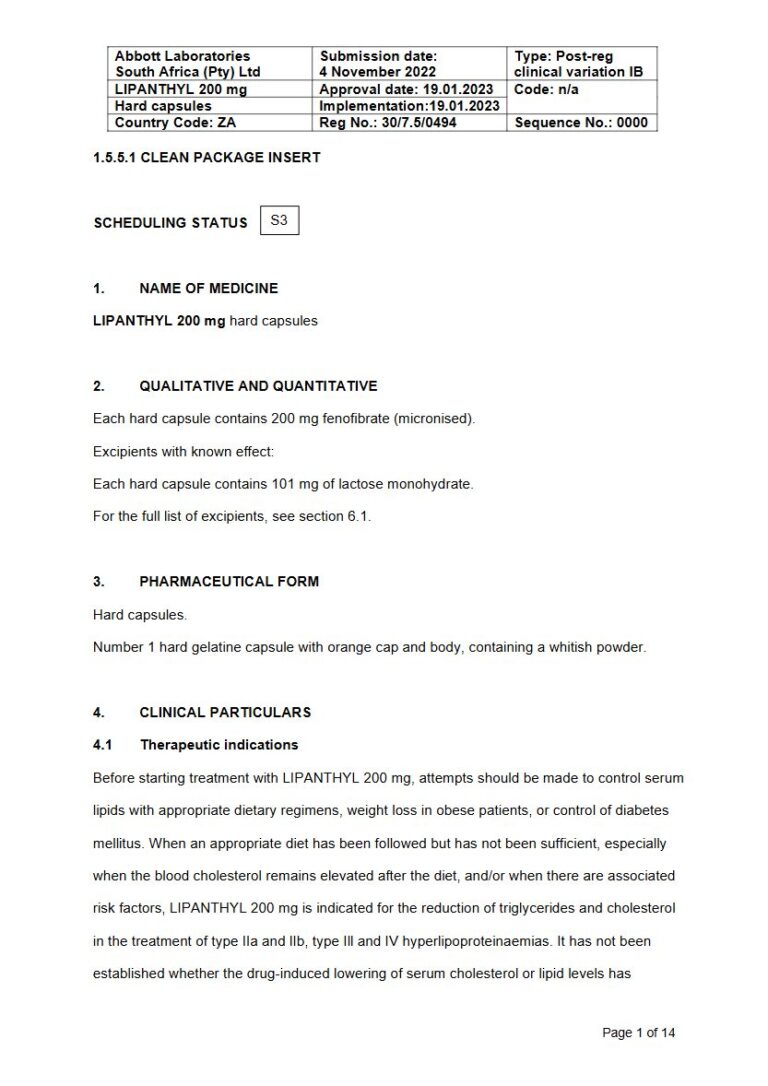
Before starting treatment with LIPANTHYL 200 mg, attempts should be made to control serum lipids with appropriate dietary regimens, weight loss in obese patients, or control of diabetes mellitus. When an appropriate diet has been followed but has not been sufficient, especially when the blood cholesterol remains elevated after the diet, and/or when there are associated risk factors, LIPANTHYL 200 mg is indicated for the reduction of triglycerides and cholesterol in the treatment of type IIa and lIb, type Ill and IV hyperlipoproteinaemias. It has not been established whether the drug-induced lowering of serum cholesterol or lipid levels has detrimental, beneficial or no effects on the morbidity or mortality due to atherosclerosis or coronary heart disease. LIPANTHYL 200 mg therapy should be discontinued if a significant lowering in serum lipids is not obtained.
4.2 Posology and method of administration
The adult dosage is one capsule daily during one of the main meals. In elderly patients without renal impairment, the normal dose is recommended. Since it is less well absorbed from an empty stomach, LIPANTHYL 200 mg should always be taken with food. Individual adapted dietary measures should be instituted together with LIPANTHYL 200 mg treatment. Response to therapy should be monitored by determination of serum lipid values. Rapid reduction of serum lipid levels usually follows LIPANTHYL 200 mg treatment, but treatment should be discontinued if adequate response has not been achieved within three months.
Method of administration
LIPANTHYL 200 mg capsules should be swallowed whole during a meal.
4.3 Contraindications
- Hypersensitivity to fenofibrate or to any of the excipients listed in section 6.1.
- LIPANTHYL 200 mg should not be administered to women who are pregnant or are breastfeeding.
- It is also contraindicated in renal lithiasis and impaired liver or kidney function.
4.4 Special warnings and precautions for use
Secondary causes of hyperlipidaemia, such as uncontrolled type 2 diabetes mellitus, hypothyroidism, nephrotic syndrome, dysproteinaemia, obstructive liver disease, pharmacological treatment, alcoholism, should be treated before LIPANTHYL 200 mg therapy is considered. Secondary cause of hypercholesterolemia related to pharmacological treatment can be seen with diuretics, u03b2-blockers, estrogens, progestogens, combined oral contraceptives, immunosuppressives and protease inhibitors. In these cases, it should be ascertained whether the hyperlipidaemia is of primary or secondary nature (possible elevation of lipid values caused by these therapeutic medicines).
Liver function
Moderately elevated levels of serum transaminase may be found in some patients but rarely interfere with treatment. However, it is recommended that serum transaminase should be monitored every three months during the first twelve months of treatment and thereafter periodically. Attention should be paid to patients who develop increase in transaminase levels and therapy should be discontinued if AST (SGOT) and ALT (SGPT) levels increase to more than 3 times the upper limit of the normal range. When symptoms indicative of hepatitis occur (e.g. jaundice, pruritus) and diagnosis is confirmed by laboratory testing, LIPANTHYL 200 mg therapy should be discontinued.
Pancreas
Pancreatitis has been reported in patients taking fenofibrate (see section 4.8). This occurrence may represent a failure of efficacy in patients with severe hypertriglyceridaemia, a direct medicine effect, or a secondary phenomenon mediated through biliary tract stone or sludge formation with obstruction of the common bile duct.
Muscle
Muscle toxicity, including cases of rhabdomyolysis, with or without renal failure has been reported with the use of administration of LIPANTHYL 200 mg. The incidence of this disorder increases in cases of hypoalbuminaemia and previous renal insufficiency. Patients with predisposing factors for myopathy and/or rhabdomyolysis, including age above 70 years, personal or familial history of hereditary muscular disorders, renal impairment, hypothyroidism and high alcohol intake, may be at an increased risk of developing rhabdomyolysis. For these patients, the putative benefits and risks of LIPANTHYL 200 mg therapy should be carefully weighed up. Muscle toxicity should be suspected in patients presenting diffuse myalgia, myositis, muscular cramps and weakness and/or marked increases in CPK (levels exceeding 5 times the normal range). In such cases treatment with LIPANTHYL 200 mg should be stopped. The risk of muscle toxicity may be increased if LIPANTHYL 200 mg is administered with another fibrate or an HMG-CoA reductase inhibitor, especially in cases of pre-existing muscular disease. Consequently, the co-prescription of LIPANTHYL 200 mg with an HMG-CoA reductase inhibitor or another fibrate should be reserved to patients with severe combined dyslipidaemia and high cardiovascular risk without any history of muscular disease and a close monitoring of potential muscle toxicity.
Renal impairment
In renal dysfunction the dose of LIPANTHYL 200 mg may need to be reduced, depending on the rate of creatinine clearance. Use of a non-micronised fibrate is preferred in elderly patients with renal impairment where dosage reduction may be required. Reversible elevations in serum creatinine have been reported in patients receiving LIPANTHYL 200 mg monotherapy or co-administered with statins. Elevations in serum creatinine were generally stable over time with no evidence for continued increases in serum creatinine with long term therapy and tended to return to baseline following discontinuation of treatment. Treatment should be interrupted when creatinine level is 50 % above the upper limit of normal. It is recommended that creatinine is measured during the first 3 months after initiation of treatment and periodically thereafter. LIPANTHYL 200 mg contains lactose monohydrate. Patients with rare hereditary problems of galactose intolerance, total lactase deficiency or glucose-galactose malabsorption should not take LIPANTHYL 200 mg.
4.5 Interaction with other medicines and other forms of interaction
Oral anticoagulants
Fenofibrate, as in LIPANTHYL 200 mg, enhances oral anticoagulant effect and may increase the risk of bleeding. In patients receiving oral anticoagulant therapy, the dose of anticoagulant should be reduced by about one third at the commencement of treatment and then gradually adjusted if necessary.
HMG-CoA reductase inhibitors or other fibrates
The risk of serious muscle toxicity is increased if a fibrate is used concomitantly with HMG-CoA reductase inhibitors or other fibrates. Such combination therapy should be used with caution and patients monitored closely for signs of muscle toxicity (see section 4.4). There is currently no evidence to suggest that fenofibrate affects the pharmacokinetics of simvastatin.
Ciclosporin
Some severe cases of reversible renal function impairment have been reported during concomitant administration of fenofibrate and ciclosporin. The renal function of these patients must therefore be closely monitored and the treatment with LIPANTHYL 200 mg stopped in the case of severe alteration of laboratory parameters.
Glitazones
Cases of reversible paradoxical reduction of HDL-cholesterol have been reported during concomitant administration of LIPANTHYL 200 mg and glitazones. It is recommended to monitor HDL-cholesterol if one of these components is added to the other and stopping of either therapy if HDL-cholesterol is too low.
Cytochrome P450 enzymes
In vitro studies using human liver microsomes indicate that fenofibrate and fenofibric acid are not inhibitors of cytochrome (CYP) P450 isoforms CYP3A4, CYP2D6, CYP2E1 or CYP1A2. They are weak inhibitors of CYP2C19 and CYP2A6, and mild-to-moderate of CYP2C9 at therapeutic concentrations. Patients co-administered fenofibrate and CYP2C19, CYP2A6, and especially CYP2C9 metabolised medicines with a narrow therapeutic index should be carefully monitored and, if necessary, dose adjustment of these medicines is recommended.
Other
No proven clinical interactions of LIPANTHYL 200 mg and with other medicines have been reported, although in vitro interaction studies suggest displacement of phenylbutazone from plasma protein binding sites. In common with other fibrates, LIPANTHYL 200 mg induces microsomal mixed-function oxidases involved in fatty-acid metabolism in rodents and may interact with medicines metabolised by these enzymes. Possible interactions with oral hypoglycaemic medicines should also be considered.
4.6 Fertility, pregnancy and lactation
LIPANTHYL 200 mg should not be administered to women who are pregnant or are breastfeeding.
4.7 Effects on ability to drive and use machines
LIPANTHYL 200 mg has no or negligible influence on the ability to drive a vehicle and use machines.
4.8 Undesirable effects
The most commonly reported adverse drug reactions during LIPANTHYL 200 mg therapy are digestive, gastric or intestinal disorders. The following undesirable effects have been observed during placebo-controlled clinical trials (n = 2 344) with the below indicated frequencies:
MedDRA system organ class
Common > 1/100 < 1/10
Uncommon > 1/1 000 < 1/100
Rare > 1/10 000 < 1/1 000
Blood and lymphatic system disorders
- Decreased haemoglobin, decreased white blood cell count
Immune system disorders
- Hypersensitivity
Nervous system disorders
- Headache
Ear and labyrinth disorders
- Vertigo
Vascular disorders
- Thromboembolism (pulmonary embolism, deep vein thrombosis)*
Gastrointestinal disorders
- Gastrointestinal signs and symptoms (abdominal pain, nausea, vomiting, diarrhoea, flatulence)
- Pancreatitis*
Hepatobiliary disorders
- Increased transaminases (see section 4.4)
- Cholelithiasis (see section 4.4)
- Hepatitis
Skin and subcutaneous tissue disorders
- Cutaneous hypersensitivity (e.g. rash, pruritus, urticaria)
- Alopecia, photosensitivity reactions
Musculoskeletal, connective tissue and bone disorders
- Muscle disorder (e.g. myalgia, myositis, muscular spasms and weakness), muscle cramps, myopathy, increased creatine phosphokinase (CPK)
Reproductive system and breast disorders
- Sexual dysfunction
Investigations
- Increased blood homocysteine level **
- Increased blood creatinine
- Increased blood urea
* In the FIELD-study, a randomised placebo-controlled trial performed in 9 795 patients with type 2 diabetes mellitus, a statistically significant increase in pancreatitis cases was observed in patients receiving fenofibrate versus patients receiving placebo (0,8 % versus 0,5 %; p = 0,031). In the same study, a statistically significant increase was reported in the incidence of pulmonary embolism (0,7 % in the placebo group versus 1,1 % in the fenofibrate group; p = 0,022) and a statistically non-significant increase in deep vein thromboses (placebo: 1,0 % [48/4 900 patients] versus fenofibrate 1,4 % [67/4 895 patients]; p = 0,074).
** In the FIELD study the average increase in blood homocysteine level in patients treated with fenofibrate was 6,5 u03bcmol/L, and was reversible on discontinuation of fenofibrate treatment. The increased risk of venous thrombotic events may be related to the increased homocysteine level. The clinical significance of this is not clear.
In addition to those events reported during clinical trials, the following side effects have been reported spontaneously during post-marketing use of LIPANTHYL 200 mg. A precise frequency cannot be estimated from the available data and is therefore classified as u201cnot knownu201d.
- Respiratory, thoracic and mediastinal disorders: interstitial lung disease
- Musculoskeletal, connective tissue and bone disorders: rhabdomyolysis
- Hepatobiliary disorders: jaundice, complications of cholelithiasis (e.g. cholecystitis, cholangitis, biliary colic)
- Skin and subcutaneous tissue disorders: severe cutaneous reactions (e.g. erythema multiforme, Stevens-Johnson syndrome, toxic epidermal necrolysis)
- General disorders and administration site conditions: fatigue.
Glucose tolerance should be monitored. Gallstones have occasionally been reported during LIPANTHYL 200 mg treatment, but any causal relationship remains inconclusive. Episodes of hepatitis have been reported less frequently.
Reporting of suspected adverse reactions
Reporting suspected adverse reactions after authorisation of LIPANTHYL 200 mg is important. It allows continued monitoring of the benefit/risk balance of LIPANTHYL 200 mg. Health care providers are asked to report any suspected adverse reactions via the u201c6.04 Adverse Drug Reaction Reporting Formu201d, found online under SAHPRAu2019s publications: https://www.sahpra.org.za/Publications/Index/8.
4.9 Overdose
Only anecdotal cases of fenofibrate overdosage have been received. In most cases no overdose symptoms were reported. No specific antidote is known. If overdose is suspected, treat symptomatically and institute appropriate supportive measures as required. Fenofibrate cannot be eliminated by haemodialysis.
