
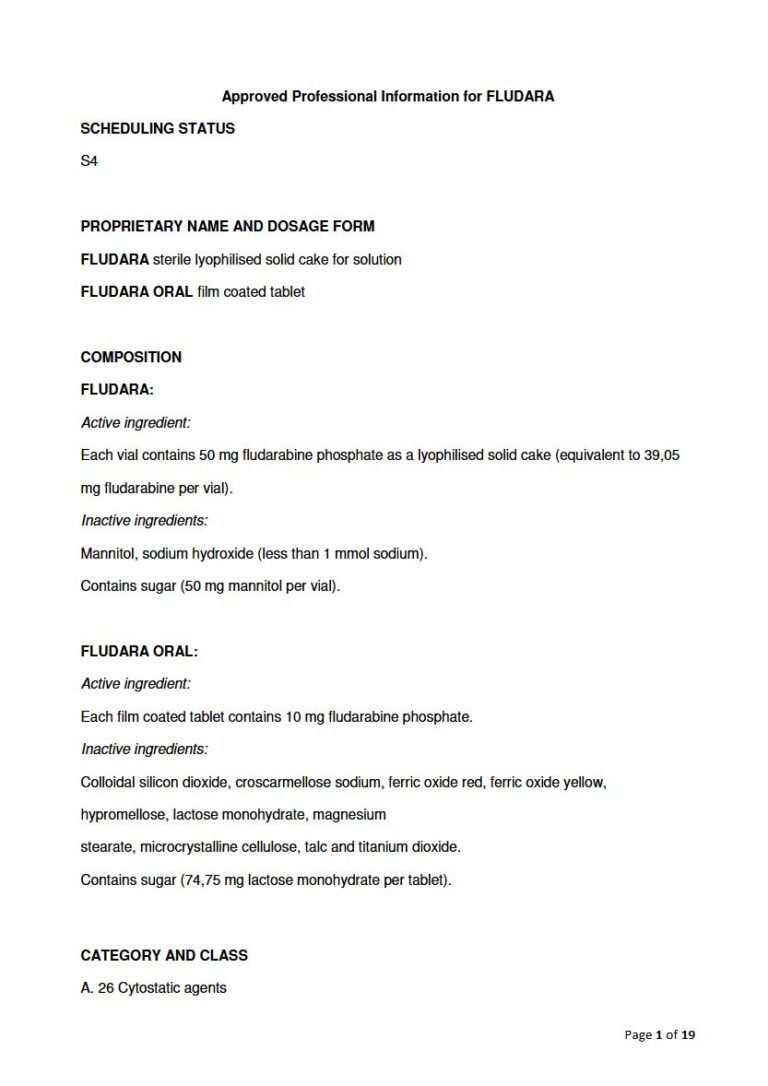
Fludara 50mg Solution
PDF Leaflet Revision Date: 10 July 2018
Clinical Summary
Quick overview from the medicine insert
Indication
Initial treatment of B-cell chronic lymphocytic leukaemia (CLL).
Dosage (summary)
IV: 25 mg/mu00b2 daily for 5 days every 28 days; Oral: 40 mg/mu00b2 daily for 5 days every 28 days.
Special Populations
- Renal impairment
- Hepatic impairment
- Elderly patients
Pregnancy & Breastfeeding
Contraindicated in pregnancy; not known if excreted in breast milk.
Key Drug Interactions
- Pentostatin (increased pulmonary toxicity)
- Dipyridamole (reduced efficacy)
Contraindications
- Hypersensitivity to fludarabine
- Renal impairment (creatinine clearance < 30 ml/min)
- Haemolytic anaemia
Common side effects
- Neutropenia
- Anaemia
- Thrombocytopenia
- Nausea
- Vomiting
- Fatigue
Counselling Points
- Monitor for neurological side effects
- Avoid live vaccines
- Use effective contraception during treatment
Serious warnings
- Severe neurotoxicity
- Leukoencephalopathy
- Myelosuppression
- Autoimmune phenomena
Important Disclaimer
The Fludara 50mg Solution professional information leaflet below is the property of Sanofi-Aventis and is provided on Medinsert exactly as issued, with no.. alterations or editorial changes. We make every effort to keep content current by updating documents as soon as new versions become available. Medinsert serves as a trusted access point for healthcare professionals, but does not replace official sources or clinical judgement. For more details, please read our full disclaimer. read more>>
 Healthcare Professionals Only
This content is for registered healthcare professionals
Sign in or create a free account to read the full package insert.
Free for HPCSA-registered professionals. Powered by Medinsert.
Clinical Particulars
Section 4 of the official insert — extracted exactly as issued, no alterations
4.1 Therapeutic indications
FLUDARA is indicated for the initial treatment of patients with B-cell chronic lymphocytic leukaemia (CLL) and for patients with CLL with sufficient bone marrow reserve who have not responded to or whose disease has progressed during or after treatment with at least one standard alkylating agent-containing regimen.
4.2 Posology and method of administration
FLUDARA should be administered under the supervision of a medical practitioner qualified and experienced in the use of antineoplastic therapy. FLUDARA must only be administered intravenously. No cases have been reported in which paravenously administered FLUDARA led to severe local adverse reactions. However, unintentional paravenous administration must be avoided.
Adults: The recommended dose is 25 mg/m2 body surface given daily for 5 consecutive days every 28 days by the intravenous route. Each vial is to be made up in 2 ml water for injection. Each ml of the resulting solution will contain 25 mg fludarabine phosphate. The dose should not be exceeded as severe neurotoxicity may occur.
The required dose (calculated on the basis of the patient's body surface) is drawn up into a syringe. For intravenous bolus injection this dose is further diluted into 10 ml of physiological saline. Alternatively, the required dose drawn up in a syringe may be diluted into 100 ml physiological saline and infused over approximately 30 minutes. Depending on the treatment success and the tolerability of the medicine, FLUDARA should be administered in chronic lymphocytic leukaemia patients up to the achievement of best response (complete or partial remission, usually 6 cycles) and then the medicine should be discontinued.
4.3 Contraindications
FLUDARA is contraindicated in those patients who are hypersensitive to fludarabine or its components, in renally impaired patients with creatinine clearance < 30 ml/minute and in patients with haemolytic anaemia. The safety and effectiveness of FLUDARA in children have not been established.
4.4 Special warnings and precautions for use
Neurotoxicity: When used at high doses in dose-ranging studies in patients with acute leukaemia, FLUDARA was associated with severe neurological effects, including blindness, coma and death. This severe central nervous system toxicity occurred in 36 % of patients treated intravenously with doses approximately four times greater (96 mg/m2/day for 5 to 7 days) than the dose recommended for treatment of chronic lymphocytic leukaemia. In patients treated at doses in the range of the dose recommended for chronic lymphocytic leukaemia, severe central nervous system toxicities including coma, seizures, agitation and confusion have occurred. In post-marketing experience neurotoxicity has been reported to occur earlier (one week) or later than in clinical trials (up to 7 months). Patients should be closely observed for signs of neurological side effects. The effect of chronic administration of FLUDARA on the central nervous system is unknown.
Administration of FLUDARA can be associated with leukoencephalopathy (LE), acute toxic leukoencephalopathy (ATL) or reversible posterior leukoencephalopathy syndrome (RPLS). These may occur:
- At the recommended dose:
- when FLUDARA is given following, or in combination with, medications known to be associated with LE, ATL or RPLS,
- or when FLUDARA is given in patients with other risk factors such as cranial or total body irradiation, haematopoietic cell transplantation, graft-versus-host disease, renal impairment, or hepatic encephalopathy.
- At doses higher than the recommended dose.
LE, ATL or RPLS symptoms may include headache, nausea and vomiting, seizures, visual disturbances such as vision loss, altered sensorium, and focal neurological deficits. Additional effects may include optic neuritis, and papillitis, confusion, somnolence, agitation, paraparesis/quadriparesis, muscle spasticity and incontinence. LE, ATL and RPLS may be irreversible, life-threatening, or fatal. Whenever LE, ATL or RPLS is suspected, fludarabine treatment should be stopped. Patients should be monitored and should undergo brain imaging, preferably utilising MRI. If the diagnosis is confirmed, FLUDARA should be permanently discontinued.
Impaired state of health: In patients with an impaired state of general health, FLUDARA should be given with caution and after careful risk/benefit consideration. This applies especially to patients with impairment of bone marrow function (thrombocytopenia, anaemia, and/or granulocytopenia), immunodeficiency or with a history of opportunistic infection.
Impaired hepatic function: No data are available concerning the use of FLUDARA in patients with hepatic impairment. In this group of patients, FLUDARA should be used with caution and administered if the perceived benefit outweighs any potential risk.
Myelosuppression: Severe bone marrow suppression, notably anaemia, thrombocytopenia and neutropenia, has been reported in patients treated with FLUDARA. In a Phase I study in solid tumour patients, the median time to nadir counts was 13 days (range 3 to 25 days) for granulocytes and 16 days (range 2 to 32 days) for platelets. Most patients had haematological impairment at baseline either as a result of disease or as a result of prior myelosuppressive therapy. Cumulative myelosuppression may be seen. While chemotherapy-induced myelosuppression is often reversible, administration of fludarabine phosphate requires careful haematological monitoring. FLUDARA is an antineoplastic medicine with potentially significant toxic side effects. Patients undergoing therapy should be closely observed for signs of haematological and non-haematological toxicity. Periodic assessment of peripheral blood counts is recommended to detect the development of anaemia, neutropenia and thrombocytopenia. Several instances of trilineage bone marrow hypoplasia or aplasia resulting in pancytopenia, sometimes resulting in death, have been reported in adult patients. The duration of clinically significant cytopenia in the reported cases has ranged from approximately 2 months to approximately 1 year. These episodes have occurred both in previously treated and untreated patients.
Disease progression: Disease progression and transformation (e.g. Richteru2019s syndrome) have been commonly reported in chronic lymphocytic leukaemia.
Transfusion of blood products: Transfusion-associated graft-versus-host disease (reaction by the transfused immunocompetent lymphocytes to the host) has been observed after transfusion of non-irradiated blood in FLUDARA treated patients. Fatal outcome as a consequence of this disease has been reported with a high frequency. Therefore, to minimize the risk of transfusion-associated graft-versus-host disease, patients who require blood transfusion and who are undergoing, or who have received, treatment with FLUDARA should receive irradiated blood only.
Skin cancer: The worsening or flare-up of pre-existing skin cancer lesions as well as the onset of skin cancer has been reported in patients during or after FLUDARA therapy.
Tumour lysis syndrome: Tumour lysis syndrome associated with FLUDARA treatment has been reported uncommonly in patients with large tumour burdens. Since FLUDARA can induce a response as early as the first week of treatment, precautions should be taken in those patients at risk of developing this complication.
Autoimmune phenomena: Irrespective of any previous history of autoimmune processes or Coombs test status, the occurrence of life-threatening and sometimes fatal autoimmune phenomena (e.g. autoimmune haemolytic anaemia, autoimmune thrombocytopenia, thrombocytopenic purpura, pemphigus, Evans syndrome) have been reported during or after treatment with FLUDARA. The majority of patients experiencing haemolytic anaemia developed a recurrence in the haemolytic process after re-challenge with FLUDARA. Patients undergoing treatment with FLUDARA should be closely monitored for signs of autoimmune haemolytic anaemia (decline in haemoglobin linked with haemolysis and positive Coombs test). Discontinuation of therapy with FLUDARA is recommended in case of haemolysis. Blood transfusion (irradiated, see above) and adrenocorticoid preparations are the most common treatment measures for autoimmune haemolytic anaemia.
Renal impairment: The total body clearance of the principal plasma metabolite 2F-ara-A shows a correlation with creatinine clearance, indicating the importance of the renal excretion pathway for the elimination of the compound. Patients with reduced renal function demonstrated an increased total body exposure (AUC of 2F-ara-A). Limited clinical data are available in patients with impairment of renal function (creatinine clearance below 70 ml/minute). Therefore, if renal impairment is clinically suspected, or in patients over the age of 70 years, creatinine clearance should be measured. If creatinine clearance is between 30 and 70 ml/min, the dose should be reduced by up to 50 % and close haematological monitoring should be used to assess toxicity. FLUDARA treatment is contraindicated if creatinine clearance is < 30 ml/minute.
Elderly patients: Since there are limited data for the use of FLUDARA in elderly persons (> 75 years), caution should be exercised with the administration of FLUDARA in these patients.
Vaccination: During and after treatment with FLUDARA, vaccination with live vaccines should be avoided.
Retreatment options after initial FLUDARA treatment: Patients who primarily respond to FLUDARA have a good chance of responding again to FLUDARA monotherapy. A crossover from initial treatment with FLUDARA to chlorambucil for non-responders to FLUDARA should be avoided because most patients who have been resistant to FLUDARA have shown resistance to chlorambucil.
4.5 Interactions with other medicines
In a clinical investigation using FLUDARA in combination with pentostatin (deoxycoformycin) for the treatment of refractory chronic lymphocytic leukaemia, there was an unacceptably high incidence of fatal pulmonary toxicity. Therefore, the use of FLUDARA in combination with pentostatin is not recommended. The therapeutic efficacy of FLUDARA may be reduced by dipyridamole and other inhibitors of adenosine uptake. Pharmacokinetic parameters after peroral administration were not significantly affected by concomitant food intake. Clinical studies and in vitro experiments showed that using FLUDARA in combination with cytarabine may increase the intracellular concentration and intracellular exposure of Ara-CTP (active metabolite of cytarabine) in leukaemic cells. Plasma concentrations of Ara-C and the elimination rate of Ara-CTP were not affected.
4.6 Fertility, pregnancy and lactation
Pregnancy: FLUDARA should not be used during pregnancy. The results from intravenous embryotoxicity studies in rats and rabbits indicated an embryolethal and teratogenic effect at the therapeutic dose. Preclinical data in rats demonstrated a transfer of FLUDARA and/or metabolites through the fetoplacental barrier. There are very limited data of FLUDARA use in pregnant women during the first trimester. FLUDARA has the potential to cause fetal harm.
Lactation: It is not known whether this medicine is excreted in human milk. However, there is evidence from preclinical data that FLUDARA and/or metabolites transfer from maternal blood to milk. Therefore, breastfeeding should not be initiated during FLUDARA treatment. Breastfeeding women should discontinue breastfeeding.
Fertility: Women of childbearing potential must be apprised of the potential hazard to the fetus. Both sexually active men and women of childbearing potential must take effective contraceptive measures during and at least for 6 months after cessation of therapy.
4.7 Effects on ability to drive and use machines
FLUDARA may reduce the ability to drive or use machines, since fatigue, weakness, visual disturbances, confusion, agitation and seizures have been observed. Reaction can be particularly impaired due to insufficient sleep, individual sensitivity and dosage.
4.8 Undesirable effects
Serious opportunistic infections have occurred in patients treated with FLUDARA. Fatalities as a consequence of serious adverse events have been reported. The adverse events below are classified by MedDRA system organ classes (MedDRA SOCs) under the CIOMS headings of frequency, using the following convention: very common (u2265 1/10), common (u2265 1/100 to < 1/10), uncommon (u2265 1/1 000 to < 1/100), rare (u2265 1/10 000 to < 1/1 000) and unknown.
Infections and infestations: Very common: Infections or opportunistic infections (like latent viral reactivation, e.g. herpes zoster virus, Epstein-Barr virus, progressive multifocal leukoencephalopathy), pneumonia. Rare: Lymphoproliferative disorder (EBV-associated).
Neoplasms benign and malignant (including cysts and polyps): Common: Myelodysplastic syndrome and acute myeloid leukaemia (mainly associated with prior, concomitant or subsequent treatment with alkylating agents, topoisomerase inhibitors or irradiation).
Blood and lymphatic system disorders: Very common: Neutropenia, anaemia, thrombocytopenia. Common: Myelosuppression.
Immune system disorders: Uncommon: Autoimmune disorder (including autoimmune haemolytic anaemia, thrombocytopenic purpura, pemphigus, Evans syndrome, acquired haemophilia).
Metabolism and nutrition disorders: Common: Anorexia. Uncommon: Tumour lysis syndrome (including renal failure, hyperkalaemia, metabolic acidosis, haematuria, urate crystalluria, hyperuricaemia, hyperphosphataemia, hypocalcaemia).
Nervous system disorders: Common: Peripheral neuropathy. Uncommon: Confusion. Rare: Agitation, seizures, coma.
Eye disorders: Common: Visual disturbance. Rare: Optic neuritis, optic neuropathy, blindness.
Cardiac disorders: Rare: Heart failure, dysrhythmia.
Vascular disorders: Uncommon: Gastrointestinal haemorrhage.
Respiratory, thoracic and mediastinal disorders: Very common: Cough. Uncommon: Pulmonary toxicity (including dyspnoea, pulmonary fibrosis, pneumonitis).
Gastrointestinal disorders: Very common: Nausea, vomiting, diarrhoea. Common: Stomatitis. Uncommon: Abnormal pancreatic enzymes.
Hepatobiliary disorders: Uncommon: Abnormal hepatic enzymes.
Skin and subcutaneous tissue disorders: Common: Rash. Rare: Skin cancer, Stevens-Johnson syndrome, toxic epidermal necrolysis (Lyell type).
General disorders and administration site conditions: Very common: Fever, fatigue, weakness. Common: Chills, malaise, oedema, mucositis.
Spontaneous reports (frequency unknown): The following events were identified from post-marketing spontaneous reporting:
Nervous system disorders: Leukoencephalopathy, acute toxic leukoencephalopathy, reversible posterior leukoencephalopathy syndrome (RPLS) (see WARNINGS AND SPECIAL PRECAUTIONS).
Vascular disorders: Haemorrhage (including cerebral haemorrhage, pulmonary haemorrhage, haemorrhagic cystitis).
4.9 Overdose
High doses of FLUDARA have been associated with leukoencephalopathy, acute toxic leukoencephalopathy, or reversible posterior leukoencephalopathy syndrome (RPLS). Symptoms may include headache, nausea and vomiting, seizures, visual disturbances such as vision loss, altered sensorium, and focal neurological deficits. Additional effects may include optic neuritis, and papillitis, confusion, somnolence, agitation, paraparesis/quadriparesis, muscle spasticity, incontinence, irreversible central nervous system toxicity characterised by delayed blindness, coma, and death. High doses are also associated with severe thrombocytopenia and neutropenia due to bone marrow suppression. There is no known specific antidote for FLUDARA overdosage. Treatment consists of discontinuation of treatment and supportive therapy.
