
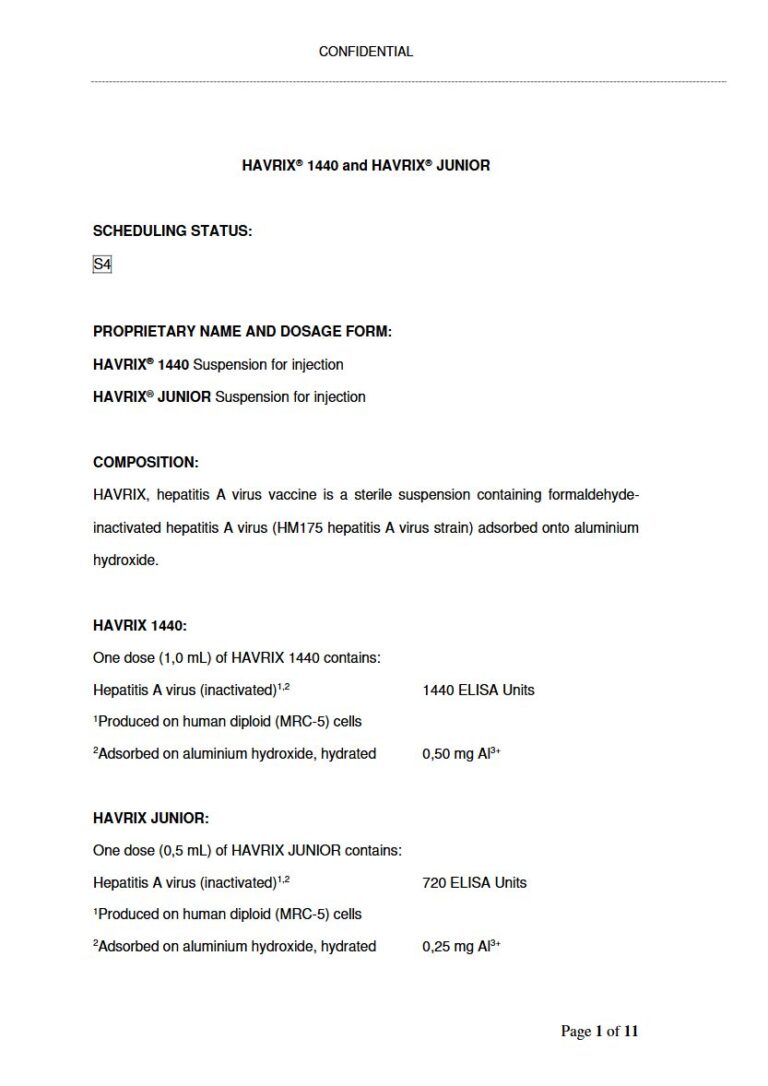
Havrix 1,0 mL/0,5 mL Suspension
PDF Leaflet Revision Date: 12 June 2025
Clinical Summary
Quick overview from the medicine insert
Indication
Active immunisation against hepatitis A virus infection.
Dosage (summary)
Adults: 1 mL (HAVRIX 1440); Children: 0.5 mL (HAVRIX JUNIOR). Booster at 6-12 months.
Special Populations
- HIV-infected persons
- Haemodialysis patients
- Chronic liver disease
Pregnancy & Breastfeeding
Use in pregnancy and lactation only when clearly needed.
Key Drug Interactions
- Concomitant use with other inactivated vaccines
- Immunoglobulins
Contraindications
- Hypersensitivity to vaccine components
Common side effects
- Headache
- Irritability
- Pain at injection site
- Fatigue
Counselling Points
- Remain under supervision for 30 mins post-vaccination
- Firm pressure at injection site for bleeding disorders
Serious warnings
- Do not freeze
- Postpone in acute severe febrile illness
- Monitor for anaphylaxis
Important Disclaimer
The Havrix 1,0 mL/0,5 mL Suspension professional information leaflet below is the property of Glaxosmithkline South Africa and is provided on Medinsert exactly as issued, with no.. alterations or editorial changes. We make every effort to keep content current by updating documents as soon as new versions become available. Medinsert serves as a trusted access point for healthcare professionals, but does not replace official sources or clinical judgement. For more details, please read our full disclaimer. read more>>
 Healthcare Professionals Only
This content is for registered healthcare professionals
Sign in or create a free account to read the full package insert.
Free for HPCSA-registered professionals. Powered by Medinsert.
Clinical Particulars
Section 4 of the official insert — extracted exactly as issued, no alterations
4.1 Therapeutic indications
HAVRIX is indicated for active immunisation against hepatitis A virus (HAV) infection in subjects at risk of exposure to HAV.
HAVRIX will not prevent hepatitis infection caused by other agents such as hepatitis B virus, hepatitis C virus, hepatitis E virus or other pathogens known to infect the liver.
In areas of low and intermediate prevalence of hepatitis A, immunisation with HAVRIX is particularly recommended in subjects who are, or will be, at increased risk of infection such as:
- Travellers: Persons moving from areas of low endemicity to areas of high endemicity.
- Armed forces: Armed Forces personnel who travel to higher endemicity areas or to areas where hygiene is poor, have an increased risk of HAV infection. Active immunisation is indicated for these individuals.
- Persons for whom hepatitis A is an occupational hazard or for whom there is an increased risk of transmission.
- Persons at increased risk due to their sexual behaviour. Homosexuals, persons with multiple sexual partners.
- Haemophiliacs.
- Abusers of injectable drugs.
- Contacts of infected persons.
- Persons who require protection as part of hepatitis A outbreak control or because of regionally elevated morbidity.
- Specific population groups known to have a higher incidence of hepatitis A.
- Subjects with chronic liver disease or who are at risk of developing chronic liver disease (e.g. hepatitis B and hepatitis C carriers and alcohol abusers). Hepatitis A tends to compromise the outcome of the chronic liver disease.
- In areas of intermediate to high prevalence of hepatitis A, susceptible individuals may be considered for active immunisation. These include children and adolescents especially in high socio-economic groups and urban areas.
4.2 Posology and method of administration
HAVRIX 1440 (1440 ELISA UNITS): Each dose consists of a 1,0 mL sterile suspension.
Adults and children 16 years of age and older: A single dose (1,0 mL suspension) of HAVRIX 1440 (1440 ELISA Units) is used for primary immunisation.
HAVRIX JUNIOR (720 ELISA UNITS): Children and adolescents from 1 year up to and including 15 years of age: A single dose (0,5 mL suspension) of HAVRIX JUNIOR (720 ELISA Units) is used for primary immunisation.
Booster vaccination: A booster dose is recommended at any time between 6 and 12 months after the primary dose of HAVRIX 1440 (1440 ELISA Units) or HAVRIX JUNIOR (720 ELISA Units) in order to ensure long term antibody titres.
Route of administration: HAVRIX is for intramuscular administration. The vaccine should be injected in the deltoid region in adults and children and in the antero-lateral part of the thigh in young children. The vaccine should not be administered in the gluteal region or subcutaneously/intradermally since administration by these routes may result in a less than optimal anti-HAV antibody response. The vaccine should never be administered intravenously.
Use and Handling: HAVRIX should be inspected visually for any particulate matter or discolouration prior to administration. Before use of HAVRIX, the vial/syringe should be well shaken to obtain a slightly opaque white suspension. Discard if the contents of the vial/syringe appear otherwise.
4.3 Contraindications
HAVRIX should not be administered to subjects with known hypersensitivity to any components of the vaccine, or to subjects having shown signs of hypersensitivity after previous HAVRIX administration.
4.4 Special warnings and precautions for use
Do not freeze; discard if vaccine has been frozen. The administration of HAVRIX should be postponed in subjects suffering from acute severe febrile illness. The presence of a minor infection, however, is not a contra-indication.
It is possible that subjects may be in the incubation period of a hepatitis A infection at the time of immunisation. It is not known whether HAVRIX will prevent hepatitis A in such cases.
In haemodialysis patients and in subjects with an impaired immune system adequate anti-HAV antibody titres may not be obtained after the primary immunisation course and such patients may therefore require administration of additional doses of vaccine. It is not known whether HAVRIX will prevent hepatitis A in such cases and it is advised that antibody titres be done in these cases to monitor the effectiveness.
Syncope (fainting) can occur following, or even before, any vaccination as a psychogenic response to the needle injection. It is important that procedures are in place to avoid injury from faints.
HAVRIX can be given to HIV-infected persons. Seropositivity against Hepatitis A is not a contra-indication.
Appropriate medication (e.g. adrenaline) should be readily available for immediate use in case of anaphylaxis or anaphylactoid reactions following the administration of the vaccine. For this reason, the vaccinee should remain under medical supervision for 30 minutes after immunisation.
HAVRIX should be administered with caution to subjects with thrombocytopenia or a bleeding disorder, since bleeding may occur following an intramuscular administration to these subjects. Firm pressure should be applied to the injection site (without rubbing) for at least 2 minutes.
4.5 Interactions with other medicines
Since HAVRIX is an inactivated vaccine its concomitant use with other inactivated vaccines is unlikely to result in interference with the immune responses. HAVRIX can be given concomitantly with any of the following vaccines: typhoid, yellow fever, cholera (injectable), tetanus, or with monovalent and combination vaccines comprised of measles, mumps, rubella and varicella.
Concomitant administration of immunoglobulins does not impact the protective effect of the vaccine. When concomitant administration of other vaccines or of immunoglobulins is considered necessary, the vaccines must be given with different syringes and at different injection sites. HAVRIX must not be mixed with other vaccines or immunoglobulins in the same syringe.
Early clinical experiences on the concomitant administration of HAVRIX and the recombinant hepatitis B virus vaccine have been satisfactory. No interference in the respective immune responses to both antigens has been observed.
4.6 Fertility, pregnancy and lactation
Pregnancy: The effect of HAVRIX on fetal development has not been assessed. HAVRIX should be used during pregnancy, only when clearly needed.
Lactation: Adequate human data on use during lactation and adequate animal reproduction studies are not available. HAVRIX should be used during lactation, only when clearly needed.
4.7 Effects on ability to drive and use machines
Not applicable.
4.8 Undesirable effects
The safety profile presented below is based on data from more than 5 300 subjects. Frequencies per dose are defined as follows:
- Very common: u2265 1/10
- Common: u2265 1/100, < 1/10
- Uncommon: u2265 1/1 000, < 1/100
- Rare: u2265 1/10 000, < 1/1000
- Very rare: < 1/10 000, including isolated reports
u2022 Clinical Trial Data:
- Infections and infestations: Uncommon: upper respiratory tract infection, rhinitis
- Metabolism and nutrition disorders: Common: appetite lost
- Psychiatric disorders: Very common: irritability
- Nervous system disorders: Very common: headache; Common: drowsiness; Uncommon: dizziness; Rare: hypoaesthesia, paraesthesia
- Gastrointestinal disorders: Common: gastrointestinal symptoms (such as diarrhoea, nausea, vomiting)
- Skin and subcutaneous tissue disorders: Uncommon: rash; Rare: pruritus
- Musculoskeletal and connective tissue disorders: Uncommon: myalgia, musculoskeletal stiffness
- General disorders and administration site conditions: Very common: pain and redness at the injection site, fatigue; Common: malaise, fever (u2265 37,5 u00b0C), injection site reaction (such as swelling or induration); Uncommon: influenza like illness; Rare: chills.
u2022 Post-marketing Surveillance:
- Immune system disorders: anaphylaxis, allergic reactions including anaphylactoid reactions and mimicking serum sickness
- Nervous system disorders: convulsions
- Vascular disorders: vasculitis
- Skin and subcutaneous tissue disorders: angioneurotic oedema, urticaria, erythema multiforme
- Musculoskeletal and connective tissue disorders: arthralgia.
4.9 Overdose
Cases of overdose have been reported during post-marketing surveillance. Adverse events reported following overdosage were similar to those reported with normal vaccine administration.
