
Zentel 400 mg Tablets
PDF Leaflet Revision Date: 26 April 2024
Clinical Summary
Quick overview from the medicine insert
Indication
Treatment of single or mixed intestinal parasites.
Dosage (summary)
400 mg as a single dose for adults and children over 2 years.
Special Populations
- Elderly
- Renal impairment
- Hepatic impairment
Pregnancy & Breastfeeding
Contraindicated in pregnancy; unknown safety in breastfeeding.
Key Drug Interactions
- Praziquantel increases plasma levels
- Ritonavir, phenytoin, carbamazepine, phenobarbital may reduce plasma concentrations
Contraindications
- Pregnancy
- Hypersensitivity to albendazole
Common side effects
- Headache
- Dizziness
- Gastrointestinal symptoms
- Rash
Counselling Points
- Avoid during early pregnancy
- Monitor for efficacy with interacting drugs
- Caution advised for skilled tasks due to dizziness
Serious warnings
- Leucopenia with prolonged use
- Potential neurological symptoms post-treatment
Important Disclaimer
The Zentel 400 mg Tablets professional information leaflet below is the property of Glaxosmithkline South Africa and is provided on Medinsert exactly as issued, with no.. alterations or editorial changes. We make every effort to keep content current by updating documents as soon as new versions become available. Medinsert serves as a trusted access point for healthcare professionals, but does not replace official sources or clinical judgement. For more details, please read our full disclaimer. read more>>
 Healthcare Professionals Only
This content is for registered healthcare professionals
Sign in or create a free account to read the full package insert.
Free for HPCSA-registered professionals. Powered by Medinsert.
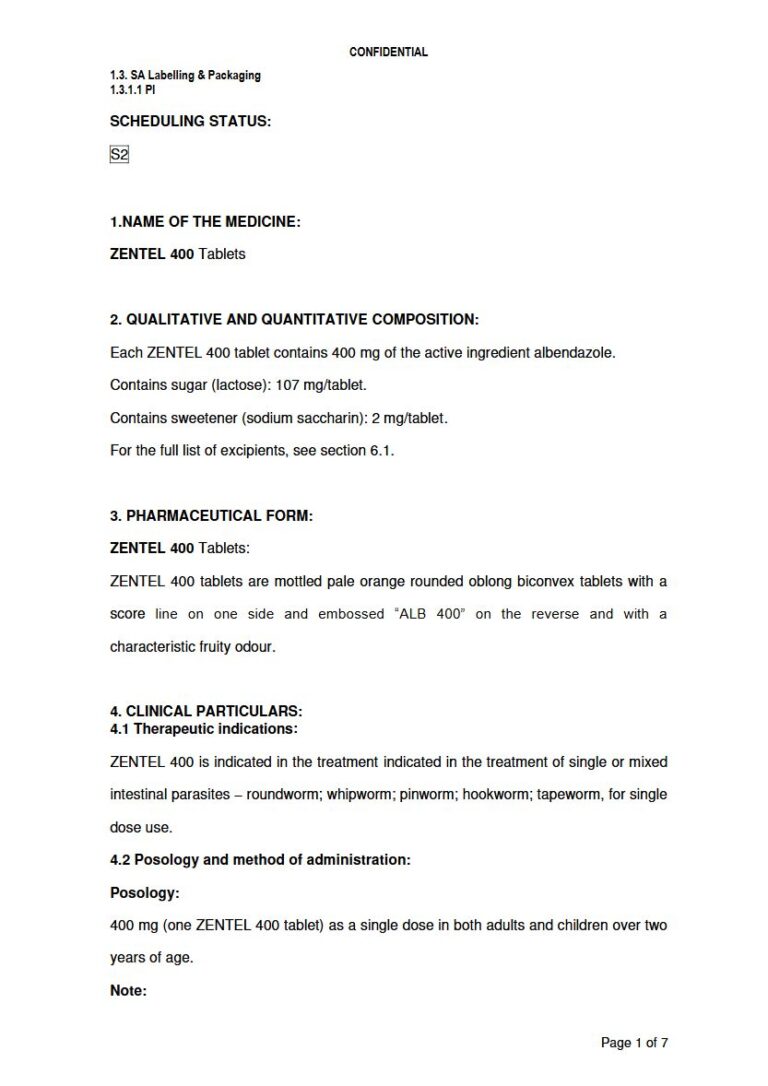
Clinical Particulars
Section 4 of the official insert — extracted exactly as issued, no alterations
4.1 Therapeutic indications
ZENTEL 400 is indicated in the treatment indicated in the treatment of single or mixed intestinal parasites u2013 roundworm; whipworm; pinworm; hookworm; tapeworm, for single dose use.
4.2 Posology and method of administration
Posology: 400 mg (one ZENTEL 400 tablet) as a single dose in both adults and children over two years of age. Note: If the patient is still symptomatic after a single course of treatment, they must consult a healthcare professional for further treatment. No special procedures, such as fasting or purging, are required. Do not exceed the maximum daily dose and treatment duration recommended. Not to be used in children aged under 1-year. Elderly: Experience in patients 65 years of age or older is limited. Reports indicate that no dosage adjustment is required; however, ZENTEL 400 should be used with caution in elderly patients with evidence of hepatic dysfunction (see Hepatic Impairment below). Renal impairment: Since renal elimination of albendazole and its primary metabolite, albendazole sulfoxide, is negligible, it is unlikely that clearance of these compounds would be altered in these patients. No dosage adjustment is required; however, patients with evidence of renal impairment should be carefully monitored. Hepatic impairment: Since albendazole is rapidly metabolised by the liver to the primary pharmacologically active metabolite, albendazole sulfoxide, hepatic impairment would be expected to have significant effects on the pharmacokinetics of albendazole sulfoxide. Patients with abnormal liver function test results (transaminases) prior to commencing ZENTEL 400 therapy should be carefully monitored.
4.3 Contraindications
ZENTEL 400 should not be administered during pregnancy or in women thought to be pregnant (see section 4.6). ZENTEL 400 is contra-indicated in patients with a known history of hypersensitivity to albendazole or constituents of ZENTEL 400.
4.4 Special warnings and precautions for use
Leucopenia may occur when ZENTEL 400 is used for periods longer than recommended. In order to avoid administering ZENTEL 400 during early pregnancy, women of childbearing age should initiate treatment during the first week of menstruation or after a negative pregnancy test. Sub-clinical neurocysticercosis may manifest after a single dose of ZENTEL 400. Treatment with albendazole may uncover pre-existing neurocysticercosis, particularly in areas with high taenosis infection. Patients may experience neurological symptoms e.g., seizures, increased intracranial pressure and focal signs as a result of an inflammatory reaction caused by death of the parasite within the brain. Symptoms may occur soon after treatment. Patients experiencing such symptoms, after taking this medicine must seek advice from a healthcare professional. Excipient warnings: Contains lactose/fructose. Patients with the rare hereditary conditions of galactose intolerance e.g., galactosaemia, Lapp lactase deficiency, glucose-galactose malabsorption or fructose intolerance should not take ZENTEL 400. Lactose may have an effect on the glycaemic control of patients with diabetes mellitus. ZENTEL 400 tablets contain sunset yellow FCF (E110 or FD&C Yellow No 6) which may cause allergic-type reactions.
4.5 Interaction with other medicinal products and other forms of interaction
Praziquantel increase the plasma levels of the active metabolite of ZENTEL 400. Ritonavir, phenytoin, carbamazepine and phenobarbital may reduce plasma concentrations of the active metabolite of ZENTEL 400; albendazole sulfoxide. The clinical relevance of this is unknown, but may result in decreased efficacy, especially in the treatment of systemic helminth infections. Patients should be monitored for efficacy and may require alternative dose regimens or therapies.
4.6 Fertility, pregnancy and lactation
Pregnancy: ZENTEL 400 should not be administered during pregnancy or in women thought to be pregnant (refer to section 4.3). Albendazole is known to be teratogenic and embryotoxic in animals. Breastfeeding: Adequate human data during lactation are not available.
4.7 Effects on ability to drive and use machines
Since dizziness has been reported following treatment with ZENTEL 400, caution is recommended in patients performing skilled tasks.
4.8 Undesirable effects
Data from clinical studies were used to determine the frequency of very common to rare undesirable reactions. The following convention has been used for the classification of frequency: Very common ( u2265 1/10), common ( u2265 1/100 to < 1/10), uncommon ( u2265 1/1 000 to < 1/100), rare ( u2265 1/10 000 to < 1/1 000), very rare (< 1/10 000). Immune system disorders: Rare: hypersensitivity reactions. Nervous system disorders: Uncommon: headache and dizziness. Gastrointestinal disorders: Uncommon: upper gastrointestinal symptoms (e.g., epigastric or abdominal pain, nausea, vomiting) and diarrhoea. Hepatobiliary disorders: Rare: elevations of hepatic enzymes. Skin and subcutaneous tissue disorders: Rare: rash, pruritus and urticaria. Post-marketing Side Effects: Skin and subcutaneous tissue disorders: Unknown: erythema multiforme, Stevens-Johnson syndrome.
4.9 Overdose
In overdose, side effects can be precipitated and/or be of increased severity (refer to section 4.8).
