
Augmentin ES Suspension
Clinical Summary
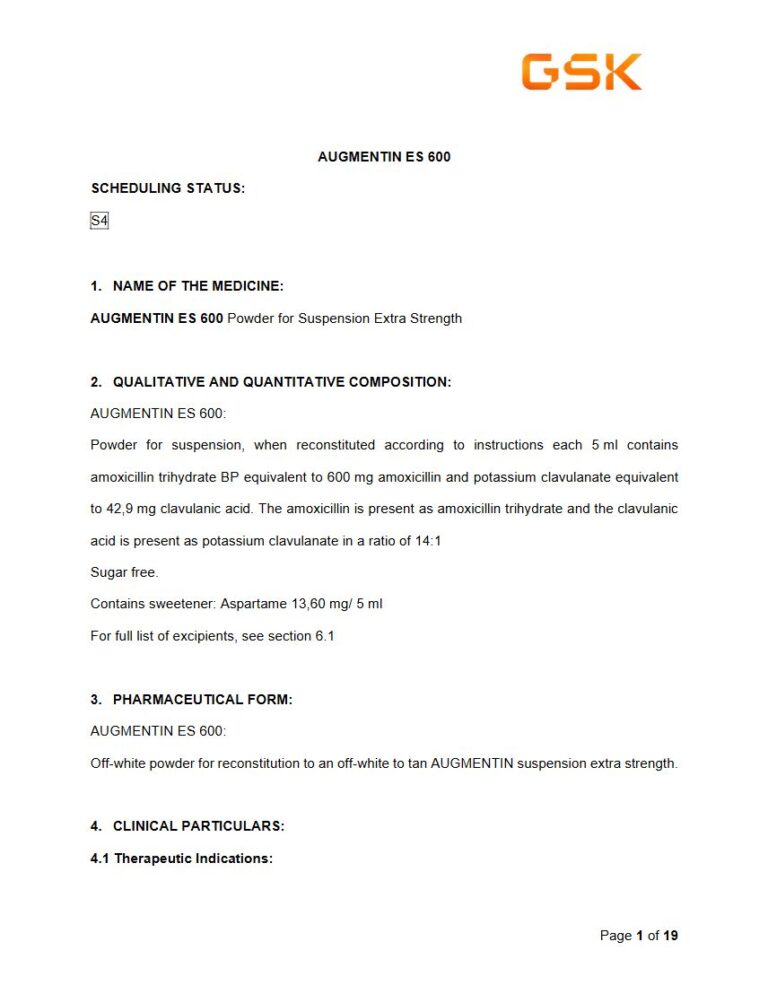
Quick overview from the medicine insert
Important Disclaimer
The Augmentin ES Suspension professional information leaflet below is the property of Glaxosmithkline South Africa and is provided on Medinsert exactly as issued, with no.. alterations or editorial changes. We make every effort to keep content current by updating documents as soon as new versions become available. Medinsert serves as a trusted access point for healthcare professionals, but does not replace official sources or clinical judgement. For more details, please read our full disclaimer. read more>>
 Healthcare Professionals Only
This content is for registered healthcare professionals
Sign in or create a free account to read the full package insert.
Free for HPCSA-registered professionals. Powered by Medinsert.
Clinical Particulars
Section 4 of the official insert — extracted exactly as issued, no alterations
4.1 Therapeutic Indications
AUGMENTIN ES 600 is indicated for short term treatment of acute bacterial otitis media infections when caused by the following AUGMENTIN sensitive organisms: Haemophilus influenzae, Streptococcus pneumoniae (penicillin MIC) u2264 4 u03bcg/ml) and Moraxella catarrhalis.
4.2 Posology and method of administration
Posology
Duration of therapy should be appropriate to the indication and should not exceed 14 days without review.
AUGMENTIN ES 600 is recommended for dosing at 90/6,4 mg/kg/day in two divided doses at 12 hourly intervals for 10 days, in children aged 3 months and older. There is no experience in paediatric patients weighing >40 kg or in adults. There are no clinical data in children under 3 months of age.
Body Weight (kg)
Volume of AUGMENTIN ES 600 providing 90/6,4 mg/kg/day
8 3,0 ml twice daily
12 4,5 ml twice daily
16 6,0 ml twice daily
20 7,5 ml twice daily
24 9,0 ml twice daily
28 10,5 ml twice daily
32 12,0 ml twice daily
36 13,5 ml twice daily
AUGMENTIN ES 600 does not contain the same amount of clavulanic acid (as the potassium salt) as any of the other AUGMENTIN suspensions, therefore these suspensions should not be substituted for AUGMENTIN ES 600, as they are not interchangeable.
Hepatic impairment:
There are insufficient data on which to base a dosage recommendation.
Renal impairment:
There are no dosing recommendations for AUGMENTIN ES 600 in patients with renal impairment.
Method of administration:
AUGMENTIN ES 600 should be taken immediately before a meal. For instructions on dilution of the product before administration, see section 6.6.
4.3 Contraindications
Hypersensitivity to penicillins, amoxicillin and cephalosporins or any other ingredient of AUGMENTIN ES 600. AUGMENTIN ES 600 is contraindicated in patients with a previous history of AUGMENTIN-associated jaundice/hepatic dysfunction.
Safety in children under 2 months of age has not been established. There are no clinical data in children under 3 months of age.
4.4 Special warnings and precautions for use
Serious and occasionally fatal hypersensitivity reactions including anaphylaxis and severe cutaneous adverse reactions have been reported in patients on penicillin therapy. Although anaphylaxis is more frequent following parenteral therapy, it has occurred in patients on oral penicillins. These reactions are more likely to occur in individuals with a history of penicillin hypersensitivity and/or a history of sensitivity to multiple allergens. There have been reports of individuals with a history of penicillin hypersensitivity, who have experienced severe reactions when treated with cephalosporins. Before initiating therapy with AUGMENTIN ES 600, careful inquiry should be made concerning previous hypersensitivity reactions to penicillins, cephalosporins or other allergens. If an allergic reaction occurs, AUGMENTIN ES 600 should be discontinued, and the appropriate alternative therapy instituted. Serious anaphylactic reactions require emergency treatment with epinephrine (adrenaline).
Since AUGMENTIN ES 600 contains amoxicillin, an aminopenicillin, it is not the treatment of choice in patients presenting with sore throat or pharyngitis because of the possibility that the underlying cause is infectious mononucleosis, in the presence of which there is a high incidence of a morbilliform rash if amoxicillin is used. AUGMENTIN ES 600 should be avoided if infectious mononucleosis is suspected.
Changes in liver function tests have been observed in some patients receiving AUGMENTIN. It should be used with care in patients with evidence of severe hepatic dysfunction and hepatic function should be monitored at regular intervals (see Section 4.2). Transient hepatitis and cholestatic jaundice have been reported. AUGMENTIN ES 600 should be used with caution in patients with evidence of hepatic dysfunction.
In patients with moderate or severe renal impairment AUGMENTIN dosage should be adjusted according to the degree of impairment (see Section 4.2). Prolonged use may also result in overgrowth of non-susceptible organisms. Pseudomembranous colitis has been reported with the use of antibiotics and may range in severity from mild to life-threatening. Therefore, it is important to consider its diagnosis in patients who develop diarrhoea during or after antibiotic use. If prolonged or significant diarrhoea occurs or the patient experiences abdominal cramps, treatment should be discontinued immediately and the patient investigated further.
The possibility of superinfections with mycotic or bacterial pathogens should be kept in mind during therapy. If superinfections occur (usually involving Aerobacter, Pseudomonas or Candida), AUGMENTIN ES 600 should be discontinued and/or appropriate therapy instituted.
Abnormal prolongation of prothrombin time (increased international normalised ratio (INR)) has been reported in patients receiving amoxicillin-clavulanate and oral anticoagulants. Appropriate monitoring should be undertaken when anticoagulants are prescribed concurrently. Adjustments in the dose of oral anticoagulants may be necessary to maintain the desired level of anticoagulation.
In patients with reduced urine output, crystalluria has been observed predominantly with parenteral therapy. During the administration of high doses of amoxicillin, it is advisable to maintain adequate fluid intake and urinary output in order to reduce the possibility of amoxicillin crystalluria (refer to section 4.9).
The use of this antibiotic may lead to the selection of resistant strains of organisms and sensitivity testing should, therefore, be carried out whenever possible, to demonstrate the appropriateness of therapy. AUGMENTIN should be used in accordance with local official antibiotic-prescribing guidelines and local susceptibility data. Susceptibility to AUGMENTIN will vary with geography and time. Local susceptibility data should be consulted where available, and microbiological sampling and susceptibility testing performed where necessary.
Periodic assessment of organ system functions, including renal, hepatic and haematopoietic function, is advisable during prolonged therapy. AUGMENTIN ES 600 should be given with caution to patients with lymphatic leukaemia since they are especially susceptible to amoxicillin induced skin rashes. AUGMENTIN ES 600 contains aspartame and should be used with caution in patients with phenylketonuria.
4.5 Interactions with other medicines and other forms of interaction
Concomitant use of probenecid is not recommended. Probenecid decreases the renal tubular secretion of amoxicillin but does not affect clavulanic acid excretion. Concomitant use with AUGMENTIN ES 600 may result in increased and prolonged blood levels of amoxicillin but not of clavulanic acid.
The concomitant administration of allopurinol and ampicillin could substantially increase the incidence of skin rashes in patients receiving both agents as compared to patients receiving ampicillin alone. It is not known whether this potentiation of ampicillin rashes is due to allopurinol or the hyperuricaemia present in these patients. There is no data on AUGMENTIN ES 600 and allopurinol administered concomitantly.
No information is available about the concurrent use of AUGMENTIN ES 600 and alcohol. However, the ingestion of alcohol whilst being treated with some other beta-lactam antibiotics has precipitated a disulfiram like reaction in some patients. Therefore, the ingestion of alcohol should be avoided during and for several days after treatment with AUGMENTIN ES 600.
AUGMENTIN may affect the gut flora, leading to lower oestrogen re-absorption and reduced efficacy of combined oral contraceptives. AUGMENTIN ES 600 may reduce the efficacy of oral contraceptives and patients should be warned accordingly.
In the literature there are rare cases of increased international normalised ratio in patients maintained on warfarin and prescribed a course of amoxicillin. If co-administration is necessary, the prothrombin time or INR should be carefully monitored with the addition or withdrawal of amoxicillin.
In patients receiving mycophenolate mofetil, reduction in pre-dose concentration of the active metabolite mycophenolic acid of approximately 50% has been reported following commencement of oral amoxicillin plus clavulanic acid. The change in pre-dose level may not accurately represent changes in overall MPA exposure.
4.6 Fertility, pregnancy and lactation
Use in Pregnancy:
The safety of AUGMENTIN in pregnancy has not been established. In women with pre-term, premature rupture of the foetal membrane (pPROM), it was reported that prophylactic treatment with amoxicillin-clavulanate may be associated with an increased risk of necrotising enterocolitis in neonates.
Use in lactation:
Amoxicillin is distributed into breast milk. There is no data on the excretion of clavulanic acid in human milk. Mothers on treatment with AUGMENTIN ES 600 should not breastfeed their infants.
4.7 Effects on ability to drive and use machines
No studies on the effects on ability to drive and use machines have been performed, however undesirable effects may occur which may influence the ability to drive and use machines.
4.8 Undesirable effects
Data from large clinical trials was used to determine the frequency of very common to rare undesirable effects. The frequencies assigned to all other undesirable effects (i.e. those occurring at <1/10 000) were mainly determined using post-marketing data and refer to a reporting rate rather than a true frequency. The following convention has been used for the classification of frequency: very common u2265 1/10, common u2265 1/100 to <1/10, uncommon u2265 1/1 000 to <1/100, rare u2265 1/10 000 to <1/1 000, very rare <1/10 000.
Clinical trial data:
Infections and infestations:
Common: Mucocutaneous candidiasis (including vaginitis stomatitis and glossitis)
Blood and lymphatic system disorders:
Rare: Reversible leucopenia (including neutropenia) and thrombocytopenia.
Nervous system disorders:
Uncommon: Dizziness, headache.
Gastrointestinal disorders:
Common: Diarrhoea, nausea, vomiting. Nausea is more often associated with higher oral dosages. If gastrointestinal reactions are evident, they may be reduced by taking AUGMENTIN ES 600 at the start of a meal.
Uncommon: Indigestion, gastritis
Hepatobiliary disorders:
Uncommon: A moderate rise in AST and/or ALT has been noted in patients treated with AUGMENTIN.
Skin and subcutaneous tissue disorders:
Uncommon: Skin rash, pruritus, urticaria.
Rare: Erythema multiforme
Post-marketing spontaneous reports:
Blood and lymphatic system disorders:
Reversible agranulocytosis and haemolytic anaemia. Prolongation of bleeding time and prothrombin time (refer to section 4.4). Appropriate monitoring should be undertaken when anticoagulants are prescribed concomitantly.
Immune system disorders:
Serious and occasional fatal hypersensitivity (anaphylactic) reactions and angioneurotic oedema can occur with oral penicillin (see section 4.4). Angioedema, anaphylaxis, serum sickness-like syndrome, hypersensitivity vasculitis.
Nervous system disorders:
Reversible hyperactivity, aseptic meningitis and convulsions. Convulsions may occur in patients with impaired renal function or in those receiving high doses.
Gastrointestinal disorders:
Antibiotic-associated colitis (including pseudomembranous colitis and haemorrhagic colitis) (see section 4.4). Black u201chairyu201d tongue. Superficial tooth discolouration has been reported which can usually be removed by brushing.
Hepatobiliary disorders:
Hepatitis and cholestatic jaundice. These events have been noted with other penicillins and cephalosporins. Hepatic events may be severe and fatal occurring predominantly in males and elderly patients and may be associated with prolonged treatment. Signs and symptoms usually occur during or shortly after treatment but in some cases may not become apparent until several weeks after treatment has ceased.
Skin and subcutaneous tissue disorders:
Stevens-Johnson syndrome, toxic epidermal necrolysis, bullous exfoliative-dermatitis, acute generalised exanthemous pustulosis (AGEP), and drug reaction with eosinophilia and systemic symptoms (DRESS). If any hypersensitivity dermatitis reaction occurs, treatment should be discontinued.
Renal and urinary disorders:
Interstitial nephritis, crystalluria (refer to section 4.9).
Reporting of adverse events:
Reporting suspected adverse events after authorisation of the medicine is important. It allows continued monitoring of the benefit/risk balance of the medicine. Healthcare professionals are asked to report any suspected adverse reactions to SAHPRA via the u20186.04 Adverse Drug Reaction Reporting formu2019, found on line under SAHPRA publications, https://www.sahpra.org.za/Publications/index/8.
4.9 Overdose
Gastrointestinal symptoms (nausea, vomiting and diarrhoea) and disturbance of the fluid and electrolyte balances may be evident. They may be treated symptomatically, with attention to the water/electrolyte imbalance. AUGMENTIN may be removed from the circulation by haemodialysis. Amoxicillin crystalluria, in some cases leading to renal failure, has been observed (refer to section 4.4).
