
Rukobia 600 Mg Tablets
PDF Leaflet Revision Date: 12 May 2023
Clinical Summary
Quick overview from the medicine insert
Indication
Treatment of heavily treatment-experienced adults with multidrug resistant HIV-1.
Dosage (summary)
600 mg orally twice daily.
Special Populations
- Elderly
- Renal impairment
- Hepatic impairment
Pregnancy & Breastfeeding
Not recommended during pregnancy; likely secreted in breast milk.
Key Drug Interactions
- Strong CYP3A inducers
- Elbasvir/Grazoprevir
- Statins (OATP1B1/3 substrates)
Contraindications
- Hypersensitivity to fostemsavir
- Strong CYP3A inducers
Common side effects
- Insomnia
- Headache
- Dizziness
- Diarrhoea
- Nausea
- Rash
Counselling Points
- Take with or without food
- Do not chew or crush tablets
- Monitor for signs of opportunistic infections
Serious warnings
- QTc prolongation
- Immune Reconstitution Syndrome
Important Disclaimer
The Rukobia 600 Mg Tablets professional information leaflet below is the property of Glaxosmithkline South Africa and is provided on Medinsert exactly as issued, with no.. alterations or editorial changes. We make every effort to keep content current by updating documents as soon as new versions become available. Medinsert serves as a trusted access point for healthcare professionals, but does not replace official sources or clinical judgement. For more details, please read our full disclaimer. read more>>
 Healthcare Professionals Only
This content is for registered healthcare professionals
Sign in or create a free account to read the full package insert.
Free for HPCSA-registered professionals. Powered by Medinsert.
Clinical Particulars
Section 4 of the official insert — extracted exactly as issued, no alterations
4.1 Therapeutic indications
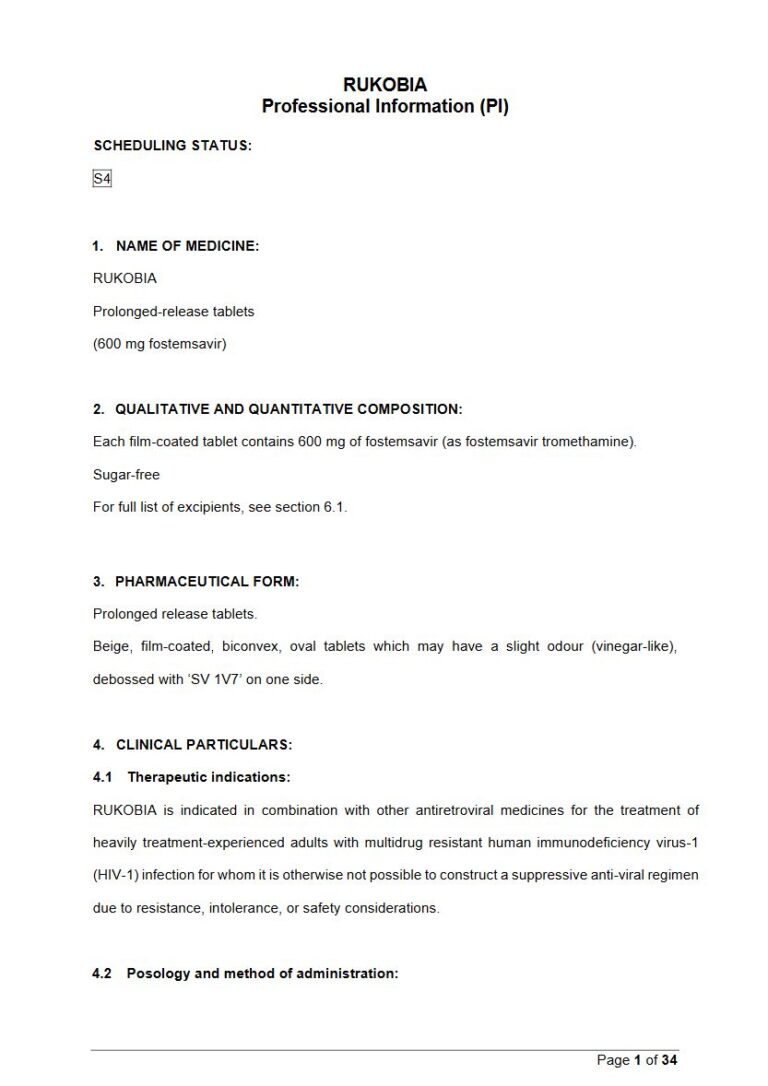
RUKOBIA is indicated in combination with other antiretroviral medicines for the treatment of heavily treatment-experienced adults with multidrug resistant human immunodeficiency virus-1 (HIV-1) infection for whom it is otherwise not possible to construct a suppressive anti-viral regimen due to resistance, intolerance, or safety considerations.
4.2 Posology and method of administration
Therapy should be initiated by a medical practitioner experienced in the management of HIV infection.
Posology:
Adults: The recommended dosage of RUKOBIA is 600 mg orally twice daily.
Method of administration: RUKOBIA can be taken with or without food. RUKOBIA tablets should be swallowed whole, and should not be chewed, crushed, or split. If the patient misses a dose of RUKOBIA, the patient should take it as soon as they remember, if it is more than 12 hours until the next dose. If the next dose is due within 12 hours, the patient should skip the missed dose and resume the usual dosing schedule.
Special populations:
Elderly: There are limited data available on the use of RUKOBIA in patients aged 65 years and older and should be used with caution (see section 5.2).
Renal impairment: No dosage adjustment of RUKOBIA is required for patients with renal impairment and those on haemodialysis (see section 5.2).
Hepatic impairment: No dosage adjustment is required in patients with hepatic impairment (see section 5.2).
Paediatric population: RUKOBIA should not be given to adolescents and children below 18 years of age, due to lack of safety and efficacy data.
4.3 Contraindications
RUKOBIA is contraindicated in patients who have demonstrated hypersensitivity to fostemsavir or any excipient in the formulation of RUKOBIA (see section 6.1).
RUKOBIA is contraindicated in combination with strong CYP3A inducers including, but not limited to carbamazepine, phenytoin (anticonvulsants), mitotane (antineoplastic), enzalutamide (androgen receptor inhibitor), rifampicin (antimycobacterial) and St Johnu2019s wort (Hypericum perforatum, herbal supplement) (see section 4.5).
4.4 Special warnings and precautions for use
Immune Reconstitution Syndrome: In HIV-infected patients with severe immune deficiency at the time of initiation of anti-retroviral therapy (ART), an inflammatory reaction to asymptomatic or residual opportunistic infections may arise and cause serious clinical conditions, or aggravation of symptoms. Typically, such reactions have been observed within the first few weeks or months of initiation of ART. Relevant examples are cytomegalovirus retinitis, generalised and/or focal mycobacterial infections and Pneumocystis jiroveci (P. carinii) pneumonia. Any inflammatory symptoms must be evaluated without delay and treatment initiated when necessary. Autoimmune disorders (such as Gravesu2019 disease, polymyositis, and Guillain-Barre syndrome) have also been reported to occur in the setting of immune reconstitution; however, the time to onset is more variable, and can occur many months after initiation of treatment and sometimes can be an atypical presentation.
QTc Prolongation: In healthy study participants, a supratherapeutic dose of fostemsavir (2400 mg twice daily) has been shown to significantly prolong the QTc interval of the electrocardiogram (see Clinical Pharmacology). RUKOBIA should be used with caution in patients with a history of QT interval prolongation, when co-administered with a medicine with a known risk of Torsade de Pointes (e.g. amiodarone, disopyramide, dofetilide, ibutilide, procainamide, quinidine, or sotalol) or in patients with relevant pre-existing cardiac disease. Elderly patients may be more susceptible to medicine-induced QT interval prolongation.
Patients with Hepatitis B or C Virus Co-infection: Monitoring of liver chemistries is recommended in patients with hepatitis B and/or C co-infection. Particular diligence should be applied in initiating or maintaining effective hepatitis B therapy (referring to treatment guidelines) when starting RUKOBIA therapy in HIV-hepatitis B co-infected patients.
Opportunistic infections: Patients receiving RUKOBIA or any other antiretroviral therapy may still develop opportunistic infections and other complications of HIV infection. Therefore, patients should remain under close clinical observation by medical practitioners experienced in the treatment of these associated HIV diseases.
Transmission of infection: While effective viral suppression with antiretroviral therapy has been proven to substantially reduce the risk of sexual transmission, a residual risk cannot be excluded. Precautions to prevent transmission should be taken in accordance with national guidelines.
Interactions: Caution should be given to co-administering medicines (prescription and non-prescription) that may change the exposure to temsavir, the active moiety of fostemsavir, or medications that may have their exposure changed by temsavir (see section 4.3 and section 4.5). Increased exposure to temsavir may increase the risk of QTc interval prolongation (see QTc interval prolongation and Clinical Pharmacology). Co-administration of RUKOBIA with elbasvir/grazoprevir is not recommended as increased grazoprevir concentrations may increase the risk of ALT elevations (see section 4.5). Dose modifications and/or careful titration of dose is recommended for certain statins that are substrates of OATP1B1/3 or BCRP (rosuvastatin, atorvastatin, pitavastatin, simvastatin and fluvastatin) when co-administered with fostemsavir (see section 4.5).
4.5 Interactions with other medicines and other forms of interaction
Effect of Fostemsavir on the Pharmacokinetics of Other Medicines: Significant interactions are not expected when fostemsavir is co-administered with substrates of cytochrome P 450 (CYPs), uridine diphosphate glucuronosyl transferases (UGTs), P-glycoprotein (P-gp), multidrug resistance protein (MRP)2, bile salt export pump (BSEP), sodium taurocholate co-transporting polypeptide (NTCP), organic anion transporters (OAT)1, OAT3, organic cation transporters (OCT)1, and OCT2 based on in vitro and clinical interaction data. Temsavir and its two metabolites (BMS-646915 and BMS-930644) inhibited breast cancer resistance protein (BCRP) (IC50 = 12, 35, and 3,5 to 6,3 u03bcM, respectively). Based on these data, temsavir is expected to affect the pharmacokinetics of medicines that are substrates of OATP1B1/3 or BCRP (e.g. rosuvastatin, atorvastatin, simvastatin, pitavastatin and fluvastatin). Therefore, dose modifications and/or careful titration of dose is recommended for certain statins. Based on in vitro data, temsavir and its two metabolites (BMS-930644 and BMS-646915) inhibited multidrug and toxin extrusion protein (MATE)1/2K. However, this interaction is unlikely to be of clinical significance. BMS-930644, a metabolite of temsavir, inhibited CYP3A4, BCRP, MATE2K, and OCT1 with IC50 values < 10 u03bcM. However, as circulating concentrations of BMS-930644 are low [Cmax of approximately 458 ng/ml (~1 u03bcM) with RUKOBIA 600 mg twice daily], clinically significant interactions are unlikely.
Effect of Other Medicines on the Pharmacokinetics of Temsavir: Temsavir is a substrate of P-gp and BCRP, but not of OATP1B1 or OATP1B3. Its biotransformation to two circulating metabolites, BMS-646915 and BMS-930644, is mediated by unidentified esterases (36,1 %) and by CYP3A4 enzyme (21,2 %), respectively. Temsavir exposures may be influenced by modulators of CYP3A4, P-gp and/or BCRP activity. However, because of the primary esterase metabolism pathway, effects are expected to be less than that of substrates primarily metabolized by CYP3A4. When RUKOBIA was co-administered with a strong CYP3A inducer rifampicin, a significant reduction in temsavir plasma concentrations was observed. Significant decreases in temsavir plasma concentrations may also occur when RUKOBIA is co-administered with other strong CYP3A inducers and may result in loss of virologic response (see section 4.3). RUKOBIA may be co-administered with strong CYP3A4, BCRP and/or P-gp inhibitors (e.g. clarithromycin, itraconazole, posaconazole, and voriconazole) without dose adjustment based on the results of clinical medicine interaction studies with cobicistat and ritonavir. Selected medicine interactions are presented in Table 1. Recommendations are based on either medicine interaction studies or predicted interactions due to the expected magnitude of the interaction and/or potential for serious adverse events or loss of efficacy.
4.6 Fertility, pregnancy and lactation
Pregnancy: The effect of RUKOBIA on human pregnancy is unknown. Temsavir was shown to cross the placenta in an animal distribution study after dosing with radiolabelled fostemsavir and was found in foetal brain tissue. RUKOBIA should not be used during pregnancy.
Breastfeeding: Temsavir is likely to be secreted into breastmilk based on animal data, although this has not been confirmed in humans. Fostemsavir was associated with decreased pup survival during the peak lactation period in an animal study at exposures substantially higher than for the therapeutic dose. HIV-infected women should not take RUKOBIA when breastfeeding their infants.
Fertility: There are no data on the effects of fostemsavir on human male or female fertility. Animal studies indicate no effects of RUKOBIA on male or female fertility at clinically relevant doses.
4.7 Effects on ability to drive and use machines
There have been no studies to investigate the effect of RUKOBIA on driving performance or the ability to operate machinery. However, RUKOBIA causes dizziness and insomnia which can affect the ability to drive and operate machinery. The clinical status of the patient and the adverse event profile of RUKOBIA should be borne in mind when considering the patient's ability to drive or operate machinery.
4.8 Undesirable effects
Clinical trial data: A total of 620 HIV-1 infected subjects received at least one dose of RUKOBIA as part of a controlled clinical trial. The safety and tolerability of the recommended dose of RUKOBIA was evaluated in a Phase III, partially randomised, double-blind, placebo-controlled trial conducted in 371 heavily treatment-experienced adult subjects (see Clinical Studies). In the randomised cohort, 272 subjects received either blinded fostemsavir, 600 mg twice daily (n = 203), or placebo (n = 69), in addition to their current failing regimen, for 8 days of functional monotherapy. Beyond Day 8, randomised subjects received open label fostemsavir, 600 mg twice daily, plus an optimised background therapy (OBT). In the non-randomised Cohort, 99 subjects received open label fostemsavir, 600 mg twice daily, plus OBT from Day 1 onward.
Adverse reactions (ADRs) identified in the Phase III clinical trial, which included a total of 370 subjects receiving at least 1 dose of fostemsavir 600 mg twice daily, are listed below by MedDRA system organ class and by frequency. Frequencies are defined as: very common (u2265 1/10), common (u2265 1/100 and < 1/10), uncommon (u2265 1/1 000 and < 1/100), rare (u2265 1/10 000 and < 1/1 000) and very rare (< 1/10 000), including isolated reports. For many of the adverse reactions listed, it is unclear whether they are related to RUKOBIA, or the other medicinal products used in the management of HIV infection, or whether they are a result of the underlying disease process.
4.9 Overdose
Symptoms and signs: There is currently limited experience of overdosage with RUKOBIA.
Treatment: There is no specific treatment for overdose with RUKOBIA. If overdose occurs, the patient should be treated supportively with appropriate monitoring as necessary. As temsavir is highly bound to plasma proteins, it is unlikely that it will be significantly removed by dialysis. Further management should be as clinically indicated or as recommended by the national poison centre, where available.
