
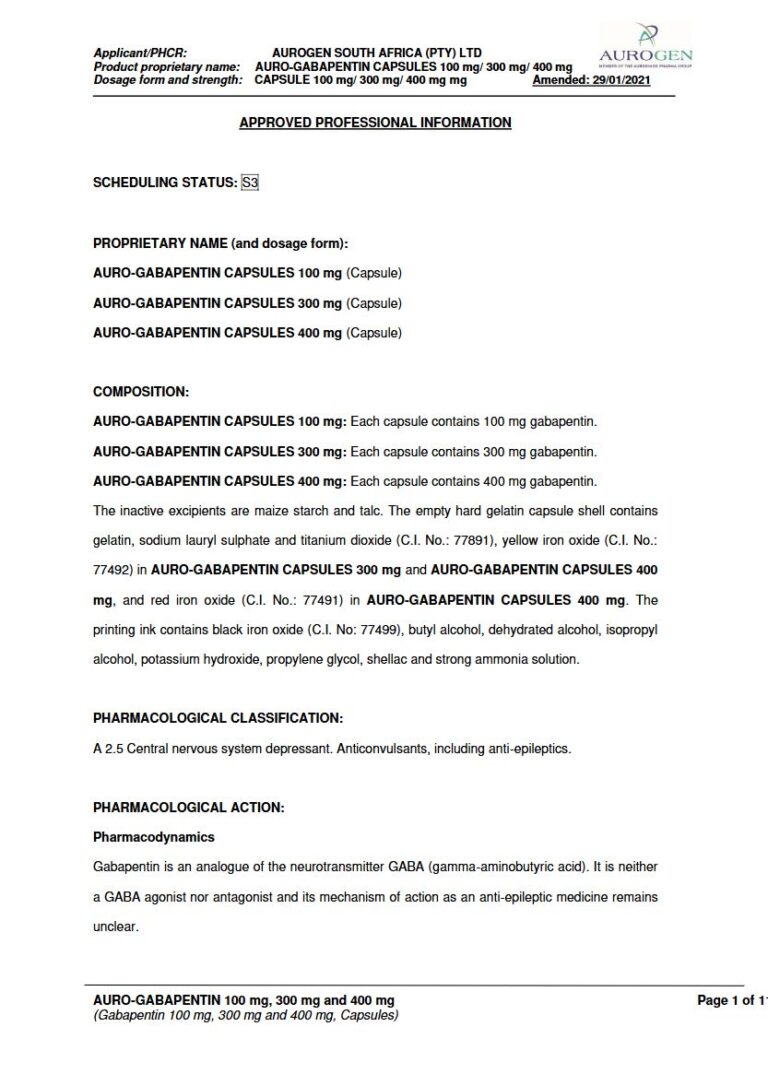
Auro-Gabapentin Capsules
PDF Leaflet Revision Date: 29 January 2021
Clinical Summary
Quick overview from the medicine insert
Indication
Adjunctive treatment for partial seizures.
Dosage (summary)
Adults: Start at 300 mg TID, may increase to 900-1800 mg/day. Max 3600 mg/day for short periods.
Onset of Action / Duration
Onset: 2-3 hours, Duration: Not specified.
Special Populations
- Elderly
- Renal impairment
Pregnancy & Breastfeeding
Safety not established in pregnancy and lactation.
Key Drug Interactions
- Antacids reduce bioavailability
- CNS depressants may enhance effects
Contraindications
- Hypersensitivity to gabapentin
- Children under 12 years
- Pregnancy and lactation
Common side effects
- Somnolence
- Dizziness
- Ataxia
- Headache
- Nystagmus
Counselling Points
- Avoid abrupt withdrawal
- Caution with driving and machinery
- Take antacid 2 hours apart
Serious warnings
- Monitor for depression and suicidal thoughts
- Caution in renal impairment
Important Disclaimer
The Auro-Gabapentin Capsules professional information leaflet below is the property of Aurogen South Africa and is provided on Medinsert exactly as issued, with no.. alterations or editorial changes. We make every effort to keep content current by updating documents as soon as new versions become available. Medinsert serves as a trusted access point for healthcare professionals, but does not replace official sources or clinical judgement. For more details, please read our full disclaimer. read more>>
 Healthcare Professionals Only
This content is for registered healthcare professionals
Sign in or create a free account to read the full package insert.
Free for HPCSA-registered professionals. Powered by Medinsert.
Clinical Particulars
Section 4 of the official insert — extracted exactly as issued, no alterations
4.1 Therapeutic indications
AURO-GABAPENTIN is indicated:
- As an adjunct to other standard anticonvulsant medications in patients who have not achieved adequate seizure control with these agents used alone or in combination.
- In controlling both simple and complex partial seizures with or without secondarily generalised tonic clonic seizures.
4.3 Contraindications
Hypersensitivity to gabapentin or the productu2019s excipients.
Children under 12 years
Pregnancy and lactation (See u201cPregnancy and lactationu201d).
4.4 Special warnings and precautions for use
Patients being treated with AURO-GABAPENTIN should be monitored for the emergence or worsening of depression, suicidal thoughts or behaviour, or any unusual changes in mood or behaviour.
Porphyria: Safety has not been established.
4.5 Interactions with other medicines
There is no interaction between AURO-GABAPENTIN, phenobarbitone, phenytoin, valproic acid, carbamazepine or carbamazepine 10, 11-epoxide.
Co-administration of AURO-GABAPENTIN with oral contraceptives, containing norethindrone and/or ethinyl estradiol, does not influence the steady-state plasma concentrations of either component.
Concomitant use of AURO-GABAPENTIN with a magnesium- and aluminium-containing antacid reduces gabapentin bioavailability by approximately 20%. It is recommended that gabapentin be taken about two hours following antacid administration.
Concurrent use of AURO-GABAPENTIN with alcohol and other CNS depressants may increase the CNS depressant effects.
False positive tests for proteinuria may occur with Ames Multistix-SG.
4.6 Fertility, pregnancy and lactation
Safety in pregnancy and lactation has not been established.
4.7 Effects on ability to drive and use machines
Patients should be warned that AURO-GABAPENTIN may affect their alertness and that caution should be exercised when driving a vehicle, operating machinery or performing hazardous tasks. The concomitant use of alcohol will intensify these effects.
4.8 Undesirable effects
Adverse events are usually mild to moderate in severity and tend to diminish with continued use.
The most frequent side effects are somnolence, dizziness, ataxia, headache, nystagmus, tremor, fatigue, diplopia, nausea and/or vomiting and rhinitis.
Side effects are categorised by organ class system.
Blood and the lymphatic system disorders: Less frequent: Leucopenia.
The following side effects have been reported and frequencies are unknown: Purpura.
Psychiatric disorders: Frequent: Thinking abnormal, emotional lability. Less frequent: Nervousness, depression.
Nervous system disorders: Frequent: Somnolence, dizziness, ataxia, nystagmus, tremor. Less frequent: Amnesia, dysarthria, insomnia, twitching, abnormal co-ordination. The following side effects have been reported and frequencies are unknown: Confusion, paraesthesia, vertigo.
Eye disorders: Frequent: Diplopia. Less frequent: Amblyopia, conjunctivitis.
Vascular disorders: Less frequent: Vasodilation.
Respiratory, thoracic and mediastinal disorders: Less frequent: Rhinitis, pharyngitis, coughing, respiratory tract infection.
Gastrointestinal disorders: Less frequent: Nausea and vomiting, dyspepsia, abdominal pain, mouth or throat dry, constipation, dental abnormalities, diarrhoea, increased appetite.
Skin and subcutaneous tissue disorders: Less frequent: Pruritus, abrasion. The following side effects have been reported and frequencies are unknown: Rash, acne, maculopapular rash.
Musculoskeletal, connective tissue and bone disorders Frequent: Myalgia. Less frequent: Fracture.
Reproductive system and breast disorders: Less frequent: Impotence.
General disorders and administrative site conditions: Frequent: Fatigue, peripheral oedema, viral infection, fever. Less frequent: Headache, weight increase, back pain.
Investigations: The following side effects have been reported and frequencies are unknown: White blood cells decreased.
4.9 Overdose
Symptoms of overdose include dizziness, double vision, slurred speech, drowsiness, lethargy and mild diarrhoea (see u201cSide -Effects and Special Precautionsu201d). Treatment is symptomatic and supportive. Haemodialysis has been shown to be effective in eliminating AURO-GABAPENTIN and may be indicated in patients with renal impairment. Reduced absorption of AURO-GABAPENTIN at higher doses may limit drug absorption and hence minimize toxicity at the time of overdosing.
