
Primovist 5 ml. 7.5 ml. 10 ml Solution for injection
PDF Leaflet Revision Date: 14 February 2022
Clinical Summary
Quick overview from the medicine insert
Indication
Gadolinium-based contrast agent for MRI of the liver.
Dosage (summary)
0.1 ml/kg body weight as an intravenous bolus injection.
Onset of Action / Duration
Onset: 10 mins, Duration: 120 mins.
Special Populations
- Elderly
- Hepatic impairment
- Renal impairment
- Paediatric population
Pregnancy & Breastfeeding
Use only if clinically necessary; minimal excretion in breast milk.
Key Drug Interactions
- OATP inhibitors
- Elevated bilirubin levels
Contraindications
- Hypersensitivity to active substance or excipients
Common side effects
- Nausea
- Headache
- Dizziness
- Increased blood pressure
Counselling Points
- Avoid intramuscular injection
- Post-procedure observation recommended
- Inform about potential allergic reactions
Serious warnings
- Risk of anaphylactoid reactions
- Monitor patients with cardiac disorders
Important Disclaimer
The Primovist 5 ml. 7.5 ml. 10 ml Solution for injection professional information leaflet below is the property of Bayer and is provided on Medinsert exactly as issued, with no.. alterations or editorial changes. We make every effort to keep content current by updating documents as soon as new versions become available. Medinsert serves as a trusted access point for healthcare professionals, but does not replace official sources or clinical judgement. For more details, please read our full disclaimer. read more>>
 Healthcare Professionals Only
This content is for registered healthcare professionals
Sign in or create a free account to read the full package insert.
Free for HPCSA-registered professionals. Powered by Medinsert.
Clinical Particulars
Section 4 of the official insert — extracted exactly as issued, no alterations
4.1 Therapeutic indications
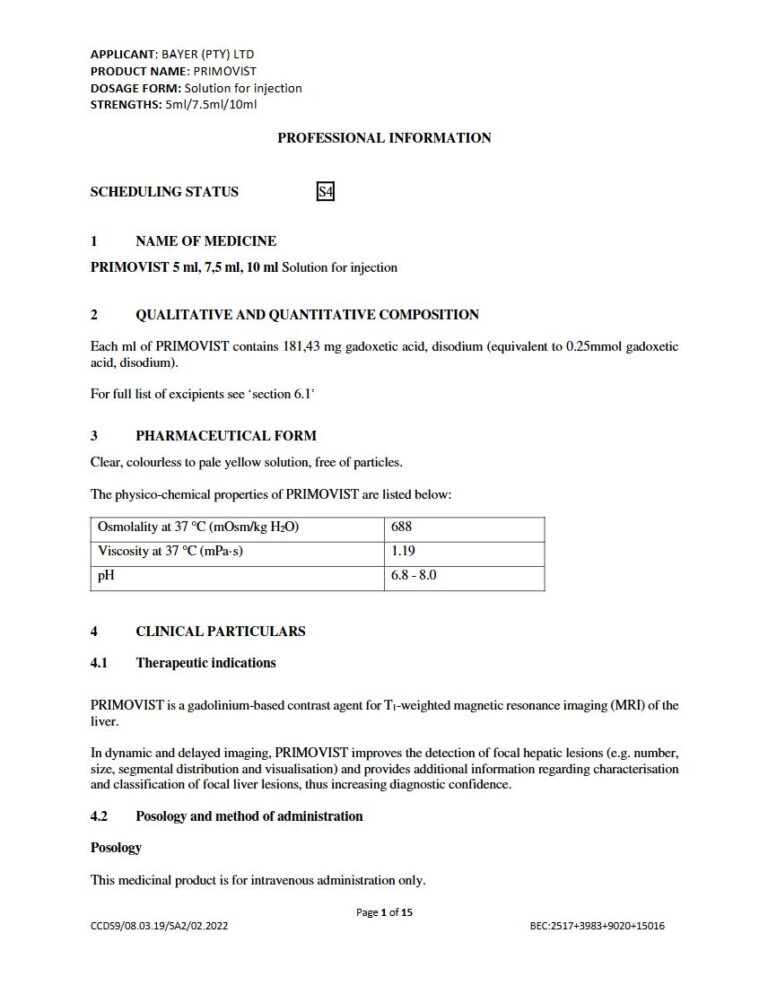
PRIMOVIST is a gadolinium-based contrast agent for T1-weighted magnetic resonance imaging (MRI) of the liver. In dynamic and delayed imaging, PRIMOVIST improves the detection of focal hepatic lesions (e.g. number, size, segmental distribution and visualisation) and provides additional information regarding characterisation and classification of focal liver lesions, thus increasing diagnostic confidence.
4.2 Posology and method of administration
Posology This medicinal product is for intravenous administration only. PRIMOVIST is a ready-to-use aqueous solution to be administered undiluted as an intravenous bolus injection. After injection of PRIMOVIST the intravenous cannula/line should be flushed using sterile physiological saline solution. After bolus injection of PRIMOVIST, dynamic imaging during arterial, portovenous, and equilibrium phases utilizes the different temporal enhancement pattern of different liver lesion types to obtain information about their classification (benign/malignant) and the specific characterization. It further improves visualization of hypervascular liver lesions. The delayed (hepatocyte) phase starts at about 10 minutes post injection (in confirmatory studies most of the data were obtained at 20 minutes post injection) with an imaging window lasting at least 120 minutes. The imaging window is reduced to 60 minutes in patients requiring haemodialysis and in patients with elevated bilirubin values (> 3 mg/dl) (see also u2018section 4.5u2019). The enhancement of liver parenchyma during the hepatocyte phase assists in the identification of the number, segmental distribution, visualization, and delineation of liver lesions, thus improving lesion detection. The different enhancement/washout patterns of liver lesions contribute to the information from the dynamic phase. Hepatic excretion of PRIMOVIST results in enhancement of biliary structures. The usual safety rules for magnetic resonance imaging must be observed, e.g. exclusion of cardiac pacemakers and ferromagnetic implants. For additional instructions see section 6.6 0,1 ml per kg body weight PRIMOVIST (equivalent to 25 u03bcmol per kg body weight).
Special population
- Elderly population (aged 65 years and above) No dosage adjustment is necessary. In clinical studies, no overall differences in safety or efficacy were observed between elderly (aged 65 years and above) and younger patients, and other reported clinical experience has not identified differences between the elderly and younger patients (see also u2018section 5.2u2019).
- Patients with hepatic impairment No dosage adjustment is necessary. In clinical studies, no overall differences in safety or efficacy were observed between patients with and without hepatic impairment, and other reported clinical experience has not identified differences in patients with hepatic impairment and healthy subjects (see also u2018section 5.2u2019).
- Patients with renal impairment In clinical studies, no overall differences in safety and efficacy were observed between patients with renal impairment and patients with normal kidney function. The elimination of PRIMOVIST is prolonged in renally impaired patients. To ensure diagnostically useful images, no dosage adjustment is recommended (see also u2018section 4.4u2019).
- Paediatric population The safety and efficacy of PRIMOVIST have not been established in patients under 18 years old. An observational study with PRIMOVIST was performed in 52 patients (aged > 2 months and < 18 years) referred for evaluation of suspected or known focal liver lesions. PRIMOVIST improved border delineation and increased contrast of the primary lesion in 86.3 % of patients when compared to non-contrast images. No safety issues were identified. Due to the retrospective nature and small sample size of this study, no definitive conclusion can be made regarding efficacy and safety in this population. No dose adjustment according to age is necessary in paediatric patients. The safety and effectiveness of PRIMOVIST have not been established in premature infants.
4.3 Contraindications
Hypersensitivity to the active substance or to any of the excipients.
4.4 Special warnings and precautions for use
Patients with existing cardiac conductance disorders should be carefully monitored during and after procedures.
Hypersensitivity Particularly careful risk-benefit assessment is required in patients with known hypersensitivity to PRIMOVIST. PRIMOVIST can be associated with anaphylactoid/ hypersensitivity or other idiosyncratic reactions characterized by cardiovascular, respiratory and cutaneous manifestations, and ranging to severe reactions including shock. The risk of hypersensitivity reactions is higher in case of:
- previous reaction to contrast media
- history of bronchial asthma
- history of allergic disorders.
In patients with an allergic disposition the decision to use PRIMOVIST must be made after particularly careful evaluation of the risk-benefit ratio. Most of these reactions occur within half an hour after administration of contrast media. Therefore, post-procedure observation of the patient is recommended. If hypersensitivity reactions occur (see u2018section 4.8u2019), injection of the contrast medium must be discontinued immediately. It is advisable to use a flexible indwelling cannula for intravenous contrast medium administration in order to give instant specific therapy u2013 if necessary. To permit immediate countermeasures to be taken in emergencies, appropriate drugs, an endotracheal tube and a respirator should be ready at hand.
Delayed reactions after hours up to several days have been rarely observed (see u2018section 4.8u2019). Hypersensitivity reactions can be more intense in patients on beta-blockers, particularly in the presence of bronchial asthma. It should be considered that patients on beta-blockers may be refractory to standard treatment of hypersensitivity reactions with beta-agonists.
Cardiovascular disease Caution should be exercised when PRIMOVIST is administered to patients with severe cardiovascular problems because only limited data are available so far.
Impaired renal function In healthy subjects, PRIMOVIST is equally eliminated via renal and hepatobiliary routes. Prior to administration of PRIMOVIST, it is recommended, that all patients are screened for renal dysfunction by obtaining a history and/or laboratory tests. In patients with severely impaired renal function, the benefits must be weighed carefully against the risks, since contrast medium elimination is delayed in such cases. A sufficient period of time for elimination of the contrast agent from the body prior to any re-administration in patients with renal impairment should be ensured. Gadoxetic acid, disodium can be removed from the body by haemodialysis. About 30% of the administered dose is eliminated from the body by a single dialysis session of 3 hours starting 1-hour post injection. In end-stage renal failure patients, PRIMOVIST was almost completely eliminated via dialysis and biliary excretion within the observation period of 6 days, the majority within 3 days. For patients already receiving haemodialysis at the time of PRIMOVIST administration, prompt initiation of haemodialysis following the administration of PRIMOVIST should be considered, in order to enhance the contrast agent's elimination (see also u2018section 5.2u2019).
There have been reports of nephrogenic systemic fibrosis (NSF) associated with the use of some contrast agents containing gadolinium in patients with:
- acute or chronic severe renal impairment (GFR < 30 ml/min/1.73m2) or
- acute renal insufficiency of any severity due to the hepato-renal syndrome or in the perioperative liver transplantation period.
Although the systemic body exposure with gadolinium is low based on the diagnostic dosage of PRIMOVIST as well as its dual elimination pathways (renal and hepatobiliary), there is a possibility that NSF may occur with PRIMOVIST. Therefore, PRIMOVIST should only be used in these patients after careful risk/benefit assessment (see u2018section 4.8u2019).
Prior to administration of PRIMOVIST all patients should be screened for renal dysfunction by obtaining a history and/or laboratory tests. PRIMOVIST can be removed from the body by haemodialysis. For patients already receiving haemodialysis at the time of PRIMOVIST administration, prompt initiation of haemodialysis following the administration of PRIMOVIST should be considered, in order to enhance the contrast agent's elimination.
Local intolerance Intramuscular administration must be strictly avoided, because it may cause local intolerance reactions, including focal necrosis, and should therefore be strictly avoided (see u2018section 5.3u2019).
Excipients This medicinal product contains 4 mmol sodium (82 mg) per dose (based on the amount given to a 70 kg person). To be taken into consideration by patients on a controlled sodium diet.
4.5 Interaction with other medicines and other forms of interaction
Interference with organic anion-transporting polypeptide (OATP) inhibitors Animal studies demonstrated that compounds belonging to the class of anionic medicinal products, e.g. rifampicin, block the hepatic uptake of PRIMOVIST, thus reducing the hepatic contrast effect. In this case the expected benefit of an injection of PRIMOVIST might be limited. No other interactions with medicinal products are known from animal studies. An interaction study in healthy subjects demonstrated that the co-administration of the OATP inhibitor erythromycin did not influence efficacy and pharmacokinetics of PRIMOVIST. No further clinical interaction studies with other medicinal products have been performed.
Interference from elevated bilirubin or ferritin levels in patients Elevated levels of bilirubin (>3 mg/dl) or ferritin can reduce the hepatic contrast effect of PRIMOVIST. If PRIMOVIST is used in these patients, complete the magnetic resonance imaging no later than 60 minutes after PRIMOVIST administration. (see u2018section 5.2u2019)
Interference with diagnostic tests Serum iron determination using complexometric methods (e.g. Ferrocine complexation method) may result in falsely high or low values for up to 24 hours after the examination with PRIMOVIST because of the free complexing agent caloxetate trisodium contained in the contrast medium solution.
4.6 Fertility, pregnancy and lactation
Pregnancy For gadoxetic acid disodium no clinical study data on exposed pregnancies are available. Animal studies at clinically relevant doses have not shown reproductive toxicity after repeated administration (see u2018section 5.3u2019). The potential risk for humans is unknown. PRIMOVIST should only be used during pregnancy if the clinical condition of the woman requires the use of gadoxetic acid disodium.
Breastfeeding It is unknown whether PRIMOVIST is excreted in human milk. There is evidence from non-clinical data that PRIMOVIST is excreted into breast milk in very small amounts (less than 0.5% of the dose intravenously administered) and the absorption via the gastrointestinal tract is poor (about 0.4 % of the dose orally administered were excreted in the urine) (see u2018section 5.2u2019). At clinical doses, no effects on the infant are anticipated and PRIMOVIST can be used during breastfeeding.
4.7 Effects on ability to drive and use machines
Not Applicable
4.8 Undesirable effects
a) Summary of the safety profile The overall safety profile of PRIMOVIST is based on data from more than 1,900 patients in clinical trials, and from post-marketing surveillance. The most frequently observed adverse drug reactions (u2265 0.5 %) in patients receiving PRIMOVIST are nausea, headache, feeling hot, blood pressure increased and dizziness. The most serious adverse drug reaction in patients receiving PRIMOVIST is anaphylactoid shock. Delayed allergy-like reactions (hours later up to several days) have been rarely observed. Most of the undesirable effects were of mild to moderate intensity.
b) Tabulated list of adverse reactions The adverse drug reactions observed with PRIMOVIST are represented in the table below. They are classified according to System Organ Class (MedDRA version 12.1). The most appropriate MedDRA term is used to describe a certain reaction and its synonyms and related conditions. Adverse drug reactions from clinical trials are classified according to their frequencies. Frequency groupings are defined according to the following convention: common: u2265 1/100 to < 1/10; uncommon: u2265 1/1 000 to < 1/100; rare: u2265 1/10 000 to < 1/1 000. The adverse drug reactions identified only during post-marketing surveillance, and for which a frequency could not be estimated, are listed under u2018not knownu2019. Within each frequency grouping, undesirable effects are presented in order of decreasing seriousness.
Table 1: Adverse drug reactions reported in clinical trials or during post-marketing surveillance in patients treated with PRIMOVIST
System Organ Class
Common Uncommon Rare Unknown
Immune system disorders Hypersensitivity / anaphylactoid reaction (e.g. shock*, hypotension, Pharyngolaryngeal oedema, urticaria, face oedema, rhinitis, conjunctivitis, abdominal pain, hypoesthesia, sneezing, cough, pallor)
Nervous system disorders Headache Vertigo Dizziness Dysgeusia Paraesthesia Parosmia Tremor Akathisia Restlessness
Cardiac disorders Bundle branch block Palpitation Tachycardia
Vascular disorders Blood pressure increase Flushing
Respiratory, thoracic and mediastinal disorders Respiratory disorders (Dyspnoea *, Respiratory distress)
Gastrointestinal disorders Nausea Vomiting Diarrhoea Dry mouth Oral discomfort Salivary hypersecretion
Skin and subcutaneous tissue disorders Rash Pruritus ** Maculopapular rash Hyperhidrosis
Musculoskeletal and connective tissue disorders Back pain
General disorders and administration site conditions Chest pain Injection site reaction *** Feeling hot Chills Fatigue Feeling abnormal Discomfort Malaise
* Life-threatening and/or fatal cases have been reported. These reports originated from post-marketing experience.
** Pruritus (Generalized pruritus, Eye pruritus)
*** Injection site reactions (various kinds) comprise the following terms: Injection site extravasation, Injection site burning, Injection site coldness, Injection site irritation, Injection site pain
c) Description of selected adverse reactions. Cases of nephrogenic systemic fibrosis (NSF) have been reported with some contrast agents containing gadolinium (see also u2018section 4.4u2019). Slightly elevated serum iron and serum bilirubin values have been observed in less than 1% of patients after administration of PRIMOVIST. However, the values did not exceed more than 2 u2013 to 3 times the baseline values and these returned to their initial values without any symptoms within 1 to 4 days.
Reporting of suspected adverse reactions Reporting suspected adverse reactions after authorisation of the medicine is important. It allows continued monitoring of the benefit/risk balance of the medicine. Healthcare professionals are asked to report any suspected adverse reactions to SAHPRA via the u201c6.04 Adverse Drug Reaction Reporting Formu201d, found online under SAHPRA publications: https://www.sahpra.org.za/Publications/Index/8.
4.9 Overdose
Based on the results of acute toxicity studies in animals, there is no risk of acute intoxication when using PRIMOVIST. Single doses of gadoxetic acid disodium as high as 0.4 ml/kg (100 u03bcmol/kg) body weight were tolerated well. In a limited number of patients, a dose of 2,0 ml/kg (500 u03bcmol/kg) body weight showed more frequent occurrences but no new undesirable effects. In view of the low volume (maximum 10 ml) and the extremely low gastrointestinal absorption rate of PRIMOVIST, and based on acute toxicity data, intoxication due to inadvertent oral ingestion of the contrast medium is extremely improbable. There have been no cases of overdose observed or reported in clinical use. Therefore, the signs and symptoms of overdosage have not been characterized.
Patients with renal and/or hepatic impairment In case of inadvertent overdosage in patients with severely impaired renal and/or hepatic function, PRIMOVIST can be removed by haemodialysis. (see u2018section 4.4u2019 and u2018section 5.2u2019).
