
Minesse 60/15 micrograms FC tablets.
PDF Leaflet Revision Date: 10 November 2022
Clinical Summary
Quick overview from the medicine insert
Indication
Prevention of pregnancy.
Dosage (summary)
One active tablet daily for 24 days, followed by 4 days of inactive tablets.
Special Populations
- Elderly
- Postpartum women
Pregnancy & Breastfeeding
Not indicated in pregnancy; may affect lactation.
Key Drug Interactions
- Antiviral HCV medicines
- Rifampicin
- St. John's wort
Contraindications
- Hypersensitivity to components
- History of thromboembolism
- Uncontrolled hypertension
- Known or suspected pregnancy
Common side effects
- Headache
- Nausea
- Mood changes
- Breakthrough bleeding
Counselling Points
- Use nonhormonal backup for first 7 days if starting late
- Does not protect against STIs
- Report mood changes or severe headaches
Serious warnings
- Increased risk of thromboembolism
- Cigarette smoking increases cardiovascular risks
- Monitor blood pressure
Important Disclaimer
The Minesse 60/15 micrograms FC tablets. professional information leaflet below is the property of Pfizer Laboratories and is provided on Medinsert exactly as issued, with no.. alterations or editorial changes. We make every effort to keep content current by updating documents as soon as new versions become available. Medinsert serves as a trusted access point for healthcare professionals, but does not replace official sources or clinical judgement. For more details, please read our full disclaimer. read more>>
 Healthcare Professionals Only
This content is for registered healthcare professionals
Sign in or create a free account to read the full package insert.
Free for HPCSA-registered professionals. Powered by Medinsert.
Clinical Particulars
Section 4 of the official insert — extracted exactly as issued, no alterations
4.1 Therapeutic indications
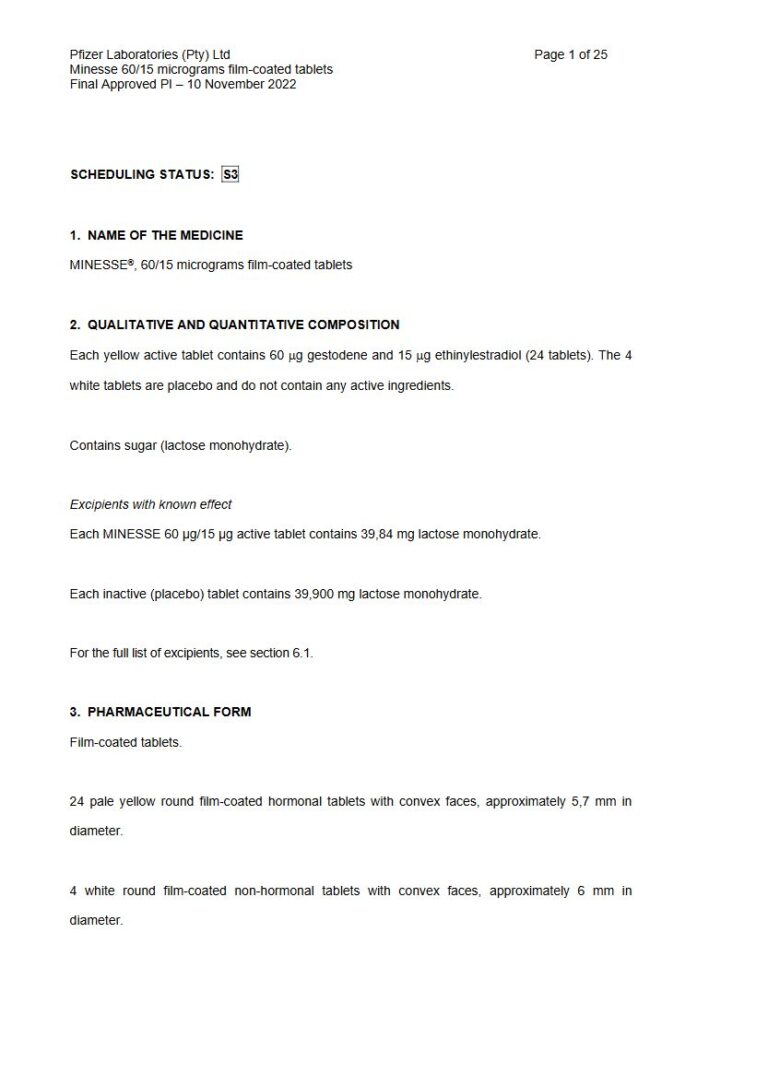
MINESSE is indicated for the prevention of pregnancy.
4.2 Posology and method of administration
Posology
How to take MINESSE
In MINESSE 28-day packs, tablets 1 - 24 contain active ingredients (active tablets) and tablets 25 - 28 do not contain any active ingredients (inactive tablets). MINESSE must be taken in the order as directed on the package and at the same time every day, preferably after the evening meal or at bedtime. One active tablet is to be taken daily for 24 consecutive days, then either followed by 4 days of inactive (placebo) tablets or a 4-day tablet-free interval. Each subsequent pack is started on the day after the last inactive tablet. A withdrawal bleed usually starts on days 2 - 3, after the last active tablet and may not have finished before the next pack is started. The tablets are taken daily, and pack follows pack without interruption and without regard to bleeding.
How to start MINESSE
No preceding hormonal contraceptive use (in the past month)
On the first day of the womanu2019s natural menstrual cycle, i.e. the first day of menstrual bleeding, the patient will take the first tablet marked with the appropriate day of the week from those in the red area of the package. Starting on days 2 - 7 (e.g. Sunday start) is allowed, but for the first 7 days of tablet-taking during the first cycle a nonhormonal back-up method of contraception (such as condoms and spermicide) is recommended. Thereafter, one tablet is taken daily, following the arrows on the package, until all 28 tablets have been taken.
Changing from another combination oral contraceptive to MINESSE
The woman should start MINESSE preferably on the day after the last active tablet of her previous combination oral contraceptive, but at the latest, on the day following the usual inactive tablet interval of her previous combination oral contraceptive.
Changing from a progestin only method (progestin-only tablet, injection, implant)
The woman may switch any day from the progestin-only tablet and should begin MINESSE the next day. She should start MINESSE on the day of an implant removal or, if using an injection, the day the next injection would be due. In all of these situations, the woman should be advised to use a nonhormonal back-up method for the first 7 days of tablet-taking.
Following first-trimester abortion
The woman may start MINESSE immediately. Additional contraceptive measures are not needed.
Following delivery or second-trimester abortion
Since the immediate post-partum period is associated with an increased risk of thromboembolism, MINESSE should be started no earlier than day 28 after delivery in the nonlactating mother or after second-trimester abortion. The woman should be advised to use a nonhormonal back-up method for the first 7 days of tablet taking. However, if intercourse has already occurred, pregnancy should be excluded before the actual start of MINESSE use or the woman must wait for her first menstrual period (see section 4.4).
Management of missed tablets
Contraceptive protection may be reduced if active (yellow) tablets are missed and particularly if the missed tablets extend the inactive (white) tablet interval.
- If one active tablet is missed, but is less than 12 hours late, it should be taken as soon as it is remembered. Subsequent tablets should be taken at the usual time.
- If one active tablet is missed and is more than 12 hours late or if more than one active tablet is missed, contraceptive protection may be reduced. The last missed tablet should be taken as soon as it is remembered, even if this means taking two tablets in one day. Subsequent tablets should be taken at the usual time. In addition, a nonhormonal back-up method of contraception should be used for the next seven days.
- If the seven days where back-up is required run beyond the last active tablet in the current pack, the next pack must be started on the day following the intake of the last active tablet in the current pack; all inactive tablets should be discarded. This prevents an extended break in tablet-taking of active tablets that may increase the risk of escape ovulation. The user is unlikely to have a withdrawal bleed until the inactive-tablet interval of the second pack, but she may experience spotting or breakthrough bleeding on days when active tablets are taken.
- If the user does not have a withdrawal bleed at the end of the second pack, the possibility of pregnancy must be ruled out before resuming tablet-taking.
Advice in case of vomiting or diarrhoea
If vomiting or diarrhoea occurs within 4 hours after tablet-taking, absorption may not be complete (see section 4.4). In such an event, the advice concerning Management of missed tablets is applicable. The woman must take the extra active tablet(s) needed from a back-up pack.
How to delay a period
To delay a period the woman should continue with another pack of MINESSE without the inactive-tablet interval. The extension can be carried on for as long as wished until the end of the second pack. During the extension the woman may experience breakthrough bleeding or spotting. Regular intake of MINESSE is then resumed after the usual 4-day inactive-tablet interval.
Special populations
Use in the elderly
MINESSE is not indicated for use in postmenopausal women.
Pediatric population
Safety and efficacy of MINESSE has been established in women of reproductive age. Use of MINESSE before menarche is not indicated.
Method of administration
For oral use.
4.3 Contraindications
MINESSE is contraindicated in patients with:
- hypersensitivity to gestodene, ethinylestradiol or to any of the excipients of MINESSE (listed in section 6.1)
- deep vein thrombosis (current or history)
- thromboembolism (current or history)
- cerebrovascular or coronary artery disease
- thrombogenic valvulopathies
- thrombogenic rhythm disorders
- hereditary or acquired thrombophilias
- headache with focal neurological symptoms, such as aura
- diabetes with vascular involvement
- uncontrolled hypertension
- known or suspected carcinoma of breast, or other known or suspected estrogen-dependent neoplasias
- hepatic adenomas or carcinomas, or active liver disease as long as liver function has not returned to normal
- undiagnosed vaginal bleeding
- pancreatitis or a history thereof if associated with severe hypertriglyceridaemia
- concomitant use with certain anti-viral hepatitis C virus (HCV) medicines such as ombitasvir, paritaprevir, ritonavir and dasabuvir (see sections 4.4 and 4.5)
- known or suspected pregnancy (see section 4.6)
- depression not well controlled with treatment
- a history of depression with the use of hormonal contraceptives
4.4 Special warnings and precautions for use
Cigarette smoking increases the risk of serious cardiovascular adverse reactions from oral contraceptive use. This risk increases with age and the extent of smoking (15 or more cigarettes per day was associated with a significantly increased risk) and is quite marked in women over 35 years of age. Women who use MINESSE should be strongly advised not to smoke.
Medical examinations
Prior to the initiation or reinstitution of MINESSE a complete medical history (including family history) should be taken and pregnancy must be ruled out. Blood pressure should be measured and a physical examination should be performed, guided by the contraindications (see section 4.3) and warnings (see section 4.4). A Papanicolaou (Pap) smear should be performed if the patient has been sexually active or if it is otherwise indicated.
Venous and arterial thrombosis and thromboembolism
Use of MINESSE is associated with an increased risk of venous and arterial thrombotic and thromboembolic events. Minimising exposure to estrogens and progestins is in keeping with good principles of therapeutics. For any particular estrogen/progestin combination, the dosage regimen prescribed should be one that contains the least amount of estrogen and progestin that is compatible with a low failure rate and the needs of the individual patient. New acceptors of MINESSE should be started on preparations containing less than 50 u03bcg of estrogen.
Venous thrombosis and thromboembolism
Use of MINESSE increases the risk of venous thrombotic and thromboembolic events. Reported events include deep venous thrombosis and pulmonary embolism. For information on retinal vascular thrombosis see Ocular lesions below. The use of MINESSE carries an increased risk of venous thrombotic and thromboembolic events compared with no use. The excess risk is highest during the first year a woman ever uses a combined oral contraceptive. Venous thromboembolism is fatal in 1 u2013 2 % of cases. For combination oral contraceptives containing gestodene with 15 u03bcg of EE (such as MINESSE) there are no data on the comparative risk of venous thrombotic and thromboembolic events. The risk of venous thrombotic or thromboembolic events is further increased in women with conditions predisposing for venous thrombosis and thromboembolism. Caution must be exercised when prescribing MINESSE for such women. Examples of predisposing conditions for venous thrombosis and thromboembolism are:
- obesity
- surgery or trauma with increased risk of thrombosis
- recent delivery or second-trimester abortion
- prolonged immobilisation
- increasing age
Further risk factors, which represent contraindications for the use of MINESSE, are listed under section 4.3. The relative risk of postoperative thromboembolic complications has been reported to be increased two- to four-fold with the use of combination oral contraceptives, such as MINESSE. The relative risk of venous thrombosis in women with predisposing conditions is twice that of women without such conditions. If feasible, MINESSE should be discontinued for four weeks prior to and for two weeks after elective surgery with increased risk of thrombosis, and during prolonged immobilisation. Since the immediate post-partum period is associated with an increased risk of thromboembolism, MINESSE should be started no earlier than day 28 after delivery or second-trimester abortion.
Arterial thrombosis and thromboembolism
The use of MINESSE increases the risk of arterial thrombotic and thromboembolic events. Reported events include myocardial infarction and cerebrovascular events (ischaemic and haemorrhagic stroke, transient ischaemic attack). For information on retinal vascular thrombosis see Ocular lesions below. The risk of arterial thrombotic and thromboembolic events is further increased in women with underlying risk factors. Caution must be exercised when prescribing MINESSE for women with risk factors for arterial thrombotic and thromboembolic events. Examples of risk factors for arterial thrombotic and thromboembolic events are:
- smoking
- hypertension
- hyperlipidaemias
- obesity
- increasing age
Further risk factors, which represent contraindications for the use of MINESSE, are listed under section 4.3.
Ocular lesions
With use of MINESSE, there have been reports of retinal vascular thrombosis, which may lead to partial or complete loss of vision. If there are signs or symptoms such as visual changes, onset of proptosis or diplopia, papilledema, or retinal vascular lesions, MINESSE should be discontinued and the cause immediately evaluated.
Blood pressure
Increases in blood pressure have been reported in women taking MINESSE. In women with hypertension, a history of hypertension or hypertension related diseases (including certain renal diseases); another method of contraception may be preferable. If MINESSE is used in such cases, close monitoring is recommended and, if a significant increase in blood pressure occurs, MINESSE should be discontinued. Elevated blood pressure associated with MINESSE use will generally return to baseline after stopping MINESSE and there appears to be no difference in the occurrence of hypertension among ever- and never-users. MINESSE use is contraindicated in women with uncontrolled hypertension (see section 4.3).
Angioedema
Exogenous estrogens may induce or exacerbate symptoms of angioedema, particularly in women with hereditary angioedema.
Carcinoma of the reproductive organs
Cervical cancer Combination oral contraceptive use, such as MINESSE use may be associated with an increase in the risk of cervical intraepithelial neoplasia or invasive cervical cancer in some populations of women. In cases of undiagnosed abnormal genital bleeding, adequate diagnostic measures are indicated.
Breast cancer
There is evidence of an increased risk of having breast cancer diagnosed in women who are using combination oral contraceptives compared to never-users. Established risk factors for the development of breast cancer include increasing age, family history, obesity, nulliparity, and late age for first full-term pregnancy.
Hepatic neoplasia/liver disease/hepatitis C
Hepatic adenomas, and hepatocellular carcinoma may be associated with combination oral contraceptive use, such as MINESSE. The risk appears to increase with duration of oral contraceptive use. Rupture of hepatic adenomas may cause death through intra-abdominal haemorrhage. Women with a history of oral contraceptive related cholestasis or women with cholestasis during pregnancy are more likely to have this condition with MINESSE use. If these patients receive MINESSE they should be carefully monitored and, if the condition recurs, MINESSE should be discontinued. Hepatocellular injury has been reported with MINESSE use. Early identification of medicine-related hepatocellular injury can decrease the severity of hepatotoxicity when MINESSE is discontinued. If hepatocellular injury is diagnosed, patients should stop MINESSE, use a nonhormonal form of contraception, and consult their medical practitioner. Acute or chronic disturbances of liver function require the discontinuation of MINESSE until liver function has returned to normal (see section 4.3).
Hepatitis C
Patients treated for HCV infections with the medicines containing ombitasvir/paritaprevir/ritonavir and dasabuvir with or without ribavirin, transaminase (ALT) elevations higher than 5 times the upper limit of normal (ULN) occurred significantly more frequently in women using EE-containing medicines such as MINESSE (see sections 4.3 and 4.5).
Migraine/headache
The onset or exacerbation of migraine or development of headache with a new pattern that is recurrent, persistent or severe requires discontinuation of MINESSE and evaluation of the cause. Women with migraine (particularly migraine with aura) who take MINESSE may be at increased risk of stroke (see section 4.3).
Carbohydrate and lipid effects
Glucose intolerance has been reported in MINESSE users. Women with impaired glucose tolerance or diabetes mellitus who use MINESSE should be carefully monitored. Adverse lipid changes may occur in women taking MINESSE. Nonhormonal contraception should be considered in women with uncontrolled dyslipidaemias. Persistent hypertriglyceridaemia may occur in a small proportion of MINESSE users. Elevations of plasma triglycerides may lead to pancreatitis and other complications. Estrogens increase serum high-density lipoproteins (HDL cholesterol), whereas a decline in serum HDL cholesterol has been reported with many progestational medicines. Some progestins may elevate low-density lipoprotein (LDL) levels and may render the control of hyperlipidaemias more difficult. The net effect of a combination oral contraceptive depends on the balance achieved between doses of estrogen and progestin and the nature and absolute amount of progestins used in the contraceptive. The amount of both hormones should be considered in the choice of MINESSE.
Women who are being treated for hyperlipidaemias should be followed closely if they elect to use MINESSE.
Genital bleeding
In some women withdrawal bleeding may not occur during the inactive-tablet interval. If MINESSE has not been taken according to directions prior to the first missed withdrawal bleed, or if two consecutive withdrawal bleeds are missed, tablet-taking should be discontinued and a nonhormonal back-up method of contraception should be used until the possibility of pregnancy is excluded. Breakthrough bleeding/spotting may occur in women taking MINESSE, especially during the first three months of use. The type and dose of progestin may be important. If this bleeding persists or recurs, nonhormonal causes should be considered and adequate diagnostic measures may be indicated to rule out pregnancy, infection, malignancy or other conditions. If pathology has been excluded, continued use of MINESSE or a change to another formulation may solve the problem. Some women may encounter post-pill amenorrhoea (possibly with anovulation) or oligomenorrhoea, especially when such a condition was pre-existent.
Depression
Depressed mood and depression are well-known undesirable effects of hormonal contraceptive use and preparations containing estrogen and/or progesterone/progestogen (see section 4.8). Depression can be serious and is a well-known risk factor for suicidal behaviour and suicide. Women should be advised to contact their medical practitioner in case of mood changes and depressive symptoms, including shortly after initiating the treatment. Women with a history of depression who use MINESSE should be carefully observed and the medicine discontinued if depression recurs to a serious degree. Patients becoming significantly depressed while taking MINESSE should stop the medicine and use an alternate method of contraception in an attempt to determine whether the symptom is medicine related.
Other
Patients should be counselled that MINESSE does not protect against HIV infections (AIDS) and other sexually transmitted diseases. Diarrhoea and/or vomiting may reduce hormone absorption resulting in decreased serum concentrations (see section 4.2).
Excipients with known effect
This medicine contains 39,84 mg and 39,900 mg lactose monohydrate per active and inactive (placebo) tablet respectively. Patients with rare hereditary problems of galactose intolerance, total lactase deficiency or glucose-galactose malabsorption should not take this medicine.
4.5 Interactions with other medicines
The prescribing information of concomitant medicines should be consulted to identify potential interactions. Interactions between EE and other medicines may lead to decreased or increased serum EE concentrations, respectively. Concomitant use with the medicines containing ombitasvir/paritaprevir/ritonavir and dasabuvir, with or without ribavirin may increase the risk of ALT elevations (see section 4.3 and section 4.4 - Hepatic neoplasia/liver disease/hepatitis C). Therefore, MINESSE users must switch to an alternative method of contraception (e.g., progestogen-only contraception or nonhormonal methods) prior to starting therapy with anti-viral HCV medicines such as ombitasvir, paritaprevir, ritonavir, dasabuvir. MINESSE can be restarted 2 weeks following completion of treatment with an anti-viral HCV medicine.
Medicines that may decrease EE concentrations
Decreased EE serum concentrations may cause an increased incidence of breakthrough bleeding and menstrual irregularities and may possibly reduce efficacy of MINESSE. During concomitant use of MINESSE and medicines that may lead to decreased EE serum concentrations, it is recommended that a nonhormonal back-up method of contraception (such as condoms and spermicide) be used in addition to the regular intake of MINESSE. In the case of prolonged use of such medicines, MINESSE should not be considered the primary contraceptive. After discontinuation of medicines that may lead to decreased EE serum concentrations, use of a nonhormonal back-up method is recommended for at least 7 days. Longer use of a back-up method is advisable after discontinuation of medicines that have led to induction of hepatic microsomal enzymes, resulting in decreased EE serum concentrations. It may sometimes take several weeks until enzyme induction has completely subsided, depending on dosage, duration of use and rate of elimination of the inducing medicine.
Examples of medicines that may decrease serum EE concentrations include:
- any medicine that reduces gastrointestinal transit time and, therefore, EE absorption
- medicines that induce hepatic microsomal enzymes, such as rifampicin, rifabutin, barbiturates, primidone, phenytoin, dexamethasone, griseofulvin, topiramate, some protease inhibitors, modafinil
- Hypericum perforatum, also known as St. Johnu2019s wort, and ritonavir (possibly by induction of hepatic microsomal enzymes)
- certain antibiotics (e.g. ampicillin and other penicillins, tetracyclines), by a decrease of enterohepatic circulation of estrogens
Medicines that may increase EE concentrations
Examples of medicines that may increase serum EE concentrations include:
- atorvastatin
- competitive inhibitors for sulphation in the gastrointestinal wall, such as ascorbic acid (vitamin C) and paracetamol
- medicines that inhibit cytochrome P450 3A4 isoenzyme such as indinavir, fluconazole and troleandomycin*
*Troleandomycin may increase the risk of intrahepatic cholestasis during co-administration with MINESSE.
Effect of EE on the metabolism of other medicines
EE may interfere with the metabolism of other medicines by inhibiting hepatic microsomal enzymes, or by inducing hepatic medicine conjugation, particularly glucuronidation. Accordingly, plasma and tissue concentrations may be either increased (e.g., ciclosporin, theophylline, corticosteroids) or decreased (e.g., lamotrigine). In patients treated with flunarizine, use of MINESSE may increase the risk of galactorrhoea.
4.6 Fertility, pregnancy and lactation
Pregnancy
MINESSE is not indicated in pregnancy. If pregnancy occurs during use of MINESSE, it must be withdrawn immediately. There is no increased risk of birth defects in children born to women who used combination oral contraceptives prior to pregnancy. Foetal abnormalities, including heart defects have been reported in the infants of women who have taken oral contraceptives early in pregnancy. The increased risk of VTE during the postpartum period should be considered when re-starting MINESSE (see section 4.2 and 4.4).
Breastfeeding
Small amounts of contraceptive steroids and/or metabolites have been identified in the milk of nursing mothers and a few adverse effects on the child have been reported, including jaundice and breast enlargement. Lactation may be influenced by MINESSE as it may reduce the quantity and change the composition of breast milk. The use of MINESSE is not recommended until the breastfeeding mother has completely weaned her child (see section 4.4 regarding postpartum use).
4.7 Effects on ability to drive and use machines
MINESSE may influence your ability to drive and use machines. Dizziness, nervousness, headaches, migraines and mood changes have been reported.
4.8 Undesirable effects
Summary of the safety profile
Use of combination oral contraceptives such as MINESSE has been associated with an increased risk of:
- arterial and venous thrombotic and thromboembolic events, including myocardial infarction, stroke, transient ischaemic attack, venous thrombosis and pulmonary embolism
- cervical intraepithelial neoplasia and cervical cancer
- breast cancer diagnosis
- benign hepatic tumours (e.g. focal nodular hyperplasia, hepatic adenomas)
Tabulated summary of adverse reactions
Adverse reactions are listed per CIOMS frequency categories: Very common (u2265 1/10); common (u2265 1/100 to < 1/10); uncommon (u2265 1/1 000 to < 1/100); rare (u2265 1/10 000 to < 1/1 000); very rare (< 1/10 000), not known (cannot be estimated from the available data).
MedDRA system organ class
Frequency
Adverse reaction
Infections and infestations
Common
Vaginitis, including candidiasis
Neoplasms benign, malignant, and unspecified (including cysts and polyps)
Very rare
Hepatocellular carcinomas
Immune system disorders
Rare
Anaphylactic/anaphylactoid reactions, including very rare cases of urticaria, angioedema, and severe reactions with respiratory and circulatory symptoms
Very rare
Exacerbation of systemic lupus erythematosus
Metabolism and nutrition disorders
Uncommon
Changes in appetite (increase or decrease)
Rare
Glucose intolerance
Very rare
Exacerbation of porphyria
Psychiatric disorders
Common
Mood changes, including depression; changes in libido
Nervous system disorders
Very common
Headache, including migraines
Common
Nervousness; dizziness
Very rare
Exacerbation of chorea
Eye disorders
Rare
Intolerance to contact lenses
Very rare
Optic neuritis*; retinal vascular thrombosis
Vascular disorders
Very rare
Aggravation of varicose veins
Gastrointestinal disorders
Common
Nausea; vomiting; abdominal pain
Uncommon
Abdominal cramps; bloating
Very rare
Pancreatitis; ischaemic colitis
Not known
Inflammatory bowel disease (Crohnu2019s disease, ulcerative colitis)
Hepato-biliary disorders
Rare
Cholestatic jaundice
Very rare
Gallbladder disease, including gallstones**
Not known
Hepatocellular injury (e.g. hepatitis, abnormal hepatic function)
Skin and subcutaneous tissue disorders
Common
Acne
Uncommon
Rash; chloasma (melasma) which may persist; hirsutism; alopecia
Rare
Erythema nodosum
Very rare
Erythema multiforme
Renal and urinary disorders
Very rare
Haemolytic uraemic syndrome
Reproductive system and breast disorders
Very common
Breakthrough bleeding/spotting
Common
Breast pain, tenderness, enlargement, secretion; dysmenorrhoea; change in menstrual flow; change in cervical ectropion and secretion; amenorrhoea
General disorders and administration site conditions
Common
Fluid retention/oedema
Investigations
Common
Changes in weight (increase or decrease)
Uncommon
Increase in blood pressure; changes in serum lipid levels, including hypertriglyceridaemia
Rare
Decrease in serum folate levels***
*Optic neuritis may lead to partial or complete loss of vision.
**Combination oral contraceptives may worsen existing gallbladder disease and may accelerate the development of this disease in previously asymptomatic women.
***Serum folate levels may be depressed by combination oral contraceptive therapy. This may be of clinical significance if the woman becomes pregnant shortly after discontinuing combination oral contraceptives.
Post-marketing reported side effects
The following side effects have been reported with the post-marketing use of hormonal contraceptives: Severe depression with a higher risk of suicidal thoughts/behaviour and suicide.
4.9 Overdose
Symptoms of MINESSE overdosage in adults and children may include nausea, vomiting, breast tenderness, dizziness, abdominal pain, drowsiness/fatigue, withdrawal bleeding, may occur in females. There is no specific antidote and further treatment of overdose, if necessary, is directed to the symptoms.
