
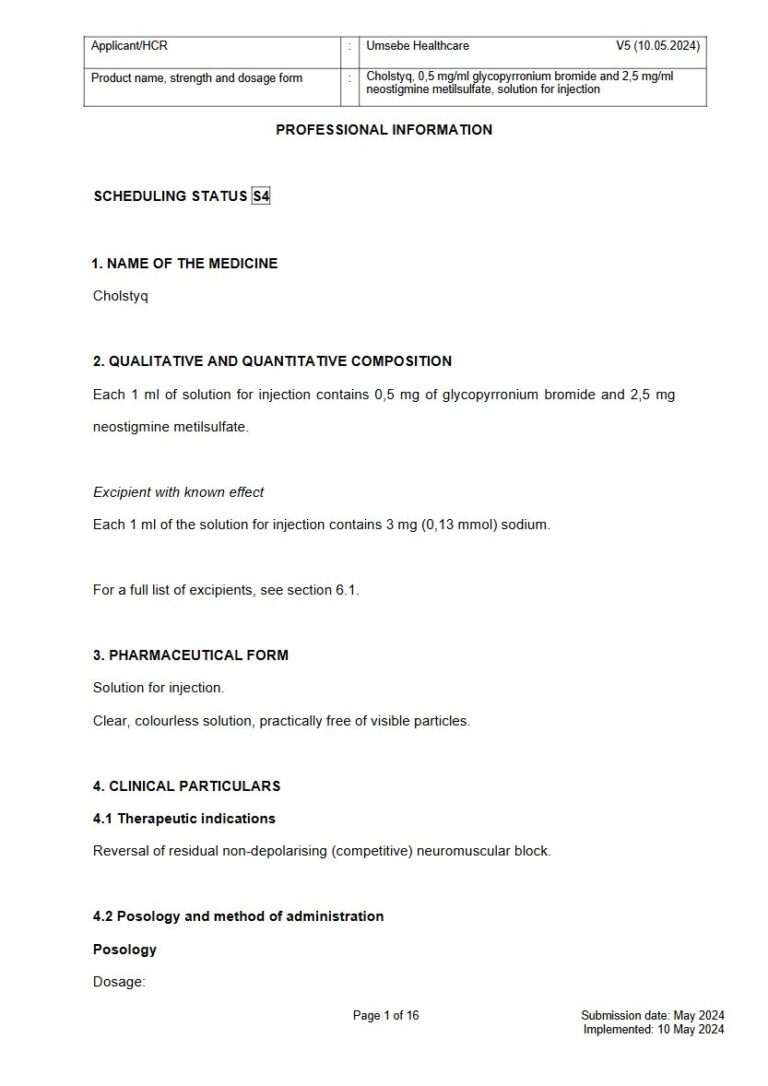
Cholstyq 0,5 mg, 2,5 mg Solution for injection
PDF Leaflet Revision Date: 10 May 2024
Clinical Summary
Quick overview from the medicine insert
Indication
Reversal of residual non-depolarising neuromuscular block.
Dosage (summary)
Adults: 1-2 ml IV over 10-30 seconds; repeat if needed. Total doses >2 ml not recommended.
Onset of Action / Duration
Onset: 1 min, Duration: Not specified.
Special Populations
- Elderly
- Renal impairment
- Asthma
- Cardiac conditions
- Epilepsy
- Myasthenia gravis
Pregnancy & Breastfeeding
Caution in pregnancy; may induce uterine irritability. Monitor breastfeeding infants.
Key Drug Interactions
- Suxamethonium
- MAOIs
- Aminoglycosides
- Beta-blockers
- Antidysrhythmics
Contraindications
- Hypersensitivity to active substances
- Mechanical obstruction of GI or urinary tracts
- Concomitant use with depolarising muscle relaxants
Common side effects
- Bradycardia
- Dizziness
- Dry mouth
- Nausea
- Blurred vision
Counselling Points
- Monitor for signs of overdose
- Avoid driving if vision is affected
- Report any severe allergic reactions
Serious warnings
- Caution in patients with asthma or severe bradycardia
- Risk of cholinergic crisis in myasthenia gravis
- Potential for ventricular dysrhythmias during inhalation anaesthesia
Important Disclaimer
The Cholstyq 0,5 mg, 2,5 mg Solution for injection professional information leaflet below is the property of Umsebe Healthcare and is provided on Medinsert exactly as issued, with no.. alterations or editorial changes. We make every effort to keep content current by updating documents as soon as new versions become available. Medinsert serves as a trusted access point for healthcare professionals, but does not replace official sources or clinical judgement. For more details, please read our full disclaimer. read more>>
 Healthcare Professionals Only
This content is for registered healthcare professionals
Sign in or create a free account to read the full package insert.
Free for HPCSA-registered professionals. Powered by Medinsert.
Clinical Particulars
Section 4 of the official insert — extracted exactly as issued, no alterations
4.1 Therapeutic indications
Reversal of residual non - depolarising (competitive) neuromuscular block.
4.2 Posology and method of administration
Posology
Dosage:
Adults and elderly patients: 1 u2013 2 ml intravenously over a period of 10 to 30 seconds (equivalent to neostigmine metilsulfate 2,5 mg with glycopyrronium bromide 0,5 mg to neostigmine metilsulfate 5 mg with glycopyrronium bromide 1 mg). Alternatively 0,02 ml/kg intravenously over a period of 10 to 30 seconds may be used, (equivalent to neostigmine metilsulfate 0,05 mg/kg with glycopyrronium bromide 0,01 mg/kg). These doses may be repeated if adequate reversal of neuromuscular blockade is not achieved. Total doses in excess of 2 ml are not recommended as this dose of neostigmine may produce depolarising neuromuscular block.
Paediatric population: 0,02 ml/kg intravenously over a period of 10 to 30 seconds (equivalent to neostigmine metilsulfate 0,05 mg/kg with glycopyrronium bromide 0,01 mg/kg). Alternatively, dilute to 10 ml with water for injections and administer 1 ml per 5 kg bodyweight.
Method of administration
For intravenous injection.
4.3 Contraindications
- u2212 Hypersensitivity to the two active substances or to any of the excipients listed in section 6.1.
- u2212 Cholstyq should not be given to patients with mechanical obstruction of the gastrointestinal or urinary tracts.
- u2212 Cholstyq should not be given in conjunction with depolarising muscle relaxants, such as suxamethonium, as neostigmine potentiates the depolarising myoneural blocking effects of this agent.
4.4 Special warnings and precautions for use
Administer with caution to patients with asthma, bronchospasm or severe bradycardia, as the neostigmine may aggravate the pathology. Administration of anticholinesterase agents to patients with intestinal anastomoses may produce rupture of the anastomosis or leakage of intestinal contents. Cholstyq should be used with caution in patients with coronary artery disease, congestive heart failure, cardiac dysrhythmias, hypertension, hyperthyroidism or thyrotoxicosis and cardiac insufficiency. Use with caution in patients with epilepsy or Parkinson's disease. Cholstyq should be used cautiously in pyrexical patients (especially children) due to inhibition of sweating. In common with other antimuscarinic medicines caution is advised in patients with prostatic hypertrophy, paralytic ileus, pyloric stenosis and closed angle glaucoma. Cholstyq should be used with caution in patients with hypotension, peptic ulceration or vagotonia. Anticholinergic medicines can cause ventricular dysrhythmias when administered during inhalation anaesthesia especially in association with the halogenated hydrocarbons. Quaternary ammonium compounds (like glycopyrronium) in large doses have been shown to block the nicotinic muscle end plate receptors. This must be evaluated prior to its administration in patients with myasthenia gravis. Cholstyq should be used with caution in patients with myasthenia gravis to avoid provoking a cholinergic crisis with increased muscular weakness. Glycopyrronium is a quaternary ammonium compound and does not cross the blood - brain barrier. It is therefore less likely to cause postoperative confusion, which is a particular concern in the elderly patients. Glycopyrronium bromide glycopyrrolate has reduced cardiovascular and ocular effects. Neostigmine metilsulfate: glycopyrronium given before or with neostigmine, prevents bradycardia, excessive salivation, and other muscarinic effects of neostigmine. Cholstyq should be used with caution in elderly patients. As neostigmine metilsulfate is excreted mainly by the kidneys, caution is advised in cases of impaired renal function. Cholstyq contains less than 1 mmol sodium (23 mg) per ampoule, that is to say essentially 'sodium free'.
4.5 Interaction with other medicines and other forms of interaction
Neostigmine metilsulfate should not be administered with suxamethonium (see section 4.3). There is increased risk of antimuscarinic side effects in patients taking medicines with antimuscarinic effects such as MAOIs (Monoamine oxidase inhibitors), amantadine, clozapine, tricyclic antidepressants and nefopam. Aminoglycosides, clindamycin, colistin and the halogenated inhalation anaesthetics possess neuromuscular blocking activity and may antagonise the effects of neostigmine metilsulfate. These agents must be used with care in conjunction with Cholstyq. Hypotension and prolonged bradycardia have occurred in patients receiving beta - adrenoceptor blocking agents following administration of neostigmine metilsulfate. Some antidysrhythmic medicines such as quinidine may antagonize neostigmine metilsulfate action by interfering with neuromuscular transmission. Administration of methylprednisone to patients receiving neostigmine metilsulfate has exacerbated symptoms and produced profound weakness often necessitating assisted ventilation.
4.6 Fertility, pregnancy and lactation
Pregnancy
There are no data from the use of glycopyrronium bromide or neostigmine metilsulfate in pregnant women. Animal studies do not indicate direct or indirect harmful effects with respect to reproductive toxicity (see section 5.3). Anticholinesterase medicines, including neostigmine may cause uterine irritability and induce premature labour when administered to pregnant women near term. Neostigmine metilsulfate should be given to a pregnant woman with caution.
Breastfeeding
It is unknown whether glycopyrronium bromide is excreted in human milk. The amount of neostigmine metilsulfate distributed into breastmilk is very small, but breastfed infants need to be monitored. Glycopyrronium bromide (including its metabolites) was excreted in the milk of lactating rats (see section 5.3). The amount of Cholstyq excreted in breastmilk following a standard single dose is not expected to have any influence on the baby.
Fertility
Reproduction studies and other data in animals do not indicate a concern regarding fertility in either males or females (see section 5.3). In a fertility and early embryonic development study in rats, male rats were treated for 28 days prior to mating and female rats were treated for 14 days prior to mating with intravenous neostigmine metilsulfate (human equivalent doses of 1,6, 4 and 8,1 mcg/kg/day, based on body surface area). No adverse effects were reported at any dose.
4.7 Effects on ability to drive and use machines
Cholstyq may cause the eyesight to become weak, which could interfere with the ability to drive or operate machinery safely.
4.8 Undesirable effects
Adverse events which have been associated with glycopyrronium bromide - neostigmine metilsulfate injection are given below, listed by system organ class and frequency. Undesirable effects are especially likely to occur at treatment onset or at dose increase.
Tabulated list of adverse reactions for glycopyrronium bromide component of Cholstyq:
System organ class (MedDRA) Adverse event Frequency
- Immune system disorders Hypersensitivity, severe allergic reaction or pharmacologic idiosyncrasies including anaphylaxis, angioedema Not known
- Nervous system disorders Confusion and /or excitement**, dizziness, headache, nervousness, drowsiness, weakness, insomnia Not known
- Eye disorders Blurred vision as a result of dilatation of the pupils, increased ocular tension, photophobia, angle closure glaucoma Not known
- Cardiac disorders Transient bradycardia* Not known
- Respiratory, thoracic and mediastinal disorders Bronchial secretion reduced Not known
- Gastrointestinal disorders Dry mouth, constipation, nausea, vomiting, loss of taste, bloated feeling Not known
- Skin and subcutaneous tissue disorders Flushing, dry skin, sweating decreased, urticaria and other dermal manifestations Not known
- Renal and urinary disorders Micturition urgency, urinary hesitance and retention Not known
- Reproductive system and breast disorders Impotence, suppression of lactation Not known
* Followed by tachycardia, palpitation and dysrhythmias **Particularly in elderly
Tabulated list of adverse reactions for Neostigmine metilsulfate component of Cholstyq:
System organ class (MedDRA) Adverse event Frequency
- Cardiac disorders Bradycardia, cardiac dysrhythmias Not known
- Respiratory, thoracic and mediastinal disorders Increased oropharyngeal secretions Not known
- Gastrointestinal disorders Increased gastrointestinal activity, nausea, vomiting, diarrhoea, abdominal cramps, anorexia Not known
- Musculoskeletal and connective tissue disorders Muscle cramps, fasciculation, weakness Not known
- General disorders and administration site conditions Salivation Not known
The glycopyrronium - neostigmine component of injection can give rise to hypersensitivity, angioedema and anaphylactic reaction. If severe neostigmine - induced muscarinic side effects occur (bradycardia, increased oropharyngeal secretions, decreased cardiac conduction rate, bronchospasm or increased gastrointestinal activity etc.), these may be treated by the intravenous administration of glycopyrronium bromide injection 200 - 600 micrograms (0,2 u2013 0,6 mg) or atropine 400 - 1200 micrograms (0,4 u2013 1,2 mg).
4.9 Overdose
Symptoms
Signs of neostigmine overdosage include nausea, vomiting, eructation, increased peristalsis, diarrhoea, urination and the desire to urinate, excessive salivation and sweating, increased oropharyngeal secretions, flushing, miosis, conjunctival congestion, ciliary spasm, brow ache, nystagmus, restlessness, agitation, fear, excessive dreaming, hallucinations, convulsions, slurred speech, tight chest, wheezing, increased bronchial secretion combined with bronchoconstriction, bradycardia or tachycardia, hypotension, cardiospasm, inco-ordination, muscle cramps, scattered fasciculations and eventually severe weakness and paralysis, convulsions and coma. Paradoxical effects may also occur due to interaction between nicotinic and muscarinic actions. Accordingly there may be tachycardia and hypertension. Death may follow due to cardiac arrest or central respiratory paralysis and pulmonary oedema. In severe cases, respiratory depression may occur and artificial ventilation may be necessary in such patients. Signs of neostigmine overdose may be treated by the administration of glycopyrronium bromide injection 0,2 u2013 0,6 mg intravenously or atropine sulphate 1 u2013 2 mg intravenously, intramuscularly or subcutaneously to control the muscarinic effects. Signs of glycopyrronium bromide overdosage include tachycardia, ventricular irritability and peripheral anticholinergic effects. Signs of glycopyrronium bromide overdose may be treated by the administration of neostigmine metilsulfate 1,0 mg for each 1,0 mg of glycopyrronium bromide known to have been administered.
Management
The treatment of overdosage depends on whether signs of anticholinesterase or anticholinergic overdosage is the predominant presenting feature. As glycopyrronium bromide is a quaternary ammonium agent, symptoms of overdosage are peripheral rather than central in nature. Centrally acting anticholinesterase medicines such as physostigmine are therefore unnecessary to treat glycopyrronium bromide overdosage.
