
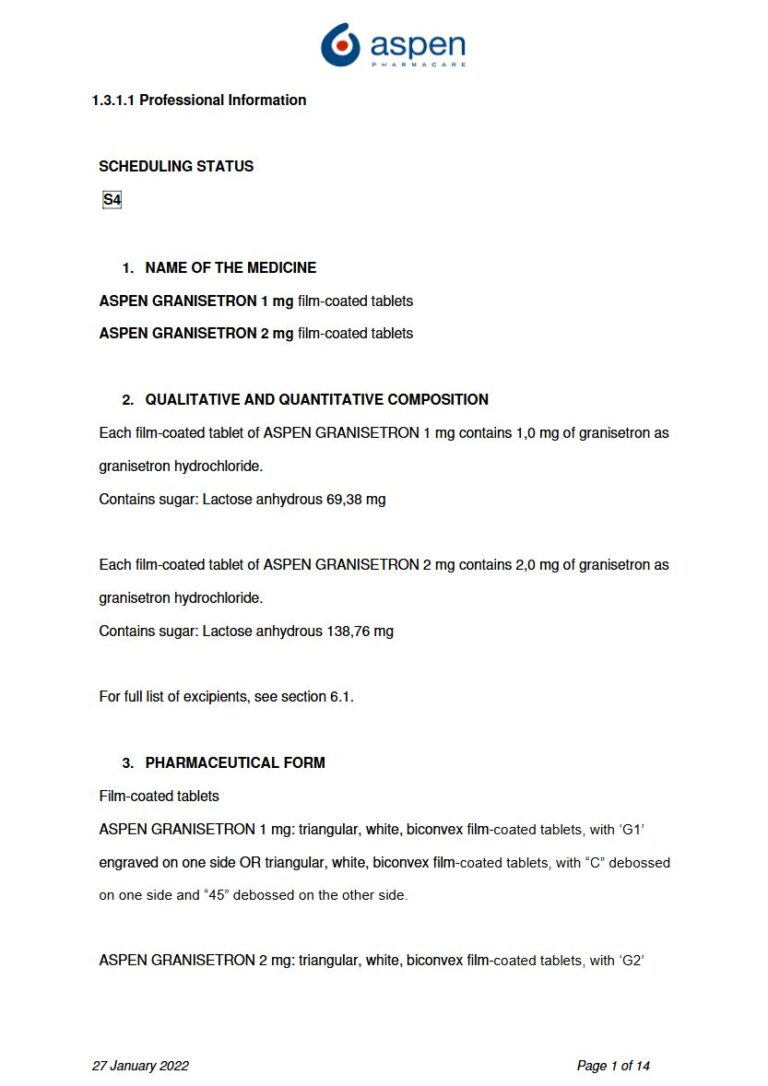
Aspen Granisetron tablets
PDF Leaflet Revision Date: 27 January 2022
Clinical Summary
Quick overview from the medicine insert
Indication
Prevention of acute and delayed nausea and vomiting associated with chemotherapy and radiotherapy.
Dosage (summary)
1 mg twice daily or 2 mg once daily for up to one week post-chemotherapy; 2 mg once daily for up to one week post-radiotherapy.
Onset of Action / Duration
Onset: 1 hour, Duration: up to 24 hours
Special Populations
- Elderly
- Renal impairment
- Hepatic impairment
Pregnancy & Breastfeeding
Not recommended during pregnancy or breastfeeding due to insufficient safety data.
Key Drug Interactions
- Serotonergic medicines
- Buprenorphine/opioids
- QT prolonging agents
Contraindications
- Hypersensitivity to granisetron
- Children under 2 years
- Congenital long QT syndrome
Common side effects
- Headache
- Constipation
- Dizziness
- Nausea
Counselling Points
- Take within 1 hour before therapy
- Monitor for serotonin syndrome symptoms
- Avoid driving if affected
Serious warnings
- QT interval prolongation
- Serotonin syndrome risk
- Lower bowel motility reduction
Important Disclaimer
The Aspen Granisetron tablets professional information leaflet below is the property of Pharmacare and is provided on Medinsert exactly as issued, with no.. alterations or editorial changes. We make every effort to keep content current by updating documents as soon as new versions become available. Medinsert serves as a trusted access point for healthcare professionals, but does not replace official sources or clinical judgement. For more details, please read our full disclaimer. read more>>
 Healthcare Professionals Only
This content is for registered healthcare professionals
Sign in or create a free account to read the full package insert.
Free for HPCSA-registered professionals. Powered by Medinsert.
Clinical Particulars
Section 4 of the official insert — extracted exactly as issued, no alterations
4.1. Therapeutic indications
ASPEN GRANISETRON is indicated for the prevention of:
- acute and delayed nausea and vomiting associated with chemotherapy (CINV) and radiotherapy (RINV).
4.2. Posology and method of administration
Posology
Adults
Chemotherapy Induced Nausea and Vomiting (CINV) Prevention: The dose of ASPEN GRANISETRON is 1 mg twice a day or 2 mg once a day, for up to one week following chemotherapy. The first dose of ASPEN GRANISETRON should be administered within one hour before the start of therapy.
Radiotherapy Induced Nausea and Vomiting (RINV): The dose of ASPEN GRANISETRON is 2 mg once a day, for up to one week following radiotherapy. The first dose of ASPEN GRANISETRON should be administered within one hour before the start of therapy.
Special populations
Geriatrics: No dosage adjustments required.
Renal impairment: No dosage adjustments required.
Hepatic Impairment: No dosage adjustments required. Although present experience indicates that no dosage adjustment is required, care should be exercised when administering ASPEN GRANISETRON to elderly patients and patients with renal or hepatic impairment.
Paediatric population: ASPEN GRANISETRON is contraindicated in children under the age of 2 years (see section 4.3). There is insufficient information to recommend use of ASPEN GRANISETRON in the prevention of RINV in children.
Method of administration: For oral administration.
4.3. Contraindications
ASPEN GRANISETRON is contraindicated in:
- Patients with hypersensitivity to granisetron, other 5-HT 3 antagonists or to any excipients in ASPEN GRANISETRON (see section 6.1).
- Children under the age of 2 years.
- Patients with congenital long QT syndrome.
- Pregnancy and lactation (see section 4.6).
4.4. Special warnings and precautions for use
Lower bowel motility: As ASPEN GRANISETRON may reduce lower bowel motility, patients with signs of sub-acute intestinal obstruction should be monitored following administration of ASPEN GRANISETRON. ASPEN GRANISETRON does not stimulate gastric or intestinal peristalsis. It should not be used instead of nasogastric suction. The use of ASPEN GRANISETRON in patients following abdominal surgery or in patients with chemotherapy-induced nausea and vomiting may mask a progressive ileus and/or gastric distension.
QT interval prolongation: ECG changes including QT interval prolongation has been reported with granisetron, as in ASPEN GRANISETRON. Therefore, ASPEN GRANISETRON should be used with caution in patients with pre-existing dysrhythmias or cardiac conduction disorders, or patients who have, or may develop prolongation of the QT interval, as these may lead to clinical consequences. Patients with cardiac diseases (such as congestive heart failure or brady-dysrhythmias), patients on cardiotoxic chemotherapy, with concomitant electrolyte abnormalities and/or on concomitant medicines that prolong the QT interval, are particularly at risk and caution should be exercised (see section 4.5). Hypokalaemia and hypomagnesaemia should be corrected prior to ASPEN GRANISETRON administration.
Cross-sensitivity: Cross-sensitivity between 5-HT 3 antagonists (e.g., dolasteron, ondansetron) has been reported (see section 4.3 and 4.5).
Serotonin syndrome: There have been reports of serotonin syndrome with the use of 5-HT 3 antagonists either alone, but mostly in combination with other serotonergic medicines (including selective serotonin reuptake inhibitors (SSRIs), and serotonin noradrenaline reuptake inhibitors (SNRIs) (see section 4.5). Concomitant administration of ASPEN GRANISETRON and buprenorphine/opioids may result in serotonin syndrome, a potentially life-threatening condition. If concomitant treatment with other serotonergic medicines is clinically warranted, careful observation of the patient is advised, particularly during treatment initiation and dose increases. Symptoms of serotonin syndrome may include mental-status changes, autonomic instability, neuromuscular abnormalities, and/or gastrointestinal symptoms. If serotonin syndrome is suspected, a dose reduction or discontinuation of therapy should be considered depending on the severity of the symptoms.
Paediatric population: ASPEN GRANISETRON is contraindicated in children under the age of 2 years (see section 4.3). There is insufficient clinical evidence to recommend administration of ASPEN GRANISETRON to children.
Excipients: ASPEN GRANISETRON contains lactose which may have an effect on the glycaemic control of patients with diabetes mellitus. Patients with the rare hereditary problems of galactose intolerance, galactosaemia, total lactase deficiency or glucose-galactose malabsorption or fructose intolerance should not take ASPEN GRANISETRON.
4.5. Interaction with other medicines and other forms of interaction
Other 5-HT 3 antagonists: Cross-sensitivity between 5-HT 3 antagonists (e.g., dolasteron, ondansetron) has been reported (see section 4.3).
Pheobarbitone: The metabolism of granisetron, as in ASPEN GRANISETRON, is induced by the cytochrome P450 inducer phenobarbitone which may cause a 25 % increase in total plasma clearance of ASPEN GRANISETRON.
Ketoconazole: In in vitro human microsomal studies, ketoconazole inhibited ring oxidation of granisetron, as in ASPEN GRANISETRON. However, given the absence of pK/pD relationship with granisetron, these changes are believed to have no clinical consequences.
Medicines known to prolong QT interval: Cases of ECG modifications including QT prolongation have been reported with granisetron, as in ASPEN GRANISETRON. In patients concurrently treated with medicines known to prolong QT interval and/or which are dysrhythmogenic, this may lead to clinical consequences (see section 4.4).
Serotonergic medicines (e.g., SSRIs and SNRIs): There have been reports of serotonin syndrome following concomitant use of 5-HT 3 antagonists and other serotonergic medicines (including SSRIs and SNRIs). ASPEN GRANISETRON should be used cautiously when co-administered with buprenorphine/opioids as the risk of serotonin syndrome, a potentially life-threatening condition, is increased (see section 4.4).
Tramadol: ASPEN GRANISETRON may increase the levels of tramadol.
General: ASPEN GRANISETRON may be co-administered with benzodiazepines (lorazepam), neuroleptics (haloperidol) and anti-ulcer medicines (cimetidine) commonly prescribed with anti-emetic treatments. Additionally, granisetron, as in ASPEN GRANISETRON, has shown no apparent interaction with emetogenic cancer chemotherapies. No specific interaction studies have been conducted in anaesthetised patients, but ASPEN GRANISETRON has been safely administered with commonly used anaesthetic and analgesic medicines. In addition, in-vitro human microsomal studies have shown that the cytochrome P450 subfamily 3A4 (involved in the metabolism of some of the main narcotic analgesic medicine) is not modified by ASPEN GRANISETRON.
4.6. Fertility, pregnancy and lactation
The use of ASPEN GRANISETRON during pregnancy and lactation is not recommended as safety and efficacy have not been established (see section 4.3).
Pregnancy: There is limited amount of data from the use of ASPEN GRANISETRON in pregnant women. Animal studies do not indicate direct or indirect harmful effects with respect to reproductive toxicity. As a precautionary measure, avoid the use of ASPEN GRANISETRON during pregnancy.
Breastfeeding: It is unknown whether granisetron or its metabolites are excreted in human milk. As a precautionary measure, breastfeeding should not be advised during use with ASPEN GRANISETRON.
Fertility: In rats, granisetron, as in ASPEN GRANISETRON, had no harmful effects on reproductive performance or fertility.
4.7. Effects on ability to drive and use machines
ASPEN GRANISETRON has no or negligible influence on the ability to drive and use machines. Since adverse reactions such as headache, dizziness, drowsiness and blurred vision have been reported in patients receiving ASPEN GRANISETRON, patients should not drive, use machinery or perform any tasks that require concentration, until they are certain that ASPEN GRANISETRON does not adversely affect their ability to do so (see section 4.8).
4.8. Undesirable effects
a) Summary of the safety profile: The most frequently reported adverse reactions for ASPEN GRANISETRON are headache and constipation, which may be transient. ECG changes including QT prolongation have been reported with granisetron, as in ASPEN GRANISETRON (see section 4.4 and 4.5).
System organ class
Frequent
Less frequent
Frequency unknown (cannot be estimated from the available data)
Infections and infestations
Infections, urinary tract infection
Blood and the lymphatic system disorders
Anaemia, leukocytosis
Immune system disorders
Immediate hypersensitivity reactions including anaphylaxis, urticaria
Psychiatric disorders
Insomnia
Somnolence, agitation, anxiety
Nervous system disorders
Headache
Dizziness, drowsiness, seizures and movement disorders, including extrapyramidal reactions such as dystonia, dyskinesia and oculogyric crisis, serotonin syndrome
Eye disorders
Transient visual disturbances such as blurred vision
Cardiac disorders
Chest pain, tachycardia, bradycardia, dysrhythmias, atrial fibrillation, transient ECG changes including QT interval prolongation
Vascular disorders
Hypotension, hypertension
Gastrointestinal disorders
Constipation, hiccups, abdominal pain, diarrhoea, nausea, vomiting
Dyspepsia, taste disturbances
Hepatobiliary disorders
A transient rise in hepatic transaminases
Skin and subcutaneous tissue disorders
Rash
General disorders and administrative site conditions
Asthenia, fever, fatigue
b) Tabulated list of adverse reactions
c) Description of selected adverse reactions: Cases of serotonin syndrome (including altered mental status, autonomic dysfunction and neuromuscular abnormalities) have been reported following the concomitant use of granisetron, as in ASPEN GRANISETRON, and other serotonergic medicines (see section 4.4 and 4.5).
4.9. Overdose
Symptoms: Headaches may occur. Granisetron, as in ASPEN GRANISETRON, may prolong the QT interval.
Treatment: There is no specific antidote for ASPEN GRANISETRON. In the case of overdosage, symptomatic and supportive treatment should be given. ECG monitoring is recommended in case of overdose with ASPEN GRANISETRON.
