
Grantryl 1 mg/1 ml & 3 mg/3 ml Injection
PDF Leaflet Revision Date: 28 November 2022
Clinical Summary
Quick overview from the medicine insert
Indication
Management of nausea and vomiting induced by chemotherapy, radiotherapy, and post-operative.
Dosage (summary)
Adults: 1-3 mg IV prior to chemotherapy/radiotherapy; max 9 mg/24h. PONV: 1 mg IV prior to anesthesia.
Special Populations
- Elderly
- Renal impairment
- Hepatic impairment
Pregnancy & Breastfeeding
Contraindicated during pregnancy and lactation.
Key Drug Interactions
- Phenobarbital may increase clearance
- Co-administer with benzodiazepines and neuroleptics
Contraindications
- Hypersensitivity
- Children under 2 years
- Congenital long QT syndrome
Common side effects
- Headache
- Dizziness
- Somnolence
- Abdominal pain
- Constipation
Counselling Points
- Avoid driving if somnolence occurs
- Report any signs of myocardial ischemia
Serious warnings
- May cause dysrhythmias
- Monitor for myocardial ischemia
- Max 9 mg/24h
Important Disclaimer
The Grantryl 1 mg/1 ml & 3 mg/3 ml Injection professional information leaflet below is the property of Acino Pharma and is provided on Medinsert exactly as issued, with no.. alterations or editorial changes. We make every effort to keep content current by updating documents as soon as new versions become available. Medinsert serves as a trusted access point for healthcare professionals, but does not replace official sources or clinical judgement. For more details, please read our full disclaimer. read more>>
 Healthcare Professionals Only
This content is for registered healthcare professionals
Sign in or create a free account to read the full package insert.
Free for HPCSA-registered professionals. Powered by Medinsert.
Clinical Particulars
Section 4 of the official insert — extracted exactly as issued, no alterations
4.1. Therapeutic indications
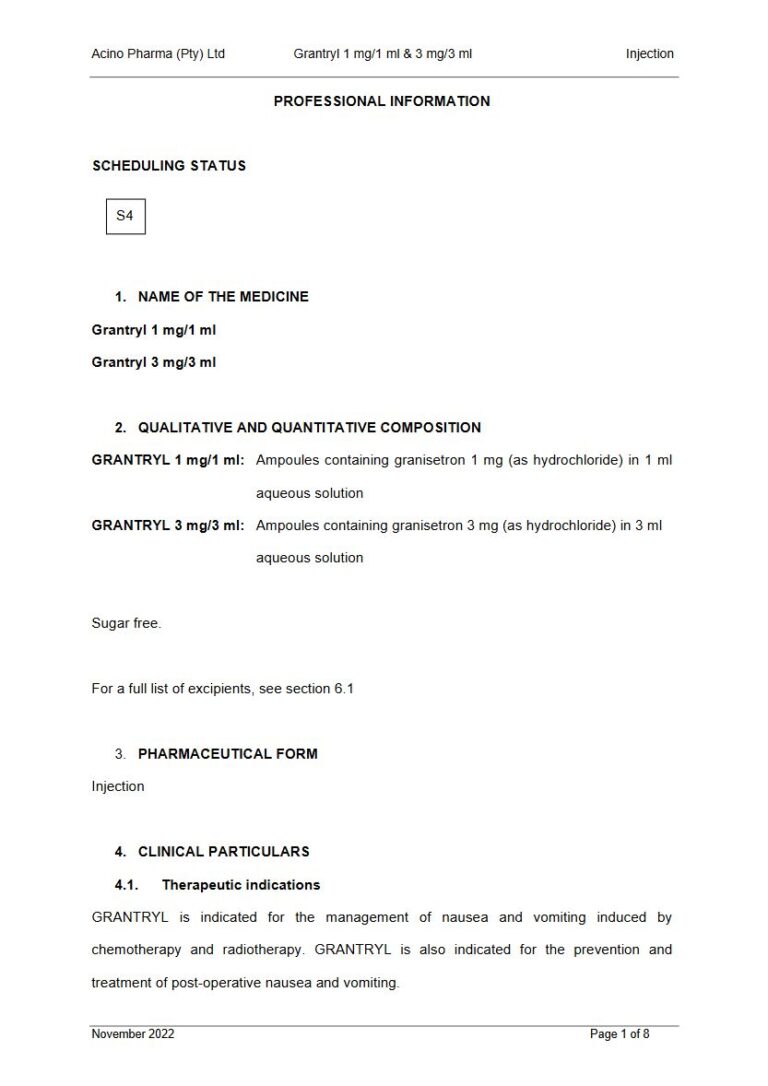
GRANTRYL is indicated for the management of nausea and vomiting induced by chemotherapy and radiotherapy. GRANTRYL is also indicated for the prevention and treatment of post-operative nausea and vomiting.
4.2. Posology and method of administration
Chemotherapy induced nausea and vomiting (CINV):
Posology
Adults
Prevention: A dose of 1-3 mg (10 u2013 40 u03bcg/kg) of GRANTRYL should either be administered either as a slow intravenous injection (over 30 seconds), or as an intravenous infusion diluted in 20 u2013 50 mu2113 infusion fluid (see Preparation of dosage form) and administered over 5 minutes, prior to the start of chemotherapy.
Treatment: A dose of 1-3 mg (10 u2013 40 u03bcg/kg) of GRANTRYL should be administered either as a slow intravenous injection (over 30 seconds), or as an intravenous infusion diluted in 20u2013 50 mu2113 infusion fluid (see Preparation of dosage form) and administered over 5 minutes. Further maintenance doses of GRANTRYL may be administered, if required, at least 10 minutes apart. The maximum dose of GRANTRYL to be administered over 24 hours should not exceed 9 mg.
Paediatrics
GRANTRYL is contra-indicated in children under 2 years of age (see CONTRA-INDICATIONS). A dose of 10 u2013 40 u03bcg/kg body weight (up to 3 mg) should be administered as an intravenous infusion, diluted in 10 to 30 mu2113 infusion fluid and administered over 5 minutes prior to the start of chemotherapy. One additional dose may be administered within a 24 hour period if required. This additional dose should not be administered until at least 10 minutes after the initial infusion.
Radiotherapy induced nausea and vomiting (RINV):
Adults
Prevention: A dose of 1-3 mg (10 u2013 40 u03bcg/kg) of GRANTRYL should be administered either as a slow intravenous injection (over 30 seconds) or as an intravenous infusion diluted in 20- 50 mu2113 infusion fluid and administered over 5 minutes, prior to the start of radiotherapy.
Paediatrics
Due to lack of data, GRANTRYL is not recommended for prevention and treatment of RINV in children.
Post-operative nausea and vomiting (PONV):
Adults
Prevention: A dose of 1 mg (10 u03bcg/kg) of GRANTRYL should be administered as a slow intravenous injection (over 30 seconds) prior to induction of anaesthesia
Treatment: A dose of 1 mg (10 u03bcg/kg) of GRANTRYL should be administered as a slow intravenous injection (over 30 seconds). The maximum dose for patients undergoing anaesthesia for surgery is a total dose of 3 mg of GRANTRYL intravenous in one day.
Paediatrics
Due to lack of data, GRANTRYL is not recommended for prevention and treatment of PONV in children.
Special dosage instructions:
Elderly patients (65 years of age or older) No dosage adjustments required.
Renal impairment No dosage adjustment required
Hepatic impairment There is no evidence to date for an increased incidence of adverse events in patients with hepatic disorders. On the basis of its kinetics, whilst no dosage adjustment is necessary, GRANTRYL should be used with a certain amount of caution in this patient group. See Pharmacokinetics.
Method of administration
Preparation of dosage form: Use immediately after reconstitution. Solutions should not be stored for longer than 24 hours at a temperature of 2 u2013 8 u00b0C unless prepared under controlled aseptic conditions.
Adults: GRANTRYL may be diluted with 20 to 50 ml of the following infusion fluids:
- 0,9 % m/v sodium chloride
- 0,18 % m/v sodium chloride and 4 % m/v glucose
- 5 % m/v glucose
- Hartmannu2019s solution
- Sodium lactate
- 10 % m/v mannitol
Children (>2 years): GRANTRYL may be diluted with 10 to 30 ml of the following infusion fluids:
- 0,9 % m/v sodium chloride
- 0,18 % m/v sodium chloride and 4 % m/v glucose
- 5 % m/v glucose
- Hartmannu2019s solution
- Sodium lactate
- 10 % m/v mannitol
4.3. Contraindications
Hypersensitivity to any of the ingredients contained in GRANTRYL.
Children under the age of 2 years.
Pregnancy and lactation (see PREGNANCY AND LACTATION).
Congenital long QT-syndrome.
4.4. Special warnings and precautions for use
As GRANTRYL may reduce lower bowel motility, patients with signs of sub-acute intestinal obstruction should be monitored following administration of GRANTRYL.
The maximum dose of GRANTRYL to be administered over 24 hours should not exceed 9 mg (120 u03bcg/kg).
GRANTRYL may be associated with dysrhythmias or ECG abnormalities. This may have clinical significance in patients with pre-existing dysrhythmias or cardiac conduction disorders and/or patients with concomitant electrolyte disturbances, or in patients who are being treated with antidysrhythmic medicines, beta-blockers and medicines that prolong the QT-interval.
Cases of myocardial ischemia have been reported in patients treated with granisetron. In some patients, especially in the case of intravenous administration, symptoms appeared immediately after administration of granisetron. Patients should be alerted to the signs and symptoms of myocardial ischaemia.
4.5. Interactions with other medicines and other forms of interaction
Hepatic enzyme induction with phenobarbital resulted in an increase in total plasma clearance of intravenous GRANTRYL of approximately one-quarter. GRANTRYL may be co-administered with benzodiazepines, neuroleptics and anti-ulcer medications commonly prescribed with anti-emetic treatments. No apparent interaction with emetogenic cancer chemotherapies has been shown. No specific interaction studies have been conducted in anaesthetised patients, but GRANTRYL may be administered with commonly used anaesthetic and analgesic agents. In addition, in vitro human microsomal studies have shown that the cytochrome P450 subfamily 3A4 (involved in the metabolism of some of the main narcotic analgesic agents) is not modified by granisetron.
4.6. Fertility, pregnancy and lactation
The use of GRANTRYL during pregnancy and lactation is contra-indicated as safety and efficacy have not been established (see CONTRA-INDICATIONS).
4.7. Effects on ability to drive and use machines
GRANTRYL may cause somnolence and transient visual disturbances. Patients should be advised not to drive or handle machinery if these side effects occur.
4.8. Undesirable effects
The following side effects may occur with use of GRANTRYL:
Infections and infestations
Frequency not known : Infection, urinary tract infection
Blood and lymphatic system disorders
Frequency not known : Anaemia, leukocytosis
Immune system disorders
Less frequent : Hypersensitivity reactions, including skin rashes and anaphylaxis.
Psychiatric disorders
Less frequent : Anxiety, insomnia, somnolence.
Nervous system disorders
Less frequent : Headache, dizziness, seizures, oculogyric crisis.
Eye disorders
Frequency not known : Transient visual disturbances such as blurred vision.
Cardiac disorders
Less frequent : Angina pectoris, dysrhythmias, atrial fibrillation, chest pain, fainting, tachycardia, bradycardia, ECG abnormalities, QT-prolongation. Frequency unknown: myocardial ischemia (see section 4.4)
Vascular disorders
Less frequent : Hypertension, hypotension, flushes.
Gastrointestinal disorders
Frequent : Abdominal pain, constipation, diarrhoea, hiccups
Less frequent : Dyspepsia, unusual taste in mouth.
Musculoskeletal disorders
Frequency not known : Dystonia and dyskinesia
Hepato-biliary disorders
Less frequent : A rise in hepatic transaminases.
General disorders and administration site disorders
Frequent : Asthenia/fatigue
Less frequent : Fever, injection site reactions.
4.9. Overdosage
Headache may occur. There is no specific antidote for granisetron. In the case of over-dosage, symptomatic and supportive treatment should be given.
