
Serenace 5mg / 1ml. 20mg / 2ml Injection
PDF Leaflet Revision Date: 17 February 2006
Clinical Summary
Quick overview from the medicine insert
Indication
Acute and chronic schizophrenia, mania, organic psychoses, agitation, childhood behavioral disorders.
Dosage (summary)
Adults: 2-10 mg IM for acute conditions; max 30 mg IM for emergencies.
Special Populations
- Elderly
- Debilitated patients
- Children
Pregnancy & Breastfeeding
Safety in pregnancy and lactation not established.
Key Drug Interactions
- Anticoagulants
- Carbamazepine
- Lithium
- CNS depressants
- Metoclopramide
Contraindications
- Parkinson's disease
- CNS depression
- Hypersensitivity
- Bone-marrow suppression
- Phaeochromocytoma
Common side effects
- Extrapyramidal symptoms
- Hypotension
- Neurological effects
- Insomnia
- Agitation
Counselling Points
- Avoid hazardous tasks initially
- Monitor for signs of dystonia
- Regular eye exams recommended
- Avoid abrupt withdrawal
Serious warnings
- Severe dystonic reactions
- Tardive dyskinesia
- Neuroleptic malignant syndrome
- Risk of sudden death
Important Disclaimer
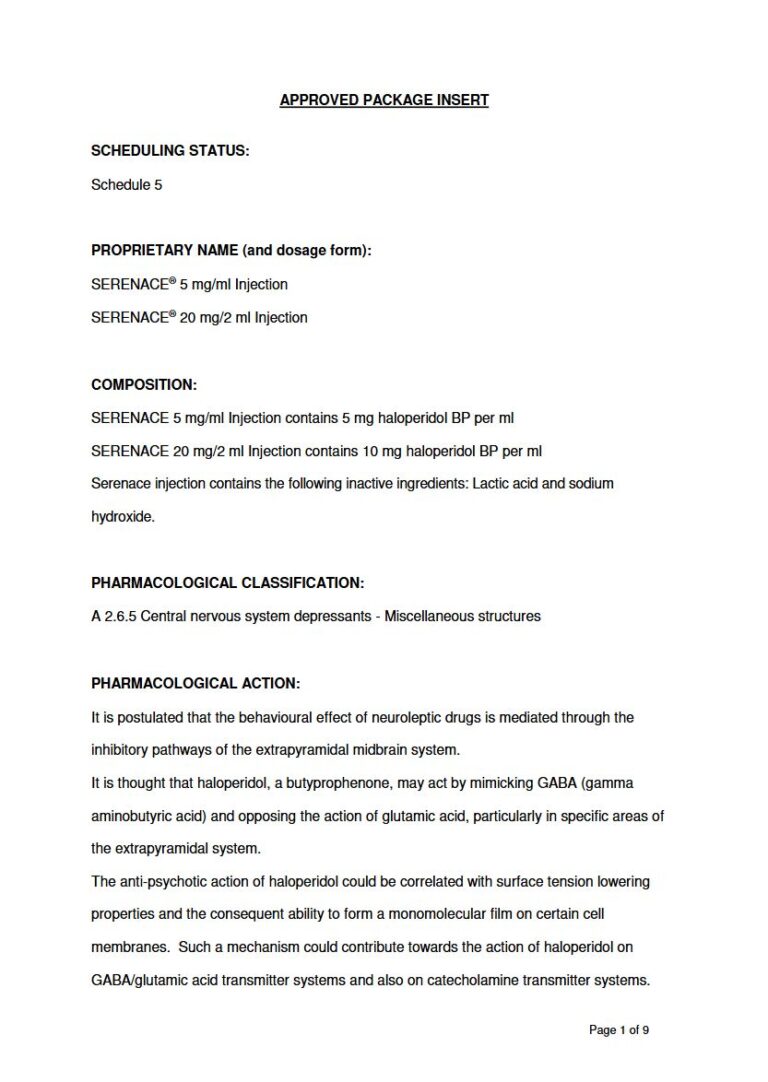
The Serenace 5mg / 1ml. 20mg / 2ml Injection professional information leaflet below is the property of Pfizer and is provided on Medinsert exactly as issued, with no.. alterations or editorial changes. We make every effort to keep content current by updating documents as soon as new versions become available. Medinsert serves as a trusted access point for healthcare professionals, but does not replace official sources or clinical judgement. For more details, please read our full disclaimer. read more>>
 Healthcare Professionals Only
This content is for registered healthcare professionals
Sign in or create a free account to read the full package insert.
Free for HPCSA-registered professionals. Powered by Medinsert.
Clinical Particulars
Section 4 of the official insert — extracted exactly as issued, no alterations
4.1 Therapeutic indications
Acute and chronic schizophrenia
Mania and hypomania
Organic psychoses
Agitation in psychotic illness
Childhood behavioural disorders:
- Explosive hyperexcitability and extreme hyperactivity in children (i.e. aggressivity, mood lability, difficulty sustaining attention and poor frustration tolerance). The use is recommended as a short term treatment and should be reserved for those patients that fail to respond to psychotherapy or medications other than neuroleptics.
- Motor tics and vocal utterances of Gilles de la Touretteu2019s syndrome.
4.2 Posology and method of administration
Dosage should be titrated to clinical efficacy, then reduced to the lowest effective level. Safety and prolonged administration of high dosages has not been demonstrated by controlled clinical trials. Children and debilitated or geriatric patients may be more sensitive to SERENACE and require adjustment of the starting dose. The maximum dose and maintenance doses are generally lower for these patients.
Adults
For the control of acute psychotic conditions, SERENACE may be given intramuscularly in doses of 2 to 10 mg; subsequent doses may be given hourly until symptoms are controlled although dosage intervals of 4 to 8 hours may be adequate. Up to 30 mg intramuscularly may be required for emergency control of very severely disturbed patients. The intravenous route may be used if required.
4.3 Contraindications
SERENACE should not be used in patients with Parkinsonu2019s disease, in severe toxic central nervous system depression, comatose states or in patients hypersensitive to SERENACE. SERENACE is contra-indicated in patients with bone-marrow suppression, or phaeochromocytoma. SERENACE should be used with caution or not at all in patients with impaired liver, kidney, cardiovascular, cerebrovascular, and respiratory function and in those with closed-angle glaucoma, parkinsonism, diabetes mellitus, hypothyroidism, myasthenia gravis, or prostatic hypertrophy.
4.4 Special warnings and precautions for use
Severe dystonic reactions have followed the use of SERENACE, particularly in children and adolescents. It should therefore be used with extreme care in children. SERENACE can potentiate the action of central nervous system depressants, including alcohol, general anaesthetics, hypnotics and sedatives and opioid anaesthetics. SERENACE should be given with great caution in patients with arteriosclerosis who may have occult lesions of the basal ganglia. Ambulatory patients should be warned that during the first few days of treatment SERENACE may impair the mental and/or physical abilities required for the performance of hazardous tasks such as operating machinery or driving a motor vehicle. Caution should be observed in the use of lithium salts together with high doses of SERENACE, as an encephalopathy syndrome (characterized by weakness, lethargy, fever, tremulousness and confusion, extrapyramidal symptoms, leukocytosis and elevated BUN, fasting blood sugar, and serum enzymes) has been observed and irreversible neurological toxicity and brain damage have followed the concomitant use of SERENACE and lithium. SERENACE should be discontinued in patients who experience early signs of this syndrome. SERENACE has been associated with tardive dyskinesia, which may appear in some patients, especially the elderly, during long term therapy or after withdrawal of the medicine (see Side-effects). The syndrome is characterized by rhythmical involuntary movements of the tongue, puffing of cheeks, puckering of mouth, chewing movements, and sometimes, involuntary movements of the extremities. It has been reported that fine vermicular movement of the tongue may be an early sign of the syndrome and, if the medication is stopped at that time, a more severe manifestation of the syndrome may be prevented. High doses of SERENACE may potentiate the action of methyldopa. Rare cases of sudden and unexpected death have been reported in association with the administration of SERENACE. Possible causes include cardiac arrhythmias or aspiration and asphyxia due to suppression of cough and gag reflexes. Abrupt withdrawal of SERENACE therapy is best avoided as mild symptoms resembling the withdrawal symptoms of dependence have been seen in patients receiving prolonged maintenance therapy.
4.5 Interactions with other medicines
The most common interactions encountered with SERENACE are adverse effects resulting from concomitant administration of agents with similar pharmacological actions.
- SERENACE should be administered cautiously to patients receiving anticoagulants, since interference with the effects of phenindione has been reported.
- Concurrent administration of carbamazepine has been reported to decrease serum SERENACE to very low levels. During chronic administration, SERENACE may elevate serum prolactin levels. The clinical significance of elevated serum prolactin levels is unknown. Tissue culture experiments indicate that approximately one-third of human breast cancers are prolactin dependent in vitro, a factor of potential importance if the prescription of these drugs is contemplated in a patient with previously detected breast cancer.
- When given with other agents that produce postural hypotension dosage adjustments may be necessary. However, it should be noted that SERENACE may reduce the antihypertensive action of guanethidine and other adrenergic neuron blockers.
- As SERENACE possesses antimuscarinic actions, it may potentiate the adverse effects of other antimuscarinics, including the antimuscarinic antiparkinsonian agents which may be given to treat phenothiazine-induced extrapyramidal effects.
- In theory, neuroleptics with dopamine-blocking activity and dopaminergic drugs such as those used to treat parkinsonism may be mutually antagonistic. Neuroleptics have been associated with the neuroleptic malignant syndrome, which is characterised by hyperthermia, muscle rigidity, autonomic instability, altered consciousness and coma. Signs of autonomic dysfunction such as tachycardia, labile arterial pressure, and sweating may precede the onset of hyperthermia, acting as early warning signs.
- Concomitant administration of metoclopramide may increase the risk of neuroleptic-induced extrapyramidal effects and antiarrhythmics which prolong the QT-interval, may increase the likelihood of ventricular arrhythmias.
- Epinephrine should not be used since SERENACE may block its vasopressor activity and cause a further decrease in blood pressure.
- Care is required in epileptic patients receiving anticonvulsant therapy as SERENACE may lower the seizure threshold. SERENACE should be avoided if possible in untreated epileptics.
4.6 Fertility, pregnancy and lactation
Safety in pregnancy and lactation has not been established.
4.7 Effects on ability to drive and use machines
Ambulatory patients should be warned that during the first few days of treatment SERENACE may impair the mental and/or physical abilities required for the performance of hazardous tasks such as operating machinery or driving a motor vehicle.
4.8 Undesirable effects
The table below contains adverse events categorized as follows utilizing the incidence rates: Very common u2265 1/10 (u2265 10%); Common u2265 1/100 and < 1/10 (u2265 1% and < 10%); Uncommon u2265 1/1000 and < 1/100 (u2265 0,1% and < 1%), Rare u2265 1/10 000 and < 1/1000 (u2265 0,01% and < 0,1%); Very rare < 1/10 000 (< 0,01%).
MedDRA System Organ Class Frequency Undesirable Effects
Blood and lymphatic system disorders Uncommon Potentially fatal agranulocytosis Rare Haemolytic anaemia, aplastic anaemia, thrombocytopenic purpura
Metabolism and nutrition disorders Uncommon Anorexia, hyponatremia Rare Hyperglycaemia, hypoglycaemia
Psychiatric disorders Uncommon Insomnia, agitation Rare Restlessness, anxiety, delirium, catatonic-like states, depression
Nervous system disorders Common Neurological effects, especially extrapyramidal syndromes, are the most common. Where high dosage treatment is used, extrapyramidal side-effects may be encountered at an early stage in the form of dystonic reactions or motor restlessness (akathisia); neuroleptic malignant syndrome Uncommon Convulsions
Eye disorders Rare Prolonged therapy may lead to deposition of pigment in the eyes; corneal and lens opacities have been observed; blurred vision; mydriasis, miosis
Cardiac disorders Uncommon Tachycardia, cardiac arrhythmias
Vascular disorders Common Hypotension Uncommon Hypertension
Respiratory, thoracic and mediastinal disorders Uncommon Laryngospasm, bronchospasm Rare Increased depth of respiration, nasal congestion
Gastrointestinal disorders Common Hypersalivation Uncommon Nausea, vomiting Rare Constipation, diarrhoea, dyspepsia, dry mouth
Skin and subcutaneous tissue disorders Uncommon Urticaria, exfoliative dermatitis, isolated cases of photosensitivity; diaphoresis Rare Prolonged therapy may lead to deposition of pigment in the skin; erythema multiforme; contact sensitivity; maculopapular and acneiform skin reactions; loss of hair; a syndrome resembling systemic lupus erythematosus has been reported
Renal and urinary disorders Rare Urinary retention
Reproductive system and breast disorders Uncommon Gynaecomastia, galactorrhoea, increased libido Rare Lactation, breast engorgement, mastalgia, menstrual irregularities, amenorrhoea, impotence, inhibition of ejaculation, priapism
General disorders and administration site conditions Uncommon Some patients on maintenance treatment experience transient dyskinetic signs after abrupt withdrawal.
Investigations Rare Weight gain; ECG changes, particularly Q and T- wave abnormalities; EEG changes; minor abnormalities of liver function tests
4.9 Overdose
See Side-effects and Special precautions. Treatment is symptomatic and supportive.
