
Amperi 5mg Solution for injection
Clinical Summary
Quick overview from the medicine insert
Indication
Management of acute and chronic psychotic disorders, including schizophrenia and acute mania.
Dosage (summary)
Initial dose of 2 to 5 mg, administered intramuscularly or intravenously. Maintenance doses may vary based on clinical response.
Onset of Action / Duration
Onset of action is typically within 30 to 60 minutes; duration of effect may last 4 to 8 hours.
Special Populations
- Elderly patients
- Patients with hepatic impairment
- Patients with renal impairment
Pregnancy & Breastfeeding
Use during pregnancy only if the potential benefit justifies the potential risk to the fetus. Haloperidol is excreted in breast milk; caution is advised when administered to nursing mothers.
Key Drug Interactions
- CNS depressants may enhance sedative effects.
- Anticholinergic drugs may increase the risk of side effects.
- Drugs that prolong QT interval may increase the risk of arrhythmias.
Contraindications
- Hypersensitivity to haloperidol or any component of the formulation.
- Severe central nervous system depression.
- Parkinson's disease.
Common side effects
- Extrapyramidal symptoms (EPS)
- Sedation
- Weight gain
- Anticholinergic effects (dry mouth, constipation)
- QT prolongation
Counselling Points
- Advise patients to report any unusual movements or symptoms of EPS.
- Instruct patients to avoid alcohol while taking this medication.
- Inform patients about the potential for sedation and to avoid driving or operating heavy machinery until they know how the medication affects them.
Serious warnings
- Monitor for signs of tardive dyskinesia, especially in long-term use.
- Use with caution in patients with a history of seizures.
- Risk of neuroleptic malignant syndrome (NMS), a potentially life-threatening condition.
Important Disclaimer
The Amperi 5mg Solution for injection professional information leaflet below is the property of Lebasi Pharmaceuticals and is provided on Medinsert exactly as issued, with no.. alterations or editorial changes. We make every effort to keep content current by updating documents as soon as new versions become available. Medinsert serves as a trusted access point for healthcare professionals, but does not replace official sources or clinical judgement. For more details, please read our full disclaimer. read more>>
 Healthcare Professionals Only
This content is for registered healthcare professionals
Sign in or create a free account to read the full package insert.
Free for HPCSA-registered professionals. Powered by Medinsert.
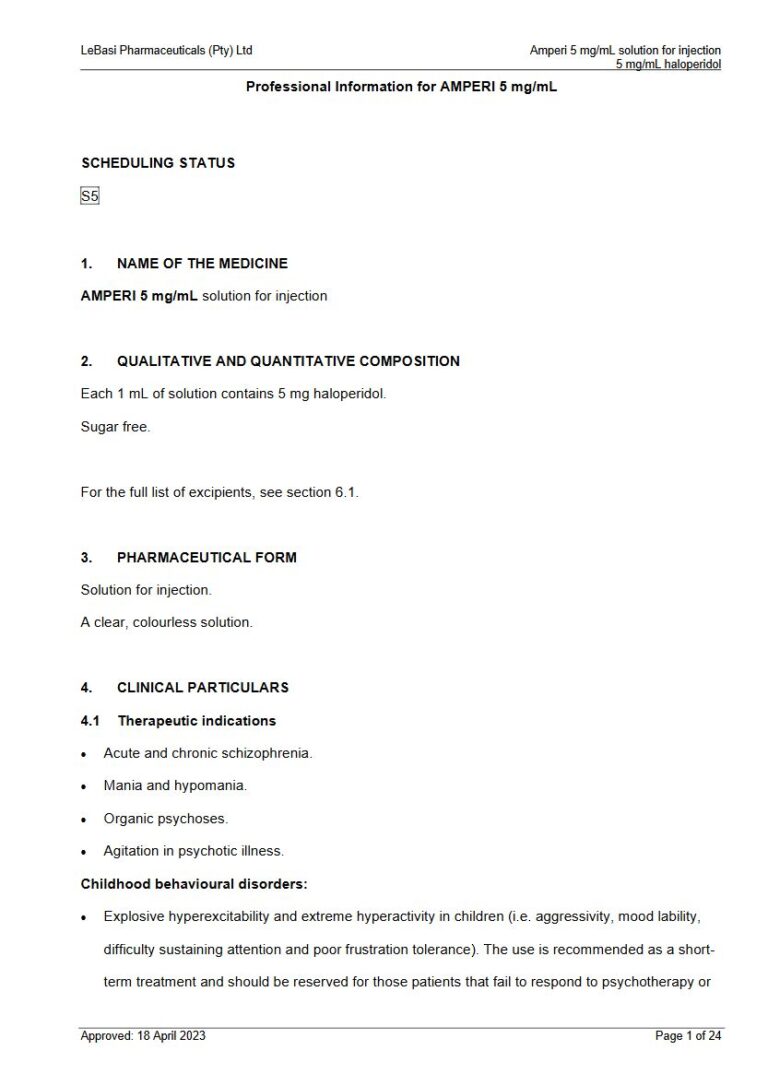
Clinical Particulars
Section 4 of the official insert — extracted exactly as issued, no alterations
4.1 Therapeutic indications
u2022 Acute and chronic schizophrenia.
u2022 Mania and hypomania.
u2022 Organic psychoses.
u2022 Agitation in psychotic illness.
Childhood behavioural disorders:
- Explosive hyperexcitability and extreme hyperactivity in children (i.e. aggressivity, mood lability, difficulty sustaining attention and poor frustration tolerance). The use is recommended as a short-term treatment and should be reserved for those patients that fail to respond to psychotherapy or medicines other than neuroleptics.
- Motor tics and vocal utterances of Gilles de la Touretteu2019s syndrome.
4.2 Posology and method of administration
Dosage should be titrated to clinical efficacy, then reduced to the lowest effective level. Safety and prolonged administration of high dosages has not been demonstrated by controlled clinical trials.
Adults: For the control of acute psychotic conditions, AMPERI 5 mg/mL may be given intramuscularly in doses of 2 to 10 mg; subsequent doses may be given hourly until symptoms are controlled although dosage intervals of 4 to 8 hours may be adequate. Up to 30 mg intramuscularly may be required for emergency control of very severely disturbed patients. The intravenous route may be used if required.
Special populations: Children and the elderly: Children and debilitated or elderly patients may be more sensitive to AMPERI 5 mg/mL and require adjustment of the starting dose. The maximum dose and maintenance doses are generally lower for these patients.
4.3 Contraindications
- Hypersensitivity to haloperidol or to any of the excipients (see section 6.1).
- In patients with Parkinsonu2019s disease.
- Severe toxic central nervous system (CNS) depression.
- Comatose states.
- In patients with bone-marrow suppression.
- In patients with phaeochromocytoma.
- Dementia with Lewy bodies.
- Progressive supranuclear palsy.
- Known QTc interval prolongation or congenital long QT syndrome.
- Recent acute myocardial infarction.
- Uncompensated heart failure.
- History of ventricular dysrhythmia or torsades de pointes.
- Uncorrected hypokalaemia.
- Concomitant treatment with medicines that prolong the QT interval (see section 4.5).
4.4 Special warnings and precautions for use
AMPERI 5 mg/mL should be used with caution in patients with impaired kidney and respiratory function and in those with myasthenia gravis or prostatic hypertrophy.
Increased mortality in elderly people with dementia: Cases of sudden death have been reported in psychiatric patients receiving antipsychotics, including haloperidol (see section 4.8). Possible causes include cardiac dysrhythmias or aspiration and asphyxia due to suppression of cough and gag reflexes.
Elderly patients with dementia-related psychosis treated with antipsychotics are at an increased risk of death. Analyses of seventeen placebo-controlled studies (modal duration of 10 weeks), largely in patients taking atypical antipsychotics, revealed a risk of death in treated patients of between 1,6 to 1,7 times the risk of death in placebo-treated patients. Over the course of a typical 10-week controlled study, the rate of death in patients treated with antipsychotics was about 4,5 %, compared to a rate of about 2,6 % in the placebo group. Although the causes of death were varied, most of the deaths appeared to be either cardiovascular (e.g., heart failure, sudden death) or infectious (e.g., pneumonia) in nature.
Observational studies suggest that treatment of elderly patients with haloperidol is also associated with increased mortality. This association may be stronger for haloperidol than for atypical antipsychotic medicines, is most pronounced in the first 30 days after the start of treatment, and persists for at least 6 months. The extent to which this association is attributable to the medicine, as opposed to being confounded by patient characteristics, has not yet been elucidated.
AMPERI 5 mg/mL is not indicated for the treatment of dementia-related behavioural disturbances.
Cardiovascular effects: QTc prolongation and/or ventricular dysrhythmias, in addition to sudden death, have been reported with haloperidol (see sections 4.3 and 4.8). The risk of these events appears to increase with high doses, high plasma concentrations, in predisposed patients or with parenteral use, particularly intravenous administration.
AMPERI 5 mg/mL is recommended for intramuscular administration only. However, if administered intravenously, continuous ECG monitoring must be performed for QTc interval prolongation and for ventricular dysrhythmias.
Caution is advised in patients with bradycardia, cardiac disease, family history of QTc prolongation or history of heavy alcohol exposure. Caution is also required in patients with potentially high plasma concentrations (see section 4.4, Poor metabolisers of CYP2D6).
A baseline ECG is recommended before intramuscular dosing. During therapy, the need for ECG monitoring for QTc interval prolongation and for ventricular dysrhythmias must be assessed in all patients, but continuous ECG monitoring is recommended for repeated intramuscular doses. ECG monitoring is recommended up to 6 hours after administration of AMPERI 5 mg/mL to patients for prophylaxis or treatment of postoperative nausea and vomiting.
Whilst on therapy, it is recommended to reduce the dose if QTc is prolonged, but AMPERI 5 mg/mL must be discontinued if the QTc exceeds 500 ms.
Electrolyte disturbances such as hypokalaemia and hypomagnesaemia increase the risk for ventricular dysrhythmias and must be corrected before treatment with AMPERI 5 mg/mL is started. Therefore, baseline and periodic electrolyte monitoring is recommended.
Tachycardia and hypotension (including orthostatic hypotension) have also been reported (see section 4.8). Caution is recommended when AMPERI 5 mg/mL is administered to patients manifesting hypotension or orthostatic hypotension.
Care should be exercised in patients with severe cardiovascular disorders because of the possibility of transient hypotension. Epinephrine should not be used since AMPERI 5 mg/mL may block its vasopressor activity and cause a further decrease in blood pressure.
Patients should remain supine for at least 30 minutes after parenteral administration of AMPERI 5 mg/mL and blood pressure should be monitored.
AMPERI 5 mg/mL should be given with great caution in patients with arteriosclerosis who may have occult lesions of the basal ganglia.
Cerebrovascular events: In randomised, placebo-controlled clinical studies in the dementia population, there was an approximately 3-fold increased risk of cerebrovascular adverse events with some atypical antipsychotics. Observational studies comparing the stroke rate in elderly patients exposed to any antipsychotic to the stroke rate in those not exposed to such medicines found an increased stroke rate among exposed patients. This increase may be higher with all butyrophenones, including AMPERI 5 mg/mL. The mechanism for this increased risk is not known. An increased risk cannot be excluded for other patient populations. AMPERI 5 mg/mL must be used with caution in patients with risk factors for stroke.
Neuroleptic malignant syndrome: AMPERI 5 mg/mL has been associated with neuroleptic malignant syndrome: a rare idiosyncratic response characterised by hyperthermia, generalised muscle rigidity, autonomic instability, altered consciousness, coma and increased serum creatine phosphokinase levels. Signs of autonomic dysfunction such as tachycardia, labile arterial pressure, and sweating may precede the onset of hyperthermia, acting as early warning signs.
Antipsychotic treatment must be withdrawn immediately and appropriate supportive therapy and careful monitoring instituted.
Tardive dyskinesia: Tardive dyskinesia may appear in some patients on long-term therapy or after discontinuation of AMPERI 5 mg/mL. The syndrome is mainly characterised by rhythmic involuntary movements of the tongue, face, mouth or jaw. The manifestations may be permanent in some patients. It has been reported that fine vermicular movement of the tongue may be an early sign of the syndrome and, if AMPERI 5 mg/mL is stopped at that time, a more severe manifestation of the syndrome may be prevented. The syndrome may be masked when treatment is reinstituted, when the dose is increased or when a switch is made to a different antipsychotic. If signs and symptoms of tardive dyskinesia appear, the discontinuation of all antipsychotics, including AMPERI 5 mg/mL, must be considered.
Extrapyramidal symptoms: Extrapyramidal symptoms may occur (e.g. tremor, rigidity, hypersalivation, bradykinesia, akathisia, acute dystonia). The use of AMPERI 5 mg/mL has been associated with the development of akathisia, characterised by a subjectively unpleasant or distressing restlessness and need to move, often accompanied by an inability to sit or stand still. This is most likely to occur within the first few weeks of treatment. In patients who develop these symptoms, increasing the dose may be detrimental.
Acute dystonia may occur during the first few days of treatment with AMPERI 5 mg/mL, but later onset as well as onset after dose increases has been reported. Dystonic symptoms can include, but are not limited to, torticollis, facial grimacing, trismus, tongue protrusion, and abnormal eye movements, including oculogyric crisis. Males and younger age groups are at higher risk of experiencing such reactions. Acute dystonia may necessitate stopping AMPERI 5 mg/mL.
Antiparkinson medicines of the anticholinergic type may be prescribed as required to manage extrapyramidal symptoms, but it is recommended that they are not prescribed routinely as a preventive measure. If concomitant treatment with an antiparkinson medicine is required, it may have to be continued after stopping AMPERI 5 mg/mL if its excretion is faster than that of AMPERI 5 mg/mL in order to avoid the development or aggravation of extrapyramidal symptoms.
The possible increase in intraocular pressure must be considered when anticholinergic medicines, including antiparkinson medicines, are administered concomitantly with AMPERI 5 mg/mL. AMPERI 5 mg/mL should be used with caution in patients with closed-angle glaucoma. Regular eye examinations are advisable for patients on long-term treatment with AMPERI 5 mg/mL and avoidance of undue exposure to direct sunlight is recommended.
Seizures/convulsions: It has been reported that seizures can be triggered by AMPERI 5 mg/mL. Caution is advised in patients suffering from epilepsy and in conditions predisposing to seizures (e.g. alcohol withdrawal and brain damage). AMPERI 5 mg/mL should be avoided if possible in untreated epileptics.
Hepatobiliary concerns: As haloperidol is metabolised by the liver, half the initial dose and caution is advised in patients with hepatic impairment (see section 5.2). Isolated cases of liver function abnormalities or hepatitis, most often cholestatic, have been reported (see section 4.8).
Endocrine system concerns: AMPERI 5 mg/mL should be used with caution in patients with hypothyroidism. Thyroxin may facilitate haloperidol toxicity. Antipsychotic therapy in patients with hyperthyroidism must be used only with caution and must always be accompanied by therapy to achieve an euthyroid state. Severe neurotoxicity (rigidity, inability to walk or talk) may occur in patients with thyrotoxicosis.
Hormonal effects of antipsychotic neuroleptic medicines include hyperprolactinaemia, which may cause galactorrhoea, gynaecomastia and oligo or amenorrhoea (see section 4.8). Tissue culture studies suggest that cell growth in human breast tumours may be stimulated by prolactin. Although no clear association with the administration of antipsychotics and human breast tumours has been demonstrated in clinical and epidemiological studies, caution is recommended in patients with previous detected breast cancer. AMPERI 5 mg/mL must be used with caution in patients with pre-existing hyperprolactinaemia and in patients with possible prolactin-dependent tumours.
AMPERI 5 mg/mL should be used with caution in patients with diabetes mellitus. Hypoglycaemia and syndrome of inappropriate antidiuretic hormone secretion have been reported with haloperidol (see section 4.8).
Venous thromboembolism: Cases of venous thromboembolism (VTE) have been reported with antipsychotic medicines. Since patients treated with antipsychotics often present with acquired risk factors for VTE, all possible risk factors for VTE should be identified before and during treatment with AMPERI 5 mg/mL and preventive measures undertaken.
Treatment response and withdrawal: In schizophrenia, the response to antipsychotic treatment may be delayed. If antipsychotics are withdrawn, recurrence of symptoms related to the underlying condition may not become apparent for several weeks or months. There have been very rare reports of acute withdrawal symptoms (including nausea, vomiting and insomnia) after abrupt withdrawal of high doses of antipsychotics. Gradual withdrawal is advisable as a precautionary measure.
Patients with depression: It is recommended that AMPERI 5 mg/mL is not used alone in patients in whom depression is predominant. It may be combined with antidepressants to treat those conditions in which depression and psychosis coexist (see section 4.5).
Switch from mania to depression: There is a risk in the treatment of manic episodes of bipolar disorder for patients to switch from mania to depression. Monitoring of patients for the switch to a depressive episode with the accompanying risks such as suicidal behaviour is important in order to intervene when such switches occur.
Poor metabolisers of CYP2D6: AMPERI 5 mg/mL should be used with caution in patients who are known poor metabolisers of cytochrome P450 (CYP) 2D6 and who are co-administered a CYP3A4 inhibitor. Elderly and debilitated patients may be more prone to the adverse effects of AMPERI 5 mg/mL.
AMPERI 5 mg/mL effects on the vomiting centre may mask the symptoms of overdosage of other medicines, or of disorders such as gastro-intestinal obstruction. Administration at extremes of temperature may be hazardous since body temperature regulation is impaired by AMPERI 5 mg/mL.
4.5 Interactions with other medicines
Interaction studies have only been performed in adults. AMPERI 5 mg/mL is contraindicated in combination with medicines known to prolong the QTc interval (see section 4.3). Examples include:
- Class IA antidysrhythmics (e.g. disopyramide, quinidine).
- Class III antidysrhythmics (e.g. amiodarone, dofetilide, dronedarone, ibutilide, sotalol).
- Certain antidepressants (e.g. citalopram, escitalopram).
- Certain antibiotics (e.g. azithromycin, clarithromycin, erythromycin, levofloxacin, moxifloxacin, telithromycin).
- Other antipsychotics (e.g. phenothiazine derivatives, sertindole, pimozide, ziprasidone).
- Certain antifungals (e.g. pentamidine).
- Certain antimalarials (e.g. halofantrine).
- Certain gastrointestinal medicines (e.g. dolasetron).
- Certain medicines used in cancer (e.g. toremifene, vandetanib).
- Certain other medicines (e.g. bepridil, methadone).
Caution is advised when AMPERI 5 mg/mL is used in combination with medicines known to cause electrolyte imbalance (see section 4.4).
Medicines that may increase AMPERI 5 mg/mL plasma concentrations: Haloperidol is metabolised by several routes (see section 5.2). The major pathways are glucuronidation and ketone reduction. The cytochrome P450 enzyme system is also involved, particularly CYP3A4 and, to a lesser extent, CYP2D6. Inhibition of these routes of metabolism by another medicine or a decrease in CYP2D6 enzyme activity may result in increased haloperidol concentrations. The effect of CYP3A4 inhibition and of decreased CYP2D6 enzyme activity may be additive (see section 5.2). Based on limited and sometimes conflicting information, the potential increase in haloperidol plasma concentrations when a CYP3A4 and/or CYP2D6 inhibitor is co-administered may range between 20 to 40 %, although in some cases, increases of up to 100 % have been reported. Examples of medicines that may increase haloperidol plasma concentrations (based on clinical experience or medicine interaction mechanism) include:
- CYP3A4 inhibitors u2013 alprazolam, fluvoxamine, indinavir, itraconazole, ketoconazole, nefazodone, posaconazole, saquinavir, verapamil, voriconazole.
- CYP2D6 inhibitors u2013 bupropion, chlorpromazine, duloxetine, paroxetine, promethazine, sertraline, venlafaxine.
- Combined CYP3A4 and CYP2D6 inhibitors: fluoxetine, ritonavir.
- Uncertain mechanism u2013 buspirone.
Increased AMPERI 5 mg/mL plasma concentrations may result in an increased risk of adverse events, including QTc prolongation (see section 4.4). Increases in QTc have been observed when haloperidol was given with a combination of the metabolic inhibitors ketoconazole (400 mg/day) and paroxetine (20 mg/day).
It is recommended that patients who take AMPERI 5 mg/mL concomitantly with such medicines be monitored for signs or symptoms of increased or prolonged pharmacologic effects of AMPERI 5 mg/mL, and the AMPERI 5 mg/mL dose be decreased as deemed necessary.
Medicines that may decrease AMPERI 5 mg/mL plasma concentrations: Co-administration of AMPERI 5 mg/mL with potent enzyme inducers of CYP3A4 may gradually decrease the plasma concentrations of AMPERI 5 mg/mL to such an extent that efficacy may be reduced. Examples include:
- Carbamazepine, phenobarbital, phenytoin, rifampicin, St John's Wort (Hypericum perforatum).
Enzyme induction may be observed after a few days of treatment. Maximal enzyme induction is generally seen in about 2 weeks and may then be sustained for the same period of time after the cessation of therapy with AMPERI 5 mg/mL. During combination treatment with inducers of CYP3A4, it is recommended that patients be monitored and the AMPERI 5 mg/mL dose increased as deemed necessary. After withdrawal of the CYP3A4 inducer, the concentration of haloperidol may gradually increase and therefore it may be necessary to reduce the AMPERI 5 mg/mL dose.
Sodium valproate is known to inhibit glucuronidation, but does not affect haloperidol plasma concentrations.
Effect of AMPERI 5 mg/mL on other medicines: AMPERI 5 mg/mL can increase the CNS depression produced by alcohol or CNS-depressant medicines, including hypnotics, sedatives or strong analgesics. An enhanced CNS effect, when combined with methyldopa, has also been reported.
AMPERI 5 mg/mL may antagonise the action of adrenaline and other sympathomimetic medicines (e.g. stimulants like amphetamines) and reverse the blood pressure-lowering effects of adrenergic-blocking medicines such as guanethidine.
AMPERI 5 mg/mL may antagonise the effect of levodopa and other dopamine agonists. AMPERI 5 mg/mL is an inhibitor of CYP2D6. AMPERI 5 mg/mL inhibits the metabolism of tricyclic antidepressants (e.g. imipramine, desipramine), thereby increasing plasma concentrations of these medicines.
Other forms of interaction: In rare cases the following symptoms were reported during the concomitant use of lithium and AMPERI 5 mg/mL: encephalopathy, extrapyramidal symptoms, tardive dyskinesia, neuroleptic malignant syndrome, acute brain syndrome and coma. Most of these symptoms were reversible. It remains unclear whether this represents a distinct clinical entity. Nonetheless, it is advised that in patients who are treated concomitantly with lithium and AMPERI 5 mg/mL, therapy must be stopped immediately if such symptoms occur.
Concomitant administration of metoclopramide may increase the risk of neuroleptic-induced extrapyramidal effects and antidysrhythmics which prolong the QT-interval, may increase the likelihood of ventricular dysrhythmias. Antagonism of the effect of the anticoagulant phenindione has been reported.
4.6 Fertility, pregnancy and lactation
Safety during pregnancy and lactation has not been established.
Pregnancy: A moderate amount of data on pregnant women (more than 400 pregnancy outcomes) indicate no malformative or foeto/neonatal toxicity of haloperidol. However, there have been isolated case reports of birth defects following foetal exposure to haloperidol, mostly in combination with other medicines. Animal studies have shown reproductive toxicity. As a precautionary measure, it is preferable to avoid the use of AMPERI 5 mg/mL during pregnancy.
Newborn infants exposed to antipsychotics (including AMPERI 5 mg/mL) during the third trimester of pregnancy are at risk of adverse reactions including extrapyramidal and/or withdrawal symptoms that may vary in severity and duration following delivery. There have been reports of agitation, hypertonia, hypotonia, tremor, somnolence, respiratory distress, or feeding disorder. Consequently, it is recommended that newborn infants be monitored carefully.
Breastfeeding: AMPERI 5 mg/mL is excreted in human milk. Small amounts of haloperidol have been detected in plasma and urine of breastfed newborns of mothers treated with haloperidol. There is insufficient information on the effects of AMPERI 5 mg/mL in breastfed infants.
Fertility: AMPERI 5 mg/mL elevates prolactin level. Hyperprolactinaemia may suppress hypothalamic GnRH, resulting in reduced pituitary gonadotropin secretion. This may inhibit reproductive function by impairing gonadal steroidogenesis in both female and male patients (see section 4.4).
4.7 Effects on ability to drive and use machines
AMPERI 5 mg/mL may impair the mental and/or physical abilities required for the performance of hazardous tasks such as operating machinery or driving a motor vehicle. Some degree of sedation or impairment of alertness may occur, particularly with higher doses and at the start of treatment and may be potentiated by alcohol. It is recommended that patients be advised not to drive or operate machines during treatment, until their susceptibility is known.
4.8 Undesirable effects
Blood and the lymphatic system disorders:
Less frequent: leucopenia, potentially fatal agranulocytosis, haemolytic anaemia, aplastic anaemia, thrombocytopenic purpura
Immune system disorders:
Less frequent: hypersensitivity
Endocrine disorders:
Less frequent: hyperprolactinaemia
Metabolism and nutrition disorders:
Less frequent: anorexia, hyponatremia, hyperglycaemia, hypoglycaemia
Psychiatric disorders:
Frequent: agitation, insomnia, psychotic disorder
Less frequent: confusional state; decreased libido, loss of libido, restlessness, anxiety, delirium, catatonic-like states, depression
Nervous system disorders:
Frequent: extrapyramidal disorder, hyperkinesia, headache, tardive dyskinesia, dystonia, dyskinesia, akathisia, bradykinesia, hypokinesia, hypertonia, somnolence, tremor, dizziness, neuroleptic malignant syndrome
Less frequent: convulsion, parkinsonism, sedation, involuntary muscle contractions, motor dysfunction, nystagmus
Eye disorders:
Frequent: oculogyric crisis; visual disturbance
Less frequent: blurred vision, mydriasis, miosis, deposition of pigment in the eyes (with prolonged therapy), corneal and lens opacities
Cardiac disorders:
Less frequent: tachycardia, cardiac dysrhythmias
Vascular disorders:
Frequent: orthostatic hypotension, hypotension
Less frequent: hypertension
Respiratory, thoracic and mediastinal disorders:
Less frequent: dyspnoea, bronchospasm, laryngospasm, increased depth of respiration, nasal congestion
Gastrointestinal disorders:
Frequent: salivary hypersecretion,
Less frequent: diarrhoea, dyspepsia, nausea, vomiting, dry mouth, constipation
Hepato-biliary disorders:
Frequent: abnormal liver function test
Less frequent: hepatitis, jaundice
Skin and subcutaneous tissue disorders:
Frequent: rash
Less frequent: photosensitivity reaction, urticaria, pruritus, hyperhidrosis, exfoliative dermatitis, diaphoresis, deposition of pigment in the skin (with prolonged exposure), erythema multiforme, contact sensitivity; maculopapular and acneiform skin reactions, loss of hair, a syndrome resembling systemic lupus erythematosus
Musculoskeletal, connective tissue and bone disorders:
Less frequent: torticollis, muscle rigidity, muscle spasms, musculoskeletal stiffness, trismus, muscle twitching
Renal and urinary disorders:
Less Frequent: urinary retention
Reproductive system and breast disorders:
Frequent: erectile dysfunction
Less frequent: amenorrhoea, dysmenorrhoea, galactorrhoea, breast discomfort / engorgement, breast pain, menorrhagia, menstrual disorder; sexual dysfunction, gynaecomastia, increased libido, inhibition of ejaculation, priapism
General disorders and administration site conditions:
Less frequent: gait disturbance, hyperthermia, oedema, transient dyskinetic signs after abrupt withdrawal (in patients on maintenance treatment)
Investigations:
Frequent: increased or decreased weight
Less frequent: ECG changes, particularly Q and T- wave abnormalities; EEG changes.
Post-marketing experience
Blood and the lymphatic system disorders: Neutropenia, pancytopenia, thrombocytopenia.
Immune system disorders: Anaphylactic reaction.
Endocrine disorders: Inappropriate antidiuretic hormone secretion.
Nervous system disorders: Akinesia, cogwheel rigidity, masked facies.
Cardiac disorders: Ventricular fibrillation, torsade de pointes, ventricular tachycardia, extrasystoles.
Respiratory, thoracic and mediastinal disorders: Laryngeal oedema.
Hepato-biliary disorders: Acute hepatic failure, cholestasis.
Skin and subcutaneous tissue disorders: Angioedema, leukocytoclastic vasculitis.
Musculoskeletal, connective tissue and bone disorders: Rhabdomyolysis.
Pregnancy, puerperium and perinatal conditions: Neonatal withdrawal syndrome (see section 4.6).
General disorders and administration site conditions: Sudden death; face oedema; hypothermia.
Reporting of suspected adverse reactions: Reporting suspected adverse reactions after authorisation of AMPERI 5 mg/mL is important. It allows continued monitoring of the benefit/risk balance of AMPERI 5 mg/mL. Health care providers are asked to report any suspected adverse reactions to SAHPRA via the u201c6.04 Adverse Drug Reactions Reporting Formu201d, found online under SAHPRAu2019s publications: https://www.sahpra.org.za/Publications/Index/8.
4.9 Overdose
Symptoms and signs: The manifestations of AMPERI 5 mg/mL overdose are an exaggeration of the known pharmacological effects and adverse reactions. The most prominent symptoms are severe extrapyramidal reactions, hypotension and sedation. An extrapyramidal reaction is manifest by muscular rigidity and a generalised or localised tremor. Hypertension rather than hypotension is also possible. In extreme cases, the patient would appear comatose with respiratory depression and hypotension that could be severe enough to produce a shock-like state. The risk of ventricular dysrhythmias, possibly associated with QTc prolongation, must be considered.
Management: There is no specific antidote. Treatment is symptomatic and supportive. Dialysis is not recommended in the treatment of overdose because it removes only very small amounts of haloperidol (see section 5.2). For comatose patients, a patent airway must be established by use of an oropharyngeal airway or endotracheal tube. Respiratory depression may necessitate artificial respiration. It is recommended that ECG and vital signs be monitored, and that monitoring continues until the ECG is normal. Treatment of severe dysrhythmias with appropriate anti-dysrhythmic measures is recommended. Hypotension and circulatory collapse may be counteracted by use of intravenous fluids, plasma or concentrated albumin and vasopressor medicines, such as dopamine or noradrenaline. Adrenaline must not be used because it might cause profound hypotension in the presence of haloperidol. In cases of severe extrapyramidal reactions, parenteral administration of an antiparkinson medicine is recommended.
