
Ibugesic Fever And Pain 100 mg Oral suspension
PDF Leaflet Revision Date: 25 October 2024
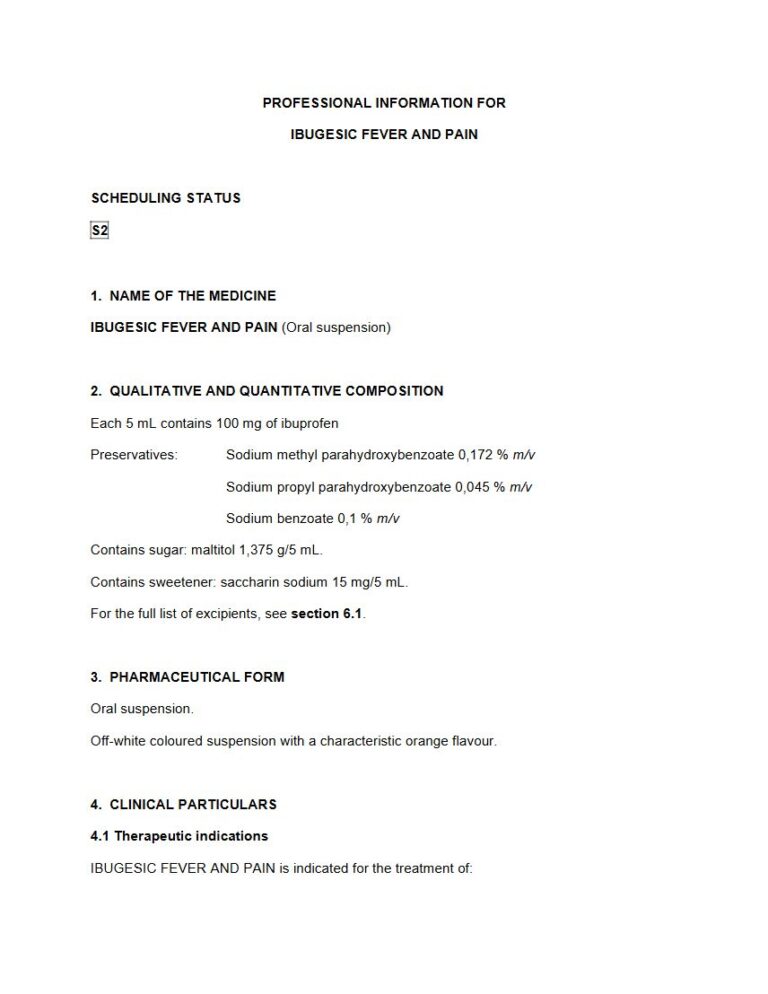
Clinical Summary
Quick overview from the medicine insert
Indication
Mild to moderate pain and fever of inflammatory origin.
Dosage (summary)
Adults: 600 mg every 6-8 hours, max 1200 mg/day.
Onset of Action / Duration
Onset: 30 mins, Duration: 6-8 hours
Special Populations
- Elderly
- Renal impairment
- Hepatic impairment
Pregnancy & Breastfeeding
Contraindicated in pregnancy and lactation.
Key Drug Interactions
- Anticoagulants
- Corticosteroids
- SSRIs
Contraindications
- Hypersensitivity to ibuprofen
- Heart failure
- Gastrointestinal ulcers
- Children under 1 year
Common side effects
- Nausea
- Vomiting
- Abdominal pain
- Dizziness
Counselling Points
- Take with food
- Monitor for gastrointestinal symptoms
- Avoid alcohol
Serious warnings
- Risk of gastrointestinal bleeding
- Serious skin reactions
- Fluid retention
Important Disclaimer
The Ibugesic Fever And Pain 100 mg Oral suspension professional information leaflet below is the property of Cipla Medpro and is provided on Medinsert exactly as issued, with no.. alterations or editorial changes. We make every effort to keep content current by updating documents as soon as new versions become available. Medinsert serves as a trusted access point for healthcare professionals, but does not replace official sources or clinical judgement. For more details, please read our full disclaimer. read more>>
 Healthcare Professionals Only
This content is for registered healthcare professionals
Sign in or create a free account to read the full package insert.
Free for HPCSA-registered professionals. Powered by Medinsert.
Clinical Particulars
Section 4 of the official insert — extracted exactly as issued, no alterations
4.1 Therapeutic indications
IBUGESIC FEVER AND PAIN is indicated for the treatment of:
- Mild to moderate pain of inflammatory origin for a maximum treatment period of 10 days.
- Fever of inflammatory origin.
- Post-traumatic conditions.
- The emergency treatment of acute attacks of gout for a maximum treatment period of 5 days.
4.2 Posology and method of administration
Posology
USE THE LOWEST EFFECTIVE DOSE FOR THE SHORTEST POSSIBLE DURATION OF TREATMENT.
Adults: The recommended dosage of IBUGESIC FEVER AND PAIN is 600 mg 6 to 8 hourly. The total daily dose of IBUGESIC FEVER AND PAIN should not exceed 1 200 mg.
Special populations
Elderly: The elderly are at increased risk of serious consequences of adverse reactions. If IBUGESIC FEVER AND PAIN is considered necessary, the lowest effective dose should be used and for the shortest possible duration. The patient should be monitored regularly for gastrointestinal bleeding during therapy. If renal or hepatic function is impaired, the dosage should be assessed individually.
Paediatric population: The total daily dosage of IBUGESIC FEVER AND PAIN is 20 mg/kg (1 mL/kg) of body mass given in divided doses. Safety in children under 1 year has not been proven (see section 4.3).
Pain: Initial dose 5 mg/kg (0,25 mL/kg) bodyweight. If pain is not controlled, a second dose of 5 mg/kg may be given after 2 hours. Thereafter, 5 mg/kg every 4 to 6 hours. DO NOT EXCEED 20 mg/kg bodyweight per day. Should the pain persist for more than 7 days, a medical practitioner should be consulted.
Fever: Administer 5 mg/kg bodyweight every 4 to 6 hours. DO NOT EXCEED 20 mg/kg bodyweight per day. Should the fever persist for more than 3 days, a medical professional should be consulted.
Dosage for suspension:
Age Bodyweight Daily dosage
- 1 to 2 years 7 to 12 kg 2,5 mL up to 3 to 4 times daily
- 3 to 7 years 14 to 23 kg 2,5 to 5 mL up to 3 to 4 times daily
- 8 to 12 years 25 to 40 kg 10 mL up to 3 to 4 times daily
Children weighing less than 7 kg or younger than 1 year of age should not be given IBUGESIC FEVER AND PAIN.
Method of administration: IBUGESIC FEVER AND PAIN is for oral administration. It should preferably be taken with or after food.
4.3 Contraindications
IBUGESIC FEVER AND PAIN is contraindicated in:
- Patients with known hypersensitivity to ibuprofen or to any of the excipients in IBUGESIC FEVER AND PAIN (see section 6.1).
- Patients with heart failure.
- Patients with a history of gastrointestinal perforation, ulceration or bleeding (PUBs) related to previous use of NSAIDs.
- Patients with active or a history of recurrent peptic ulcers/haemorrhages/perforations.
- Patients sensitive to aspirin or other non-steroidal anti-inflammatory medicines (NSAIDs), or with a history of severe allergic reactions, such as anaphylaxis or angioedema induced by aspirin or other NSAIDs, due to the possibility of cross-sensitivity resulting from structural relationships which exist among NSAIDs. Acute allergic reactions are likely to occur in patients who have exhibited allergic reactions to these medicines.
- Lithium, as risk of toxicity is increased.
- Patients with aspirin-induced nasal polyps associated with bronchospasm.
- Children under the age of 1 year.
- Pregnancy and lactation (see section 4.6).
- Patients with conditions involving a tendency to bleeding.
- Patients with severe hepatic failure or renal failure.
4.4 Special warnings and precautions for use
The antipyretic, analgesic and anti-inflammatory action of IBUGESIC FEVER AND PAIN may mask symptoms or the presence or worsening of infections. Caution is required in patients with a history of hypertension as fluid retention and oedema have been reported in association with IBUGESIC FEVER AND PAIN therapy (see section 4.3 and section 4.8).
In view of IBUGESIC FEVER AND PAINu2019s inherent potential to cause fluid retention, heart failure may be precipitated in some compromised patients. The elderly have an increased frequency of adverse reactions to NSAIDs, especially gastrointestinal perforation, ulceration and bleeding (PUBs), which may be fatal. The risk of gastrointestinal bleeding or perforation is higher with increasing doses of IBUGESIC FEVER AND PAIN, in patients with a history of ulcers, and in the elderly. When gastrointestinal bleeding or ulceration occurs in patients receiving IBUGESIC FEVER AND PAIN, treatment with IBUGESIC FEVER AND PAIN should be stopped.
Patients with a history of gastrointestinal disease, particularly the elderly, should report any unusual abdominal symptoms (especially gastrointestinal bleeding), particularly in the initial stages of treatment. Other side effects include nausea, vomiting, diarrhoea, flatulence, constipation, dyspepsia, abdominal pain, melaena, haematemesis, ulcerative stomatitis, exacerbation of colitis and Crohnu2019s disease, and gastritis (see section 4.8).
IBUGESIC FEVER AND PAIN should be given with caution to patients with a history of gastrointestinal disease (e.g. ulcerative colitis, Crohnu2019s disease, hiatus hernia, gastro-oesophageal reflux disease, angiodysplasia) as these conditions may be exacerbated (see section 4.8).
Serious skin reactions, some of them fatal, including exfoliative dermatitis, Stevens-Johnson syndrome, and toxic epidermal necrolysis have been reported. IBUGESIC FEVER AND PAIN should be discontinued at the first appearance of skin rash, mucosal lesions, or any other sign of hypersensitivity (see section 4.8).
Caution is advised when the following medical conditions exist:
- IBUGESIC FEVER AND PAIN should be given with care to the elderly, to patients with asthma or bronchospasm, and cardiovascular disease.
- Patients with cirrhosis, diuretic-induced volume depletion, or renal insufficiency require local synthesis of vasodilating prostaglandins to maintain renal perfusion and therefore these patients are at greater risk of developing renal dysfunction due to NSAID-induced inhibition of renal prostaglandin synthesis.
- IBUGESIC FEVER AND PAIN should be discontinued in patients who experience blurred or diminished vision, or changes in colour vision (see section 4.8).
- Patients with collagen disease, including systemic lupus erythematosus, may be at risk of developing aseptic meningitis (see below).
- Anaemia.
- Stomatitis.
Caution should be advised in patients receiving concomitant medicines which could increase the risk of ulceration or bleeding, such as oral corticosteroids, anticoagulants such as warfarin, selective serotonin reuptake inhibitors or antiplatelet agents, such as aspirin (see section 4.5).
Long-term administration of IBUGESIC FEVER AND PAIN has resulted in renal papillary necrosis and other renal pathologic changes. Renal toxicity has also been seen in patients in whom renal prostaglandins have a compensatory role in the maintenance of renal perfusion. In these patients, administration of a NSAID, such as IBUGESIC FEVER AND PAIN, may cause a dose-dependent reduction in prostaglandin formation and, secondarily, in renal blood flow, which may precipitate overt renal decompensation. Patients at greatest risk of this reaction are those with impaired renal function, heart failure, liver dysfunction, those taking diuretics and ACE inhibitors, and the elderly. Discontinuation of IBUGESIC FEVER AND PAIN therapy is usually followed by recovery to the pre-treatment state.
Risk of renal tubular acidosis and hypokalaemia are associated with non-steroidal anti-inflammatory medicine (NSAID) usage. IBUGESIC FEVER AND PAIN can interfere with platelet aggregation and has been shown to prolong bleeding time in normal subjects. Aseptic meningitis has been observed on rare occasions in patients on ibuprofen, as in IBUGESIC FEVER AND PAIN, therapy. Although it is probably more likely to occur in patients with systemic lupus erythematosus and related connective tissue diseases, it has been reported in patients who do not have an underlying chronic disease.
IBUGESIC FEVER AND PAIN is contraindicated in pregnancy and lactation (see CONTRAINDICATIONS).
Maltitol IBUGESIC FEVER AND PAIN contains maltitol. Patients with the rare hereditary condition of fructose intolerance should not take IBUGESIC FEVER AND PAIN.
4.5 Interaction with other medicines and other forms of interaction
Corticosteroids: There is an increased risk of gastrointestinal perforation, ulceration and bleeding (PUBs) when IBUGESIC FEVER AND PAIN is co-administered with corticosteroids.
Anticoagulants: Co-administration of IBUGESIC FEVER AND PAIN with anticoagulants may enhance the effects of anticoagulants, such as warfarin, and increase the possibility of gastrointestinal ulceration or bleeding.
Antiplatelet agents (clopidogrel, ticlopidine): There is an increased risk of gastrointestinal bleeding if IBUGESIC FEVER AND PAIN is co-administered with these medicines.
Selective serotonin reuptake inhibitors (SSRIs): There is an increased risk of gastrointestinal bleeding if IBUGESIC FEVER AND PAIN is co-administered with these medicines.
Alcohol, bisphosphonates, pentoxifylline: Concomitant administration with IBUGESIC FEVER AND PAIN poses an increased risk of gastrointestinal ulceration and bleeding (PUBs).
Antidiabetic medicines: The hypoglycaemic effects of these medicines may be increased.
Digoxin: Co-administration with IBUGESIC FEVER AND PAIN may cause an increase in serum digoxin concentrations. NSAIDs, such as IBUGESIC FEVER AND PAIN, may also exacerbate cardiac failure and reduce glomerular filtration rate in patients taking digoxin.
Lithium: Lithium is contraindicated and co-administration with IBUGESIC FEVER AND PAIN may increase the steady-state concentration of lithium (see section 4.3).
Methotrexate: Increased and prolonged methotrexate plasma concentration and an increased risk of methotrexate toxicity may occur when methotrexate and IBUGESIC FEVER AND PAIN are given concomitantly.
Nephrotoxic medicines, e.g. ciclosporin: There is an increased risk of nephrotoxicity when nephrotoxic medicines are co-administered with IBUGESIC FEVER AND PAIN. There is also a possible increased risk of nephrotoxicity when IBUGESIC FEVER AND PAIN is given with tacrolimus.
Antihypertensive or diuretic medicines: Reduction or reversal of the antihypertensive effect may occur. Diuretics can also increase the risk of nephrotoxicity of NSAIDs, including that of IBUGESIC FEVER AND PAIN.
Bone marrow depressants: The leukopenic and/or thrombocytopenic effects of these medicines may be increased.
Non-steroidal anti-inflammatory medicines (NSAIDs): Use of two or more NSAIDs, including cyclo-oxygenase-2 inhibitors, concomitantly could result in an increase in side effects. Concomitant administration of IBUGESIC FEVER AND PAIN and aspirin is not recommended because of the potential of increased adverse effects (see section 4.4).
Quinolone antibiotics: Patients taking NSAIDs, such as IBUGESIC FEVER AND PAIN, and quinolones may have an increased risk of developing convulsions.
Zidovudine: There is an increased risk of haematological toxicity when NSAIDs, such as IBUGESIC FEVER AND PAIN, are given with zidovudine. There is evidence of an increased risk of haemarthroses and haematoma in Human Immunodeficiency Virus positive [HIV(+)] haemophiliacs receiving concomitant treatment with zidovudine and IBUGESIC FEVER AND PAIN.
Aminoglycosides: NSAIDs, such as IBUGESIC FEVER AND PAIN, may decrease the excretion of aminoglycosides.
Herbal extracts: Ginkgo biloba may potentiate the risk of bleeding with NSAIDs, such as IBUGESIC FEVER AND PAIN.
CYP2C9 inhibitors: Concomitant administration of IBUGESIC FEVER AND PAIN and CYP2C9 inhibitors may increase the exposure to ibuprofen (CYP2C9 substrate). In a study with voriconazole and fluconazole (CYP2C9 inhibitors), an increased S(+)-ibuprofen exposure by approximately 80 to 100 % has been shown. Reduction of the IBUGESIC FEVER AND PAIN dose should be considered when potent CYP2C9 inhibitors are administered concomitantly, particularly when high-dose ibuprofen is administered with either voriconazole or fluconazole.
4.6 Fertility, pregnancy and lactation
Pregnancy: IBUGESIC FEVER AND PAIN is contraindicated during pregnancy (see section 4.3). Inhibition of prostaglandin synthesis may adversely affect the pregnancy and/or embryo/foetal development. Data from epidemiological studies suggest an increased risk of miscarriage and of cardiac malformation and gastroschisis after the use of a prostaglandin synthesis inhibitor such as IBUGESIC FEVER AND PAIN, in early pregnancy. In animals, the administration of a prostaglandin synthesis inhibitor has been shown to result in increased pre- and post-implantation losses, and embryo/foetal lethality. In addition, increased incidences of various malformations, including cardiovascular, have been reported in animals given a prostaglandin synthesis inhibitor during the organogenetic period. Regular use of non-steroidal anti-inflammatory medicines, such as IBUGESIC FEVER AND PAIN, during the third trimester of pregnancy may result in premature closure of the foetal ductus arteriosus in utero and possibly in persistent pulmonary hypertension of the newborn. The onset of labour may be delayed and its duration increased (see section 4.3). In addition, use of NSAIDs, such as IBUGESIC FEVER AND PAIN around 20 weeks gestation or later in pregnancy may cause a rare but serious foetal renal dysfunction leading to oligohydramnios, and, in some cases, neonatal renal impairment. Complications of prolonged oligohydramnios include limb contractures and delayed lung maturation, which may require invasive procedures such as exchange transfusion or dialysis, in some cases. At the end of pregnancy, prostaglandin synthesis inhibitors, such as IBUGESIC FEVER AND PAIN, may expose the mother and the neonate to possible prolongation of bleeding time.
Breastfeeding: IBUGESIC FEVER AND PAIN appears in breast milk. IBUGESIC FEVER AND PAIN is contraindicated during lactation (see section 4.3).
Fertility: If IBUGESIC FEVER AND PAIN is used by a woman attempting to conceive, the dose should be kept as low and duration of treatment as short as possible. The use of IBUGESIC FEVER AND PAIN may impair female fertility and is not recommended in women attempting to conceive. In women who have difficulties conceiving or who are undergoing investigation of infertility, withdrawal of IBUGESIC FEVER AND PAIN should be considered.
4.7 Effects on ability to drive and use machines
Undesirable effects, such as dizziness, drowsiness, fatigue and visual disturbances are possible after taking IBUGESIC FEVER AND PAIN. Patients should be advised not to drive or operate machinery until they know how IBUGESIC FEVER AND PAIN affects them.
4.8 Undesirable effects
Tabulated summary of adverse reactions
MedDRA system organ class Frequency Side effects
Infections and infestations Less frequent Rhinitis and aseptic meningitis (see section 4.4)
Blood and lymphatic system disorders Frequent Agranulocytosis, thrombocytopenia, anaemia, neutropenia, eosinophilia. Less frequent Leukopenia, aplastic anaemia, haemolytic anaemia.
Immune system disorders Frequent Hypersensitivity reactions (fever, rashes, hepatotoxicity, aseptic meningitis). Frequency unknown Non-specific allergic reaction and anaphylaxis, respiratory tract reactivity (comprising asthma, aggravated asthma, bronchospasm, or dyspnoea), assorted skin disorders (pruritus, urticaria, purpura, angioedema, exfoliative and bullous dermatoses u2013 also see Skin and subcutaneous tissue disorders below).
Metabolism and nutrition disorders Frequency unknown Hypokalaemia (see section 4.4).
Psychiatric disorders Frequent Nervousness, depression, insomnia. Less frequent Anxiety, confusional state, hallucinations.
Nervous system disorders Frequent Dizziness, headache, drowsiness. Less frequent Paraesthesia, somnolence.
Eye disorders Frequent Blurred vision, changes in visual colour perception, toxic amblyopia. Less frequent Optic neuritis, visual impairment, toxic optic neuropathy.
Ear and labyrinth disorders Frequent Tinnitus. Less frequent Impaired hearing, vertigo.
Cardiac disorders Frequent Tachycardia, oedema. Frequency unknown Cardiac failure, hypertension (see section 4.4).
Vascular disorders Frequent Flushing and increase in blood pressure.
Gastrointestinal disorders Frequent Abdominal discomfort, peptic ulceration, gastrointestinal bleeding, nausea, vomiting, abdominal cramps and pain, diarrhoea, flatulence, constipation, dyspepsia, melaena, haematemesis, ulcerative stomatitis, exacerbation of colitis and Crohnu2019s disease (see section 4.4). Less frequently Gastritis, gastrointestinal perforation, pancreatitis. Frequency unknown Transient burning in the mouth or throat.
Hepatobiliary disorders Frequent Hepatitis. Less frequent Abnormalities in liver function, hepatic failure, jaundice.
Skin and subcutaneous tissue disorders Frequent Allergic dermatitis, erythema multiforme, Stevens-Johnson syndrome and toxic epidermal necrolysis (see Immune system disorders above). Less frequent Photosensitivity reaction.
Renal and urinary disorders Frequent Impairment of renal function, acute reversible renal impairment, interstitial nephritis, nephrotic syndrome. Less frequent Renal failure. Frequency unknown Renal tubular acidosis (RTA) (see section 4.4).
General disorders Less frequent Malaise, fatigue.
Reporting of suspected adverse reactions Reporting suspected adverse reactions after authorisation of the medicine is important. It allows continued monitoring of the benefit/risk balance of the medicine. Health care providers are asked to report any suspected adverse reactions to SAHPRA via the u201cAdverse Drug Reactions Reporting Formu201d, found online under SAHPRAu2019s publications: https://www.sahpra.org.za/document/adverse-drug-reactions-and-quality-problemreporting-form/ or to Cipla Medpro (Pty) Ltd. by email: [email protected] or telephone: 080 222 6662 (toll free).
4.9 Overdose
Symptoms: Most patients who have ingested significant amounts of ibuprofen, as in IBUGESIC FEVER AND PAIN, will manifest symptoms within 4 to 6 hours. The most frequently reported symptoms of overdose include nausea, vomiting, abdominal pain, lethargy and drowsiness. Central nervous system (CNS) effects include headache, tinnitus, dizziness, convulsion and loss of consciousness. Nystagmus, metabolic acidosis, hypothermia, renal effects, gastrointestinal bleeding, coma, apnoea, diarrhoea and depression of the central nervous and respiratory systems have also been less frequently been reported. Disorientation, excitation, fainting and cardiovascular toxicity, including hypotension, bradycardia and tachycardia have been reported. In cases of significant overdose, renal failure and liver damage are possible.
Therapeutic measures: Patients should be treated symptomatically as required. Within one hour of ingestion of a potentially toxic amount, activated charcoal should be considered. Good urine output should be ensured. Renal and liver function should be closely monitored. Patients should be observed for at least four hours after ingestion of potentially toxic amounts. Frequent or prolonged convulsions should be treated with intravenous diazepam. Other measures may be indicated by the patientu2019s clinical condition. Treatment is symptomatic and supportive.
