
Ibugesic Forte 200 mg. 250 mg. 10 mg Capsules
PDF Leaflet Revision Date: 15 October 2024
Clinical Summary
Quick overview from the medicine insert
Indication
Relief of mild to moderate pain of inflammatory origin with or without fever.
Dosage (summary)
Adults: 1-2 capsules every 6 hours, max 6 capsules/24 hours. Not for use beyond 4 days.
Onset of Action / Duration
Onset: 30 mins, Duration: 4-6 hours for pain, 6-8 hours for fever.
Special Populations
- Elderly
- Renal impairment
- Hepatic impairment
Pregnancy & Breastfeeding
Not recommended during pregnancy or breastfeeding; risks include renal dysfunction and pulmonary hypertension in newborns.
Key Drug Interactions
- MAOIs
- Alcohol
- Anticoagulants
- Antihypertensives
Contraindications
- Hypersensitivity to ingredients
- Acute respiratory depression
- Severe liver impairment
- Peptic ulcer disease
- Uncontrolled asthma
Common side effects
- Dizziness
- Nausea
- Constipation
- Drowsiness
Counselling Points
- Avoid alcohol
- Do not exceed recommended dose
- Seek medical advice if pain persists beyond 5 days
Serious warnings
- Risk of dependence with prolonged use
- Serious skin reactions
- Risk of gastrointestinal bleeding
Important Disclaimer
The Ibugesic Forte 200 mg. 250 mg. 10 mg Capsules professional information leaflet below is the property of Cipla Medpro and is provided on Medinsert exactly as issued, with no.. alterations or editorial changes. We make every effort to keep content current by updating documents as soon as new versions become available. Medinsert serves as a trusted access point for healthcare professionals, but does not replace official sources or clinical judgement. For more details, please read our full disclaimer. read more>>
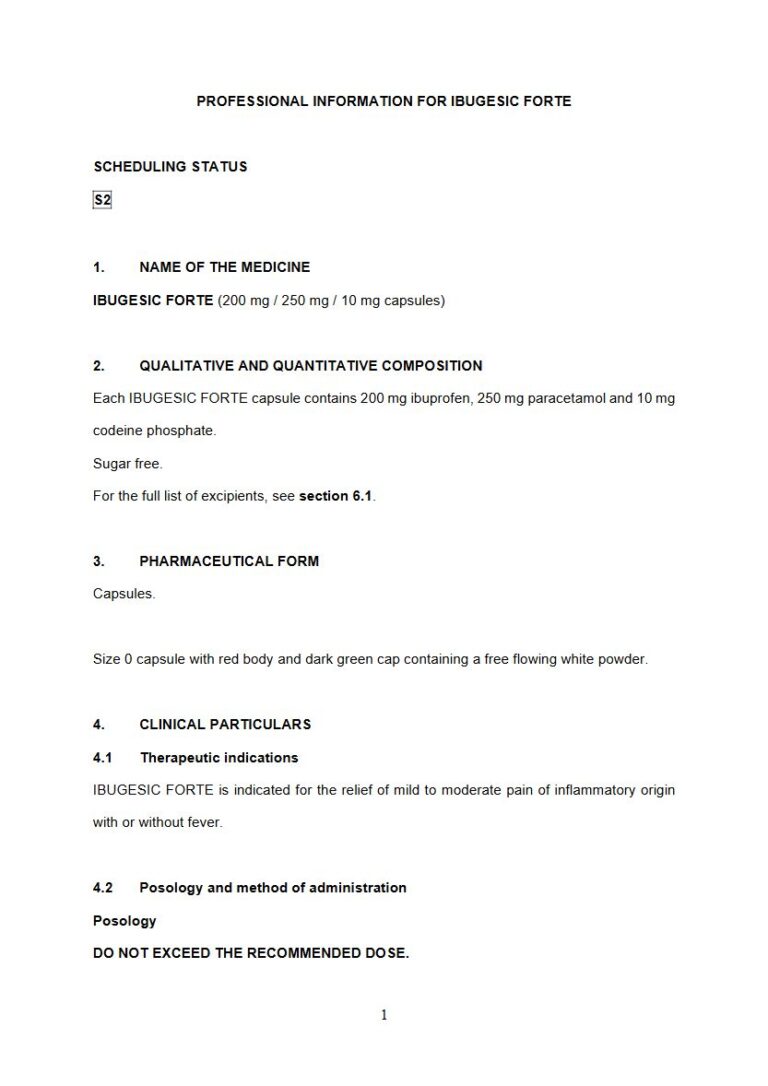 Healthcare Professionals Only
This content is for registered healthcare professionals
Sign in or create a free account to read the full package insert.
Free for HPCSA-registered professionals. Powered by Medinsert.
Clinical Particulars
Section 4 of the official insert — extracted exactly as issued, no alterations
4.1 Therapeutic indications
IBUGESIC FORTE is indicated for the relief of mild to moderate pain of inflammatory origin with or without fever.
4.2 Posology and method of administration
Posology
DO NOT EXCEED THE RECOMMENDED DOSE.
Adults: 1 to 2 capsules 6 hourly. Do not take more than 6 capsules in 24 hours. If no effective pain relief is achieved, the patients should be advised to seek the views of a physician. IBUGESIC FORTE is for short term use and is not recommended for use beyond 4 days.
Paediatric population
Not recommended for children under twelve years of age.
4.3 Contraindications
IBUGESIC FORTE is contraindicated in:
u2022 patients with known hypersensitivity to ibuprofen, paracetamol, codeine phosphate or to any of the excipients of IBUGESIC FORTE (see section 6.1)
u2022 patients with acute respiratory depression
u2022 concurrent use with Monoamine Oxidase Inhibitors (MAOIs) or within 14 days of stopping such treatment (see section 4.5)
u2022 patients with diarrhoea associated with pseudomembranous colitis
u2022 patients with severe liver impairment
u2022 patients with peptic ulcer disease or gastrointestinal bleeding
u2022 patients sensitive to aspirin or other nonsteroidal anti-inflammatory medicines
u2022 patients with uncontrolled asthma or bronchospasm
u2022 patients with nasal polyps associated with aspirin-induced bronchospasm
u2022 patients with bleeding disorders
u2022 avoid use of NSAIDs, including IBUGESIC FORTE in women around 30 weeks gestation and later in pregnancy due to the risks of oligohydramnios/foetal renal dysfunction and premature closure of the foetal ductus arteriosus (see section 4.6)
u2022 heart failure
u2022 patients with history of gastrointestinal perforation, ulceration or bleeding (PUBs) related to previous NSAIDs, including IBUGESIC FORTE
u2022 patients with active or history of recurrent ulcer/haemorrhage/perforations.
4.4 Special warnings and precautions for use
IBUGESIC FORTE should be used with caution in the following:
u2022 acute abdominal conditions - diagnosis or clinical course may be obscured
u2022 acute asthma attack or respiratory impairment or disease u2013 may decrease respiratory drive and increase airway resistance in these patients
u2022 cardiac arrhythmias u2013 may be induced or exacerbated
u2022 convulsions or history thereof u2013 may be induced or exacerbated
u2022 alcoholism, drug abuse or dependence u2013 patient is predisposed to drug abuse
DEPENDENCE MAY DEVELOP WITH PROLONGED USE OF HIGH DOSES
u2022 gallbladder disease or gallstones u2013 may cause biliary tract spasm
u2022 recent gastrointestinal tract surgery
u2022 head injury, increased intracranial pressure or intracranial lesions u2013 risk of respiratory depression and further increase in intracranial pressure. IBUGESIC FORTE may also cause sedation and pupillary changes that may obscure the clinical course of head injury
u2022 hepatic function impairment u2013 IBUGESIC FORTE is metabolised in the liver
u2022 renal function impairment u2013 IBUGESIC FORTE may cause urine retention as the metabolites are excreted via the kidneys, renal impairment may lead to accumulation resulting in an increase in adverse effects
u2022 adrenocortical insufficiency
u2022 inflammatory or obstructive bowel disorders u2013 risk of toxic megacolon may be increased
u2022 prostatic hypertrophy, obstruction, urethral stricture or recent urinary tract surgery - as urinary retention may be precipitated by IBUGESIC FORTE
u2022 elderly or debilitated patients, these patients are more likely to develop adverse hepatic or renal effects and if gastrointestinal ulceration or bleeding occurs, it is more likely to cause serious consequences u2013 dosage should be reduced
u2022 alcoholism or impaired liver function u2013 increased risk of hepatotoxicity, especially in alcoholics with high doses and prolonged use
u2022 diabetic patients may experience false results with blood glucose tests
u2022 surgery u2013 possible increased risk for post-operative bleeding
u2022 allergic conditions u2013 possibility of cross sensitivity
u2022 anaemia u2013 may be exacerbated. Dosages of IBUGESIC FORTE in excess of those recommended may cause severe liver damage. This product contains paracetamol which may be fatal in overdose. In the event of overdosage or suspected overdose and notwithstanding the fact that the person may be asymptomatic, the nearest doctor, hospital or poison centre must be contacted immediately. Risk of renal tubular acidosis and hypokalaemia are associated with non-steroidal anti-inflammatory medicine (NSAID) usage. Severe cutaneous adverse reactions (SCARs) such as toxic epidermal necrolysis (TEN), Steven-Johnson syndrome (SJS), acute generalised exanthematous pustulosis (AGEP), eosinophilia and systemic (DRESS)/Drug-induced hypersensitivity syndrome (DIHS) and fixed drug eruptions (FDE) have been reported in patients treated with paracetamol containing medicines. If a patient develops SCAR, treatment with IBUGESIC FORTE must immediately be discontinued and appropriate treatment instituted. The antipyretic, analgesic and anti-inflammatory action of IBUGESIC FORTE may mask symptoms of the occurrence or worsening of infection. IBUGESIC FORTE may cause drowsiness; ability to perform skilled tasks, drive or operate machinery may be impaired. Avoid alcohol. If taking for pain, including arthritic pain, and the pain persists for longer than 5 days, or if taking for fever and the fever persists for longer than 3 days, or if the condition deteriorates or new symptoms develop, the doctor needs to be contacted as additional treatment may be necessary.
4.5 Interaction with other medicines and other forms of interaction
u2022 MAOIs u2013 possible severe and sometimes fatal reactions may occur (see section 4.3).
u2022 Alcohol or central nervous system depressants - depressant effects are enhanced.
u2022 Anticholinergics u2013 increased risk of severe constipation.
u2022 Antidiarrhoeals u2013 increased risk of severe constipation and central nervous system depression.
u2022 Hypotension-producing medications u2013 hypotensive effects may be potentiated.
u2022 Hepatotoxic medicines u2013 increased risk of hepatotoxicity.
u2022 Enzyme inducing medicines u2013 increased risk of hepatotoxicity. Possible decrease in therapeutic effects of paracetamol.
u2022 Metoclopramide u2013 absorption of paracetamol may be accelerated.
u2022 Probenecid u2013 excretion of paracetamol may be affected and plasma concentrations altered.
u2022 Cholestyramine u2013 absorption of paracetamol is reduced if given within one hour of cholestyramine.
u2022 Anticoagulants u2013 enhancement of anticoagulant effect and the possibility of gastrointestinal ulceration or bleeding.
u2022 Alcohol, corticosteroids, clopidogrel, ticlopidine, bisphosphonates, oxpentifylline u2013 increased risk of gastrointestinal bleeding and ulceration.
u2022 Antidiabetic agents u2013 hypoglycaemic effects of these medicines may be increased.
u2022 Digoxin u2013 increase in serum digoxin concentrations.
u2022 Lithium u2013 increase in the steady-state concentration of lithium.
u2022 Methotrexate u2013 increased and prolonged methotrexate plasma concentration and an increased risk of methotrexate toxicity.
u2022 Nephrotoxic medicines e.g., ciclosporin u2013 increased risk of nephrotoxicity.
u2022 Antihypertensives or diuretics u2013 reduction or reversal of the antihypertensive effect may occur.
u2022 Bone marrow depressants u2013 the leucopenic and/or thrombocytopenic effects of these medicines may be increased.
u2022 Anti-platelet medicines and selective serotonin reuptake inhibitors (SSRIs): increased risk of gastrointestinal bleeding.
4.6 Fertility, pregnancy and lactation
IBUGESIC FORTE is not recommended for use by pregnant or breastfeeding women (see section 4.3). Use of non-steroidal anti-inflammatory medicines during the third trimester of pregnancy, may result in persistent pulmonary hypertension of the newborn. Use of NSAIDs, including IBUGESIC FORTE, can cause premature closure of the foetal ductus arteriosus and foetal renal dysfunction leading to oligohydramnios and, in some cases, neonatal renal impairment. Because of these risks, the use of IBUGESIC FORTE dose and duration between 20 and 30 weeks of gestation should be limited and avoided at around 30 weeks of gestation and later in pregnancy (see sections 4.3 and 4.4). The onset of labour may be delayed and its duration increased.
Fertility
No data on male and female fertility are available.
4.7 Effects on ability to drive and use machines
Patients should be advised not to drive or operate machinery if affected by dizziness or sedation. This medicine can impair cognitive function and can affect a patient's ability to drive safely. Patients should be advised that they do not engage in the above activities until they are aware of the measure to which IBUGESIC FORTE affects them.
4.8 Undesirable effects
Tabulated list of adverse reactions
The following adverse reactions have been classified according to the following categories, frequent, less frequent and frequency unknown.
MedDRA system organ class
Frequency
Side effects
Ibuprofen
Blood and lymphatic system disorders
Less frequent: Agranulocytosis, thrombocytopenia.
Metabolism and nutrition disorders
Frequency unknown: Hypokalaemia.
Nervous system disorders
Less frequent: Dizziness, nervousness, depression, drowsiness, insomnia, headache.
Eye disorders
Less frequent: Blurred vision and other ocular reactions.
Cardiac disorders
Less frequent: Heart failure may be precipitated in compromised patients, angina pectoris, cardiac arrhythmias.
Gastrointestinal disorders
Frequent: Dyspepsia, nausea, diarrhoea, abdominal cramps and pain, bloating, constipation.
Less frequent: Peptic ulceration, gastrointestinal bleeding, decreased appetite.
Frequency unknown: Exacerbation of colitis and Crohnu2019s disease, gastritis.
Hepato-biliary disorders
Less frequent: Abnormalities of liver function tests.
Skin and subcutaneous tissue disorders
Less frequent: Skin rash, pruritus.
Renal and urinary disorders
Less frequent: Impairment of renal function, acute reversible renal failure, oedema.
Frequency unknown: Renal tubular acidosis (RTA).
Other
Less frequent: Tinnitus, hypersensitivity reactions.
Paracetamol
Blood and lymphatic system disorders
Less frequent: Haematological reaction (including thrombocytopenia, leucopenia, pancytopenia, neutropenia and agranulocytosis).
Hepato-biliary
Less frequent: Hepatitis.
Skin and subcutaneous tissue disorders
Frequency unknown: Risk of fixed drug eruptions (FDE) and Drug-induced hypersensitivity syndrome (DIHS).
Renal and urinary disorders
Less frequent: Renal colic, renal failure.
Other
Less frequent: Sensitivity reactions resulting in reversible skin rash (which may be accompanied by fever and mucosal lesions) or blood disorders.
Codeine Phosphate
Nervous system disorders
Frequent: Drowsiness, confusion.
Less frequent: Restlessness, vertigo, changes in mood, hypothermia, raised intracranial pressure.
Eye disorders
Less frequent: Changes in myosis.
Cardiac disorders
Less frequent: Bradycardia, palpitations, orthostatic hypotension.
Respiratory, thoracic and mediastinal disorders
Less frequent: Respiratory depression.
Gastrointestinal disorders
Frequent: Nausea, vomiting, constipation.
Less frequent: Dry mouth.
Skin and subcutaneous tissue disorders
Less frequent: Sweating, facial flushing, urticaria, pruritus.
Renal and urinary disorders
Less frequent: Micturition difficulties, ureteric or biliary spasm.
4.9 Overdose
(see section 4.8). Paracetamol and ibuprofen: Prompt treatment is essential. In the event of an overdosage, consult a doctor immediately, or take the person to a hospital directly. A delay in starting treatment may mean that the antidote is given too late to be effective. Evidence of liver damage is often delayed until after the time for effective treatment has lapsed. Susceptibility to paracetamol toxicity is increased in patients who have taken repeated high doses (greater than 5 to 10 g/day) of paracetamol for several days, in chronic alcoholism, chronic liver disease, AIDS, malnutrition, and with the use of medicines that induce liver microsomal oxidation such as barbiturates, isoniazid, rifampicin, phenytoin and carbamazepine. Symptoms of paracetamol overdose: In the first 24 hours these symptoms include pallor, nausea, vomiting, anorexia and possibly abdominal pain. Mild symptoms during the first two days of acute poisoning do not reflect the potential seriousness of the overdosage. Symptoms of ibuprofen overdose: Gastrointestinal symptoms (e.g. abdominal pain, nausea, vomiting), central nervous system symptoms (e.g. lethargy, drowsiness), gastrointestinal haemorrhage, acute renal failure, convulsions and coma. Liver damage may become apparent 12 to 48 hours, or later after ingestion of paracetamol, initially by elevation of the serum transaminase and lactic dehydrogenase activity, increased serum bilirubin concentrations and prolongation of the prothrombin time. Liver damage may lead to encephalopathy, coma and death. Acute renal failure with acute tubular necrosis may develop even in the absence of severe liver damage. Abnormalities of glucose metabolism and metabolic acidosis may occur. Cardiac arrhythmias have been reported. Cerebral oedema and non-specific myocardial depression have occurred. Treatment of overdose: Although evidence is limited, it is recommended that an adult who has ingested 5 to 10 g or more of paracetamol (or a child who has had more than 140 mg/kg) within the preceding 4 hours, should have the stomach emptied by lavage (emesis may be adequate for children) and a single dose of 50 g activated charcoal given via the lavage tube. Ingestion of amounts of paracetamol smaller than this may require treatment in patients susceptible to paracetamol poisoning (see above). In patients who are stuperose or comatose, endotracheal intubation should precede gastric lavage in order to avoid aspiration. N-acetylcysteine should be administered to all cases of suspected overdose as soon as possible, preferably within 8 hours of overdosage, although treatment up to 36 hours after ingestion may still be of benefit, especially if more than 150 mg/kg of paracetamol was taken. An initial dose of 150 mg/kg N-acetylcysteine in 200 mL dextrose injection given intravenously over 15 minutes, followed by an infusion of 50 mg/kg in 500 mL dextrose injection over the next 4 hours, and then 100 mg/kg in 1 000 mL dextrose injection over the next 16 hours. The volume of intravenous fluid should be modified for children. Although the oral formulation is not the treatment of choice, 140 mg/kg dissolved in water as a 5 % solution may be administered initially, followed by 70 mg/kg every 4 hours for seventeen doses. If activated charcoal is used, then it should be removed by gastric lavage as it may interfere with absorption of orally administered N-acetylcysteine and decrease its efficacy. A plasma paracetamol level should be determined 4 hours after ingestion in all cases of suspected overdosage. Levels done before 4 hours, unless high, may be misleading. Patients at risk of liver damage, and hence requiring continued treatment with N-acetylcysteine, can be identified according to their 4 hours plasma paracetamol level. The plasma paracetamol level can be plotted against time since ingestion in the nomogram. The nomogram should be used only in relation to a single acute ingestion. Adapted from Smilkstein et al., Ann. Emerg.Med., 1991, 20, 1059. Those whose plasma paracetamol levels are above the u201cnormal treatment lineu201d, should continue N-acetylcysteine treatment with 100 mg/kg IV over 16 hours repeatedly until recovery. Patients with increased susceptibility to liver damage as identified above, should continue treatment if concentrations are above the u201chigh risk treatment lineu201d. Prothrombin index correlates best with survival. Monitor all patients with significant ingestions for at least 96 hours. Codeine: Codeine overdose may result in central nervous system and respiratory depression with hypoxia, hypotension, shock, gastric hypomotility with ileus, and non-cardiogenic pulmonary oedema. The opiate intoxication syndrome is described as a triad of depressed level of consciousness, miotic pupils, and decreased respirations. Treatment is based more on clinical presentation than on specific laboratory data, except when complications have occurred. Plasma codeine levels are not clinically useful. Support the respiratory and cardiovascular function. Monitor arterial blood gases and/or pulse oximetry, pulmonary function tests, and chest x-ray in patients with significant exposure. Ipecac-induced emesis is not recommended because of the potential for CNS depression and seizures. Consider pre-hospital administration of activated charcoal as aqueous slurry in patients with a potentially toxic ingestion who are awake and able to protect their airway. Activated charcoal is most effective when administered within one hour of ingestion. Use a minimum of 240 mL of water per 30 g charcoal. Optimum dose has not been established, but the usual dose is 25 to 100 g in adults and adolescents; 25 to 50 g in children aged 1 to 12 years (or 0,5 to 1 g/kg body weight); and 1 g/kg in infants up to 1 year old. Consider naloxone as antidote in patients with decreased level of consciousness. The most frequently recommended initial naloxone dose for codeine overdose is 0,4 to 2 mg intravenous bolus in both children and adults. This dose can also be given subcutaneously in the absence of intravenous access or intratracheally.
