
Holoxan 500 Mg/1 G/2 G Injection
PDF Leaflet Revision Date: 24 November 2022
Clinical Summary
Quick overview from the medicine insert
Indication
Treatment of various carcinomas and malignant lymphomas.
Dosage (summary)
Individualized; typically 50-60 mg/kg IV for 5 days or 20-30 mg/kg for 10 days.
Special Populations
- Renal impairment
- Hepatic impairment
- Elderly patients
Pregnancy & Breastfeeding
Contraindicated; may cause fetal damage and toxicity in breastfed infants.
Key Drug Interactions
- Increased myelosuppression with other cytostatics
- Increased cardiotoxicity with anthracyclines
- Increased nephrotoxicity with cisplatin
Contraindications
- Hypersensitivity to ifosfamide
- Severely depressed bone marrow function
- Active infections
- Severe renal impairment
- Cystitis
- Pregnancy and lactation
Common side effects
- Myelosuppression
- Nausea
- Vomiting
- Alopecia
- CNS toxicity
Counselling Points
- Hydration is essential during treatment
- Use of Mesna is mandatory to prevent urotoxicity
- Discuss fertility preservation options
Serious warnings
- Risk of severe infections due to immunosuppression
- Potential for secondary malignancies
- CNS toxicity may be fatal
Important Disclaimer
The Holoxan 500 Mg/1 G/2 G Injection professional information leaflet below is the property of Baxter Healthcare South Africa and is provided on Medinsert exactly as issued, with no.. alterations or editorial changes. We make every effort to keep content current by updating documents as soon as new versions become available. Medinsert serves as a trusted access point for healthcare professionals, but does not replace official sources or clinical judgement. For more details, please read our full disclaimer. read more>>
 Healthcare Professionals Only
This content is for registered healthcare professionals
Sign in or create a free account to read the full package insert.
Free for HPCSA-registered professionals. Powered by Medinsert.
Clinical Particulars
Section 4 of the official insert — extracted exactly as issued, no alterations
4.1 Therapeutic indications
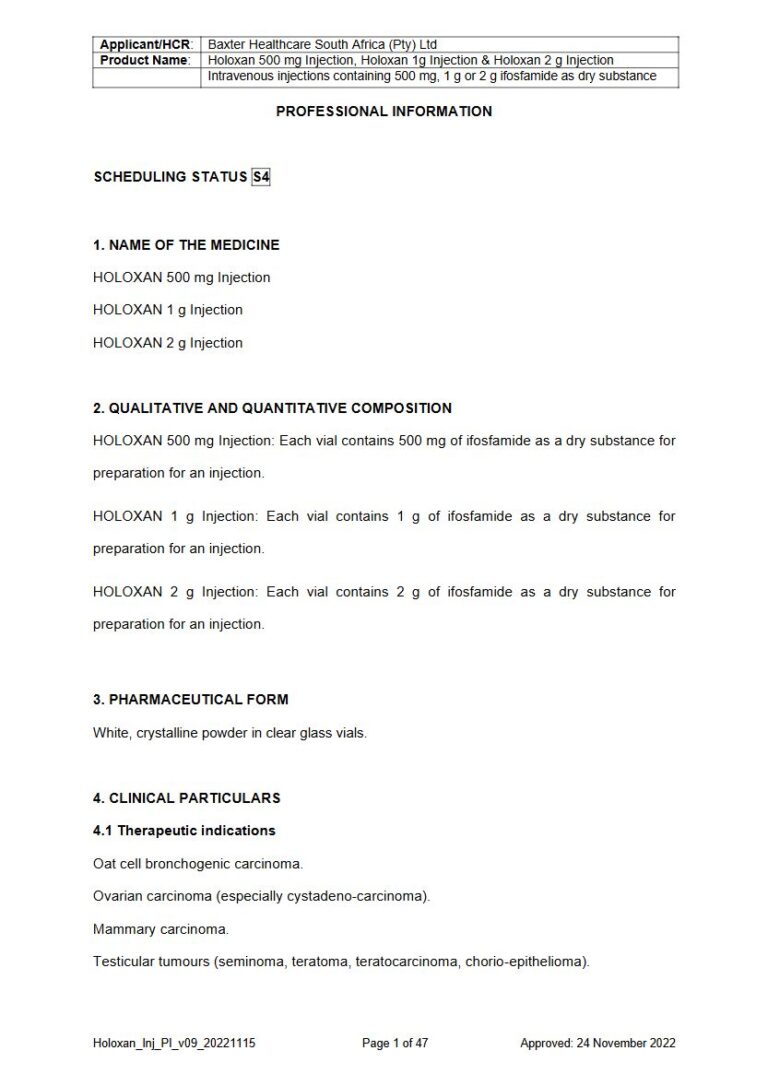
Oat cell bronchogenic carcinoma.
Ovarian carcinoma (especially cystadenocarcinoma).
Mammary carcinoma.
Testicular tumours (seminoma, teratoma, teratocarcinoma, chorioepithelioma).
Pancreatic carcinoma.
Hypernephroma.
Malignant lymphoma (non-Hodgkinu2019s type).
Chondro-, osteo-, leio- and rhabdomyosarcoma.
Children and adolescents (see section 5.1, Paediatric population).
HOLOXAN is evidently ineffective in: Fibro-, myxo- and spindle-cell sarcoma, carcinoma of the bladder, malignant melanoma and cerebral metastasis.
4.2 Posology and method of administration
Posology
HOLOXAN should be administered only by medical practitioners who are experienced in cancer chemotherapy. Dosage must be individualised. Doses and duration of treatment and/or treatment intervals depend on the therapeutic indication, the scheme of a combination therapy, the patientu2019s general state of health and organ function, and the results of laboratory monitoring. Where indicated, use of haematopoiesis-stimulating agents (colony-stimulating factors and erythropoiesis-stimulating agents) may be considered to reduce the risk of myelosuppressive complications and/or help facilitate the delivery of the intended dosing.
For information on a potential interaction with G-CSF and GM-CSF (granulocyte colony-stimulating factor, granulocyte macrophage colony-stimulating factor) (see section 4.6).
Before therapy, possible obstructions within the urinary tract should be excluded, any infections cleared up and disturbances of electrolyte balance corrected. The optimal dosage is a total dose of 250 to 300 mg per kg per treatment: The normal dose administered on five consecutive days is 50 to 60 mg per kg i.v. Should a lower daily dosage or distribution of the total dose over a longer period be indicated, 20 to 30 mg per kg is injected i.v. for ten consecutive days. In therapy-resistant cases, which do not respond to the lower dose (and only after the leucocyte count has recovered to 4,000), an injection of 80 mg per kg for two to three consecutive days should be administered. During or immediately after administration, adequate amounts of fluid should be ingested or infused to force diuresis in order to reduce the risk of urothelial toxicity (see section 4.4, Urothelial effects).
Duration of treatment
Treatment may be repeated after an interval of not less than three to four weeks. Duration of treatment and/or of the intervals depend on the therapeutic indication, the scheme of the combination therapy, the patientu2019s general state of health, the laboratory parameters as well as on the recovery of the blood picture.
Note
The dosage recommendation mentioned above shall mainly apply in case of monotherapy with HOLOXAN. When used together with other cytostatic agents as combination chemotherapy, the dosage instructions of the appropriate therapy scheme must be observed. When used in combination with other chemotherapeutic substances of similar toxicity, dose reduction and/or extension of the treatment-free intervals might become necessary. Because of its urotoxicity, HOLOXAN should always be combined with Mesna. Other toxicities and the therapeutic effects of HOLOXAN are not affected by Mesna.
Special dosage recommendations
Patients with renal impairment
In patients with renal impairment, particularly in those with severe renal impairment, decreased renal excretion may result in increased plasma levels of ifosfamide and its metabolites. This may result in increased toxicity (e.g., neurotoxicity, nephrotoxicity, haematotoxicity) and should be considered when determining the dosage in such patients. The dose may need to be adjusted in patients with renal impairment (see sections 4.3 and 4.4). Ifosfamide and its metabolites are dialyzable. In patients requiring dialysis, use of a consistent interval between HOLOXAN administration and dialysis should be considered.
Patients with hepatic impairment
Hepatic impairment, particularly if severe, may be associated with decreased activation of ifosfamide. This may alter the effectiveness of ifosfamide treatment. Low serum albumin and hepatic impairment are also considered risk factors for the development of CNS toxicity. Hepatic impairment may increase the formation of a metabolite that is believed to cause or contribute to CNS toxicity and also contribute to nephrotoxicity. This should be considered when selecting the dose and interpreting response to the dose selected.
The dose may need to be adjusted in patients with hepatic impairment (see section 4.4).
Elderly patients
In elderly patients, monitoring for toxicities and the need for dose adjustment should reflect the higher frequency of decreased hepatic, renal, cardiac, or other organ function, and concomitant diseases or other medicine therapy in this population. See section 4.4.
Children and adolescents (see section 5.1, Paediatric population)
A variety of dosage schedules and regimens of ifosfamide in combination with other antitumour agents, are used. The prescriber should refer to chemotherapy regimens for specific tumour type in choosing a specific dosage, mode of administration and schedules. Usually the doses of ifosfamide in paediatric tumours range from 0.8 to 3 g/mu00b2/day for 2 u2013 5 days for a total dose of 4 u2013 12 g/mu00b2 for chemotherapy course. Fractionated administration of ifosfamide is performed as intravenous infusion over a period ranging between 30 minutes and 2 hours, depending on the infusion volume or recommendations of protocol: Uroprotection with Mesna is mandatory during ifosfamide administration with a dose equivalent to 80 - 120 % of ifosfamide. It is recommended to prolong Mesna infusion to 12 u2013 48 hours after the end of ifosfamide infusion. 20 % of the whole Mesna dose should be given as i.v. start bolus. Hyperhydration with at least 3000 ml/mu00b2 is required during ifosfamide infusion and for 24 u2013 48 hours after the end of ifosfamide administration. Under treatment with ifosfamide, especially in case of long-term treatment, sufficient diuresis and regular control of renal function will be required. Children 5 years of age or younger may be more susceptible to ifosfamide-induced renal toxicity than older children or adults. Severe nephrotoxicity leading to Fanconiu2019s syndrome has been reported. Progressive tubular damage resulting in potentially debilitating hypophosphataemia and rickets has been reported rarely but should be taken into consideration. Paediatric data from randomised controlled clinical studies are limited.
Recommendations concerning dose adjustment for patients with myelosuppression
Leucocyte count/u03bcl Thrombocyte count/u03bcl Dosage
- > 4000 > 100000 100 % of the planned dose
- 4000 to 2500 100000 to 50000 50 % of the planned dose
- < 2500 < 50000 Postponement until normalisation or individual decision
Preparation of the injectable solution
Attention must be paid to ensure that the ready-to-use HOLOXAN solution does not exceed a concentration of 4 %. The injectable solution is prepared by dissolving: 500 mg HOLOXAN in 13 ml Water for Injections, 1000 mg HOLOXAN in 25 ml Water for Injections, 2000 mg HOLOXAN in 50 ml Water for Injections. Water for Injections = double-distilled water. The substance is easily soluble, provided the bottles are thoroughly shaken for a u00bd to 1 minute after adding the solvent. If dissolution does not occur without any residue, it is advisable to allow the solution to stand for a couple of minutes. Before parenteral administration, the substance must be completely dissolved. Parenteral medicinal products should be inspected visually for particulate matter and discoloration prior to administration. In patients with sensitive veins or in cases where the vessels are already damaged, HOLOXAN can also be used by perfusion. The solution of HOLOXAN injection can be kept for up to 24 hours in the refrigerator at 5 u00baC. For intravenous infusion (approx. 30 - 120 minutes) the prepared HOLOXAN solution is diluted in 250 ml of Ringeru2019s solution or 5 % strength glucose solution or 0.9 % strength physiological saline solution. For longer administration over one to two hours it is recommended to dilute the solution with 500 ml of Ringer's solution or 5 % strength glucose solution or 0.9 % strength physiological saline solution. For continuous 24-hour infusion with high doses of HOLOXAN, the prepared HOLOXAN solution, e.g. 5 g/mu00b2 is diluted in 3 litres of 5 % strength glucose solution and/or 0.9 % strength physiological saline solution.
4.3 Contraindications
HOLOXAN is contraindicated in patients with:
- Known hypersensitivity to ifosfamide (see section 4.4).
- Severely depressed bone marrow function (especially in patients previously treated with cytotoxic agents or radiotherapy).
- Active infections.
- Severe renal impairment (see sections 4.2 and 4.4) and/or obstructions of the urine flow.
- Inflammation of the urinary bladder (cystitis).
- Pregnancy and lactation (see section 4.6).
Further conditions for exclusion of HOLOXAN-therapy are:
- Advanced cerebral sclerosis.
- Platelet values below 50 000 per mmu00b3.
- Lack of willing cooperation of patient.
4.4 Special warnings and precautions for use
The handling and preparation of HOLOXAN should always be in accordance with current guidelines on safe handling of cytotoxic agents. Skin reactions associated with accidental exposure to HOLOXAN may occur. In view of the possible absorption of ifosfamide through the skin and by inhalation, it is recommended to wear face masks and impervious gloves for protection when handling the HOLOXAN injection. Avoid skin and mucosal contact. If HOLOXAN solution contacts the skin or mucosa, immediately wash the skin thoroughly with soap and water or rinse the mucosa with copious amounts of water.
Warnings
Myelosuppression, Immunosuppression, Infections
Treatment with HOLOXAN may cause myelosuppression and significant suppression of immune responses, which can lead to severe infections including pneumonias, as well as other bacterial, fungal, viral, parasitic infections, sepsis, and septic shock. Fatal outcome of HOLOXAN-associated myelosuppression has been reported. HOLOXAN-induced myelosuppression can cause leukopenia, neutropenia, thrombocytopenia (associated with a higher risk of bleeding events), and anaemia.
Administration of HOLOXAN is normally followed by a reduction in the leukocyte count. The nadir of the leukocyte count tends to be reached approximately during the second week after administration. Subsequently, the leukocyte count rises again. Severe myelosuppression and immunosuppression must be expected particularly in patients pre-treated with and/or receiving concomitant chemotherapy/haematotoxic agents, immunosuppressants and/or radiation therapy (see section 4.5). The risk of myelosuppression is dose-dependent and is increased with administration of a single high dose compared to fractionated administration. The risk of myelosuppression is increased in patients with reduced renal function. Latent infections can be reactivated. In patients treated with HOLOXAN, reactivation has been reported for various viral infections. Antimicrobial prophylaxis may be indicated in certain cases of neutropenia at the discretion of the managing physician. In case of neutropenic fever and/or leucopenia, antibiotics and/or fungal agents must be given empirically until infection has been cleared/improved. Close haematologic monitoring is recommended. White blood cell (WBC) count, platelet (Pt) count and haemoglobin (Hb) levels should be obtained prior to each administration and at appropriate intervals after administration. Unless essential, HOLOXAN should not be given to patients with a WBC count below 2500 u03bcl.
Patients with weak immune defence (e.g. in case of diabetes mellitus or chronic liver or kidney disorders) need to be closely monitored.
Central Nervous System Toxicity, Neurotoxicity
Administration of HOLOXAN can cause Central Nervous System (CNS) toxicity and other neurotoxic effects. Manifestations of CNS toxicity reported with HOLOXAN treatment include:
- Confusion
- Somnolence
- Coma
- Hallucinations
- Blurred vision
- Psychotic behaviour
- Extrapyramidal symptoms
- Urinary incontinence
- Seizures
There also have been reports of peripheral neuropathy associated with HOLOXAN use. HOLOXAN neurotoxicity may manifest within a few hours to a few days after first administration and in most cases resolves within 48 to 72 hours of HOLOXAN discontinuation. Symptoms may persist for longer periods of time. Occasionally, recovery has been incomplete. Fatal outcome of CNS toxicity has been reported. Recurrence of CNS toxicity after several uneventful treatment courses has been reported.
CNS toxicity has been reported very commonly and appears to be dose-dependent (see section 4.8). Other risk factors that have been demonstrated or discussed in the literature include:
- Renal dysfunction, elevated serum creatinine (> 132.6 u03bcmol/l)
- Low serum albumin
- Hepatic dysfunction
- Low bilirubin, low haemoglobin levels, decreased white blood cell count
- Acidosis, low serum bicarbonate
- Electrolyte imbalances, hyponatremia and inappropriate ADH (vasopressin) secretion, water intoxication, low fluid intake
- Presence of brain metastases, prior CNS disease, brain irradiation
- Cerebral sclerosis, peripheral vasculopathy
- Presence of tumour in lower abdomen, bulky abdominal disease
- Poor performance status, advanced age, younger age
- Obesity, female gender, individual predisposition
- Interactions with other medicines (e.g., aprepitant, CYP 3A4 inhibitors), alcohol, drug abuse, or pre-treatment with cisplatin (see section 4.5)
Neurotoxicity often manifests in patients without identifiable risk factors. The risk of CNS toxicity and other neurotoxic effects of HOLOXAN necessitates careful monitoring of the patient. If encephalopathy develops, treatment with HOLOXAN should be discontinued. The possibility to reintroduce HOLOXAN should be determined after careful assessment of the benefits and risks for the individual patient.
The effectiveness of methylene blue for the treatment and prophylaxis of ifosfamide encephalopathy appears to be not well established and possibly inconsistent. Due to the potential for additive effects, medicines acting on the CNS (such as anti-emetics, sedatives, narcotics or antihistamines) must be used with particular caution or, if necessary, be discontinued in the case of HOLOXAN-induced encephalopathy.
Renal and Urothelial Toxicity
HOLOXAN is both nephrotoxic and urotoxic. Glomerular and tubular kidney function must be evaluated and checked before commencement of therapy, as well as during and after treatment. Urinary sediment should be checked regularly for the presence of erythrocytes and other signs of uro/nephrotoxicity. Close clinical monitoring of serum and urine chemistries, including phosphorus, potassium, and other laboratory parameters appropriate for identifying nephrotoxicity and urothelial toxicity is recommended. Appropriate replacement therapy should be administered as indicated.
Nephrotoxic Effects
Renal parenchymal and tubular necrosis, and fatal outcome from nephrotoxicity have been reported in patients treated with HOLOXAN. Disorders of renal function (glomerular and tubular) following HOLOXAN administration are very common. Manifestations include a decrease in glomerular filtration rate and an increase in serum creatinine, proteinuria, enzymuria, cylindruria, aminoaciduria, phosphaturia, and glycosuria as well as renal tubular acidosis. Fanconi syndrome, renal rickets, and growth retardation in children as well as osteomalacia in adults have also been reported. Distal tubular dysfunction impairs the ability of the kidney to concentrate urine. Development of a syndrome resembling SIADH (syndrome of inappropriate antidiuretic hormone secretion) has been reported with HOLOXAN. Tubular damage may become apparent during therapy, months or even years after cessation of treatment. Glomerular or tubular dysfunction may resolve with time, remain stable, or progress over a period of months or years, even after completion of HOLOXAN treatment. Acute tubular necrosis, acute renal failure and chronic renal failure secondary to HOLOXAN therapy have been reported. The risk of developing clinical manifestations of nephrotoxicity is increased with, for example:
- large cumulative doses of HOLOXAN.
- pre-existing renal impairment.
- prior or concurrent treatment with potentially nephrotoxic medicines (such as cisplatin) (see section 4.5).
- younger age in children (in particular for children up to approximately 5 years of age).
- reduced nephron reserve as in patients with renal tumours and those having undergone renal radiation or unilateral nephrectomy.
The risks and expected benefits of HOLOXAN therapy should be carefully weighed when considering the use of HOLOXAN in patients with pre-existing renal impairment or reduced nephron reserve.
Urothelial Effects
HOLOXAN administration is associated with urotoxic effects, which can be reduced by prophylactic use of Mesna. Haemorrhagic cystitis requiring blood transfusion has been reported with HOLOXAN. The risk of haemorrhagic cystitis is dose-dependent and increased with administration of single high doses compared to fractionated administration. Haemorrhagic cystitis after a single dose of HOLOXAN has been reported. Before starting treatment, it is necessary to exclude or correct any urinary tract obstructions (see sections 4.3, 4.4 and 4.5). During or immediately after administration, adequate hydration with up to 3 litres of liquid/day should be ingested or infused to force diuresis in order to reduce the risk of urinary tract toxicity. For prophylaxis of haemorrhagic cystitis, HOLOXAN should be used in combination with Mesna.
HOLOXAN should be used with caution, if at all, in patients with active urinary tract infections. Past or concomitant radiation of the bladder or busulfan treatment may increase the risk for haemorrhagic cystitis. A cystitis, which does not heal, may lead to bladder fibrosis or even bladder tumours. It is therefore necessary to initiate timely treatment for prophylaxis of cystitis or to treat intensively an existing cystitis. Should any bladder defects occur, treatment with HOLOXAN should be discontinued, until these have subsided. In addition, it is advisable to prescribe a saluretic. Alkalisation of the urine e.g. with citrate complexes, should commence two days prior to the first HOLOXAN injection, and be continued until at least 24 hours after the last injection of HOLOXAN. In high-risk patients (for example, those with previous bladder diseases, those who have undergone preliminary abdominal irradiation or those with bladder complaints) a preparation of the SH-containing medicines should be instilled into the bladder by an in-dwelling catheter every four hours. This treatment must be continued for 24 hours after the last injection of HOLOXAN. Under treatment with HOLOXAN, special attention should be paid to sufficient hydration (up to 3 litres of liquid per day), regular emptying and draining of the bladder and the use of Mesna (see section 4.2). Especially in case of long-term treatment with HOLOXAN, sufficient diuresis and regular control of renal function will be required. In particular, this shall apply to children. In case of onset of nephropathy, irreversible kidney damage must be expected if treatment with HOLOXAN is continued. Careful appraisal of the risk-benefit ratio will be required.
4.5 Interactions with other medicines
Planned co-administration or sequential administration of other substances or treatments that could increase the likelihood or severity of toxic effects (by means of pharmacodynamic or pharmacokinetic interactions) requires careful individual assessment of the expected benefit and the risks. Patients receiving such combinations must be monitored closely for signs of toxicity to permit timely intervention. Potentiation of the myelotoxicity due to interaction with other cytostatics or irradiation must be borne in mind. HOLOXAN can intensify the dermal radiation reaction. Patients being treated with HOLOXAN and agents that reduce its activation should be monitored for a potential reduction of therapeutic effectiveness and the need for dose adjustment. Increased haematotoxicity and/or immunosuppression may result from a combined effect of HOLOXAN and, for example:
- ACE inhibitors: ACE inhibitors can cause leukopenia.
- Carboplatin
- Cisplatin
- Natalizumab
Increased cardiotoxicity may result from a combined effect of HOLOXAN and, for example:
- Anthracyclines
- Irradiation of the cardiac region
Increased pulmonary toxicity may result from a combined effect of HOLOXAN and, for example:
- Amiodarone
- G-CSF, GM-CSF (granulocyte colony-stimulating factor, granulocyte macrophage colony-stimulating factor)
Increased nephrotoxicity may result from a combined effect of HOLOXAN and, for example:
- Cisplatin
- Aminoglycosides
- Acyclovir
- Amphotericin B
- Carboplatin
These medicines can potentiate the nephrotoxicity of HOLOXAN and consequently haematotoxicity and CNS-toxicity. An increased risk of developing haemorrhagic cystitis may result from a combined effect of HOLOXAN and, for example:
- Busulfan
- Irradiation of the bladder
Additive CNS effects may result from a combined effect of HOLOXAN and, for example:
- Anti-emetics
- Sedatives
- Narcotics
- Antihistamines
These medicines are to be used with particular caution in the case of HOLOXAN-induced encephalopathy, or, if possible discontinued.
Inducers of human hepatic and extrahepatic microsomal enzymes (e.g., cytochrome P450 enzymes): The potential for increased formation of metabolites responsible for cytotoxicity and other toxicities (depending on the enzymes induced) must be considered in case of prior or concomitant treatment with, for example:
- Phenobarbital
- Phenytoin
- Benzodiazepines
- Primidone
- Carbamazepine
- Rifampicin
- Chloralhydrate
- Corticosteroids
- St. Johnu2019s Wort
See also aprepitant below. Findings from in vitro experiments indicate that bupropion is mainly metabolised via the microsomal enzyme cytochrome P450 IIB6 (CYP2B6). Therefore, caution must be exercised in case of concomitant administration of bupropion, as well as preparations that act on the isoenzyme CYP2B6 (such as orphenadrine, cyclophosphamide and ifosfamide).
Inhibitors of CYP 3A4: Reduced activation and metabolism of HOLOXAN may alter the effectiveness of HOLOXAN treatment. Inhibition of CYP 3A4 can also lead to increased formation of a HOLOXAN metabolite associated with CNS and nephrotoxicity. CYP 3A4 inhibitors include:
- Ketoconazole
- Fluconazole
- Itraconazole
See also aprepitant below. Aprepitant: Reports suggest increased HOLOXAN neurotoxicity in patients receiving antiemetic prophylaxis with aprepitant, which is both an inducer and a moderate inhibitor of CYP 3A4. Docetaxel: Increased gastrointestinal toxicity has been reported when HOLOXAN was administered before docetaxel infusion. Coumarin derivatives: Increased INR (international normalized ratio) has been reported in patients receiving HOLOXAN and warfarin, which can lead to a stronger reduction of blood coagulation and an increased risk of haemorrhage. Vaccines: The immunosuppressive effects of HOLOXAN can be expected to reduce the response to vaccination. Use of live vaccines may lead to vaccine-induced infection. Tamoxifen: Concomitant use of tamoxifen and chemotherapy may increase the risk of thromboembolic complications. Cisplatin: Cisplatin-induced hearing loss can be exacerbated by concurrent HOLOXAN therapy (see also interactions above). Irinotecan: Formation of the active metabolite of irinotecan may be reduced when irinotecan is administered with HOLOXAN. Alcohol: In some patients, alcohol may increase HOLOXAN-induced nausea and vomiting. The following medicine interactions have been reported with cyclophosphamide. HOLOXAN may have similar interactions:
- Potentiation of myelosuppression on concomitant administration of allopurinol or hydrochlorothiazide.
- Intensified effect and toxicity of HOLOXAN on concomitant administration of chlorpromazine, triiodothyronine or aldehyde dehydrogenase inhibitors such as disulfiram.
- Potentiation of the blood glucose-lowering effect of sulphonylureas.
- Potentiation of the muscle-relaxant effect of suxamethonium.
Due to the possibility of a decreased activation and thus reduced efficacy of HOLOXAN by a substance (CYP isoenzyme inhibitor) included in grapefruit, grapefruit or grapefruit juice should be avoided.
4.6 Fertility, pregnancy and lactation
Pregnancy
Women should not become pregnant during treatment with HOLOXAN (see section 4.3). The administration of HOLOXAN during organogenesis has been shown to have a fetotoxic effect in mice, rats and rabbits, and therefore may cause foetal damage when administered to pregnant women.
Foetal growth retardation and neonatal anaemia have been reported following exposure to ifosfamide-containing chemotherapy regimens during pregnancy. In addition, exposure to cyclophosphamide, another oxazaphosphorine cytotoxic agent, has been reported to cause miscarriage, malformations (following exposure during the first trimester), and neonatal effects, including leukopenia, pancytopenia, severe bone marrow hypoplasia, and gastroenteritis. Animal data generated with cyclophosphamide, another oxazaphosphorine cytotoxic agent suggest that an increased risk of failed pregnancy and malformations may persist after discontinuation of the agent as long as oocytes/follicles exist that were exposed to the agent during any of their maturation phases (see Genotoxicity). In a vital indication during the first trimester of pregnancy a medical consultation regarding abortion is absolutely necessary. After the first trimester of pregnancy, if therapy cannot be delayed and the patient wishes to continue with her pregnancy, chemotherapy may be undertaken after informing the patient of the minor but possible risk of teratogenic effects and the potential hazard for the fetus. If HOLOXAN is used during pregnancy, or if the patient becomes pregnant while taking HOLOXAN or after treatment (see Genotoxicity) the patient should be apprised of the potential hazard to a fetus and should seek genetic consultation. If treatment should be required in women with childbearing potential a reliable contraceptive method must be used during the therapy as well as for up to six months after the end of treatment.
Lactation
HOLOXAN may pass into the breastmilk. HOLOXAN toxicity may occur in a breastfed child. These toxicities include neutropenia, thrombocytopenia, low haemoglobin, and diarrhoea. Women must not breastfeed during treatment with HOLOXAN.
Fertility
HOLOXAN interferes with oogenesis and spermatogenesis. Amenorrhea, azoospermia and sterility in both sexes have been reported. Development of sterility appears to depend on the dose of HOLOXAN, duration of therapy, and state of gonadal function at the time of treatment. Sterility may be irreversible in some patients. HOLOXAN may cause transient or permanent amenorrhea in women and oligospermia or azoospermia in men.
Female Patients
Women treated with HOLOXAN should be informed prior to treatment about the possibility to save and preserve their eggs. The risk of permanent chemotherapy-induced amenorrhea is increased in older women. Girls treated with HOLOXAN during prepubescence may develop secondary sexual characteristics normally and have regular menses. Girls treated with HOLOXAN during prepubescence subsequently have conceived. Girls who have retained ovarian function after completing treatment are at increased risk of developing premature menopause.
Male Patients
Men to be treated with HOLOXAN should be informed about sperm preservation before treatment starts. Sexual function and libido generally are unimpaired in these patients. Boys treated with HOLOXAN during prepubescence may develop secondary sexual characteristics normally, but may have oligospermia or azoospermia. Some degree of testicular atrophy may occur. Azoospermia may be reversible in some patients, though the reversibility may not occur for several years after cessation of therapy. Men treated with HOLOXAN have subsequently fathered children.
Genotoxicity
HOLOXAN is mutagenic and genotoxic in male and female germ cells. Therefore, women should not become pregnant and men should not father a child during therapy with HOLOXAN. Women treated with HOLOXAN should take contraceptive measures for at least 1 year after discontinuation of ifosfamide therapy. Men should not father a child for up to six months after end of therapy.
Animal data generated with cyclophosphamide, another oxazaphosphorine cytotoxic agent indicate that exposure of oocytes during follicular development may result in a decreased rate of implantations and viable pregnancies and in an increased risk of malformations. This effect should be considered in case of intended fertilization or pregnancy after discontinuation of ifosfamide therapy. The exact duration of follicular development in humans is not known, but may be longer than 12 months. Sexually active women and men should use effective methods of contraception during these periods of time.
4.7 Effects on ability to drive and use machines
HOLOXAN can lead to impairment of the ability to drive a vehicle or to operate machinery, directly by inducing encephalopathy and indirectly by inducing nausea and vomiting u2013 particularly in the case of concomitant administration of medicines acting on the CNS or alcohol.
4.8 Undesirable effects
Depending on individual sensitivity, the type of disease and the dosage, side effects of differing degrees may be encountered, for which adequate preliminary and secondary treatment is required. In patients receiving HOLOXAN as a single agent, the dose-limiting toxicities are myelosuppression and urotoxicity. A uroprotector such as Mesna, vigorous hydration and dose fractionation can significantly reduce the incidence of haematuria, especially gross haematuria, associated with haemorrhagic cystitis. Leucopenia, when it occurs, is usually mild to moderate. Other significant side effects include alopecia, nausea, vomiting, and central nervous system toxicities.
Patients on HOLOXAN therapy may experience the following dose-dependent side effects:
(Please refer to the discussion section on these side effects following the tabular listing).
Primary SOC Very common (u2265 1/10) Common (u2265 1/100 to < 1/10) Uncommon (u2265 1/1000 to < 1/100) Rare (u2265 1/10000 to < 1/1000) Very rare (< 1/10000), including isolated reports Unknown (unable to calculate)
Infections and infestations Infections Pneumonia Sepsis Neoplasms benign and malignant (incl. cysts and polyps) Secondary tumours Urinary tract carcinoma Myelodysplastic syndrome Acute leukaemia Blood and lymphatic system disorders Myelosuppression Leucopenia 1 (any) Leukopenia <1 x 10u00b3/u03bcl Thrombocytopenia 2 (any) Anaemia 3 Thrombocytopenia <50 x 10u00b3/u03bcl Haemolytic uraemic syndrome Disseminated intravascular coagulation Immune system disorders Hypersensitivity reactions Anaphylactic shock Endocrine disorders Irreversible ovulation SIADH (Syndrome of disturbances inadequate ADH secretion) Metabolism and nutrition disorders Metabolic acidosis Anorexia Hyponatraemia Dehydration Water retention Electrolyte imbalance Hypokalaemia Psychiatric disorders Hallucinations Depressive psychosis Disorientation Restlessness Confusion Nervous system disorders Drowsiness Central nervous system toxicity 4,5 Somnolence Forgetfulness Dizziness Peripheral neuropathy Cerebellar syndrome Coma Seizures Polyneuropathy Eye disorders Blurred vision Visual impairment Cardiac disorders Dysrhythmia Ventricular dysrhythmia Supraventricular dysrhythmia Cardiac failure Cardiotoxicity 6 Cardiac arrest Myocardial infarction Vascular disorders Bleeding Hypotension 7 Thromboembolism Respiratory disorders Pulmonary disorder Cough Dyspnoea Interstitial pneumonitis Interstitial pulmonary fibrosis Respiratory failure Toxic allergic pulmonary oedema Gastro-intestinal disorders Nausea Vomiting Diarrhoea Constipation Stomatitis Faecal incontinence Acute pancreatitis Hepato-biliary disorders Hepatotoxicity 8 Liver function disturbances Skin and sub-cutaneous tissue disorders Alopecia Papular rash Dermatitis Toxic skin reactions Musculo-skeletal and connective tissue disorders Cramps Rickets Osteomalacia Rhabdomyolysis Renal and urinary disorders Haematuria with Mesna Haematuria without Mesna Microhaematuria without Mesna Haemorrhagic cystitis 9 Renal Nephropathies Tubular dysfunction Macro-haematuria Microhaematuria with Mesna Incontinence Dysuria Disturbed urinary frequency Bladder irritation Glomerular dysfunctions Tubular acidosis Fanconi syndrome dysfunction Renal structural damage 11 Reproductive system and breast disorders Impairment of spermatogenesis Amenorrhoea Reduced levels of female sex hormones Azoospermia Persistent oligospermia Congenital, familial and genetic disorders Aminoaciduria General disorders and administrative site conditions. Asthenic conditions Weakness Phlebitis 12 Neutropenic Fever 13 Fatigue Mucositis Injection site reactions Death Malaise Investigations Elevation of the ST segment Increase in liver enzymes Increase in ALT Increase in AST Increase in gamma-GT Increase in ALP Increase in bilirubin Phosphaturia Surgical and medical procedures Intensified reaction on radiotherapy
4.9 Overdose
Serious consequences of overdosage include manifestations of dose-dependent toxicities such as CNS toxicity, nephrotoxicity, myelosuppression and mucositis (see section 4.4). Patients who received an overdose should be closely monitored for the development of toxicities. Since no specific antidote for ifosfamide is known, great caution is advised each time it is used. Overdosage should be managed with supportive measures, including appropriate, state-of-the-art treatment for any concurrent infection, myelosuppression, or other toxicity, should it occur. Ifosfamide as well as ifosfamide metabolites are dialysable. Therefore, rapid haemodialysis is indicated when treating any suicidal or accidental overdose or intoxication. In the case of overdose, myelosuppression, mostly leucocytopenia, is to be expected, among other reactions. The severity and duration of the myelosuppression depends on the extent of the overdose. Frequent checks of the blood count and monitoring of the patient are necessary. If neutropenia develops, infection prophylaxis must be given and infections must be treated adequately with antibiotics. If thrombocytopenia develops, thrombocyte replacement should be ensured according to need. Cystitis prophylaxis (uroprotector such as Mesna) is absolutely necessary in order to avoid severe haemorrhagic cystitis. Haemorrhagic cystitis may be treated by the instillation of substances containing the SH-group. The incidence of haemorrhagic cystitis has been reduced by bladder irrigation with acetyl cysteine. In uncontrollable haemorrhagic cystitis, it is recommended to instill 200 to 300 ml of a 5 % formalin solution into the bladder. The solution should be washed out after 15 minutes with 1 litre of distilled water.
