
Chirorab ≥ 2,5 IU/1,0 ml Suspension
PDF Leaflet Revision Date: 10 December 2021
Clinical Summary
Quick overview from the medicine insert
Indication
Active immunisation against rabies.
Dosage (summary)
1.0 ml IM for all ages; 0.1 ml ID for all ages.
Special Populations
- Paediatric patients
- Elderly patients
- Immunocompromised individuals
Pregnancy & Breastfeeding
Safe during pregnancy and breastfeeding when benefits outweigh risks.
Key Drug Interactions
- Immunosuppressive medicines
- Rabies immunoglobulin
Contraindications
- Hypersensitivity to vaccine components
- Acute diseases requiring treatment
Common side effects
- Injection site pain
- Headache
- Dizziness
- Nausea
- Rash
Counselling Points
- Monitor for allergic reactions
- Avoid mixing with other vaccines
- Follow local wound treatment guidelines
Serious warnings
- Anaphylactic reactions
- CNS effects like encephalitis
- Do not inject intravascularly
Important Disclaimer
The Chirorab ≥ 2,5 IU/1,0 ml Suspension professional information leaflet below is the property of Kahma Biotech and is provided on Medinsert exactly as issued, with no.. alterations or editorial changes. We make every effort to keep content current by updating documents as soon as new versions become available. Medinsert serves as a trusted access point for healthcare professionals, but does not replace official sources or clinical judgement. For more details, please read our full disclaimer. read more>>
 Healthcare Professionals Only
This content is for registered healthcare professionals
Sign in or create a free account to read the full package insert.
Free for HPCSA-registered professionals. Powered by Medinsert.
Clinical Particulars
Section 4 of the official insert — extracted exactly as issued, no alterations
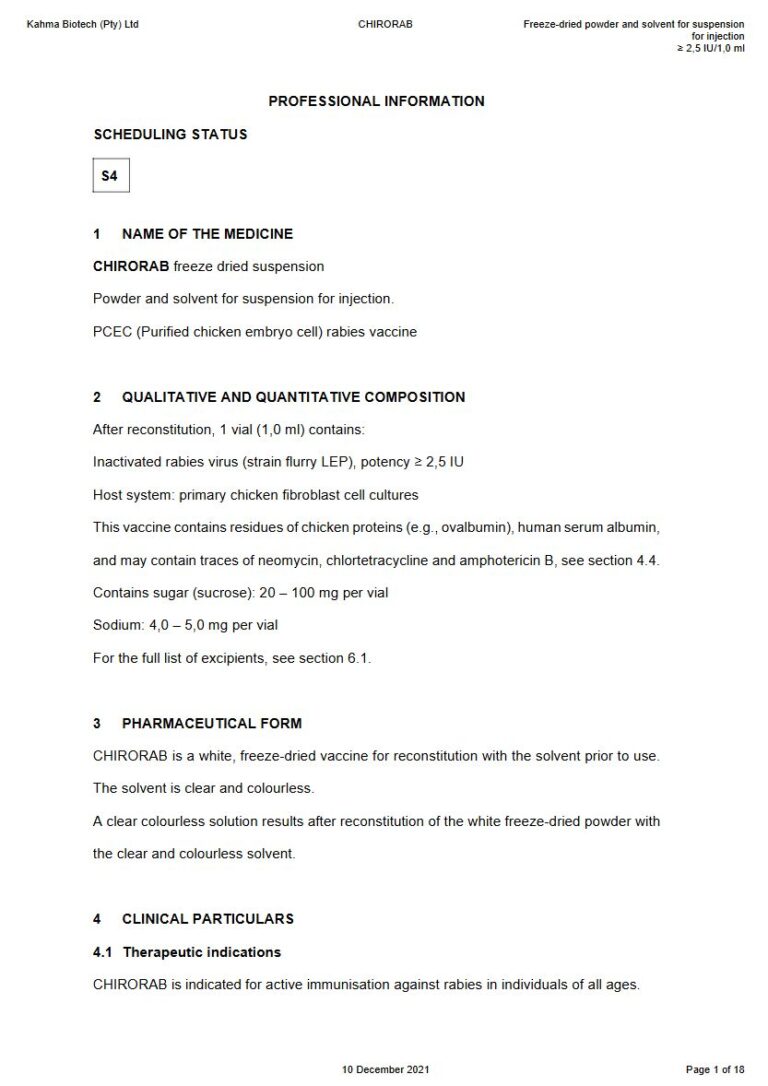
4.1 Therapeutic indications
CHIRORAB is indicated for active immunisation against rabies in individuals of all ages. This includes pre-exposure prophylaxis (i.e. before possible risk of exposure to rabies) in both primary series and booster dose and for post-exposure prophylaxis (i.e. after suspected or proven exposure to rabies). CHIRORAB is to be used on the basis of WHO official recommendations.
4.2 Posology and method of administration
Posology
The recommended single intramuscular (IM) dose is 1,0 ml in individuals of all ages. The recommended single intradermal (ID) dose is 0,1 ml in individuals of all ages.
Pre-exposure prophylaxis (PrEP)
Primary immunisation
Intramuscular (IM) administration
In previously unvaccinated individuals, an initial course of pre-exposure immunisation consists of three doses (each of 1,0 ml), administered intramuscularly on days 0, 7 and 21 (or 28). Pre-exposure prophylaxis is recommended for anyone who is at continual, frequent or increased risk for exposure to the rabies virus, as a result of their residence or occupation, such as laboratory workers dealing with rabies virus and other lyssaviruses, veterinarians and animal handlers. Travellers in high-risk areas should be vaccinated after a risk assessment. Children living in or visiting rabies-affected areas are at particular risk and should be given pre-exposure prophylaxis on an individual basis or in mass campaigns when there are no economic, programmatic or logistical obstacles (WHO 2013 recommendations).
Intradermal (ID) administration
In previously unvaccinated individuals, an initial course of pre-exposure prophylaxis consists of three doses (each of 0,1 ml) administered ID on days 0, 7 and 21 (or 28).
Booster doses
Intramuscular (IM) administration
The individual IM booster dose is 1,0 ml. CHIRORAB may be used for booster vaccination after prior immunisation with human diploid cell rabies vaccine (HDCV). The need of intermittent serological testing for the presence of antibody u2265 0,5 IU/ml and the administration of booster doses should be assessed in accordance with official recommendations. A booster would be recommended only if rabies virus neutralizing antibody (RVNA) concentration falls to less than 0,5 IU/ml (assessed by rapid fluorescent focus inhibition test [RFFIT] or fluorescent antibody virus neutralisation test [FAVNT]). According to WHO, periodic booster doses of rabies vaccine are not necessary for people living in or travelling to high-risk areas who have received a complete primary series of pre- or post-exposure prophylaxis with rabies vaccine. Periodic booster injections are recommended only for people whose occupation puts them at continual or frequent risk of exposure as an extra precaution in the absence of recognized exposure. If possible, antibody monitoring of personnel at risk is preferred to the administration of routine boosters. For people who are potentially at risk of laboratory exposure to high concentrations of live rabies virus, antibody testing should be done every 6 months. If the RVNA concentration falls below 0,5 IU/ml of serum, one booster dose of vaccine should be given intramuscularly or intradermally. Those professionals who are not at continual risk of exposure through their activities, such as certain categories of veterinarians and animal health officers, should have serological monitoring every 2 years (WHO 2013). Alternatively, booster doses may be given at official recommended intervals without prior serological testing according to the perceived risk. Experience shows that reinforcing doses are generally required every 2 - 5 years.
Intradermal ID administration
The individual ID booster dose is 0,1 ml.
Post-exposure prophylaxis (PEP)
Post-exposure prophylaxis consists of:
- local treatment of the wound as soon as possible after exposure
- a course of potent, effective rabies vaccine that meets WHO recommendations, and
- administration of rabies immunoglobulin, if indicated.
4.3 Contraindications
- Hypersensitivity to the active pharmaceutical ingredient (see section 2) or to any of the excipients (see section 6.1)
- Post-exposure prophylaxis (PEP) In view of the almost invariably fatal outcome of rabies, there is no contraindication to post-exposure prophylaxis, including pregnancy.
- Individuals with acute diseases requiring treatment should not be vaccinated until at least 2 weeks after recovery. Minor infections are not a contraindication to vaccination.
4.4 Special warnings and precautions for use
Reports of anaphylactic reactions including anaphylactic shock have occurred following CHIRORAB vaccination. As with all injectable vaccines, appropriate medical treatment and supervision should always be readily available in case of a rare anaphylactic event following the administration of the vaccine.
Hypersensitivity reactions (PEP only)
Patients considered to be at risk of a severe hypersensitivity reaction to the vaccine or any of the vaccine components should receive an alternative rabies vaccine if a suitable product is available. CHIRORAB contains residues of egg and chicken proteins, such as ovalbumin. In instances in which individuals have developed clinical symptoms of anaphylaxis such as generalised urticaria, upper airway (lip, tongue, throat, laryngeal or epiglottal) oedema, laryngeal or bronchospasm, hypotension and shock, following exposure to egg or chicken protein, the vaccination should only be administered by personnel with the capability and facilities to manage anaphylaxis post-vaccination.
Central nervous system effects
Encephalitis and Guillain-Barru00e9 Syndrome have been reported to be temporally associated with the use of CHIRORAB (see section 4.8). The use of corticosteroids to treat adverse reactions such as these may inhibit the development of immunity to rabies (see section 4.5). A patientu2019s risk of developing rabies must be carefully considered, before deciding to discontinue immunisation.
Route of administration
Unintentional intravascular injection may result in systemic reactions, including shock. Do not inject intravascularly. CHIRORAB must not be given by intra-gluteal injection or subcutaneously, as the induction of an adequate immune response may be less reliable. The vaccine must not be mixed in the same syringe with other medicines. If rabies immunoglobulin is indicated in addition to CHIRORAB vaccine, then it must be administered at an anatomical site distant to the vaccination (see section 4.5).
Anxiety-related reactions
Anxiety-related reactions, including vasovagal reactions (syncope), hyperventilation or stress-related reactions, may occur in association with vaccination as a psychogenic response to the needle injection (see section 4.8). It is important that procedures are in place to avoid injury from fainting.
Excipient with known effect:
CHIRORAB contains sucrose. Patients with rare hereditary conditions such as fructose intolerance, glucose-galactose mal-absorption or sucrose-isomaltase insufficiency should not take CHIRORAB. Sucrose may have an effect on the glycaemic control of patients with diabetes mellitus. CHIRORAB contains less than 1 mmol sodium (23 mg) per dosage unit, that is to say essentially u2018sodium-freeu2019.
4.5 Interaction with other medicines and other forms of interaction
Immunosuppressive medicines can interfere with the development of an adequate response to the rabies vaccine. Therefore, it is recommended that serological responses should be monitored in such subjects, and additional doses administered as necessary (see section 4.2). All of the rabies immunoglobulin, or as much as anatomically possible (but avoiding possible compartment syndrome), should be administered into or around the wound site or sites. The remaining immunoglobulin, if any, should be injected intramuscularly at a site distant from the site of vaccine administration to avoid possible interference with simultaneously administered rabies vaccine. Concomitant vaccines should always be administrated at separate injection sites and preferably contralateral limbs. The ID route must not be used in the following instances:
- individuals receiving long term corticosteroid or other immunosuppressive therapy or chloroquine
- immunocompromised individuals.
4.6 Fertility, pregnancy and lactation
Pregnancy
No cases of harm attributable to use of CHIRORAB during pregnancy have been observed. CHIRORAB may be administered to pregnant women when post-exposure prophylaxis is required. The vaccine may also be used for pre-exposure prophylaxis during pregnancy if it is considered that the potential benefit outweighs any possible risk to the foetus.
Breastfeeding
While it is not known whether CHIRORAB enters breast milk, no risk to the breastfeeding infant has been identified. CHIRORAB may be administered to breastfeeding women when post-exposure prophylaxis is required. The vaccine may also be used for pre-exposure prophylaxis in breastfeeding women if it is considered that the potential benefit outweighs any possible risk to the infant.
Fertility
Non-clinical reproductive and developmental toxicity studies have not been performed.
4.7 Effects on ability to drive and use machines
No studies have been carried out with CHIRORAB to assess the effect on the ability to drive or use machines (see section 4.8). Some of the adverse effects, e.g. headache and dizziness, described in section 4.8, may affect the ability to drive and use machines.
4.8 Undesirable effects
a. Summary of the safety profile
In clinical trials, the most commonly reported solicited adverse reactions were injection site pain (30 u2013 85 %) or injection site induration (15 u2013 35 %). Most injection site reactions were not severe and resolved within 24 to 48 hours.
b. Tabulated summary of adverse reactions
Adverse reactions from clinical trials are listed according to System Organ Classes in MedDRA. Within each System Organ Class, the adverse reactions are ranked by frequency, with the most frequent reactions first. Within each frequency grouping, adverse reactions are presented in order of decreasing seriousness. In addition, the corresponding frequency category using the following convention (CIOMS III) is also provided for each adverse reaction: very common (u2265 1/10); common (u2265 1/100, < 1/10); uncommon (u2265 1/1 000, < 1/100); rare (u2265 1/10 000, < 1/1 000) very rare (< 1/10 000).
System organ class Frequency Adverse reactions
Blood and lymphatic system disorders Common Lymphadenopathy
Immune system disorders Rare Hypersensitivity
Frequency unknown* Anaphylaxis including anaphylactic shock
Metabolism and nutrition disorders Common Decreased appetite
Nervous system disorders Very common Headache, dizziness
Rare Paraesthesia
Frequency unknown* Encephalitis, Guillain-Barru00e9 syndrome, presyncope, syncope, vertigo
Gastrointestinal disorders Common Nausea, vomiting, diarrhoea, abdominal pain/discomfort
Skin and subcutaneous tissue disorders Very common Rash
Common Urticaria
Rare Hyperhidrosis (sweating)
Frequency unknown* Angioedema
Musculoskeletal and connective tissue disorders Common Myalgia, arthralgia
General disorders and administration site conditions Very common Injection site reactions, malaise, fatigue, asthenia, fever
Rare Chills
* Additional adverse reactions from spontaneous reporting
c. Description of selected adverse reactions
Once initiated, rabies post-exposure prophylaxis should not be interrupted or discontinued because of local or mild systemic adverse reactions to rabies vaccine.
Reporting of suspected adverse reactions
Reporting suspected adverse reactions after authorisation of the medicine is important. It allows continued monitoring of the benefit/risk balance of the medicine. Health care providers are asked to report any suspected adverse reactions to SAHPRA via the u201c6.04 Adverse Drug Reactions Reporting Formu201d, found online under SAHPRAu2019s publications: https://www.sahpra.org.za/Publications/Index/8
4.9 Overdose
No symptoms of overdose are known.
