
Lipiodol Ultra Fluid 480 mg I/ml Solution for injection
PDF Leaflet Revision Date: 13 January 2023
Clinical Summary
Quick overview from the medicine insert
Indication
Used as a contrast agent in diagnostic and interventional radiology.
Dosage (summary)
Administered by slow injection; usual adult dose for lymphography is 8-15 ml.
Special Populations
- Elderly
- Children
- Patients with renal impairment
Pregnancy & Breastfeeding
Contraindicated in pregnancy; breastfeeding should be discontinued after use.
Key Drug Interactions
- Metformin
- Beta-blockers
- Diuretics
- Interleukin 2
Contraindications
- Hypersensitivity to iodine
- Pregnancy
- Recent bleeding
- Hyperthyroidism
Common side effects
- Hypersensitivity reactions
- Fever
- Nausea
- Vomiting
Counselling Points
- Monitor for delayed allergic reactions
- Hydrate before and after administration
- Avoid use in patients with thyroid dysfunction
Serious warnings
- Risk of pulmonary embolism
- Monitor for anaphylactic reactions
- Adjust dose in elderly with cardiorespiratory issues
Important Disclaimer
The Lipiodol Ultra Fluid 480 mg I/ml Solution for injection professional information leaflet below is the property of Guerbet South Africa and is provided on Medinsert exactly as issued, with no.. alterations or editorial changes. We make every effort to keep content current by updating documents as soon as new versions become available. Medinsert serves as a trusted access point for healthcare professionals, but does not replace official sources or clinical judgement. For more details, please read our full disclaimer. read more>>
 Healthcare Professionals Only
This content is for registered healthcare professionals
Sign in or create a free account to read the full package insert.
Free for HPCSA-registered professionals. Powered by Medinsert.
Clinical Particulars
Section 4 of the official insert — extracted exactly as issued, no alterations
4.1 Therapeutic indications
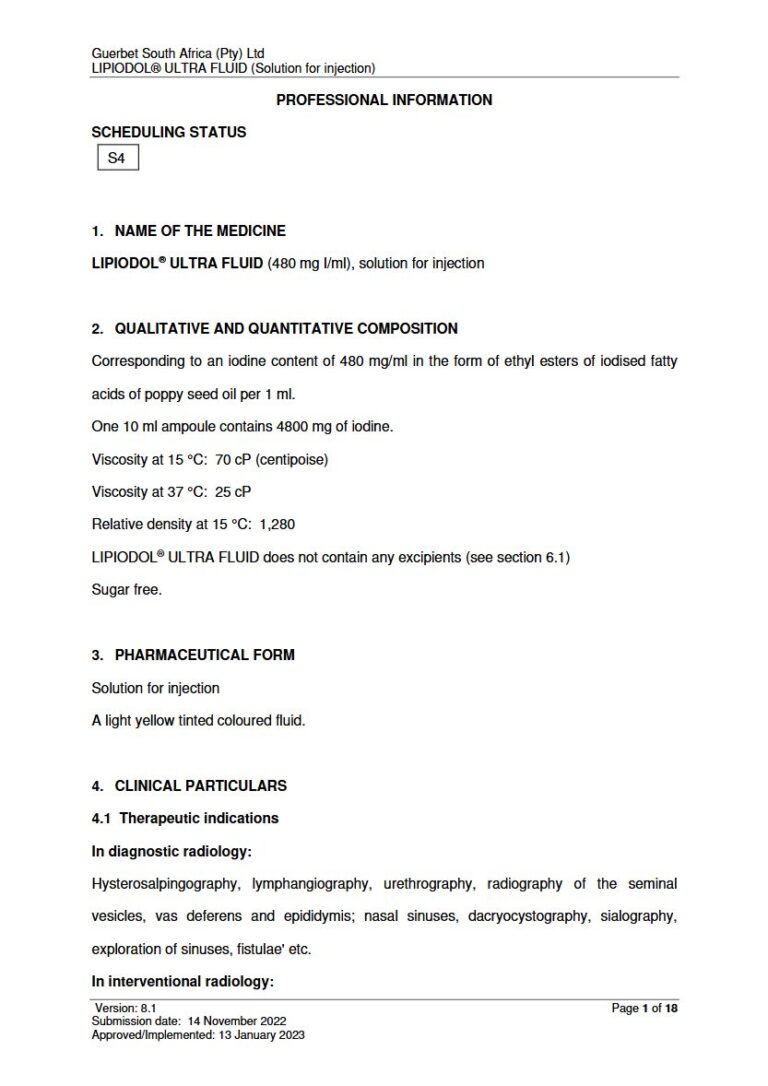
In diagnostic radiology: Hysterosalpingography, lymphangiography, urethrography, radiography of the seminal vesicles, vas deferens and epididymis; nasal sinuses, dacryocystography, sialography, exploration of sinuses, fistulae' etc.
In interventional radiology:
- Visualisation, localisation and vectorisation during Trans-Arterial Chemo-Embolisation (TACE) of hepatocellular carcinoma at intermediate stage, in adults.
- Embolisation with surgical glues. In association with surgical glues during vascular embolisations.
4.2 Posology and method of administration
LIPIODOL u00ae ULTRA FLUID must be administered by slow injection or by catheter, using an appropriate glass syringe and a catheter (see Section 6.2).
In diagnostic radiology:
Hysterosalpingography For visualisation of the uterus and fallopian tubes, LIPIODOL u00ae ULTRA FLUID may be used. Care is needed to avoid the risk of venous intravasation. The injection must therefore not be made for the first few days after a menstrual period and not in the few days before a menstrual period is due. When the injection is made by means of a cannula, direct trauma to the uterine mucosa must be avoided. Excessive pressure should not be used in making the injection which should be avoided entirely when the endometrium and the cervix have been subjected to surgical trauma. On account of the disadvantages and potential dangers (very rare instance of oil emboli and iodism) associated with the use of LIPIODOL u00ae ULTRA FLUID in hysterosolpingography, etc., many radiologists prefer to use water soluble contrast agents such as Diagino Viscous brand sodium acetrizoate 40 % m/v in dextran solution.
Lymphography LIPIODOL u00ae ULTRA FLUID may be used for the visualisation of the lymph nodes and lymph vessels. The vessels should first be rendered visible with a subcutaneous injection of patent blue V; the oily medium is then injected by means of an automatic infusion machine at the rate of 1 ml every 10 minutes. The usual dosage to visualise the lymphatic system of the leg in the adult patient is 8 ml, in the arm, 3 - 4 ml is usually adequate to show the axillary glands. For bilateral examinations a total of 15 ml, usually gives adequate filling of inguinal, iliac and para-aortic glands. In children dosage is reduced according to bodyweight using approximately 0,25 ml per kg. The procedure is usually carried out under local analgesia. Exposure is made at the end of the infusion, further films are taken 24 and 48 hours later. The lymph glands retain LIPIODOL u00ae ULTRA FLUID for several weeks or months and changes in their appearance may be followed by serial radiographs for example, after a course of chemo- or radiotherapy.
Other uses LIPIODOL u00ae ULTRA FLUID is employed in urethrography, radiography of the seminal vesicles, vas deferens and epididymis, nasal sinuses (for which purpose dilution to one-half or one-third strength with liquid paraffin or a suitable vegetable oil is generally advised); dacryocystography; sialography and the exploration of sinuses, fistulae, etc. It has also been used in the form of a 20 % emulsion for the X-ray examination of empyema cavities.
Paediatric population The dose must be reduced proportionally in children.
Patients with low weight The dose must be reduced proportionally in this population.
Elderly LIPIODOL u00ae ULTRA FLUID must be administered with special care in patients over 65 years of age with underlying diseases of the cardiovascular, respiratory or nervous systems. Keeping in mind that part of the product temporarily embolises the pulmonary capillaries, the dose must be adjusted in elderly patients with cardiorespiratory failure or the examination must be cancelled.
In interventional radiology: Trans-Arterial Chemo-Embolisation of hepatocellular carcinoma The administration is by selective intra-arterial catheterisation of the hepatic artery. The procedure should be performed within a typical interventional radiology setting with the appropriate equipment. The dose of LIPIODOL u00ae ULTRA FLUID depends on the extent of the lesion, but should usually not exceed a total dose of 15 ml in adults. LIPIODOL u00ae ULTRA FLUID can be mixed with anticancer medicines such as cisplatin, doxorubicin, epirubicin and mitomycin. Instructions and precautions for use of the anticancer medicines must be strictly followed.
Instructions for preparation of the mixture of LIPIODOL u00ae ULTRA FLUID with an anticancer medicine
- Prepare two syringes large enough to contain the total volume of mixture. The first syringe contains the anticancer medicine solution, the second syringe contains LIPIODOL u00ae ULTRA FLUID.
- Connect the two syringes to a 3-way stopcock.
- Perform 15 to 20 back and forth movements between the two syringes to obtain a homogeneous mixture. It is recommended to start by pushing the syringe with the anticancer medicine first.
- The mixture is to be prepared at the time of use and must be used promptly after preparation (within 3 hours). If necessary during the interventional radiology procedure, the mixture can be re-homogenised as described above.
- When the adequate mixture is obtained, use a 1 to 3 ml syringe to inject in the micro-catheter.
- The procedure can be repeated every 4 to 8 weeks according to tumour response and patient conditions.
Paediatric population The efficacy and safety of the use of LIPIODOL u00ae ULTRA FLUID for Trans-Arterial Chemo-Embolisation of hepatocellular carcinoma have not been established in children.
Elderly The product must be administered with special care in patients over 65 years of age with underlying diseases of the cardiovascular, respiratory or nervous systems.
Embolisation with surgical glues Exclusive selective arterial catheterisation. The dose of LIPIODOL u00ae ULTRA FLUID per embolisation session is determined depending on the size of the lesions. The proportion of LIPIODOL u00ae ULTRA FLUID versus the liquid embolising agent can vary from 20 to 80 % but is usually a 50/50 mixture. The injection volume must not exceed 15 ml.
4.3 Contraindications
- Hypersensitivity to LIPIODOL u00ae ULTRA FLUID (ethyl esters of iodised fatty acids of poppy seed oil) or iodine
- Traumatic lesions, haemorrhage or recent bleeding (risk of extravasation or embolism)
- Pregnant women
- Confirmed hyperthyroidism
- Bronchography (the product rapidly inundates the bronchioles and alveoli).
Contraindications specific to the use in interventional radiology:
- Trans-Arterial Chemo-Embolisation Administration in liver areas with dilated bile ducts unless drainage has been performed.
- Embolisation with surgical glues Patients with portal vein thrombosis.
4.4 Special warnings and precautions for use
LIPIODOL u00ae ULTRA FLUID must not be administered intravenously, intra-arterially (apart from selective catheterisation) or intrathecally. There is a risk of hypersensitivity whatever the dose administered.
Iodine idiosyncrasy It is strongly recommended that the patient be tested for iodine idiosyncrasy before the administration of LIPIODOL u00ae ULTRA FLUID. Simple and reliable tests can be affected by painting an area of the skin with iodine solution or by giving potassium iodide orally for a few days. Care should be taken in those subjects presenting a history of previous allergic manifestations or of thyroid dysfunction. If marked side effects or suspected allergic reactions occur during administration, it is possible that the patient has such a hypersensitivity, and the administration must be abandoned.
Lymphography Pulmonary embolism occurs in most patients undergoing lymphography with injection of LIPIODOL u00ae ULTRA FLUID, as part of the product temporarily embolises the pulmonary capillaries. It is uncommon for this embolism to be manifested clinically; should this occur, the signs are immediate (though they may appear several hours or even several days after administration) and are usually transient. For this reason, doses must be adjusted or the examination cancelled in subjects with impaired respiratory function, cardiorespiratory failure or right ventricular overload, particularly if the patient is elderly. Doses must also be reduced after antineoplastic chemotherapy or radiotherapy because lymph nodes shrink significantly and retain very little contrast agent. The injection should be carried out with radiological or endoscopic guidance. Pulmonary invasion can be reduced to the minimum by confirming radiologically that the injection is strictly intralymphatic (and not intravenous) and by discontinuing the examination as soon as the contrast agent becomes visible in the thoracic duct or as soon as lymphatic obstruction is observed.
Hypersensitivity All iodinated contrast agents may cause minor or major hypersensitivity reactions that may be life-threatening. These hypersensitivity reactions may be either allergic (described as anaphylactic reactions when serious) or non-allergic. They may be immediate (within 60 minutes) or delayed (up to 7 days). Anaphylactic reactions occur immediately and can be fatal. They are independent of the dose, can occur after even the first dose of the product, and are often unpredictable. Emergency resuscitation equipment must be immediately available due to the risk of a major reaction. Patients who have previously experienced a reaction during administration of LIPIODOL u00ae ULTRA FLUID or who have a history of hypersensitivity to iodine are at higher risk for another reaction if the product is again administered. They are thus considered to be patients at risk.
Injection of LIPIODOL u00ae ULTRA FLUID may exacerbate symptoms of asthma. In patients whose asthma is not controlled by treatment, the decision to use LIPIODOL u00ae ULTRA FLUID must be based on a careful consideration of the benefit-to-risk ratio.
Thyroid Because of the free iodine content in iodinated contrast agents, they may modify thyroid function and cause hyperthyroidism in predisposed patients. Patients at risk are those with latent hyperthyroidism or thyroid autonomy. Iodism occurs more commonly with LIPIODOL u00ae ULTRA FLUID than with water-soluble organic iodine derivatives. Lymphography saturates the thyroid with iodine for several months and consequently thyroid function tests must be carried out before the radiological examination.
Other LIPIODOL u00ae ULTRA FLUID has been shown to dissolve polystyrene; for this reason, disposable syringes made from the latter must not be used to administer these preparations.
Trans-Arterial Chemo-Embolisation Trans-Arterial Chemo-Embolisation is not recommended in patients with decompensated liver cirrhosis (Child- Pugh u2265 8), advanced liver dysfunction, macroscopic invasion and/or extra-hepatic spread of the tumour. Hepatic intra-arterial procedures can cause an irreversible liver insufficiency in patients with serious liver malfunction and/or undergoing close multiple sessions. More than 50 % liver replacement with tumour, bilirubin level greater than 2 mg/dL, lactate dehydrogenase level greater than 425 mg/dL, aspartate aminotransferase level greater than 100 IU/L and decompensated cirrhosis have been described as associated with increased post-procedural mortality. Oesophageal varices must be carefully monitored as they can rupture immediately after treatment. If a risk of rupture is demonstrated, endoscope sclerotherapy/ligature should be performed before the Trans-Arterial Chemo-Embolisation procedure. Iodinated contrast agent induced renal insufficiency must be systematically prevented by correct rehydration before and after the procedure. The risk of superinfection in the treated area is normally prevented by administration of antibiotics.
Embolisation with surgical glues An early polymerisation reaction may exceptionally occur between LIPIODOL u00ae ULTRA FLUID and certain surgical glues, or even certain batches of glue. Before using new batches of LIPIODOL u00ae ULTRA FLUID or surgical glue, the compatibility of LIPIODOL u00ae ULTRA FLUID and the glue must be tested in vitro.
Precautions for use Hypersensitivity Before the examination: Identify patients at risk in a detailed interview on their history. Corticosteroids and H1 antihistamines have been proposed as premedication in patients at greatest risk for hypersensitivity reactions (patients with known hypersensitivity to a contrast agent). However, they do not prevent the occurrence of serious or fatal anaphylactic shock. Throughout the examination, maintain:
- medical monitoring
- an indwelling intravenous catheter.
After the examination: After contrast agent administration, the patient must be monitored for at least 30 minutes, as most serious adverse reactions occur within this time period. The patient must be warned of the possibility of delayed reactions (for up to seven days) (see Section 4.8).
Thyroid Possible thyroid risk factors must be investigated to prevent metabolic disorders. If iodinated contrast agents are to be administered to patients at risk, thyroid function tests must be carried out before the examination.
Trans-Arterial Chemo-Embolisation / Embolisation Iodinated contrast agents can induce a transient deterioration of renal function or exacerbate pre-existing renal failure. The preventive measures are as follows:
- Identify patients at risk, i.e. patients who are dehydrated or who have renal failure, diabetes, severe heart failure, monoclonal gammopathy (multiple myeloma, Waldenstrom's macroglobulinemia), a history of renal failure after administration of iodinated contrast agents, children under one year of age and elderly atheromatous subjects.
- Hydrate the patient before and after the examination.
- Avoid combinations with nephrotoxic medicines. If such a combination is necessary, laboratory monitoring of renal function must be intensified. The medicines concerned are in particular the aminoglycosides, organoplatinums, high doses of methotrexate, pentamidine, foscarnet and certain antiviral agents [aciclovir, ganciclovir, valaciclovir, adefovir, cidofovir, tenofovir], vancomycin, amphotericin B, immunosuppressors such as cyclosporine or tacrolimus, ifosfamide)
- Allow at least 48 hours between radiological examinations or interventions with iodinated contrast agent injections or delay further examinations or interventions until renal function returns to baseline.
- Check for lactic acidosis in diabetics treated with metformin, by monitoring serum creatinine. Normal renal function: discontinue metformin before and for at least 48 hours after contrast agent administration or until renal function returns to baseline. Abnormal renal function: metformin is contraindicated. In emergencies, if the examination is required, precautions must be taken, i.e. discontinue metformin, hydrate the patient, monitor renal function and test for signs of lactic acidosis.
- Cardiovascular and/or pulmonary co-morbidities should be assessed before initiation of a Trans-Arterial Chemo-Embolisation procedure.
Other Injection into certain fistulae requires the utmost caution to avoid any vascular penetration, taking into account the risk of fat embolisms. Care should be taken not to inject the product into areas of bleeding or trauma.
4.5 Interaction with other medicines and other forms of interaction
Interactions with other medicines
+Metformin In diabetic patients, intra-arterial administration LIPIODOL u00ae ULTRA FLUID may cause lactic acidosis induced by diminished renal function. In patients undergoing embolisation or a Trans-Arterial Chemo-Embolisation, metformin must be discontinued 48 hours before the procedure and resumed no earlier than two days after the procedure.
Combinations requiring caution
- +Beta-blockers, vasoactive substances, angiotensin-converting enzyme inhibitors, angiotensin receptor antagonists These medicines reduce the efficacy of cardiovascular compensation mechanisms for blood pressure disorders. The doctor must be aware of this before administering LIPIODOL u00ae ULTRA FLUID and emergency measures must be available.
- +Diuretics As diuretics may cause dehydration, the risk of acute renal failure is increased, particularly when high doses of contrast agents are administered. Precautions for use: rehydration before intra-arterial administration of LIPIODOL u00ae ULTRA FLUID for embolisation.
- +Interleukin 2 Reactions to contrast agents may be increased if the patient has recently been treated with interleukin 2 (i.v.), i.e. skin eruptions or more rarely hypotension, oliguria, or renal failure.
Interference with laboratory tests As LIPIODOL u00ae ULTRA FLUID remains in the body for several months, thyroid laboratory tests may be falsified for as long as two years after lymphography.
4.6 Fertility, pregnancy and lactation
Pregnancy LIPIODOL u00ae ULTRA FLUID must not be used in pregnant women because of the trans-placental transfer of iodine, over a long period of time, which interferes probably with the thyroid function of the foetus, with a potential risk of cerebral lesions and permanent hypothyroidism.
Breastfeeding Pharmacokinetic studies have shown significant secretion of iodine in breast milk after intramuscular administration of LIPIODOL u00ae ULTRA FLUID. It has been demonstrated that the iodine enters the vascular system of the breastfed infant via the gastrointestinal tract and this could interfere with thyroid function. Consequently, breastfeeding should be discontinued if LIPIODOL u00ae ULTRA FLUID must be used.
4.7 Effects on ability to drive and use machines
No studies on the effects of LIPIODOL u00ae ULTRA FLUID on the ability to drive and use machines have been performed.
4.8 Undesirable effects
Most of the adverse reactions are dose-related and consequently the dose should be as low as possible. Use of LIPIODOL u00ae ULTRA FLUID causes a foreign body reaction, with the formation of macrophages and foreign-body giant cells and the occurrence of sinus catarrh, plasmacytosis and subsequently changes in lymph node connective tissue. Healthy lymph nodes tolerate the resulting decrease in transport capacity. In patients with lymph node lesions or hypoplasia, these changes may exacerbate lymph stasis. Hypersensitivity reactions are possible. These reactions may involve one or more effects, occurring concomitantly or successively, and usually including cutaneous, respiratory and/or cardiovascular manifestations, each of which can be a warning sign of incipient shock and, in very rare instances, can even prove fatal.
In diagnostic radiology:
- Lymphography A large increase in temperature followed by a fever of 38 to 39 u00b0C may occur within 24 hours following the examination.
Fat micro-embolisms may occur, with or without symptoms. In very rare cases, they may resemble embolisms originating in the body, in terms of their appearance and size. They usually appear as punctiform opacities on radiographic images of the lungs. Transient increases in temperature are possible. Fat micro-embolisms usually occur following an overdose of contrast agent or excessively rapid infusion. Anatomic anomalies such as lymphovenous fistulas or a decrease in the capacity of lymph nodes to retain the contrast agent (in elderly patients or after radiotherapy or cytostatic therapy) favour their occurrence. Patients with a right-to-left cardiac shunt and those with a massive pulmonary embolism are particularly at risk for fat micro-embolisms in the brain.
In diagnosis of hepatic lesions A temperature increase is often observed. Other more rare complications may occur, i.e. nausea, vomiting and diarrhoea.
In interventional radiology:
- In Trans-Arterial Chemo-Embolisation Most of the adverse reactions are not caused by LIPIODOL u00ae ULTRA FLUID itself but are due to anticancer medicines or the embolisation itself. The most frequent adverse reactions of the TACE treatment are post embolisation syndrome (fever, abdominal pain, nausea, vomiting) and transitory changes in liver function tests.
- Embolisation with surgical glues Specific adverse reactions directly related to LIPIODOL u00ae ULTRA FLUID have not been reported.
Adverse reactions are given in the following table according to system organ class and frequency, using the following classification: very common (u2265 1/10), common (u2265 1/100 to < 1/10), uncommon (u2265 1/1000 to < 1/100), rare (u2265 1/10 000 to < 1/1000), very rare (< 1/10 000), undetermined frequency (cannot be estimated on the basis of available data).
System organ class Frequency: adverse reactions Immune system disorders Undetermined frequency: hypersensitivity, anaphylactic reaction. Endocrine disorders Undetermined frequency: hyperthyroidism. Nervous system disorders Undetermined frequency: cerebral embolism. Respiratory, thoracic and mediastinal disorders Undetermined frequency: pulmonary embolism. Gastrointestinal disorders Undetermined frequency: vomiting, diarrhoea, nausea. General disorders and administration site conditions Undetermined frequency: fever, pain. Injury, poisoning and procedural complications Rare: spinal cord injury. Undetermined frequency: fat embolism.
Adverse reactions in children The types of adverse reactions to LIPIODOL u00ae ULTRA FLUID are the same as those reported in adults. Their frequency cannot be estimated on the basis of available data.
Reporting of suspected adverse reactions Reporting suspected adverse reactions after authorisation of the medicine is important. It allows continued monitoring of the benefit/risk balance of the medicine. Healthcare providers are asked to report any suspected adverse reactions to SAHPRA via the u201c6.04 Adverse Drug Reactions Reporting Formu201d found online under SAHPRAu2019s publications: https://www.sahpra.org.za/Publications/Index/8.
4.9 Overdose
Overdose can cause respiratory, cardiac or cerebral complications, which can be fatal. The frequency of micro-embolisms may be increased after an overdose.
The total dose of LIPIODOL u00ae ULTRA FLUID must not exceed 20 ml. The treatment of an overdose involves immediate symptomatic treatment and maintenance of vital functions. Establishments performing examinations with contrast agents must have emergency medicines and equipment available.
