
Soolantra 10 mg Cream.
PDF Leaflet Revision Date: 16 March 2021
Clinical Summary
Quick overview from the medicine insert
Indication
Topical treatment of moderate to severe inflammatory lesions of papulopustular rosacea in adults.
Dosage (summary)
Apply once daily at bedtime to affected areas for up to 4 months; maximum 1 g per day.
Onset of Action / Duration
Onset: 4 weeks, Duration: Not specified
Special Populations
- Renal impairment
- Hepatic impairment
- Elderly patients (u2265 65 years)
Pregnancy & Breastfeeding
Not established for pregnancy; contraindicated in breastfeeding.
Key Drug Interactions
- CYP3A4 inhibitors may increase ivermectin exposure
Contraindications
- Hypersensitivity to ivermectin or excipients
Common side effects
- Skin burning sensation
- Skin irritation
- Pruritus
- Dry skin
Counselling Points
- Apply a pea-sized amount to affected areas
- Wash hands after application
- Avoid contact with eyes and mucosal surfaces
Serious warnings
- Transient aggravation of rosacea may occur
- Discontinue if severe dermal reaction occurs
Important Disclaimer
The Soolantra 10 mg Cream. professional information leaflet below is the property of Galderma Laboratories South Africa and is provided on Medinsert exactly as issued, with no.. alterations or editorial changes. We make every effort to keep content current by updating documents as soon as new versions become available. Medinsert serves as a trusted access point for healthcare professionals, but does not replace official sources or clinical judgement. For more details, please read our full disclaimer. read more>>
 Healthcare Professionals Only
This content is for registered healthcare professionals
Sign in or create a free account to read the full package insert.
Free for HPCSA-registered professionals. Powered by Medinsert.
Clinical Particulars
Section 4 of the official insert — extracted exactly as issued, no alterations
4.1 Therapeutic indications
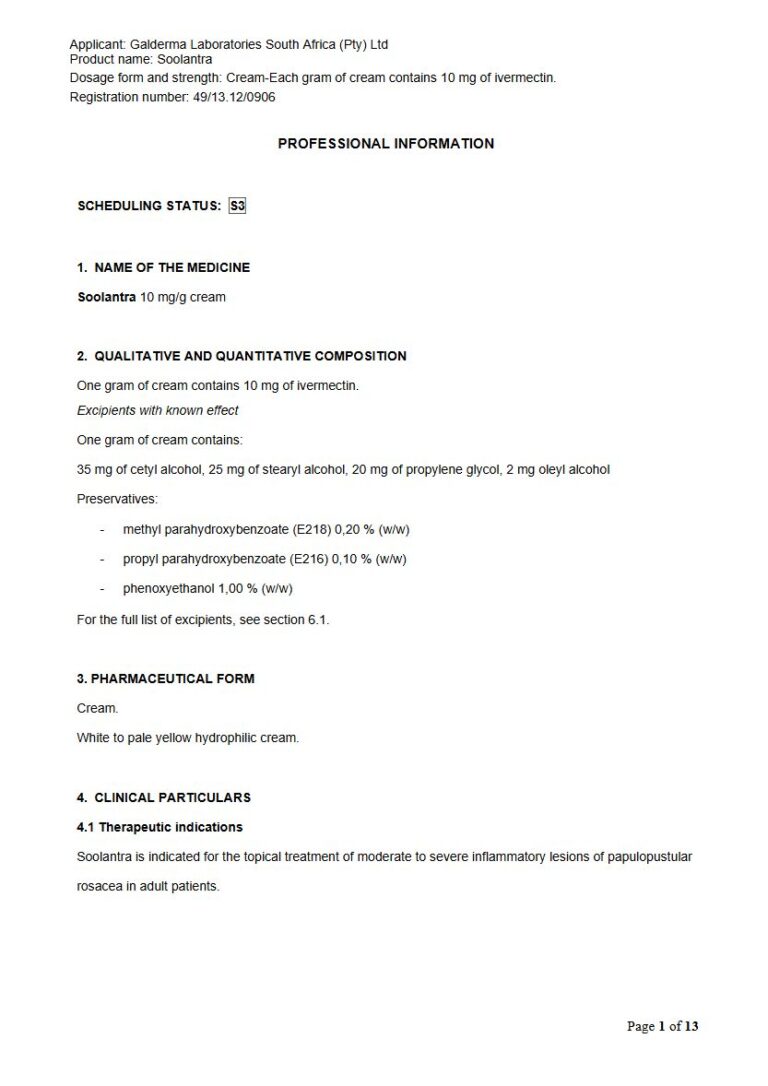
Soolantra is indicated for the topical treatment of moderate to severe inflammatory lesions of papulopustular rosacea in adult patients.
4.2 Posology and method of administration
Posology
One application a day at bedtime, to the affected areas of the face for up to 4 months. The treatment course may be repeated. In case of no improvement after 3 months, the treatment should be discontinued.
Special populations
Renal impairment
Safety in patients with renal impairment has not been established.
Hepatic impairment
Safety in patients with hepatic impairment has not been established.
Elderly patients (u2265 65 years of age)
No dosage adjustment is necessary in the elderly population (see also section 4.8).
Paediatric population
The safety and efficacy of Soolantra in children and adolescents aged less than 18 years have not been established. No data is available.
Method of administration
Cutaneous use only. Cutaneous application of a pea-size amount of Soolantra to each of the affected areas of the face (forehead, chin, nose, and each cheek), which corresponds to a maximum recommended daily dose of 1 g in total weight. Soolantra should be spread as a thin layer across the affected areas, avoiding the eyelids, eyes, lips, mouth and mucosal surfaces. Maximum total cutaneous dose of Soolantra 1% cream per day is 1 gram which is equivalent to 10 mg ivermectin. Soolantra should be applied only to the face, and is not for oral, ophthalmic, intranasal or intravaginal use. Hands should be washed after applying Soolantra. Cosmetics may be applied after Soolantra has dried.
4.3 Contraindications
Hypersensitivity to the active substance or to any of the excipients listed in section 6.1.
Pregnancy and Lactation (see Section 4.6)
4.4 Special warnings and precautions for use
Patients may experience transient aggravation of rosacea, which usually resolves within 1 week under continuation of the treatment due to a reaction to the dying Demodex mites. In case of severe worsening with a strong dermal reaction, the treatment should be discontinued. Soolantra contains:
- cetyl alcohol and stearyl alcohol which may cause local skin reactions (e.g. contact dermatitis),
- methyl parahydroxybenzoate (E218) and propyl parahydroxybenzoate (E216) which may cause allergic reactions (possibly delayed),
- and propylene glycol which may cause skin irritation.
4.5 Interaction with other medicines and other forms of interaction
No interaction studies have been performed (see section 5.2 for Biotransformation). Concomitant use of Soolantra with other topical or systemic medicines for the treatment of rosacea has not been investigated. In vitro studies have shown that ivermectin is primarily metabolised by CYP3A4. Consequently, caution is advised when ivermectin is administered concomitantly with potent CYP3A4 inhibitors as the plasma exposure may be significantly increased.
4.6 Fertility, pregnancy and lactation
Pregnancy
Safety of topical use of Soolantra in pregnancy has not been established. Soolantra should not be used in pregnancy. There are no or a limited amount of data from the topical use of ivermectin in pregnant women. Oral reproductive toxicity studies have shown that ivermectin is teratogenic in rats (cleft palates) and rabbits (carpal flexures and low birth weight) (see section 5.3). Although the systemic exposure in humans following the topical administration of ivermectin is relatively low at the proposed posology, and the systemic exposure that may cause harm to the embryo/developing foetus is unknown, a possible safety concern for the human foetus cannot be excluded.
Breastfeeding
Women breastfeeding their babies should not be treated with Soolantra. Excretion of Ivermectin in human milk following topical administration has not been evaluated. In pharmacokinetic/toxicology studies done with oral ivermectin in nursing female rats, ivermectin was excreted in the milk and neonatal toxicity was observed in the litters. Because of the potential for serious adverse reactions with Soolantra Cream in the breastfed infants, a decision should be made whether to discontinue nursing or to discontinue Soolantra taking into account the benefit of breastfeeding for the child and the benefit of therapy for the mother.
Fertility
No human data on the effect of ivermectin on fertility are available. In rats, there was no effect on mating or fertility with ivermectin treatment.
4.7 Effects on ability to drive and use machines
Soolantra has no or negligible influence on the ability to drive and use machines.
4.8 Undesirable effects
Summary of the safety profile
The most commonly reported adverse reactions are skin burning sensation, skin irritation, pruritus and dry skin, all occurring in 1% or less of patients treated with ivermectin in clinical trials. They are typically mild to moderate in severity, and usually decrease when treatment is continued. No meaningful differences in the safety profile were observed between subjects 18 to 65 years and subjects u226565 years of age.
Tabulated summary of adverse reactions
The adverse reactions are classified by System Organ Class and frequency, using the following convention: very common (u2265 1/10), common (u2265 1/100 to < 1/10), uncommon (u2265 1/1,000 to < 1/100), rare (u2265 1/10,000 to <1/1,000), very rare (< 1/10,000), not known (cannot be estimated from the available data) and were reported with Soolantra in clinical studies (see Table 1).
4.9 Overdose
In overdose, side effects can be precipitated and/or be of increased severity (see Section 4.8). Soolantra should be stopped. Treatment is symptomatic and supportive (see below). In accidental or significant exposure to unknown quantities of veterinary formulations of ivermectin in humans, either by ingestion, inhalation, injection, or exposure to body surfaces, the following adverse effects have been reported most frequently: rash, oedema, headache, dizziness, asthenia, nausea, vomiting, and diarrhoea. Other adverse effects that have been reported include: seizure, ataxia, dyspnea, abdominal pain, paresthesia, urticaria, and contact dermatitis. In case of accidental ingestion, symptomatic and supportive therapy, if indicated, should include parenteral fluids and electrolytes, respiratory support (oxygen and mechanical ventilation if necessary) and pressor agents if clinically significant hypotension is present. Induction of emesis as soon as possible, followed by purgatives and other routine anti-poison measures, may be indicated if needed to prevent absorption of ingested material.
