
Duphalac Dry 10g/5ml Crystalline powder / SYRUP
PDF Leaflet Revision Date: 27 May 1994
Clinical Summary
Quick overview from the medicine insert
Indication
Treatment of constipation and portal systemic encephalopathy.
Dosage (summary)
Adults: 10-30 g for constipation; 20-35 g three times daily for encephalopathy.
Onset of Action / Duration
Onset: 1-2 days, Duration: varies.
Special Populations
- Elderly
- Children
- Diabetic patients
Pregnancy & Breastfeeding
Considered safe during pregnancy and breastfeeding.
Key Drug Interactions
- Increased potassium loss with thiazides
- Cardiac glycosides effect enhancement
Contraindications
- Hypersensitivity to lactulose
- Galactosaemia
- Intestinal obstruction
Common side effects
- Flatulence
- Abdominal pain
- Nausea
- Diarrhoea
Counselling Points
- Increase fluid intake
- Monitor for abdominal discomfort
- Adjust dosage if diarrhoea occurs
Serious warnings
- Risk of electrolyte imbalance with prolonged use
- Consult physician if no response after several days
Important Disclaimer
The Duphalac Dry 10g/5ml Crystalline powder / SYRUP professional information leaflet below is the property of Abbott Laboratories Sa and is provided on Medinsert exactly as issued, with no.. alterations or editorial changes. We make every effort to keep content current by updating documents as soon as new versions become available. Medinsert serves as a trusted access point for healthcare professionals, but does not replace official sources or clinical judgement. For more details, please read our full disclaimer. read more>>
 Healthcare Professionals Only
This content is for registered healthcare professionals
Sign in or create a free account to read the full package insert.
Free for HPCSA-registered professionals. Powered by Medinsert.
Clinical Particulars
Section 4 of the official insert — extracted exactly as issued, no alterations
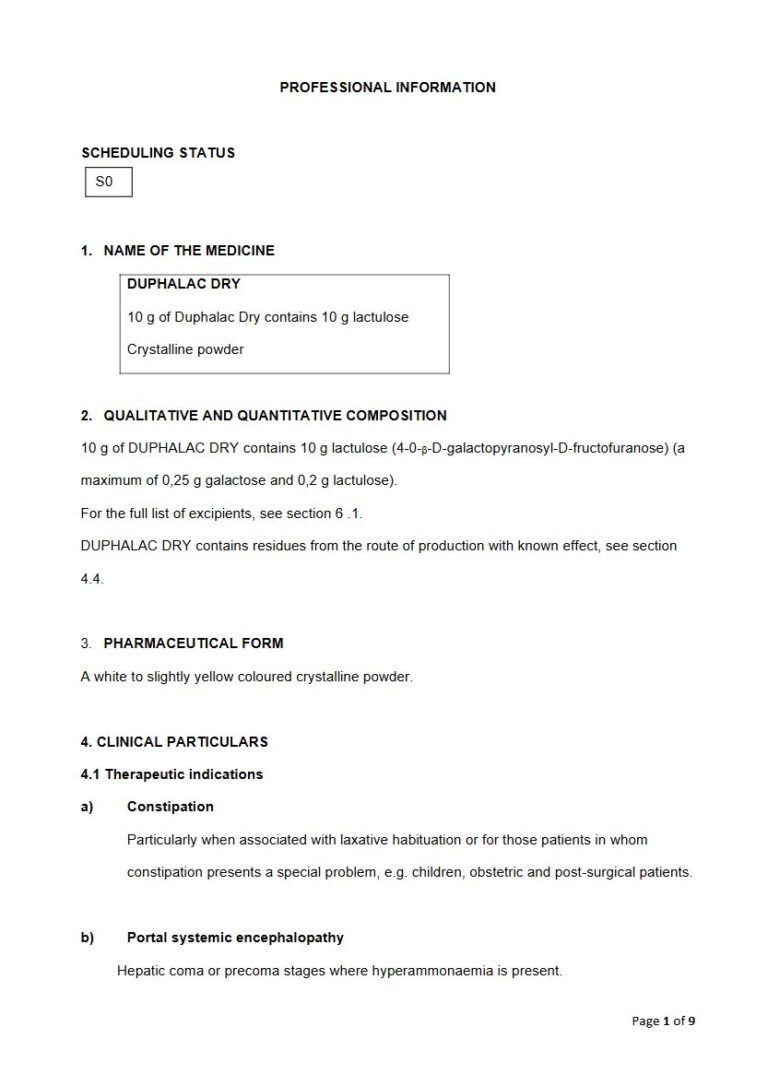
4.1 Therapeutic indications
a) Constipation
Particularly when associated with laxative habituation or for those patients in whom constipation presents a special problem, e.g. children, obstetric and post-surgical patients.
b) Portal systemic encephalopathy
Hepatic coma or precoma stages where hyperammonaemia is present.
4.2 Posology and method of administration
Posology
a) Constipation
The dosage for constipation can be varied according to the individual response, but the following serves as a guide.
Starting dose (3 days) gram per day
Maintenance dose gram per day
Adults 10 - 30 g 10 - 20 g
Children 7 - 14 years 10 g 10 g
Children 1 - 6 years 5 - 10 g 5 - 10 g
If there is no response within 48 hours the dosage can be increased and if diarrhoea occurs dosage should be decreased. Since DUPHALAC DRY exerts its effect when it reaches the colon it may take 1 - 2 days before normal defaecation occurs.
b) Portal systemic encephalopathy
Starting dose 20 - 35 g three times a day. Maintenance dose has to be adjusted to the individual response. DUPHALAC DRY can be taken with breakfast cereals, or drinks such as tea, coffee, fruit juice or milk.
4.3 Contraindications
Hypersensitivity to lactulose (see section 6.1)
Galactosaemia including patients on a galactose-free diet.
Patients with intestinal obstruction.
4.4 Special warnings and precautions for use
In case of insufficient therapeutic effect after several days consultation of a physician is advised. DUPHALAC DRY may cause abdominal discomfort associated with flatulence or cramps. Nausea and vomiting have been reported less frequently following high doses. From the route of synthesis, DUPHALAC DRY may contain small amounts of sugars. Care should be taken in patients with lactose intolerance and in diabetic patients because of the presence of galactose and lactose. Patients with rare hereditary problems of galactose or fructose intolerance, the Lapp lactase deficiency or glucose-galactose mal-absorption should not take this medicine. Lactulose may contain more than 5 g lactose/galactose/epilactose depending upon the dose taken. This should be taken into account in patients with diabetes mellitus. 15 ml of Lactulose contain 42,7 KJ (10,2 kcals) = 0,21 BU. For patients with gastro-cardiac syndrome (Roemheld syndrome) lactulose should only be taken after consultation of a physician. If symptoms like meteorism or bloating occur in such patients after lactulose intake, the dose should be reduced or the treatment should be discontinued. Chronic use of unadjusted doses and misuse can lead to diarrhoea and disturbance of the electrolyte balance. For elderly patients or patients that are in bad general condition and take lactulose for a more than 6 months period, periodic control of electrolytes is indicated. During the therapy with laxatives it is recommended to drink sufficient amounts of fluids (1,5 - 2 l/day, equal to 6 - 8 glasses).
4.5 Interaction with other medicines and other forms of interaction
Lactulose may increase the loss of potassium induced by other drugs (e.g. thiazides, steroids and amphotericin B). Concomitant use of cardiac glycosides can increase the effect of the glycosides through potassium deficiency. With increasing dosage a decrease of pH-value in the colon is found. Therefore drugs which are released in the colon pH-dependently (e.g. 5-ASA) can be inactivated.
4.6 Fertility, pregnancy and lactation
Pregnancy
Limited data on pregnant patients indicate neither malformative nor foeto/neonatal toxicity. Animal studies do not indicate direct or indirect harmful effects with respect to pregnancy, embryonal/foetal development, parturition or postnatal development (see section 5.3). The use of DUPHALAC DRY may be considered during pregnancy if necessary.
Breastfeeding
DUPHALAC DRY can be used during breastfeeding.
Fertility
For DUPHALAC DRY, no clinical data on the effects on fertility are available.
4.7 Effects on ability to drive and use machines
Lactulose has no or negligible influence on the ability to drive and use machines.
4.8 Undesirable effects
DUPHALAC DRY may cause abdominal discomfort associated with flatulence or cramps. Nausea and vomiting have been reported less frequently following high doses. Care should be taken in patients with lactose intolerance and in diabetic patients because of the presence of galactose and lactose.
Very common u2265 1/10
Common u2265 1/100 to < 1/10
Uncommon u2265 1/1,000 to <1/100
Rare u2265 1/10,000 to < 1/1,000
Very rare < 1/10,000
Not known cannot be estimated from the available data
Summary of the safety profile
Flatulence may occur during the first few days of treatment. As a rule it disappears after a couple of days. When dosages higher than instructed are used, abdominal pain and diarrhoea may occur. In such a case the dosage should be decreased.
Tabulated list of adverse reactions
The following undesirable effects have been experienced with the below indicated frequencies in lactulose-treated patients in placebo-controlled clinical trials.
4.9 Overdose
If the dose is too high, the following may occur: diarrhea and abdominal pain. Treatment: cessation of treatment or dose reduction. Extensive fluid loss by diarrhea or vomiting may require correction of electrolyte disturbances. See section 4.8. Treatment is symptomatic and supportive.
