
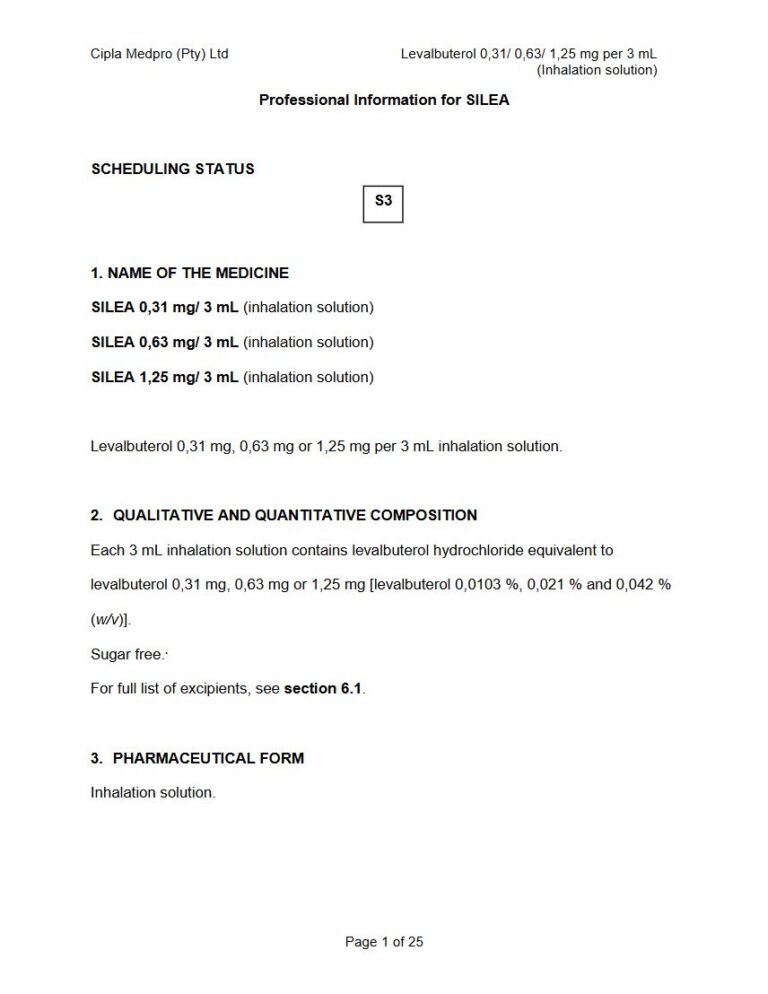
Silea 0,31 Mg/3 Ml/0,63 Mg/1,25 Mg Solution
PDF Leaflet Revision Date: 04 April 2023
Clinical Summary
Quick overview from the medicine insert
Indication
Treatment of reversible airway obstruction in asthma and bronchospasm prevention.
Dosage (summary)
Adults: 0.63 mg/3 mL thrice daily; max 1.25 mg/3 mL if needed.
Special Populations
- Children <6 years
- Renal impairment
Pregnancy & Breastfeeding
Not adequately studied in pregnancy; use with caution. Unknown if excreted in breast milk.
Key Drug Interactions
- Beta-blockers may cause severe bronchospasm
- Caution with diuretics and digoxin
Contraindications
- Hypersensitivity to levalbuterol or ingredients
- Children <6 years
Common side effects
- Dizziness
- Tachycardia
- Headache
- Nervousness
Counselling Points
- Do not exceed recommended dose
- Monitor for worsening asthma
- Use caution in driving or operating machinery
Serious warnings
- Paradoxical bronchospasm may occur
- Risk of cardiovascular effects
- Potential for hypokalaemia
Important Disclaimer
The Silea 0,31 Mg/3 Ml/0,63 Mg/1,25 Mg Solution professional information leaflet below is the property of Cipla Medpro and is provided on Medinsert exactly as issued, with no.. alterations or editorial changes. We make every effort to keep content current by updating documents as soon as new versions become available. Medinsert serves as a trusted access point for healthcare professionals, but does not replace official sources or clinical judgement. For more details, please read our full disclaimer. read more>>
 Healthcare Professionals Only
This content is for registered healthcare professionals
Sign in or create a free account to read the full package insert.
Free for HPCSA-registered professionals. Powered by Medinsert.
Clinical Particulars
Section 4 of the official insert — extracted exactly as issued, no alterations
4.1 Therapeutic Indications
SILEA is indicated in adults, adolescents and children 6 years of age and older for:
- Treatment of reversible airway obstruction in asthma, chronic bronchitis and emphysema, or
- Prevention of bronchospasm in exercise induced asthma.
4.2. Posology and method of administration
Posology:
Children 6 to 11 years old: The recommended dose of SILEA is 0,31 mg/ 3 mL, administered thrice daily by nebulisation. Routine dosing should not exceed 0,63 mg/ 3 mL three times per day.
Adults and children u226512 years old: The recommended starting dose of SILEA is 0,63 mg/ 3 mL, administered thrice daily (every 6 to 8 hours) by nebulisation. Patients 12 years and older with more severe asthma or patients who do not respond adequately to a dose of 0,63 mg/ 3 mL of SILEA may benefit from a dosage of 1,25 mg/ 3 mL three times per day. Patients receiving the highest dose of SILEA should be monitored closely for adverse systemic effects, and the risks of such effects should be balanced against the potential for improved efficacy. The use of SILEA can be continued as medically indicated to control recurring bouts of bronchospasm. During this time, most patients gain optimal benefit from regular use of the inhalation solution. If a previously effective dosage regimen fails to provide the expected relief, medical advice should be sought immediately, since this is often a sign of seriously worsening asthma that would require reassessment of therapy. The physico-chemical compatibility of SILEA as well as its safety and efficacy when mixed with other medicines in a nebuliser have not been established.
The safety and efficacy of SILEA have been established in clinical studies when administered using the PARI LC Jet TM and PARI LC PLUS TM nebulisers, and the PARI Master u00ae Dura-Neb u00ae 2000 and Dura-Neb u00ae 3000 compressors. The safety and efficacy of SILEA has not been established when administered using other nebulisers. Do not exceed the recommended dose.
Special populations
Paediatric population: There are no data to support use in children under the age of 6 years, see section 4.3.
Method of administration
SILEA is administered by inhalation with a nebuliser (with a face mask or mouthpiece) connected to an air compressor.
4.3. Contraindications
Hypersensitivity to levalbuterol hydrochloride, racemic albuterol or any of the inactive ingredients. Safety and efficacy in children under the age of 6 years have not been established, see section 4.2.
4.4. Special warnings and precautions for use
Paradoxical bronchospasms:
Like other inhaled beta-adrenergic agonists, SILEA can produce paradoxical bronchospasm, which may be life threatening. If paradoxical bronchospasm occurs, SILEA should be discontinued immediately and alternative therapy instituted. It should be noted that paradoxical bronchospasm, when associated with inhaled formulations, frequently occurs with the first use of a new canister or vial.
Deterioration of asthma:
Asthma may deteriorate acutely over a period of hours or chronically over several days or longer. If the patient needs more doses of SILEA than usual, this may be a marker of destabilisation of asthma and requires re-evaluation of the patient and treatment regimen, giving special consideration to the possible need for anti-inflammatory treatment, e.g., corticosteroids.
Use of anti-inflammatory medicines:
The use of beta-adrenergic agonist bronchodilators alone may not be adequate to control asthma in many patients. Early consideration should be given to adding anti-inflammatory medicines, e.g., corticosteroids, to the therapeutic regimen.
Cardiovascular effects:
SILEA, like all other beta-adrenergic agonists, can produce a clinically significant cardiovascular effect in some patients, as measured by pulse rate, blood pressure, and/or symptoms. Although such effects are less frequent after administration of SILEA at recommended doses, if they occur, the medicine may need to be discontinued. In addition, beta-agonists have been reported to produce electrocardiogram (ECG) changes, such as flattening of the T-wave, prolongation of the QTc interval and ST segment depression. The clinical significance of these findings is unknown. Therefore, SILEA, like all sympathomimetic amines, should be used with caution in patients with cardiovascular disorders, especially coronary artery insufficiency, cardiac dysrhythmias and arterial hypertension.
Exceeding recommended dose:
Fatalities have been reported in association with excessive use of inhaled sympathomimetic medicines such as SILEA in patients with asthma. The exact cause of death is unknown, but cardiac arrest following an unexpected development of a severe acute asthmatic crisis and subsequent hypoxia is suspected.
Immediate hypersensitivity reactions:
Immediate hypersensitivity reactions may occur after administration of racemic albuterol, as demonstrated by less frequent cases of urticaria, angioedema, rash, bronchospasm, anaphylaxis and oropharyngeal oedema. The potential for hypersensitivity must be considered in the clinical evaluation of patients who experience immediate hypersensitivity reactions while receiving SILEA.
Hypokalaemia:
Hypokalaemia may occur through intracellular shifting, which has the potential to produce adverse cardiovascular effects. SILEA overdosage may cause cardiac effects.
High doses may increase the risk of serious side effects, including cardiac dysrhythmias. This risk is further aggravated if SILEA is administered concomitantly with other medicines that cause hypokalaemia and cardiac dysrhythmias, or in the presence of hypoxia and acidosis. The maximum dose of SILEA should not be exceeded.
Coexisting conditions:
SILEA should be used with caution in patients with cardiovascular disorders, especially coronary artery insufficiency, arterial hypertension and cardiac dysrhythmias, in patients with convulsive disorders, hyperthyroidism, or diabetes mellitus; and in patients who are unusually responsive to sympathomimetic amines. Clinically significant increases in systolic and diastolic blood pressure have been seen in individual patients and could be expected to occur in some patients after the use of any beta-adrenergic bronchodilator. Blood glucose levels may be increased in diabetic patients. Large doses of intravenous racemic albuterol have been reported to aggravate pre-existing diabetes mellitus and ketoacidosis.
4.5. Interaction with other medicines and other forms of interaction
Other short-acting sympathomimetic aerosol bronchodilators or epinephrine should be used with caution with levalbuterol. If additional adrenergic medicines are to be administered by any route, they should be used with caution to avoid deleterious cardiovascular effects.
Beta-blockers:
Beta-adrenoceptor blockers not only block the pulmonary effect of beta 2-receptor-agonists such as SILEA, but may also produce severe bronchospasm in asthmatic patients. Therefore, patients with asthma should not normally be treated with beta-blockers.
Diuretics:
The ECG changes (e.g. QT interval prolongation, flattening and inversion of T waves, dysrhythmias, torsades de Pointes and ventricular tachycardia) and/or hypokalaemia that may result from the administration of non-potassium sparing diuretics (such as loop or thiazide diuretics) can be acutely worsened by beta-adrenoreceptor agonists, especially when the recommended dose of the beta-agonist is exceeded. The clinical significance of these effects depends on the severity of the hypokalaemia. Caution is advised in the coadministration of beta-adrenoreceptor agonists with non-potassium sparing diuretics.
Digoxin:
Mean decreases of 16 % and 22 % in serum digoxin levels were demonstrated after single-dose intravenous and oral administration of racemic albuterol, respectively, to normal volunteers who had received digoxin for 10 days. The clinical significance of these findings for patients with obstructive airway disease who are receiving SILEA and digoxin on a chronic basis is unclear. Nevertheless, it would be prudent to carefully evaluate the serum digoxin levels in patients who are concurrently receiving digoxin and SILEA.
Monoamine oxidase inhibitors or tricyclic antidepressant:
SILEA should be administered with extreme caution to patients treated with monoamine oxidase inhibitors or tricyclic antidepressants, or within 2 weeks of discontinuation of such medicines, because the action of levalbuterol hydrochloride on the cardiovascular system may be potentiated.
4.6. Fertility, pregnancy and lactation
Pregnancy:
SILEA has not been studied adequately in pregnant women. In women with poorly or moderately controlled asthma, there is an increased risk of preeclampsia in the mother and prematurity, low birth weight and small for gestational age in the neonate. Pregnant women should be closely monitored and medicine adjusted as necessary to maintain optimal control.
Use in labour and delivery:
Because of the potential for beta-adrenergic agonists to inhibit uterine contractility, the use of SILEA for the treatment of bronchospasm during labour should be restricted to those patients in whom the benefits clearly outweigh the risk. SILEA has not been approved for the management of preterm labour. The benefit-risk ratio when SILEA is administered for tocolysis has not been established. Serious adverse reactions, including maternal pulmonary oedema, have been reported during or following treatment of premature labour with beta 2-adrenoreceptor agonists, including racemic albuterol.
Breastfeeding:
SILEA has not been studied in breastfeeding women or breastfed children.
4.7. Effects on ability to drive and use machines
SILEA can cause dizziness and syncope (see section 4.8), therefore it might have a negative influence on the ability to drive and use machines.
4.8. Undesirable effects
Table 1: List of adverse events
System organ class
Side effects in adults and children aged u2265 12 years
Side effects in children aged 6 to 11 years
Infections and infestations
Frequent: flu syndrome, rhinitis, sinusitis, viral infection.
Frequent: viral infection, pharyngitis, rhinitis.
Immune system disorders
Frequent: hypersensitivity reactions including urticaria, angioedema, rash, anaphylaxis and oropharyngeal oedema (see section 4.3).
Frequent: hypersensitivity reactions including urticaria, angioedema, rash, anaphylaxis and oropharyngeal oedema (see section 4.3).
Blood and lymphatic system disorders
Frequent: lymphadenopathy.
Frequent: lymphadenopathy.
Psychiatric disorders
Frequent: insomnia.
Nervous system disorders
Frequent: dizziness, hypertonia, nervousness, tremor, anxiety, hypaesthesia of the hand, paraesthesia.
Frequent: headache.
Eye disorders
Frequent: eye itch.
Ear and labyrinth disorders
Frequent: otitis media.
Cardiac disorders
Frequent: chest pain, tachycardia, ECG abnormal, ECG change.
Vascular disorders
Frequent: migraine hypertension, hypotension, syncope.
Respiratory, thoracic and mediastinal
Frequent: cough increased, rhinitis, sinusitis, turbinate oedema.
Frequent: asthma, pharyngitis, rhinitis.
Gastrointestinal disorders
Frequent: diarrhoea, dry mouth, dry throat, dyspepsia, gastroenteritis, nausea.
Frequent: abdominal pain, diarrhoea.
Skin and subcutaneous tissue disorders
Frequent: eczema, rash, urticaria.
Musculoskeletal and connective tissue disorders
Frequent: leg cramps, myalgia.
Frequent: myalgia.
General disorders and administrative site disorders
Frequent: accidental injury, pain, back pain, chills.
Frequent: accidental injury, asthenia, fever, pain.
Post-marketing data:
Immune system disorders: Angioedema, anaphylaxis, rash, urticaria.
Metabolism and nutrition disorders: Metabolic acidosis.
Cardiac disorders: Dysrhythmias (including atrial fibrillation, supraventricular tachycardia, extrasystoles), tachycardia, chest pain, angina.
Nervous system disorders: Nervousness, CNS stimulation.
Ear and labyrinth disorders: Vertigo.
Respiratory, thoracic and mediastinal disorders: Asthma, cough increased, dyspnoea.
Gastrointestinal disorders: Gastroesophageal reflux disease (GORD), nausea.
General disorders and administrative site disorders: Dysphonia, tremor.
Metabolism and nutrition disorders: Metabolic acidosis.
4.9. Overdose
The expected symptoms with overdosage are those of excessive beta-adrenergic receptor stimulation and/or occurrence or exaggeration of any of the symptoms listed under section 4.8, e.g. angina pectoris, arterial hypertension or hypotension, tachycardia with rates up to 200 beats/min, dysrhythmias, nervousness, headache, tremor, dry mouth, nausea, dizziness, fatigue and sleeplessness. Hypokalaemia may also occur. As with all sympathomimetic medicines, cardiac arrest and even death may be associated with the abuse of SILEA. Treatment consists of discontinuation of SILEA together with appropriate symptomatic therapy. The judicious use of a cardio selective beta 2-receptor blocker may be considered, bearing in mind that such medicine can produce bronchospasm. There is insufficient evidence to determine if dialysis is beneficial for overdosage of SILEA.
