
Triphasil Tablets
PDF Leaflet Revision Date: 10 February 2023
Clinical Summary
Quick overview from the medicine insert
Indication
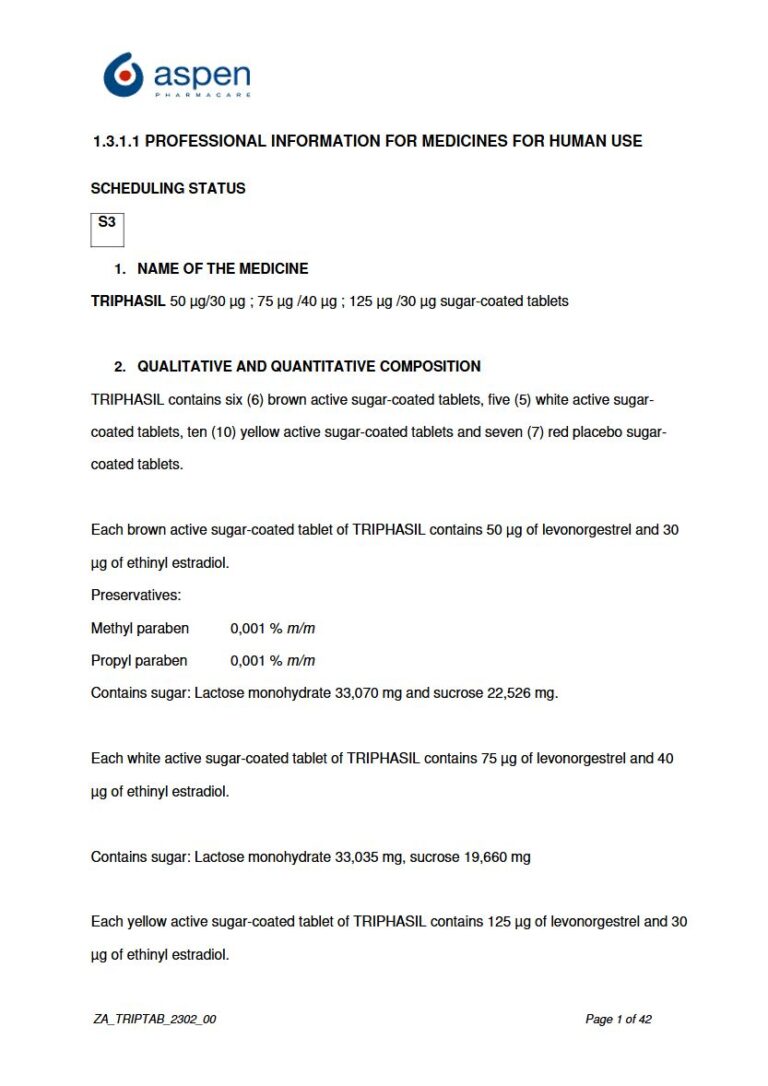
Fertility control and treatment of dysmenorrhoea.
Dosage (summary)
One tablet daily for 21 days, followed by a 7-day tablet-free interval.
Special Populations
- Elderly
- Diabetics
- Smokers over 35
Pregnancy & Breastfeeding
Contraindicated in pregnancy and lactation; may reduce breast milk production.
Key Drug Interactions
- Anticonvulsants
- Antibiotics
- St. John's Wort
Contraindications
- VTE history
- Severe hepatic disease
- Breast cancer
Common side effects
- Nausea
- Headache
- Depression
- Breast tenderness
Counselling Points
- Take at the same time daily
- Use barrier contraception if missed doses
- Report any severe headaches or vision changes
Serious warnings
- Increased risk of VTE
- Monitor for migraines
- Caution in smokers
Important Disclaimer
The Triphasil Tablets professional information leaflet below is the property of Pharmacare and is provided on Medinsert exactly as issued, with no.. alterations or editorial changes. We make every effort to keep content current by updating documents as soon as new versions become available. Medinsert serves as a trusted access point for healthcare professionals, but does not replace official sources or clinical judgement. For more details, please read our full disclaimer. read more>>
 Healthcare Professionals Only
This content is for registered healthcare professionals
Sign in or create a free account to read the full package insert.
Free for HPCSA-registered professionals. Powered by Medinsert.
Clinical Particulars
Section 4 of the official insert — extracted exactly as issued, no alterations
4.1. Therapeutic indications
TRIPHASIL is indicated for:
- Fertility control in women.
- Control of cases of dysfunctional uterine bleeding.
- Symptomatic treatment of primary dysmenorrhoea where contraception is also desired.
TRIPHASIL may benefit women on contraception with coincidental acne. The decision to prescribe TRIPHASIL should take into consideration the individual woman's current risk factors, particularly those for venous thromboembolism (VTE) (see section 4.4).
4.2. Posology and method of administration
Posology
Adults
For contraception
To achieve maximum effectiveness, TRIPHASIL tablets must be taken exactly as directed and at intervals not exceeding 24 hours. Patients should be instructed to take the tablets at the same time every day, preferably after the evening meal or at bedtime. One tablet daily is taken for 21 consecutive days. Each subsequent pack is started after a 7-day tablet-free interval; during which time a withdrawal bleed usually occurs. This bleeding will usually begin on the 2nd or 3rd day after ingestion of the last tablet and it may not have ceased, before the next pack is started.
How to start TRIPHASIL
No preceding intake of hormonal contraceptives (within the last month)
First Cycle: The patient is instructed to take the first TRIPHASIL tablet on the first day of the menstrual cycle (first day of bleeding). Starting intake on day 2 to 5 is allowed, but during the first cycle the concurrent use of barrier contraceptive method during the first 7 days of tablet intake is advisable. The first tablet should be selected from those in the red area of the pack marked with the appropriate day of the week. Thereafter, one tablet is taken daily, following the arrows marked on the package until all the tablets have been taken. Withdrawal bleeding should occur within 2 to 4 days after the patient has taken the last yellow tablet.
During the first cycle, where treatment with TRIPHASIL tablets is started after the first day of the menstrual cycle, contraceptive reliance should not be placed on TRIPHASIL tablets and a mechanical i.e. barrier, method of contraception should be supplemented for the first 14 consecutive days of administration. If the tablets are begun after Day 5 or postpartum, it must be considered that ovulation and conception may have occurred before the tablets were started.
New patients with a history of short menstrual cycles, (i.e. less than 25 days) should also use a supplementary, nonsteroidal method of contraception (e.g. mechanical) until they have taken a tablet daily for 14 consecutive days.
Subsequent Cycles: A new pack should be started the day after completion of the previous pack by taking the tablet in the red area of the new pack indicated with the appropriate day of the week. There must be no interruption of treatment, i.e. the new pack is started immediately after completion of the previous pack and each new pack is started with the same tablet in the red area of the pack even if withdrawal bleeding has not occurred or is still in progress. This method should continue for as long as contraception is desired. Each cycle or pack will begin on the same day of the week.
The patient who is changing from another oral contraceptive product will begin TRIPHASIL tablets on the day she would usually start a new package of the other product. During the first TRIPHASIL tablet cycle, a mechanical, i.e. barrier, method of contraception should be used until 14 consecutive daily tablets have been taken.
If:
- transient spotting or breakthrough bleeding occurs, the patient is instructed to continue the regimen since such bleeding is usually without significance.
- the bleeding is persistent or prolonged, the patient is advised to consult her doctor.
In the non-lactating mother, use of TRIPHASIL tablets may be instituted immediately after delivery or at the first postpartum examination, whether or not menstruation has resumed.
MISSED TABLETS: The patient should be instructed to take a missed tablet as soon as it is remembered. If:
- two consecutive tablets are missed, they should both be taken as soon as remembered. The next tablet should be taken at the usual time.
- at any time the patient misses one or two tablets she should also use a supplementary, nonsteroidal method of contraception (e.g. mechanical) until she has taken a tablet daily for 14 consecutive days or until the package is finished if less than 14 tablets remain.
- the patient misses one or more inert tablets, she is still protected against pregnancy, provided she begins the active tablets on the proper day.
- three consecutive tablets are missed, all medication has to be discontinued and the remainder of the package discarded. A new tablet cycle is started on the eighth day after the last tablet was taken and a supplementary nonsteroidal means of contraception (e.g. mechanical) should be used for the remaining days without tablets and until the patient has taken a tablet daily for 14 consecutive days.
If:
- withdrawal bleeding does not occur and TRIPHASIL tablets have been taken according to directions, it is unlikely that the patient has conceived. She should be instructed to begin a second course of TRIPHASIL tablets on the usual day.
- bleeding does not occur at the end of this second cycle, TRIPHASIL tablets should not be taken until diagnostic procedures to exclude the possibility of pregnancy have been performed.
- the patient has not adhered to the prescribed regimen (missed one or more active tablets or started taking them on a day later than recommended), the probability of pregnancy should be considered at the time of the first missed period before TRIPHASIL is resumed.
Changing from another combined hormonal contraceptive (combined pill, vaginal ring, transdermal patch) The woman should start with TRIPHASIL on the day after she took the last active tablet in her previous blister pack of contraceptive pills (or removed the transdermal patch or vaginal ring), or no later than on the day after the usual pill-free (or placebo, patch-free or ring-free) interval with her previous contraceptive.
Changing from a progestogen-only method (progestogen-only pills, injectable, implant) The woman can change from progestogen-only pills on any day (changing from implant on the day of its removal; changing from injection when the next injection should have been given). In all these cases concurrent use of a barrier method during the first 7 days of tablet intake is advisable.
After abortion in 1st trimester The woman may begin intake of tablets immediately. If she so does, it is not necessary to take further contraceptive measures.
After delivery or abortion in 2nd trimester The woman should be advised to start on day 21 to 28 after delivery or abortion in 2nd trimester, since there is an increased risk of thromboembolism during the post-partum period. She should be advised to use a barrier contraceptive method concurrently during the first 7 days of tablet intake if she starts later. If she has already had intercourse, pregnancy must be excluded before she starts tablet intake, or she must await her first menstrual bleeding.
FOR THE SYMPTOMATIC TREATMENT OF PRIMARY DYSMENORRHOEA AND CASES OF DYSFUNCTIONAL UTERINE BLEEDING - dosage as for contraception.
FOR THE TREATMENT OF ANDROGEN-DEPENDENT ACNE - dosage as for contraception.
Gastrointestinal upset
Vomiting or diarrhoea may reduce the efficacy of TRIPHASIL by preventing full absorption. If vomiting or diarrhoea occurs within 4 hours of taking TRIPHASIL tablet-taking from the current pack should be continued. Additional non-hormonal methods of contraception (except the rhythm or temperature method) should be used during the gastro-intestinal upset and for 7 days following the upset. If these 7 days overrun the end of a pack, the next pack should be started without a break. In this situation, a withdrawal bleed should not be expected until the end of the second pack. If the patient does not have a withdrawal bleed during the tablet-free interval following the end of the second pack, the possibility of pregnancy must be ruled out before starting the next pack.
Other methods of contraception should be considered if the gastrointestinal disorder is likely to be prolonged.
Method of administration
For oral administration. The tablets must be taken orally in the order directed on the blister package at about the same time every day, with some liquid if necessary.
4.3. Contraindications
TRIPHASIL is contraindicated in:
- Patients with hypersensitivity to ethinyl oestradiol or levonorgestrel or to any of the excipients in TRIPHASIL (see section 6.1).
- Patients with depression not well controlled with treatment.
- Patients with a history of depression with the use of hormonal contraceptives.
- Risk of venous thromboembolism (VTE).
- Venous thromboembolism u2013 current VTE (on anticoagulants) or history of (e.g. deep venous thrombosis (DVT) or pulmonary embolism (PE)).
- Known hereditary or acquired predisposition for venous thromboembolism, such as APC-resistance (a haemostatic disorder characterised by a poor anticoagulant response to activated protein C), (including Factor V Leiden), antithrombin u2013 III u2013 deficiency, protein C deficiency, protein S deficiency.
- Use of ritonavir.
- Major surgery with prolonged immobilisation.
- A high risk of venous thromboembolism due to the presence of multiple risk factors.
- Risk of arterial thromboembolism (ATE).
- Arterial thromboembolism u2013 current arterial thromboembolism, history of arterial thromboembolism (e.g. myocardial infarction) or prodromal condition (e.g. angina pectoris).
- Cerebrovascular disease u2013 current stroke, history of stroke or prodromal condition (e.g. transient ischaemic attack, TIA).
- Known hereditary or acquired predisposition for arterial thromboembolism, such as hyperhomocysteinaemia and antiphospholipid antibodies (anticardiolipin-antibodies, lupus anticoagulant).
- History of migraine with focal neurological symptoms.
- A high risk of arterial thromboembolism due to multiple risk factors or to the presence of one serious risk factor such as:
- diabetes mellitus with vascular symptoms
- severe hypertension
- severe dyslipoproteinaemia.
- Presence or history of severe hepatic disease, e.g. active viral hepatitis and severe cirrhosis, as long as liver function values have not returned to normal.
- Patients with recurrent cholestatic jaundice.
- Undiagnosed vaginal bleeding.
- Medication should be discontinued immediately if migraine becomes focal or there is a loss of vision or if there is an onset of unexplained chest pain.
- Current or history of breast cancer.
- Benign or malignant liver tumours which developed during the use of oral contraceptives or oestrogen-containing medicines.
- Known or suspected sex-steroid influenced malignancies (e.g. of the genital organs or the breasts).
- Concomitant use with medicines containing ombitasvir/paritaprevir/ritonavir, dasabuvir, glecaprevir/pibrentasvir and sofosbuvir/velpatasvir/voxilaprevir (see sections 4.4 and 4.5).
- Ocular disorder of vascular origin.
- Dubin Johnson syndrome.
- Rotar syndrome.
- Porphyria.
- Pregnancy and lactation (see section 4.6).
Relative contraindications include a history of diabetes mellitus, epilepsy, asthma, hypertension, depression, or states in which fluid retention occur.
4.4. Special warnings and precautions for use
CIGARETTE SMOKING INCREASES THE RISK OF SERIOUS CARDIOVASCULAR SIDE EFFECTS FROM THE USE OF TRIPHASIL. THE RISK INCREASES WITH AGE AND WITH HEAVY SMOKING (15 OR MORE CIGARETTES PER DAY) AND IS MARKED IN WOMEN OVER 35 YEARS OF AGE. WOMEN WHO USE ORAL CONTRACEPTIVES SUCH AS TRIPHASIL SHOULD BE STRONGLY ADVISED NOT TO SMOKE.
If any of the conditions or risk factors mentioned below are present, the suitability of TRIPHASIL should be discussed with the woman. In the event of aggravation, or first appearance of any of these conditions or risk factors, the woman should be advised to contact her doctor to determine whether the use of TRIPHASIL should be discontinued.
Ocular Lesions
Discontinue TRIPHASIL and institute appropriate diagnostic and therapeutic measures if there is a gradual or sudden, partial or complete loss of vision, proptosis or diplopia, papilloedema, or any evidence of retinal vascular lesions or optic neuritis.
Carcinoma
Ovarian, endometrial, cervical and breast cancer have been reported in women using combined oral contraceptives such as TRIPHASIL. Data suggests that long-term continuous administration of either natural or synthetic oestrogen increases the frequency of carcinoma of the breast, cervix, vagina and liver. Under the influence of oestrogen-progestogen preparations, pre-existing uterine leiomyomata may increase in size. Close clinical surveillance is essential in all women taking TRIPHASIL.
In all cases of undiagnosed, persistent, or recurrent vaginal bleeding, appropriate diagnostic measures should be taken to eliminate the possibility of malignancy. Women with a strong family history of breast cancer or who have breast nodules, fibrocystic disease, or abnormal mammograms should be monitored with particular care.
Breast cancer
Epidemiological studies have shown that women using contraceptive pills such as TRIPHASIL have an increased risk of being diagnosed with breast cancer. This increased risk gradually declines for 10 years after cessation of contraceptive pills. The most important risk factor for breast cancer in combined oral contraceptive (COC) users is the age at which women discontinue the COC; the older the age at stopping, the more breast cancers are diagnosed. The excess risk gradually disappears during the course of the 10 years after stopping COC use such that by 10 years there appears to be no excess. The possible increase in risk of breast cancer should be discussed with the user.
Cervical Cancer
The most important risk factor for cervical cancer is persistent HPV infection. Long-term use of COCs may further contribute to this increased risk.
Tumours and cancer
A meta-analysis of 54 epidemiological studies showed that there is a slightly increased relative risk (RR = 1.24) of having breast cancer diagnosed in women who are currently using COCs such as TRIPHASIL. The excess risk gradually disappears during the course of the 10 years after cessation of COC use. Because breast cancer is rare in women under 40 years of age, the excess number of breast cancer diagnoses in current and recent COC users is small in relation to the overall risk of breast cancer. These studies do not provide evidence for causation. The observed pattern of increased risk may be due to an earlier diagnosis of breast cancer in COC, such as TRIPHASIL users, the biological effects of COCs or a combination of both. The breast cancers diagnosed in ever-users tend to be less advanced clinically than the cancers diagnosed in never-users.
Benign liver tumours, and malignant liver tumours have been reported in users of COCs, such as TRIPHASIL. In isolated cases, these tumours have led to life-threatening intra-abdominal haemorrhages. A hepatic tumour should be considered in the differential diagnosis when severe upper abdominal pain, liver enlargement or signs of intra-abdominal haemorrhage occur in women taking COCs.
Headache
The onset or exacerbation of migraine or development of headache of a new pattern which is recurrent, persistent, or severe, requires discontinuation of TRIPHASIL and evaluation of the cause.
Use during or immediately preceding pregnancy
Foetal abnormalities, including heart defects and limb defects, have been reported in offspring of women who have taken oral contraceptives in early pregnancy. Pregnancy should be ruled out before TRIPHASIL is begun and considered in women who have missed two consecutive menstrual periods. The possibility of pregnancy should be considered at the first missed menstrual period in a patient who has not adhered to the prescribed regimen. Further oral contraceptive use should be withheld until pregnancy has been ruled out.
TRIPHASIL has not been shown to have any deleterious effects on the foetus or to increase the incidence of miscarriage in women who discontinue their use PRIOR to conception. However, in women who discontinue TRIPHASIL with the intent of becoming pregnant, a non-hormonal method of contraception is recommended for a period of three months before attempting to conceive.
Female sex hormones have been used during pregnancy in an attempt to treat threatened or habitual abortion. There is considerable evidence that oestrogens are ineffective for these indications, and there is no evidence from well-controlled studies that progestins are effective for these uses. The administration of progestin-only or oestrogen-progestin combinations to induce withdrawal bleeding should not be used as a test of pregnancy.
Use during lactation:
TRIPHASIL given in the postpartum period may interfere with lactation. There may be a decrease in the quantity of breast milk. Furthermore, the hormonal components of TRIPHASIL are secreted in the milk of mothers. The use of oestrogen containing oral contraceptives should be deferred until the infant has been weaned. Mothers taking TRIPHASIL should not breastfeed their infants (see section 4.6).
4.5. Interactions with other medicines
Pharmacodynamic interactions
Concomitant use with medicines containing ombitasvir/paritaprevir/ritonavir, dasabuvir, with or without ribavirin, glecaprevir/pibrentasvir and sofosbuvir/velpatasvir/voxilaprevir may increase the risk of ALT elevations (see sections 4.3 and 4.4). Therefore, TRIPHASIL users must switch to an alternative method of contraception (e.g., progestagen-only contraception or non-hormonal methods) prior to starting therapy with these medicines regimens. TRIPHASIL can be restarted 2 weeks following completion of treatment with these medicines.
Pharmacokinetic interactions
Interactions between COCs, such as TRIPHASIL and other medicines may impair the contraceptive efficacy and/or lead to breakthrough bleeding and/or contraceptive failure. Women on treatment with any of these medicines should temporarily use a barrier contraceptive method or another method of contraception in addition to the COC, such as TRIPHASIL. With liver enzyme inducing medicines, the barrier contraceptive method must be used during the whole time of the concomitant medicines therapy and for 28 days after its discontinuation.
If the medicine therapy runs beyond the end of the tablets in the TRIPHASIL pack, the next TRIPHASIL pack should be started without the usual tablet-free interval.
Hepatic metabolism: Interactions can occur with medicines that induce hepatic microsomal enzymes, resulting in increased clearance of sex hormones (e.g. phenytoin, barbiturates, primidone, carbamazepine, rifampicin, and possibly also oxcarbazepine, topiramate, felbamate, griseofulvin).
4.6. Fertility, pregnancy and lactation
The use of TRIPHASIL is contraindicated in pregnancy and lactation (see section 4.3).
Pregnancy
If pregnancy occurs during treatment with TRIPHASIL, further intake must be stopped immediately. Foetal abnormalities, including heart defects have been reported in the infants of women who have taken oral contraceptives early in pregnancy. (see section 4.4). The increased risk of VTE during the postpartum period should be considered when re-starting TRIPHASIL.
Breastfeeding
Mothers taking TRIPHASIL should not breastfeed their infants (see section 4.3). Lactation may be influenced by TRIPHASIL by reducing the amount and changing the composition of breast milk, thus, the use of TRIPHASIL should not be recommended until the nursing mother has weaned the child completely. Contraceptive steroids and/or their metabolites are excreted with the milk. Mothers who are breastfeeding their infants are advised to use another method of contraception.
Fertility
There is no fertility data.
4.7. Effects on ability to drive and use machines
TRIPHASIL has none or negligible influence on the ability to drive and use machines. Since adverse reactions such as dizziness have been reported in patients receiving TRIPHASIL patients should not drive, use machinery or perform any tasks that require concentration, until they are certain that TRIPHASIL does not adversely affect their ability to do so (see section 4.8).
4.8. Undesirable effects
a) Summary of the safety profile
The most frequent adverse reactions include: nausea, vomiting, headache, breast tenderness, weight increased, depression, altered mood, acne, cholelithiasis, chloasma and metrorrhagia.
b) Tabulated list of adverse reactions
System organ class
Frequent
Less frequent
Frequency unknown (cannot be estimated from the available data)
Infections and infestations
Vaginal candidiasis, acute attack of vaginitis
Neoplasm benign, malignant and unspecified (including cysts and polyps)
Breast cancer, hepatic adenoma, hepatic neoplasm malignant, cervical cancer
Immune system disorders
Hypersensitivity, exacerbation of hereditary angioedema
Metabolism and nutrition disorders
Hyperlipidaemia, fluid retention, changes in appetite
Hypercholesterolaemia, hypertriglyceridaemia
Psychiatric disorders
Depression, altered mood
Decreased libido, increased libido, loss of libido, nervousness, irritability, severe depression with a higher risk of suicidal thoughts/behavior and suicide
Nervous system disorders
Headache
Cerebrovascular accident, Sydenhamu2019s chorea, migraine, dizziness
Cerebrovascular disorder, aggravated epilepsy
Eye disorders
Visual disturbance, corneal disorder due to contact lens (intolerance to contact lenses), changes in corneal curvature (steepening), intolerance to contact lenses, cataracts
Ear and labyrinth disorders
Otosclerosis
Cardiac disorders
Myocardial infarction
Vascular disorders
Hypertension, venous embolism
Embolism arterial, pulmonary embolism, phlebitis
Gastrointestinal disorders
Nausea, abdominal pain
Ulcerative colitis, Crohnu2019s disease, pancreatitis, bloating, vomiting
Hepato-biliary disorders
Cholelithiasis
Cholestatic jaundice
Skin and subcutaneous tissue disorders
Acne, chloasma
Erythema multiforme, erythema nodosum, rash, loss of scalp hair, haemorrhagic eruption, urticaria
Hypertrichosis, seborrhoea
Musculoskeletal and connective tissue disorders
Systemic lupus erythematosus, sensation of heaviness
Renal and urinary disorders
Haemolytic uremic syndrome, porphyria
Cystitis like syndrome
Pregnancy, puerperium and perinatal conditions
Reproductive system and breast disorders
Breast tenderness, breast pain, metrorrhagia
Breast enlargement, breast discharge, vaginal discharge
Amenorrhoea, anovulatory cycle, breast disorder, oligomenorrhoea, cervical erosion or cervical secretion.
General disorders and administrative site conditions
Fluid retention/oedema
Investigations
Changes in weight (increase or decrease)
Increase in blood pressure, changes in serum lipid levels, including hypertriglyceridemia.
c) Description of selected adverse reactions
The following serious adverse events have been reported in women using COCs, which are discussed in section 4.4:
- Venous thromboembolic disorders
- Arterial thromboembolic disorders
- Hypertension
- Liver tumours
- Crohn's disease, ulcerative colitis, porphyria, systemic lupus erythematosus, herpes gestationis, Sydenham's chorea, haemolytic uremic syndrome, cholestatic jaundice.
The frequency of diagnosis of breast cancer is slightly increased among COC users. As breast cancer is rare in women under 40 years of age the excess number is small in relation to the overall risk of breast cancer. Causation with COC use is unknown. For further information, see sections 4.3 and 4.4.
Exogenous estrogens may induce or exacerbate symptoms of hereditary and acquired angioedema.
Reporting of suspected adverse reactions
Reporting suspected adverse reactions after authorisation of the medicine is important. It allows continued monitoring of the benefit/risk balance of the medicine. Healthcare providers are asked to report any suspected adverse reactions to: SAHPRA: https://www.sahpra.org.za/health-products-vigilance/ Aspen Pharmacare: E-mail: [email protected] Tel: 0800 118 088/ 011 239 6200
4.9 Overdose
Symptoms
Overdose may cause nausea, vomiting and withdrawal bleeding.
Treatment
Treatment is symptomatic and supportive.
