
Annin Tablets
Clinical Summary
Quick overview from the medicine insert
Indication
Hypertension and heart failure management; reduction of stroke risk in patients with hypertension and left ventricular hypertrophy.
Dosage (summary)
Initial dose is typically 50 mg once daily; may be adjusted based on blood pressure response, up to a maximum of 100 mg once daily.
Onset of Action / Duration
Antihypertensive effect usually observed within 1 week; maximum effect may take 3 to 6 weeks.
Special Populations
- Elderly patients
- Patients with renal impairment
- Patients with hepatic impairment
Pregnancy & Breastfeeding
Not recommended during pregnancy; contraindicated in the second and third trimesters. Use with caution during lactation.
Key Drug Interactions
- Potassium-sparing diuretics may increase the risk of hyperkalemia.
- Non-steroidal anti-inflammatory drugs (NSAIDs) may reduce the antihypertensive effect.
- Other antihypertensive agents may have additive effects.
Contraindications
- Hypersensitivity to losartan or any component of the formulation.
- Pregnancy (especially in the second and third trimesters).
- Severe hepatic impairment.
Common side effects
- Dizziness
- Fatigue
- Hypotension
- Hyperkalemia
- Renal impairment
Counselling Points
- Take the medication at the same time each day.
- Monitor blood pressure regularly.
- Report any signs of swelling, difficulty breathing, or severe dizziness.
- Avoid potassium supplements unless directed by a healthcare provider.
Serious warnings
- Use with caution in patients with renal artery stenosis.
- Monitor renal function periodically during treatment.
- Discontinue if angioedema occurs.
Important Disclaimer
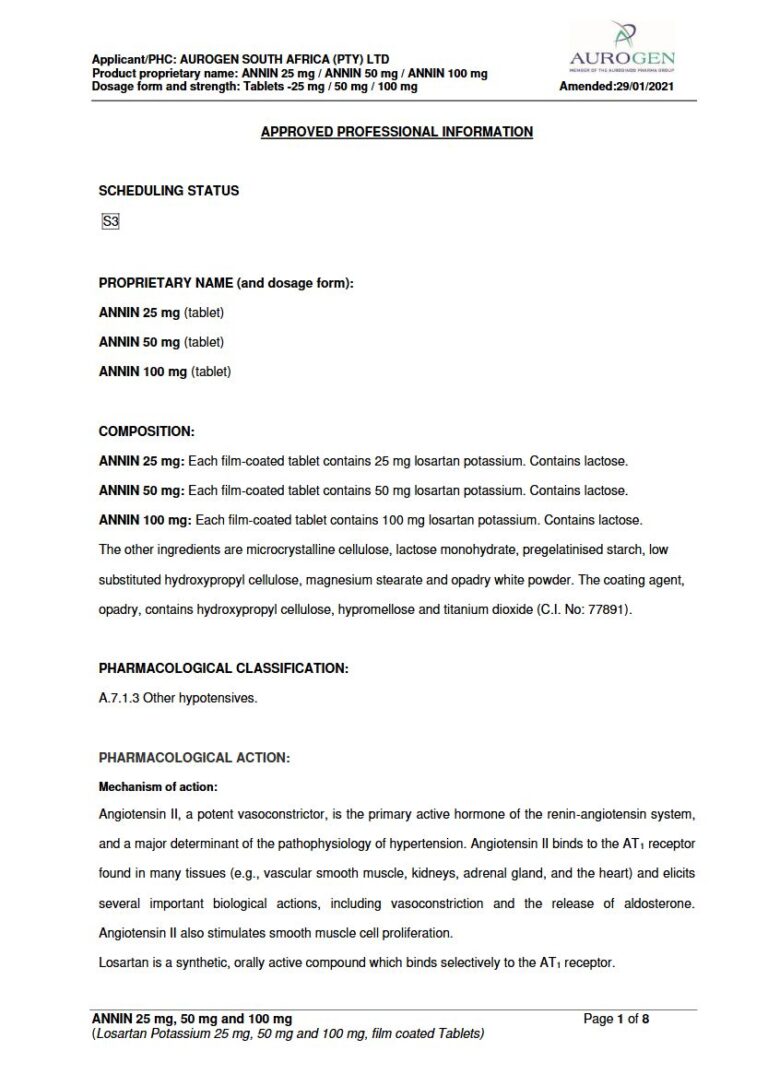
The Annin Tablets professional information leaflet below is the property of Aurogen South Africa and is provided on Medinsert exactly as issued, with no.. alterations or editorial changes. We make every effort to keep content current by updating documents as soon as new versions become available. Medinsert serves as a trusted access point for healthcare professionals, but does not replace official sources or clinical judgement. For more details, please read our full disclaimer. read more>>
 Healthcare Professionals Only
This content is for registered healthcare professionals
Sign in or create a free account to read the full package insert.
Free for HPCSA-registered professionals. Powered by Medinsert.
Clinical Particulars
Section 4 of the official insert — extracted exactly as issued, no alterations
4.1 Therapeutic indications
ANNIN is indicated for the treatment of hypertension.
4.2 Posology and method of administration
The usual starting and maintenance dose is 50 mg once daily for most patients. The maximal antihypertensive effect is attained three to six weeks after initiation of therapy. The dose may be increased to 100 mg once daily.
For patients with intravascular volume-depletion (e.g., those treated with high-dose diuretics), a starting dose of 25 mg once daily should be considered (see u201cWARNINGS AND SPECIAL PRECAUTIONSu201d).
For elderly patients and patients with renal impairment, including patients on dialysis, no initial dosage adjustment is necessary. A lower dose should be considered for patients with a history of hepatic impairment (see u201cWARNINGS AND SPECIAL PRECAUTIONSu201d).
ANNIN may be administered with other antihypertensive agents.
ANNIN may be administered with or without food.
4.3 Contraindications
- Sensitivity to any component of ANNIN.
- A history of angioedema related to previous therapy with ACE inhibitors or angiotensin receptor blockers (ARBs). These patients must never again be given these medicines.
- Hereditary or idiopathic angioedema.
- Hypertrophic obstructive cardiomyopathy.
- Moderate to severe renal function impairment (creatinine clearance less than 30 ml/min).
- Bilateral renal artery stenosis.
- Renal artery stenosis in a patient with a single kidney.
- Aortic stenosis.
- Concomitant therapy with potassium sparing diuretics such as spironolactone, triamterene, amiloride.
- Porphyria.
- Thiazide diuretics in (fixed dose) combination with ANNIN should not be given to patients with Addisonu2019s disease. This therapy is also contraindicated in patients with severe renal impairment or anuria, and in patients who show hypersensitivity to other sulphonamide-derived medicines.
- Lithium therapy: Concomitant administration with ANNIN may lead to toxic blood concentrations of lithium.
- Pregnancy and lactation (see u201cPREGNANCY AND LACTATIONu201d).
- Paediatric use: Safety and effectiveness in children have not been established.
4.4 Special warnings and precautions for use
In patients who are intravascularly volume-depleted (e.g., those treated with high-dose diuretics), symptomatic hypotension may occur. These conditions should be corrected prior to administration of ANNIN, or a lower starting dose should be used (see u201cDOSAGE AND DIRECTIONS FOR USEu201d).
When impaired renal function is present, changes in renal function as a consequence of inhibiting the renin-angiotensin system including renal failure have been reported in susceptible individuals.
Agents that affect the renin-angiotensin system may increase serum creatinine and blood urea in patients with bilateral renal artery stenosis or stenosis of the artery to a solitary kidney. Similar effects have been reported with ANNIN TABLETS.
Based on pharmacokinetic data which demonstrate significantly increased plasma concentrations of losartan in cirrhotic patients, halving of the dose should be considered for patients with a history of hepatic impairment (see u201cDOSAGE AND DIRECTIONS FOR USEu201d).
In patients whose renal function may depend on the activity of the renin-angiotensin-aldosterone system (e.g., patients with severe congestive heart failure), treatment with angiotensin converting enzyme inhibitors has been associated with oliguria and/or progressive azotemia and (less frequently) with acute renal failure and/or death. Similar outcomes have been reported with ANNIN.
ANNIN contains lactose and should not be administered to patients with rare hereditary problems, or a history of galactose intolerance, Lapp lactase deficiency or glucose-galactose malabsorption.
4.5 Interactions with other medicines
The antihypertensive effects of losartan may be potentiated by medicines or other agents that lower blood pressure. An additive hyperkalaemic effect is possible with potassium supplements, potassium-sparing diuretics, or other drugs that can cause hyperkalaemia; losartan and potassium-sparing diuretics should not generally be given together. Losartan and some other angiotensin II receptor antagonists are metabolised by cytochrome P450 isoenzymes and interactions may occur with drugs that affect these enzymes.
Non-steroidal anti-inflammatory medicines (NSAIDS) may antagonise the antihypertensive effect of ANNIN.
4.6 Fertility, pregnancy and lactation
Pregnancy: Safety in pregnancy and lactation has not been established (see u201cCONTRA-INDICATIONSu201d). When pregnancy is planned or confirmed ANNIN should be discontinued. Medicines affecting the renin-angiotensin system, such as ANNIN, can cause embryonal toxicity, foetal and neonatal morbidity and mortality when administered to pregnant women. Women of childbearing age should ensure effective contraception. ANNIN are contra-indicated in lactation.
4.7 Effects on ability to drive and use machines
There are no data to suggest that ANNIN affects the ability to drive and use machines.
4.8 Undesirable effects
In controlled clinical trials for essential hypertension, dizziness, orthostatic hypotension, headache and rash were side effects reported. The following side effects may also occur:
- Body as a whole: Less frequent: Asthenia/fatigue. The following side effects have been reported and frequencies are unknown: Abdominal pain, chest pain, oedema/swelling.
- Cardiovascular: The following side effects have been reported and frequency is unknown: Palpitation, tachycardia, hypotension.
- Digestive: Less frequent: Diarrhoea. The following side effects have been reported and frequency is unknown: Dyspepsia, nausea.
- Musculoskeletal: Less frequent: Back pain, muscle cramps.
- Nervous/Psychiatric: More frequent: Headache. Less frequent: Dizziness, insomnia, migraine.
- Respiratory: Less frequent: Cough, nasal congestion, pharyngitis, sinus disorder, upper respiratory infection.
- Hypersensitivity: The following side effect has been reported and frequency is unknown: Angioedema (involving swelling of the face, lips, and/or tongue).
- Skin: The following side effect has been reported and frequency is unknown: Urticaria.
- Laboratory test findings: In controlled clinical trials, hyperkalemia (serum potassium greater than 5.5 mEq/L) occurred in 1.5% of patients, but in these trials, discontinuation of losartan therapy due to hyperkalemia was not necessary. Elevations of alanine amino transferase (ALT) have occurred but usually resolved upon discontinuation of therapy.
4.9 Overdose
Limited data are available in regard to overdosage in humans. The most likely manifestation of overdosage would be hypotension and tachycardia; bradycardia could occur from parasympathetic (vagal) stimulation. Supportive treatment should be instituted if symptomatic hypotension should occur. Neither losartan nor the active metabolite can be removed by haemodialysis.
