
Forlax 10g Powder for Solution
PDF Leaflet Revision Date: 16 September 2022
Clinical Summary
Quick overview from the medicine insert
Indication
Symptomatic treatment of chronic functional constipation in adults and children aged 8 years and above.
Dosage (summary)
1 to 2 sachets per day, preferably in the morning.
Onset of Action / Duration
Onset: 24-48 hours
Special Populations
- Elderly
- Renal impairment
- Hepatic impairment
Pregnancy & Breastfeeding
Can be used during pregnancy and lactation; negligible systemic absorption.
Key Drug Interactions
- Reduced absorption of narrow therapeutic index drugs
- Interaction with starch-based thickeners
Contraindications
- Hypersensitivity to macrogol
- Severe inflammatory bowel disease
- Digestive perforation
- Ileus
- Indeterminate abdominal pain
Common side effects
- Abdominal pain
- Diarrhoea
- Nausea
- Vomiting
Counselling Points
- Maintain hydration
- Adjuvant to lifestyle changes
- Monitor for severe diarrhoea
Serious warnings
- Caution in patients with electrolyte imbalances
- Risk of aspiration in neurologically impaired children
Important Disclaimer
The Forlax 10g Powder for Solution professional information leaflet below is the property of Litha Pharma and is provided on Medinsert exactly as issued, with no.. alterations or editorial changes. We make every effort to keep content current by updating documents as soon as new versions become available. Medinsert serves as a trusted access point for healthcare professionals, but does not replace official sources or clinical judgement. For more details, please read our full disclaimer. read more>>
 Healthcare Professionals Only
This content is for registered healthcare professionals
Sign in or create a free account to read the full package insert.
Free for HPCSA-registered professionals. Powered by Medinsert.
Clinical Particulars
Section 4 of the official insert — extracted exactly as issued, no alterations
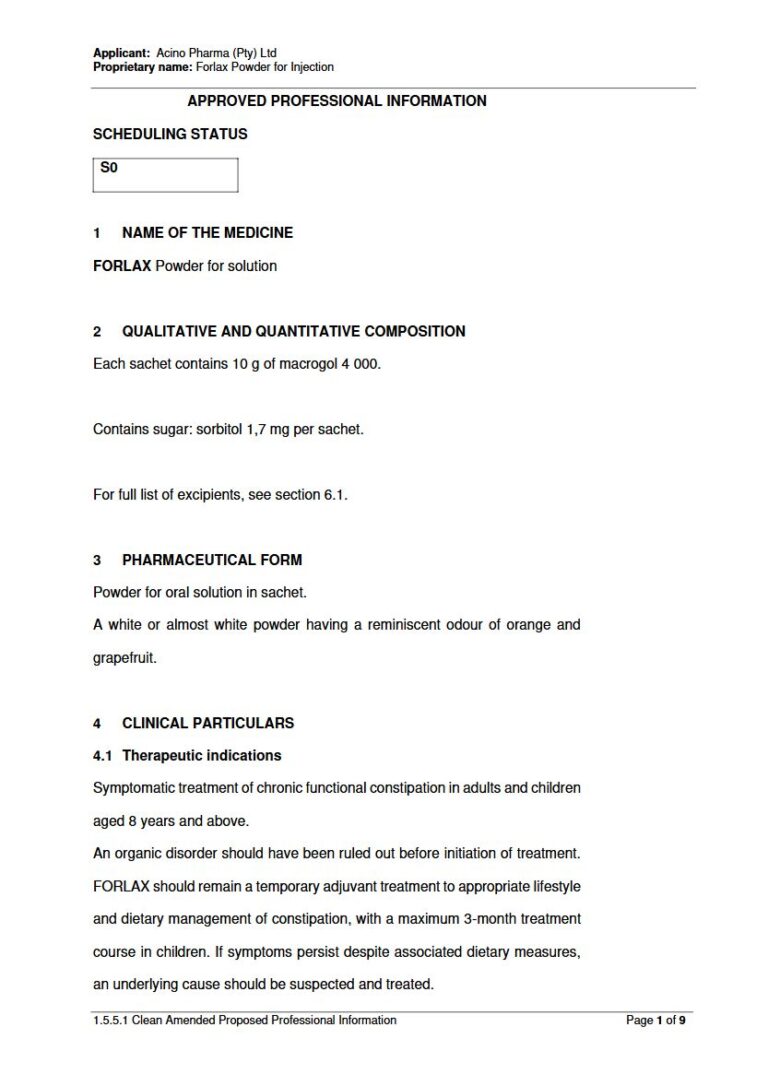
4.1 Therapeutic indications
Symptomatic treatment of chronic functional constipation in adults and children aged 8 years and above. An organic disorder should have been ruled out before initiation of treatment. FORLAX should remain a temporary adjuvant treatment to appropriate lifestyle and dietary management of constipation, with a maximum 3-month treatment course in children. If symptoms persist despite associated dietary measures, an underlying cause should be suspected and treated.
4.2 Posology and method of administration
Posology 1 to 2 sachets per day, preferably taken as a single dose in the morning. The effects of FORLAX becomes apparent within 24 to 48 hours after its administration. In children, treatment should not exceed 3 months due to the lack of clinical data for more than 3 months. Treatment-induced restoration of bowel movements will be maintained by lifestyle and dietary measures. In adults the need for continuing treatment should be reassessed at 3 months. The daily dose should be adapted according to the clinical effects and may range from one sachet every other day (especially in children) up to 2 sachets a day. Method of administration Oral use. The content of each sachet should be dissolved in a glass about 50 ml of water just before use. The resultant solution will be clear and transparent like water.
4.3 Contraindications
- Hypersensitivity to macrogol (polyethylene glycol) or to any of the excipients of FORLAX (see section 6.1).
- Severe inflammatory bowel disease (such as ulcerative colitis, Crohnu2019s disease) or toxic megacolon, associated with symptomatic stenosis.
- Digestive perforation or risk of digestive perforation.
- Ileus or suspicion of intestinal obstruction.
- Painful abdominal syndromes of indeterminate cause.
4.4 Special warnings and precautions for use
The treatment of constipation with any medicine is only an adjuvant to a healthy lifestyle and diet, for example:
- increase intake of liquids and dietary fibre,
- advice on appropriate physical activity and rehabilitation of the bowel reflex.
Use with caution in patients with impaired gag reflex and patients prone to regurgitation or aspiration. Neurologically impaired children who have oral-motor dysfunction are particularly at risk of aspiration. In patients with swallowing problems, who need the addition of a thickener to solutions to enhance an appropriate intake, interactions should be considered, (see section 4.5).
Precautions for use FORLAX does not contain a significant quantity of sugar or polyol and can be prescribed to diabetic patients or patients on a galactose-free diet. This medicine contains less than 1 mmol sodium (23 mg) per sachet that is to say essentially u201csodium - freeu201d.
4.5 Interaction with other medicines and other forms of interaction
There is a possibility that the absorption of other medicines could be transiently reduced during use with FORLAX, particularly medicines with a narrow therapeutic index or short half-life such as digoxin, anti-epileptics, coumarins and immunosuppressive medicines, leading to decreased efficacy. FORLAX may result in a potential interactive effect when used with starch-based food thickeners. The polyethylene glycol (PEG) ingredient counteracts the thickening effect of starch, effectively liquefying preparations that need to remain thick for people with swallowing problems.
4.6 Fertility, pregnancy and lactation
Pregnancy Animal studies do not indicate direct or indirect harmful effects with respect to reproductive toxicity (see section 5.3). There is a limited amount of data (less than 300 pregnancy outcomes) for the use of FORLAX in pregnant women. No adverse effects during pregnancy are anticipated, since systemic exposure to FORLAX is negligible. FORLAX can be used during pregnancy.
Breastfeeding There are no data on the excretion of macrogol 4 000 in breast milk. As macrogol 4 000 is not significantly absorbed, FORLAX may be administered during lactation.
Fertility No fertility studies were conducted with FORLAX however since macrogol 4 000 is not significantly absorbed no effect on fertility is anticipated.
4.7 Effects on ability to drive and use machines
No studies on the effects on the ability to drive and use machines have been performed.
4.8 Undesirable effects
Adverse Drug Reactions are listed under headings of frequency using the following categories: Adverse Drug Reaction Classification Terminology (frequency): Very common (u22651/10); common (u22651/100 to <1/10); uncommon (u22651/1,000 to <1/100); rare (u22651/10,000 to <1/1,000); very rare (<1/10,000); unknown (postmarketing data).
Adults: The undesirable effects listed in the table below have been reported during clinical trials (including 600 adult patients) and post-marketing use. Generally, adverse reactions have been mostly mild and transitory and have mainly concerned the gastrointestinal system:
Children: The undesirable effects listed in the table below have been reported during clinical trials including 147 children aged from 6 months to 15 years and post-marketing use. The adverse reactions have generally been mostly mild and transitory and have mainly concerned the gastrointestinal system:
System organ class Children Adults Gastrointestinal disorders Common Abdominal pain Diarrhoea* Abdominal pain Abdominal distension Diarrhoea Nausea Uncommon Bloating Vomiting Nausea Vomiting Defaecation urgency Faecal incontinence Metabolism and nutrition disorders Frequency unknown Electrolytes disorders (Hyponatraemia, Hypokalaemia) Dehydration Immune system disorders Frequency unknown Hypersensitivity (Anaphylactic shock, Angioedema, Urticaria, Rash, Pruritus) Hypersensitivity (Anaphylactic shock, Angioedema, Urticaria, Rash, Pruritus) * Diarrhoea may cause perianal soreness.
Reporting of suspected adverse reactions Reporting suspected adverse reactions after authorisation of the medicine is important. It allows continued monitoring of the benefit/risk balance of the medicine. Health care providers are asked to report any suspected adverse reactions to SAHPRA via the u201c6.04 Adverse Drug Reactions Reporting Formu201d, found online under SAHPRAu2019s publications: https://www.sahpra.org.za/Publications/Index/8 or Acino Pharma (Pty) Ltd: E-mail: [email protected] Tel: 060 998 7896
4.9 Overdose
Excessive doses may cause diarrhoea, generally stops when the dosage is reduced, or treatment temporarily interrupted. Diarrhoea, abdominal pain and vomiting have been reported. In cases of severe diarrhoea, weight loss and electrolytes imbalance may occur. Excessive fluid loss by diarrhoea or vomiting may require correction of electrolyte disturbances.
