
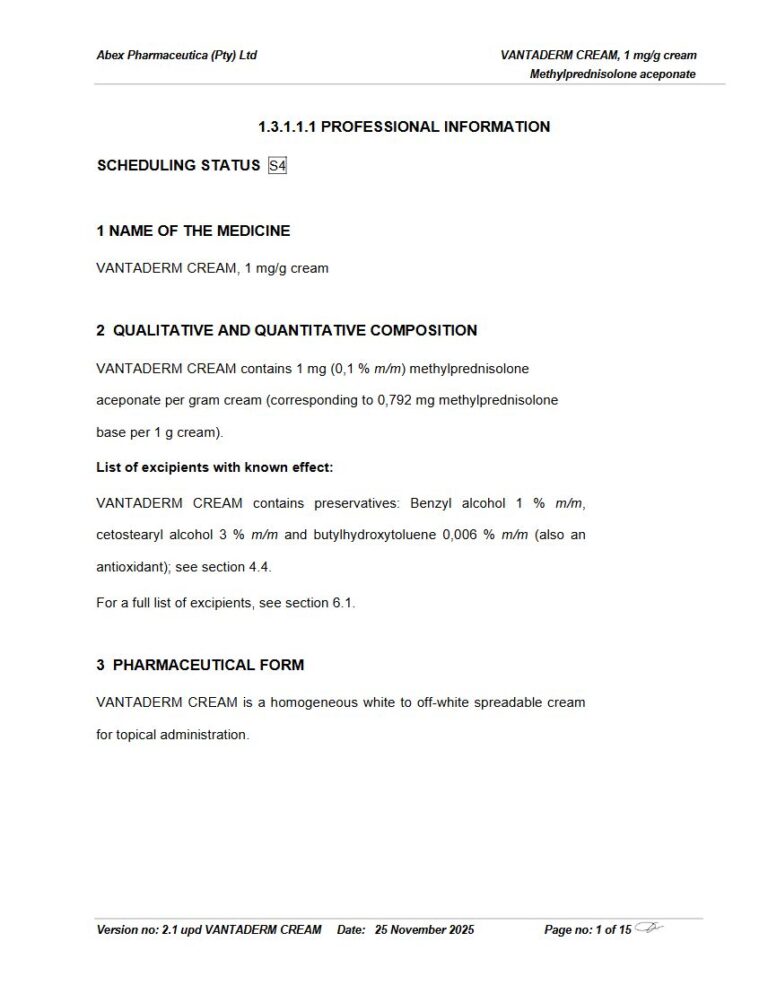
Vantaderm Cream 1 mg Cream
PDF Leaflet Revision Date: 25 November 2025
Clinical Summary
Quick overview from the medicine insert
Indication
Treatment of various types of eczema.
Dosage (summary)
Apply thinly once daily; max 12 weeks for adults, 4 weeks for children.
Special Populations
- Elderly
- Children under 4 months
Pregnancy & Breastfeeding
Not recommended during pregnancy; caution in breastfeeding.
Contraindications
- Hypersensitivity to methylprednisolone aceponate
- Tuberculous or syphilitic processes
- Viral diseases
- Facial application with rosacea or ulcers
- Children under 4 months
Common side effects
- Burning
- Pruritus
- Skin atrophy
- Telangiectasia
Counselling Points
- Apply only to affected areas
- Avoid contact with eyes
- Do not use on sensitive areas for long periods
Serious warnings
- Potential for HPA axis suppression
- Avoid prolonged use
- Risk of rebound flares
Important Disclaimer
The Vantaderm Cream 1 mg Cream professional information leaflet below is the property of Abex Pharmaceutica and is provided on Medinsert exactly as issued, with no.. alterations or editorial changes. We make every effort to keep content current by updating documents as soon as new versions become available. Medinsert serves as a trusted access point for healthcare professionals, but does not replace official sources or clinical judgement. For more details, please read our full disclaimer. read more>>
 Healthcare Professionals Only
This content is for registered healthcare professionals
Sign in or create a free account to read the full package insert.
Free for HPCSA-registered professionals. Powered by Medinsert.
Clinical Particulars
Section 4 of the official insert — extracted exactly as issued, no alterations
4.1 Therapeutic indications
Endogenous eczema (atopic dermatitis, neurodermatitis), contact eczema, dyshidrotic and other eczemas.
4.2 Posology and method of administration
FOR EXTERNAL USE ONLY. The VANTADERM CREAM formulation appropriate to the skin condition is applied thinly once per day to the diseased areas of skin. In general, the duration of use should not exceed 12 weeks in adults and 4 weeks in children. The respective bases are of major importance to the therapeutic effect of the VANTADERM CREAM formulations. VANTADERM CREAM As a low-fat formulation with a high water content, VANTADERM CREAM is particularly suitable for acute and weeping stages of eczema, for very greasy skin and for use on exposed or hairy parts of the body. If the skin dries out excessively under protracted use of VANTADERM CREAM, a switch should be made to a fattier formulation.
4.3 Contraindications
- Hypersensitivity to methylprednisolone aceponate or to any of the excipients listed in 6.1.
- Tuberculous or syphilitic processes in the area to be treated; virus diseases (e.g. herpes simplex, vaccinia, chickenpox, shingles).
- VANTADERM CREAM must not be applied to the face if rosacea, ulcers, atrophic skin diseases, acne vulgaris or perioral dermatitis are present.
- Corticosteroids have been shown to be teratogenic in animals following dermal application. As these substances are absorbed percutaneously, teratogenicity following topical application cannot be excluded. Therefore, [PROPRIETARY NAME] should not be used during pregnancy (see section 4.6).
- Children under four months due to lack of experience.
4.4 Special warnings and precautions for use
Potent topical corticosteroid preparations, such as VANTADERM CREAM, should not be applied to any skin crease areas. Reduced potency and/or frequency of application of topical corticosteroid should be considered, especially in the case of long-term treatment. Special precaution is advised on the prolonged application of VANTADERM CREAM to sensitive areas such as the face and genitals, with duration of treatment to be addressed with the patient. VANTADERM CREAM should not be allowed to come into contact with the eyes, deep open wounds and mucosae. VANTADERM CREAM should be used with caution in nursing mothers. Regular review should be made of the necessity for continuing therapy. If signs of hypersensitivity develop, VANTADERM CREAM should be discontinued and appropriate treatment instituted. Long-term continuous treatment with VANTADERM CREAM should be avoided as far as possible as this may cause atrophic changes in the skin leading to thinning, striae, loss of elasticity, telangiectasia and ecchymoses. These changes are particularly likely to occur on the face and when occlusive dressings are used. Acneiform skin conditions can occur under therapy with potent corticosteroids. Treatment should be discontinued if symptoms such as cutaneous atrophy occur (see also section 4.8). Long-term continuous or inappropriate use of VANTADERM CREAM can result in the development of rebound flares after stopping treatment. There are reports of flares manifesting as dermatitis with intense redness, stinging, and burning that can spread beyond the initial treatment area (see also section 4.8). Underuse of VANTADERM CREAM can prolong treatment duration and increase the risk of certain adverse effects. Systemic absorption of topically applied corticosteroids may occur, particularly under the following conditions: when large quantities are used, or when application is made to wide areas of the body, or to damaged skin, when potent topical corticosteroids are used, and when the occlusive dressing technique is applied. Depression of the hypothalamic-pituitary adrenal (HPA) axis with consequent suppression of the adrenal gland may occur. These effects are most likely to be severe in infants and children. Growth may be retarded and a Cushingoid state may be produced (see u2018Special populationsu2019 below). Benign increased intracranial pressure has been reported. If a secondary microbial skin infection is present suitable concomitant antimicrobial therapy should be instituted. If fungal infections are present, a topically active antimycotic should be applied. Any spread of infection may require withdrawal of topical corticosteroid therapy. VANTADERM CREAM should be used with particular caution in facial dermatoses, and only for short periods. A steroid rosacea-like facies may be produced. If rosacea or perioral dermatitis is present, VANTADERM CREAM must not be applied to the face (see section 4.3). VANTADERM CREAM should not be used in the nappy areas in infants for flexural eruptions, and ideally it should not be applied to infants and young children. The treatment of psoriasis with VANTADERM CREAM may provoke the pustular form of the disease. Glaucoma may also develop from using VANTADERM CREAM (e.g. after large-dose or extensive application over a prolonged period, application under occlusive dressings, or application to skin around or near the eyes). Some of the excipients in VANTADERM CREAM may reduce the effectiveness of latex products such as condoms and diaphragms.
4.5 Interaction with other medicines and other forms of interaction
No specific information exists on interactions with other medicines.
4.6 Fertility, pregnancy and lactation
Pregnancy There is no adequate data from the use of VANTADERM CREAM in pregnant women; VANTADERM CREAM should therefore not be used during pregnancy (see section 4.3). Methylprednisolone aceponate had shown embryonic and/or teratogenic effects in animals. Epidemiological data suggest that there could possibly be an increased risk of oral clefts among newborns of women who were treated with glucocorticosteroids during the first trimester of pregnancy. Reduced placental and birth weight have been recorded in animals and humans after long-term treatment with topical corticosteroids. The possibility of suppression of the adrenal cortex in the new-born baby after long-term treatment must be considered. Breastfeeding It is not known whether topical administration of VANTADERM CREAM could result in sufficient systemic absorption of methylprednisolone aceponate to produce detectable quantities in human milk. Therefore, caution should be exercised when VANTADERM CREAM is administered to a woman who is breastfeeding her baby. Nursing mothers should avoid treatment over large areas, prolonged use or occlusive dressings. VANTADERM CREAM should not be applied to the chest area during breast feeding to avoid possible ingestion by infants. Fertility No information available.
4.7 Effects on ability to drive and use machines
VANTADERM CREAM has no effect on the ability to drive or use machines.
4.8 Undesirable effects
Summary of the safety profile The most frequently reported side effects are burning and pruritus at the application site with VANTADERM CREAM. Tabulated list of adverse reactions System organ class/ Adverse reactions Frequency Immune system disorders Less frequent: Hypersensitivity Eye disorders Frequency not known: Vision blurred Skin and subcutaneous tissue disorders Less frequent: Pyoderma, skin fissures, telangiectasia, skin atrophy, fungal skin infection, acne Frequency not known: Rebound flares after long-term treatment is discontinued, i.e., dermatitis with intense redness, stinging and burning that can spread beyond the initial treatment area. General disorders and administration site conditions Frequent: Application site burning, application site pruritus Less frequent: Application site dryness, application site erythema, application site vesicles, application site folliculitis, application site rash, application site paraesthesia, application site cellulitis, application site oedema, application site irritation Class effects: Systemic effects due to absorption may occur when topical preparations containing corticoids, such as VANTADERM CREAM, are applied. The following additional local side effects may occur with topical corticoids in general, including VANTADERM CREAM: folliculitis, skin atrophy, skin striae, hypertrichosis, perioral dermatitis, skin discolouration. Paediatric population No specific data are available on adverse events in the paediatric population. For precautions in paediatric use, see section 4.4 u201cSpecial populationsu201d. Reporting of suspected adverse reactions Reporting suspected adverse reactions after authorisation of the medicine is important. It allows continued monitoring of the benefit/risk balance of the medicine. Healthcare providers are asked to report any suspected adverse reactions to SAHPRA via the Med Safety APP (Medsafety X SAHPRA) and e-Reporting platform (who-ucmc.org) found on the SAHPRA website.
4.9 Overdose
Excessive dosing may occur with prolonged or intensive topical use. Refer to section 4.8 for further information. If any symptoms of overdosage occur, treatment must be discontinued.
