
Micononin 50 mg/100 mg Solution
PDF Leaflet Revision Date: 03 February 2026
Clinical Summary
Quick overview from the medicine insert
Indication
Treatment and prophylaxis of invasive candidiasis.
Dosage (summary)
Adults: 100 mg/day for invasive candidiasis; 150 mg/day for oesophageal candidiasis.
Special Populations
- Hepatic impairment
- Renal impairment
- Paediatric population
Pregnancy & Breastfeeding
Not recommended during pregnancy or breastfeeding.
Key Drug Interactions
- Sirolimus
- Nifedipine
- Itraconazole
Contraindications
- Hypersensitivity to micafungin
Common side effects
- Nausea
- Vomiting
- Phlebitis
- Increased liver enzymes
Counselling Points
- Monitor for liver function
- Report any rash or allergic reactions
- Avoid in lactose intolerance
Serious warnings
- Risk of liver tumors
- Anaphylactic reactions
- Severe hepatic dysfunction
Important Disclaimer
The Micononin 50 mg/100 mg Solution professional information leaflet below is the property of Kahma Biotech and is provided on Medinsert exactly as issued, with no.. alterations or editorial changes. We make every effort to keep content current by updating documents as soon as new versions become available. Medinsert serves as a trusted access point for healthcare professionals, but does not replace official sources or clinical judgement. For more details, please read our full disclaimer. read more>>
 Healthcare Professionals Only
This content is for registered healthcare professionals
Sign in or create a free account to read the full package insert.
Free for HPCSA-registered professionals. Powered by Medinsert.
Clinical Particulars
Section 4 of the official insert — extracted exactly as issued, no alterations
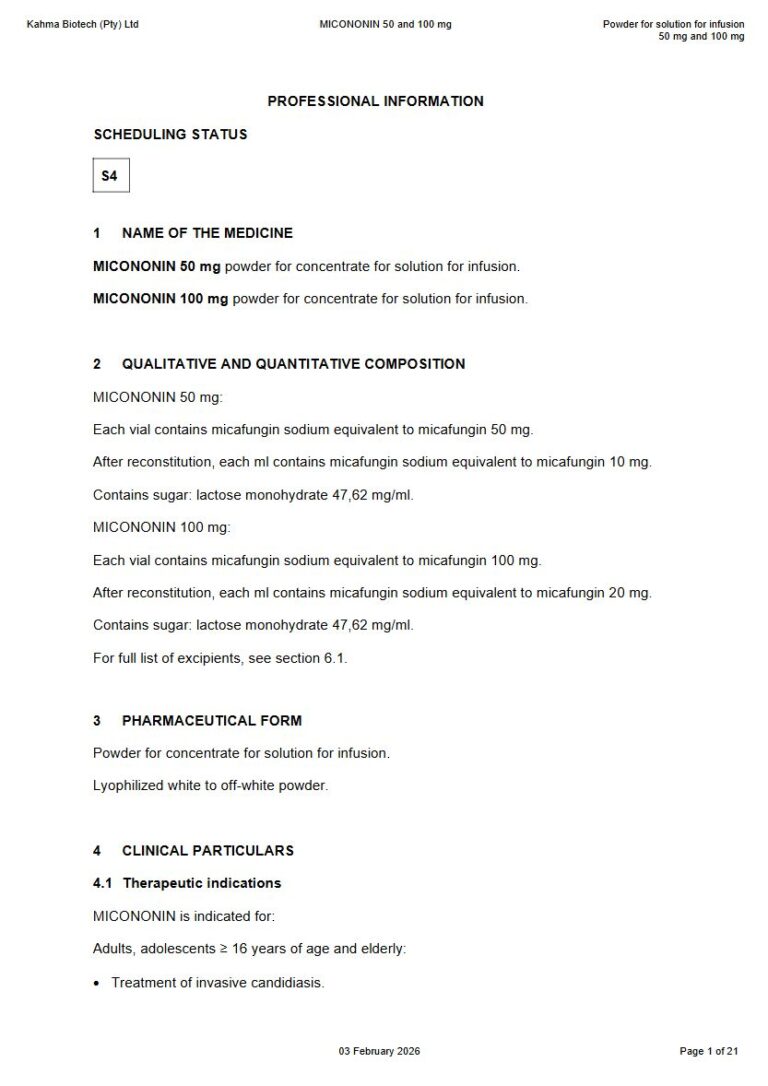
4.1 Therapeutic indications
MICONONIN is indicated for:
Adults, adolescents u2265 16 years of age and elderly:
- Treatment of invasive candidiasis.
- Treatment of oesophageal candidiasis in patients for whom intravenous therapy is appropriate.
- Prophylaxis of Candida infection in patients undergoing allogenic haematopoietic stem cell transplantation or patients who are expected to have neutropenia (absolute neutrophil count < 500 cells/u03bcl) for 10 or more days.
Children (including neonates) and adolescents < 16 years of age:
- Treatment of invasive candidiasis.
- Prophylaxis of Candida infection in patients undergoing allogenic haematopoietic stem cell transplantation or patients who are expected to have neutropenia (absolute neutrophil count < 500 cells/u03bcl) for 10 or more days.
Commonly susceptible species [MIC ranges in Europe, mg/L] in vitro Candida albicans [0,007 u2013 0,25], Candida glabrata [0,007 u2013 0,12], Candida tropicalis [0,007 u2013 0,12], Candida krusei [0,015 u2013 0,12], Candida kefyr [0,03 u2013 0,06], Candida parapsilosis [0,12 u2013 2], Candida guilliermondii [0,5], Candida lusitaniae [0,12 u2013 0,25], Candida spp. [0,015 u2013 0,5] (incl. C. famata, C. dubliniensis, C. lipolytica, C. pelliculosa, C. rugosa, C. stellatoidea and C. zeylanoides ), Aspergillus fumigatus, Aspergillus flavus, Aspergillus niger, Aspergillus terreus, Aspergillus nidulans, Aspergillus versicolor .
The mycelial form of dimorphic fungi (e.g. Histoplasma capsulatum, Blastomyces dermatitidis, Coccidioides immitis ).
The decision to use MICONONIN should take into account a potential risk for the development of liver tumours MICONONIN should therefore only b e used if other antifungals are not appropriate (see section 4.4).
4.2 Posology and method of administration
Posology
Treatment with MICONONIN should be initiated by a medical practitioner experienced in the management of fungal infections. Specimens for fungal culture and other relevant laboratory studies (including histopathology) should be obtained prior to therapy to isolate and identify causative organism(s). Therapy may be instituted before the results of the cultures and other laboratory studies are known. However, once these results become available, antifungal therapy should be adjusted accordingly.
The dose regimen of MICONONIN depends on the body weight of the patient as given in the following tables:
Use in adults, adolescents u2265 16 years of age and elderly
Indication Body weight > 40 kg Body weight u2264 40 kg
- Treatment of invasive candidiasis 100 mg/day* 2 mg/kg/day
- Treatment of oesophageal candidiasis 150 mg/day 3 mg/kg/day
- Prophylaxis of Candida infection 50 mg/day 1 mg/kg/day
* If the patientu2019s response is inadequate, e.g., persistence of cultures or if clinical condition does not improve, the dose may be increased to 200 mg/day in patients weighing > 40 kg or 4 mg/kg/day in patients u2264 40 kg.
Use in children u2265 4 months of age up to adolescents < 16 years of age
Indication Body weight > 40 kg Body weight u2264 40 kg
- Treatment of invasive candidiasis 100 mg/day* 2 mg/kg/day
- Prophylaxis of Candida infection 50 mg/day 1 mg/kg/day
* If the patientu2019s response is inadequate, e.g., persistence of cultures or if clinical condition does not improve, the dose may be increased to 200 mg/day in patients weighing > 40 kg or 4 mg/kg/day in patients u2264 40 kg.
Use in children (including neonates) < 4 months
Indication Treatment of invasive candidiasis 4 - 10 mg/kg/day* Prophylaxis of Candida infection 2 mg/kg/day
* Micafungin dosed at 4 mg/kg in children less than 4 months approximates drug exposures achieved in adults receiving 100 mg/day for the treatment of invasive candidiasis. If central nervous system (CNS) infection is suspected, a higher dosage (e.g. 10 mg/kg) should be used due to the dose-dependent penetration of micafungin into the CNS. The safety and efficacy in children (including neonates) less than 4 months of age of doses of 4 and 10 mg/kg for the treatment of invasive candidiasis with CNS involvement has not been adequately established in controlled clinical studies.
Treatment duration
Invasive candidiasis The treatment duration of Candida infection should be a minimum of 14 days. The antifungal treatment should continue for at least one week after two sequential negative blood cultures have been obtained and after resolution of clinical signs and symptoms of infection.
Oesophageal candidiasis For the treatment of oesophageal candidiasis, MICONONIN should be administered for at least one week after resolution of clinical signs and symptoms.
Prophylaxis of Candida infections For prophylaxis of Candida infection, MICONONIN should be administered for at least one week after neutrophil recovery.
Special populations
Hepatic impairment No dose adjustment is necessary in patients with mild or moderate hepatic impairment. There are currently no data available for the use of MICONONIN in patients with severe hepatic impairment and its use is not recommended in these patients (see section 4.4 and 4.8).
Renal impairment No dose adjustment is necessary in patients with renal impairment.
Paediatric population Experience with MICONONIN in patients less than 2 years of age is limited.
Method of administration For intravenous use. After reconstitution and dilution, the solution should be administered by intravenous infusion over approximately 1 hour. More rapid infusions may result in more frequent histamine mediated reactions. The reconstituted solution should be a clear transparent solution and free of visible particles as undissolved matter. For reconstitution instructions see section 6.6.
4.3 Contraindications
- Hypersensitivity to micafungin or to any of the other excipients of MICONONIN (see section 6.1).
4.4 Special warnings and precautions for use
Hepatic effects The development of foci of altered hepatocytes (FAH) and hepatocellular tumours after a treatment period of 3 months or longer were observed in rats. The assumed threshold for tumour development in rats is approximately in the range of clinical exposure. The clinical relevance of this finding is not known. Liver function should be carefully monitored during micafungin treatment. To minimise the risk of adaptive regeneration and potentially subsequent liver tumour formation, early discontinuation in the presence of significant and persistent elevation of ALT/AST is recommended. Micafungin treatment should be conducted on a careful risk/benefit basis, particularly in patients having severe liver function impairment or chronic liver diseases known to represent preneoplastic conditions, such as advanced liver fibrosis, cirrhosis, viral hepatitis, neonatal liver disease or congenital enzyme defects, or receiving a concomitant therapy including hepatotoxic and/or genotoxic properties. Principles of antibiotics stewardship should be adhered to.
Data indicates that micafungin (as contained in MICONONIN) treatment was associated with significant impairment of liver function (increase of ALT, AST or total bilirubin > 3 times ULN) in both healthy volunteers and patients. In some patients more severe hepatic dysfunction, hepatitis, or hepatic failure including fatal cases have been reported. Paediatric patients < 1 year of age might be more prone to liver injury (see section 4.8).
Anaphylactic reactions During administration of MICONONIN, anaphylactoid reactions including shock may occur. If these reactions occur, MICONONIN infusion should be discontinued, and appropriate treatment administered.
Skin reactions Exfoliative cutaneous reactions, such as Stevens-Johnson syndrome and toxic epidermal necrolysis have been reported. If patients develop a rash, they should be monitored closely and MICONONIN discontinued if lesions progress.
Haemolysis Cases of haemolysis, including acute intravascular haemolysis or haemolytic anaemia, have been reported in patients treated with micafungin (as in MICONONIN). Patients who develop clinical or laboratory evidence of haemolysis during MICONONIN therapy should be monitored closely for evidence of worsening of these conditions and evaluated for the risk/benefit of continuing MICONONIN therapy.
Renal effects MICONONIN may cause kidney problems, renal failure, and abnormal renal function test. Patients should be closely monitored for worsening of renal function.
4.5 Interactions with other medicines
A total of 14 clinical interaction studies were conducted in healthy volunteers to evaluate the potential for interaction between micafungin and mycophenolate mofetil, ciclosporin, tacrolimus, prednisolone, sirolimus, nifedipine, fluconazole, ritonavir, rifampicin, amphotericin B, itraconazole and voriconazole. In these studies, no interaction that altered the pharmacokinetics of micafungin was observed. Exposure (AUC) of sirolimus was increased in the presence of micafungin (21 %). Patients receiving sirolimus in combination with micafungin should be monitored for sirolimus toxicity and the sirolimus dosage should be adjusted if necessary.
4.6 Fertility, pregnancy and lactation
Pregnancy There are no data from the use of MICONONIN in pregnant women. In animal studies micafungin crossed the placental barrier and reproductive toxicity was seen. The potential risk for humans is unknown. MICONONIN should not be used during pregnancy.
Breastfeeding It is not known whether MICONONIN is excreted in human breast milk. Animal studies have shown excretion of MICONONIN in breast milk. MICONONIN should not be used during breastfeeding.
Fertility Testicular toxicity was observed in animal studies. MICONONIN may have the potential to affect male fertility in humans.
4.7 Effects on ability to drive and use machines
No studies on the effects on the ability to drive and use machines have been performed. However, patients should be informed that somnolence and dizziness has been reported during treatment with MICONONIN (see section 4.8).
4.8 Undesirable effects
a. Summary of the safety profile Overall, 32,2 % of the patients experienced adverse drug reactions. The most frequently reported adverse reactions were nausea, increased blood alkaline phosphatase, phlebitis (primarily in HIV infected patients with peripheral lines), vomiting, and increased aspartate aminotransferase. No clinically significant differences were seen when the safety data were analysed by gender or race.
b. Tabulated summary of adverse reactions The frequency of adverse reactions listed below is defined using the following convention: frequent; less frequent or frequency unknown (cannot be estimated from the available data).
System organ class Frequency Adverse reactions
Blood and lymphatic system disorders Frequent Leukopenia, neutropenia, anaemia Less frequent Pancytopenia, thrombocytopenia, eosinophilia, hypoalbuminaemia, haemolytic anaemia, haemolysis (see section 4.4) Frequency unknown Disseminated intravascular coagulation
Immune system disorders Less frequent Anaphylactic/anaphylactoid reaction, hypersensitivity Frequency unknown Anaphylactic and anaphylactoid shock (see section 4.4)
Endocrine disorders Less frequent Hyperhidrosis
Metabolism and nutrition disorders Frequent Hypokalaemia, hypomagnesaemia, hypocalcaemia Less frequent Hyponatraemia, hyperkalaemia, hypophosphataemia, anorexia
Psychiatric disorders Less frequent Insomnia, anxiety, confusion
Nervous system disorders Frequent Headache Less frequent Somnolence, tremor, dizziness, dysgeusia
Cardiac disorders Less frequent Tachycardia, palpitations, bradycardia
Vascular disorders Frequent Phlebitis Less frequent Hypotension, hypertension, flushing
Frequency unknown Shock
Respiratory, thoracic and mediastinal disorders Less frequent Dyspnoea
Gastrointestinal disorders Frequent Nausea, vomiting, diarrhoea, abdominal pain Less frequent Dyspepsia, constipation
Hepato-biliary disorders Frequent Increased blood alkaline phosphatase, increased aspartate aminotransferase, increased alanine aminotransferase, increased blood bilirubin (including hyperbilirubinaemia), abnormal liver function test
Less frequent Hepatic failure (see section 4.4), increased gammaglutamyl-transferase, jaundice, cholestasis, hepatomegaly, hepatitis
Frequency unknown Hepatocellular damage including fatal cases (see section 4.4)
Skin and subcutaneous tissue disorders Frequent Rash Less frequent Urticaria, pruritis, erythema (2, 3) Frequency unknown Toxic skin eruption, erythema multiforme, Stevens-Johnson syndrome, toxic dermal necrolysis (see section 4.4)
Renal and urinary disorders Less frequent Increased blood creatinine, increased blood urea, aggravated renal failure
Frequency unknown Renal impairment (see section 4.4), acute renal failure
General disorders and administration site conditions Frequent Pyrexia, rigors Less frequent Injection site thrombosis, infusion site inflammation, injection site pain, peripheral oedema
Investigations Less frequent Increased blood lactate dehydrogenase
c. Description of selected adverse reactions Hepatic adverse reactions Most hepatic adverse reactions were mild and moderate. Most frequent reactions were increase in AP, AST, ALT, blood bilirubin and abnormal liver function test. Few patients discontinued treatment due to a hepatic event. Cases of serious hepatic dysfunction occurred uncommonly (see section 4.4).
d. Paediatric population Some adverse reactions (listed below) were higher in paediatric patients than in adult patients. Additionally, paediatric patients < 1 year of age experienced about two times more often an increase in ALT, AST and AP than older paediatric patients. The most likely reason for these differences were different underlying conditions compared with adults or older paediatric patients. The proportion of paediatric patients with neutropenia was several-fold higher than in adult patients, as well as allogenic HSCT and haematological malignancy.
Blood and lymphatic system disorder Frequent u2013 thrombocytopenia Cardiac disorder Frequent u2013 tachycardia Vascular disorders Frequent u2013 hypertension, hypotension Hepatobiliary disorders Frequent u2013 hyperbilirubinaemia, hepatomegaly Renal and urinary disorders Frequent u2013 acute renal failure, increased blood urea
Reporting of suspected adverse reactions Reporting suspected adverse reactions after authorisation of the medicine is important. It allows continued monitoring of the benefit/risk balance of the medicine. Health care providers are asked to report any suspected adverse reactions to SAHPRA via the Med Safety APP (Medsafety X SAHPRA) and eReporting platform (who-umc.org) found on the SAHPRA website.
4.9 Overdose
There is no experience with overdoses of MICONONIN. In case of overdose, general supportive measures and symptomatic treatment should be administered. MICONONIN is highly protein-bound and not dialysable.
