
Daktarin 20mg / 1g Cream
PDF Leaflet Revision Date: 25 November 2011
Clinical Summary
Quick overview from the medicine insert
Indication
Treatment of dermatomycoses and candidial infections.
Dosage (summary)
Apply twice daily until lesions disappear, then continue for 10-14 days.
Pregnancy & Breastfeeding
Safety in pregnancy and lactation not established.
Key Drug Interactions
- Caution with oral anticoagulants like warfarin.
- Increased effects of oral hypoglycemics and phenytoin.
Contraindications
- Hypersensitivity to miconazole or formulation ingredients.
Common side effects
- Skin burning sensation
- Application site irritation
- Hypersensitivity reactions
Counselling Points
- For external use only.
- Monitor for skin irritation.
Serious warnings
- Discontinue if sensitivity or irritation occurs.
- Avoid contact with eyes.
Important Disclaimer
The Daktarin 20mg / 1g Cream professional information leaflet below is the property of Janssen and is provided on Medinsert exactly as issued, with no.. alterations or editorial changes. We make every effort to keep content current by updating documents as soon as new versions become available. Medinsert serves as a trusted access point for healthcare professionals, but does not replace official sources or clinical judgement. For more details, please read our full disclaimer. read more>>
 Healthcare Professionals Only
This content is for registered healthcare professionals
Sign in or create a free account to read the full package insert.
Free for HPCSA-registered professionals. Powered by Medinsert.
Clinical Particulars
Section 4 of the official insert — extracted exactly as issued, no alterations
4.1 Therapeutic indications
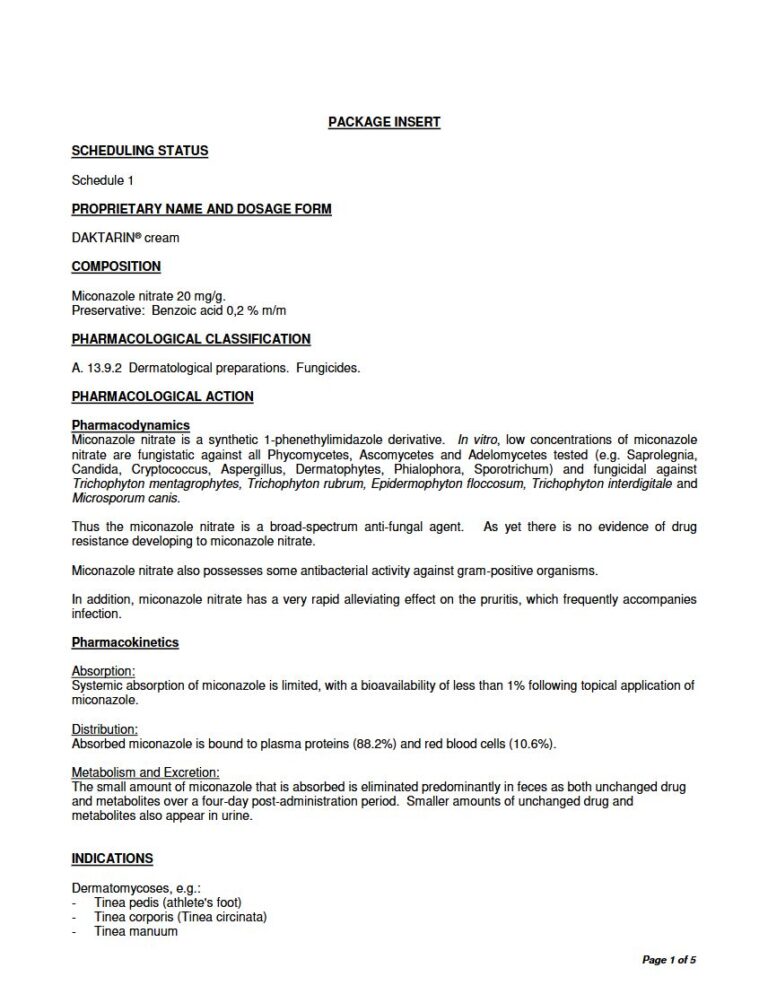
Dermatomycoses, e.g.:
- Tinea pedis (athlete's foot)
- Tinea corporis (Tinea circinata)
- Tinea manuum
- Tinea cruris due to:
- Trichophyton mentagrophytes
- Trichophyton rubrum
- Microsporum audouinii
- Epidermophyton floccosum
Candidial infections:
Infections of the skin (.e.g. intertrigo)
Perianal infections
Stomatitis angularis (cheilitis, perleche)
Balanoposthitis
4.2 Posology and method of administration
For external use only. DAKTARIN cream should be applied to the lesion twice daily and thoroughly rubbed into the skin with a finger. When all lesions have disappeared (usually after 2 to 5 weeks), treatment should be continued for a further 10 to 14 days to prevent relapse.
4.3 Contraindications
DAKTARIN cream is contra-indicated in individuals with a known hypersensitivity to miconazole or another ingredient of the formulation.
4.4 Special warnings and precautions for use
If a reaction suggesting sensitivity or irritation should occur, the treatment should be discontinued. DAKTARIN cream must not come into contact with the eyes.
4.5 Interactions with other medicines
Miconazole administered systemically is known to inhibit CYP3A4/2C9. Due to the limited systemic availability after topical application (see Pharmacokinetic properties), clinically relevant interactions occur very rarely. However, in patients on oral anticoagulants, such as warfarin, caution should be exercised and the anticoagulant effect should be monitored. The effects and side effects of some other drugs (e.g., oral hypoglycemics and phenytoin), when co-administered with DAKTARIN cream, can be increased and caution should be exercised.
4.6 Fertility, pregnancy and lactation
Pregnancy
Although there is no evidence that miconazole is embryotoxic or teratogenic in animals, safety in human pregnancy has not been demonstrated.
Lactation
It is not known whether miconazole is excreted in human breast milk. Therefore, safety has not been demonstrated in breastfeeding women.
4.7 Effects on ability to drive and use machines
Not applicable
4.8 Undesirable effects
Clinical trial data
Adverse drug reactions reported among 834 patients who received miconazole 2% cream and/or placebo cream base in 21 double-blind clinical trials are presented in Table 1 below. Included in the table are all adverse events considered to be related to study medicine. A dash indicates that the adverse reaction was not reported by patients in the specified treatment group.
Table 1: Adverse drug reactions reported by patients in either treatment group in 21 double-blind clinical trials of miconazole 2% cream versus placebo.
System Organ Class Adverse drug reaction Miconazole 2% cream (n= 426), % Placebo cream base (n=408), % Overall adverse drug reactions 1.9 1.2 Skin and subcutaneous tissue disorders Skin burning sensation Skin inflammation Skin hypopigmentation General disorders and administration site conditions Application site irritation Application site burning Application site pruritus Application site reaction (Not otherwise specified) Application site warmth 0.2 0.2 0.2 0.7 0.2 0.2 0.2 0.2 0.7 -- -- 0.5 0.2 -- -- --
Note: Individual patients may have reported more than a single event.
4.9 Overdose
Symptoms
Topical use: Excessive use can result in skin irritation, which usually disappears after discontinuation of therapy.
Treatment
Accidental ingestion: DAKTARIN cream is intended for topical use, not for oral use. Should accidental oral ingestion of large quantities of this product occur, an appropriate method of gastric emptying may be used if considered necessary.
