
Nasonex 100 mg Aqueous Nasal Spray
PDF Leaflet Revision Date: 19-01-2018
Clinical Summary
Quick overview from the medicine insert
Indication
Treatment of seasonal or perennial allergic rhinitis.
Dosage (summary)
Adults: 2 sprays in each nostril once daily; Children (2-11 years): 1 spray in each nostril once daily.
Special Populations
- Children under 2 years
- Patients with untreated infections
Pregnancy & Breastfeeding
Safety in pregnancy and lactation not established.
Key Drug Interactions
- Strong CYP3A4 inhibitors may increase corticosteroid effects
Contraindications
- Hypersensitivity to ingredients
- Untreated localized infections
- Children under 2 years
Common side effects
- Epistaxis
- Pharyngitis
- Nasal burning
- Headache
Counselling Points
- Shake well before use
- Monitor for nasal mucosa changes
- Report visual disturbances
Serious warnings
- Caution in patients with infections
- Potential for adrenal insufficiency during corticosteroid withdrawal
Important Disclaimer
The Nasonex 100 mg Aqueous Nasal Spray professional information leaflet below is the property of Organon South Africa and is provided on Medinsert exactly as issued, with no.. alterations or editorial changes. We make every effort to keep content current by updating documents as soon as new versions become available. Medinsert serves as a trusted access point for healthcare professionals, but does not replace official sources or clinical judgement. For more details, please read our full disclaimer. read more>>
 Healthcare Professionals Only
This content is for registered healthcare professionals
Sign in or create a free account to read the full package insert.
Free for HPCSA-registered professionals. Powered by Medinsert.
Clinical Particulars
Section 4 of the official insert — extracted exactly as issued, no alterations
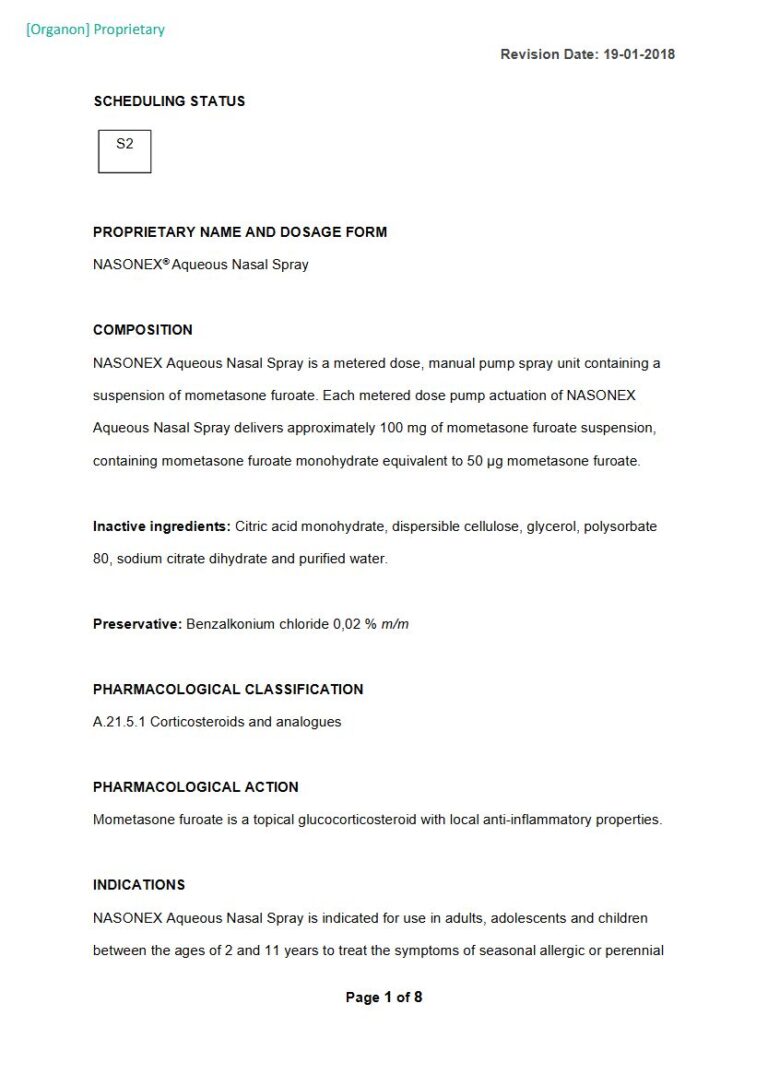
4.1 Therapeutic indications
NASONEX Aqueous Nasal Spray is indicated for use in adults, adolescents and children between the ages of 2 and 11 years to treat the symptoms of seasonal allergic or perennial allergic rhinitis. In patients who have a history of moderate to severe symptoms of seasonal allergic rhinitis, prophylactic treatment with NASONEX Aqueous Nasal Spray is recommended prior to the anticipated start of the pollen season.
4.2 Posology and method of administration
After initial priming of the NASONEX Aqueous Nasal pump (usually 10 actuations, until a uniform spray is observed), each actuation delivers approximately 100 mg of mometasone furoate suspension, containing mometasone furoate monohydrate equivalent to 50 u03bcg mometasone furoate. If the spray pump has not been used for 14 days or longer, it should be reprimed with 2 actuations, until a uniform spray is observed, before next use. No priming subsequent to the initial priming is required with regular use. Shake container well before each use.
Seasonal or Perennial Allergic Rhinitis
Adults (including geriatric patients) and adolescents: The usual recommended dose for prophylaxis and treatment is 2 sprays (50 u03bcg/spray) into each nostril once daily (total dose 200 u03bcg). Once symptoms are controlled, dose reduction to 1 spray into each nostril (total dose 100 u03bcg) may be effective in some patients for maintenance. If symptoms are inadequately controlled, the dose may be increased to a maximum daily dose of 4 sprays into each nostril once daily (total dose 400 u03bcg). Dose reduction is recommended following control of symptoms.
Children between the ages of 2 and 11 years: The usual recommended dose is 1 spray (50 u03bcg/spray) into each nostril once daily (total dose 100 u03bcg). Administration to young children should be aided by an adult.
4.3 Contraindications
Hypersensitivity to any ingredients of NASONEX Aqueous Nasal Spray. Pregnancy and lactation (see PREGNANCY AND LACTATION). Children under 2 years, as safety and efficacy have not been demonstrated.
4.4 Special warnings and precautions for use
NASONEX Aqueous Nasal Spray should not be used in the presence of untreated localised infection involving the nasal mucosa. Because of the inhibitory effect of corticosteroids on wound healing, patients who have experienced recent nasal surgery or trauma should not use a nasal corticosteroid until healing has occurred. Patients using NASONEX Aqueous Nasal Spray over several months or longer should be examined periodically for possible changes in the nasal mucosa. If localised fungal infection of the nose or pharynx develops, discontinuance of NASONEX Aqueous Nasal Spray or appropriate treatment may be required. Persistence of nasopharyngeal irritation may be an indication for discontinuing NASONEX Aqueous Nasal Spray. NASONEX Aqueous Nasal Spray should be used with caution, if at all, in patients with active or quiescent tuberculous infections of the respiratory tract, or in untreated fungal, bacterial, systemic viral infections or ocular herpes simplex.
Patients who are transferred from long-term administration of systemically active corticosteroids to NASONEX Aqueous Nasal Spray require careful attention. Systemic corticosteroid withdrawal in such patients may result in adrenal insufficiency for a number of months until recovery of hypothalamic-pituitary-adrenal (HPA) axis function. If these patients exhibit signs and symptoms of adrenal insufficiency, systemic corticosteroid administration should be resumed and other modes of therapy and appropriate measures instituted. During transfer from systemic corticosteroids to NASONEX Aqueous Nasal Spray, some patients may experience symptoms of withdrawal from systemically active corticosteroids (e.g. joint and/or muscular pain, lassitude and depression initially) despite relief from nasal symptoms and will require encouragement to continue NASONEX Aqueous Nasal Spray therapy. Such transfer may also unmask pre-existing allergic conditions, such as allergic conjunctivitis and eczema, previously suppressed by systemic corticosteroid therapy. Patients receiving corticosteroids who are potentially immunosuppressed should be warned of the risk of exposure to certain infections (e.g. chickenpox, measles) and of the importance of obtaining medical advice if such exposure occurs. Following the use of intranasal aerosolised corticosteroids, instances of nasal septum perforation or increased intraocular pressure have been reported very rarely. Visual disturbance may be reported with systemic and topical (including intranasal, inhaled and intraocular) corticosteroid use. If a patient presents with symptoms such as blurred vision or other visual disturbances, the patient should be considered for referral to an ophthalmologist for evaluation of possible causes of visual disturbances which may include cataract, glaucoma or rare diseases such as central serous chorioretinopathy (CSCR) which have been reported after use of systemic and topical corticosteroids.
4.5 Interactions with other medicines
NASONEX Aqueous Nasal Spray has been administered concomitantly with loratadine with no apparent effect on plasma concentrations of loratadine or its major metabolite. Mometasone furoate plasma concentrations were not detectable. Mometasone furoate is metabolised by CYP3A4. Co-administration with strong CYP3A4 inhibitors (e.g. ketoconazole, itraconazole, clarithromycin, ritonavir, cobicistat-containing products) may lead to increased plasma concentrations of corticosteroids and potentially increase the risk for systemic corticosteroid side effects. Consider the benefit of co-administration versus the potential risk of systemic corticosteroid effects, in which case patients should be monitored for systemic corticosteroid side effects.
4.6 Fertility, pregnancy and lactation
Safety in pregnancy and lactation has not been established (see CONTRAINDICATIONS).
4.7 Effects on ability to drive and use machines
No specific studies have been conducted to evaluate the effects of NASONEX Aqueous Nasal Spray on the ability to drive and use machines.
4.8 Undesirable effects
Treatment-related adverse events reported in clinical studies for allergic rhinitis in adult and adolescent patients are shown below in Table 1.
Table 1: Allergic Rhinitis - Treatment Related Undesirable Effects for NASONEX Aqueous Nasal Spray
Very Common (u2265 1/10); Common (u2265 1/100 to < 1/10); Uncommon (u2265 1/1 000 to < 1/100); Rare (u2265 1/10 000 to < 1/1 000); Very Rare (< 1/10 000)
Respiratory, thoracic and mediastinal disorders
- Common: Epistaxis, pharyngitis, nasal burning, nasal irritation, nasal ulceration
General disorders and administration site conditions
- Common: Headache
Epistaxis was generally self-limiting and mild in severity. In clinical trials in paediatric patients, the incidence of adverse effects e.g. epistaxis (6 %), headache (3 %), nasal irritation (2 %) and sneezing (2 %) was comparable to placebo. Other side effects are: Dizziness, rhinitis, sinusitis, cough, skin rash, nasal septum irritation, rhinorrhoea, conjunctivitis, dry eyes and nausea. Disturbances of taste and smell have been reported very rarely. Cases of immediate hypersensitivity reactions (e.g. bronchospasm, dyspnoea), angioedema and anaphylaxis have been reported after intranasal administration. Blurred vision has been reported.
4.9 Overdose
See WARNINGS AND SPECIAL PRECAUTIONS. Because of the negligible (u2264 0,1 %) systemic bioavailability of NASONEX Aqueous Nasal Spray, overdose is unlikely to require any therapy other than observation, followed by initiation of the appropriate prescribed dosage. Inhalation or oral administration of excessive doses of corticosteroids may lead to suppression of HPA axis function.
