
Dulera Suspension
PDF Leaflet Revision Date: 26 August 2022
Clinical Summary
Quick overview from the medicine insert
Indication
Prophylactic maintenance treatment of asthma and COPD.
Dosage (summary)
Adults: 2 inhalations twice daily. Children 5-12 years: 2 inhalations of 50/5 u03bcg twice daily.
Special Populations
- Paediatric patients < 5 years
- Geriatric patients u2265 65 years
Pregnancy & Breastfeeding
Safety not established; monitor infants for hypoadrenalism.
Key Drug Interactions
- Strong CYP3A4 inhibitors
- Beta-adrenergic blockers
- Xanthine derivatives
Contraindications
- Hypersensitivity to components
- Active tuberculosis
Common side effects
- Dysphonia
- Oral candidiasis
- Headache
Counselling Points
- Rinse mouth after use
- Use short-acting beta-agonist for acute symptoms
- Monitor for signs of infection
Serious warnings
- Not for acute asthma/COPD episodes
- Risk of adrenal suppression
- Potential for inhalation-induced bronchospasm
Important Disclaimer
The Dulera Suspension professional information leaflet below is the property of Organon South Africa and is provided on Medinsert exactly as issued, with no.. alterations or editorial changes. We make every effort to keep content current by updating documents as soon as new versions become available. Medinsert serves as a trusted access point for healthcare professionals, but does not replace official sources or clinical judgement. For more details, please read our full disclaimer. read more>>
 Healthcare Professionals Only
This content is for registered healthcare professionals
Sign in or create a free account to read the full package insert.
Free for HPCSA-registered professionals. Powered by Medinsert.
Clinical Particulars
Section 4 of the official insert — extracted exactly as issued, no alterations
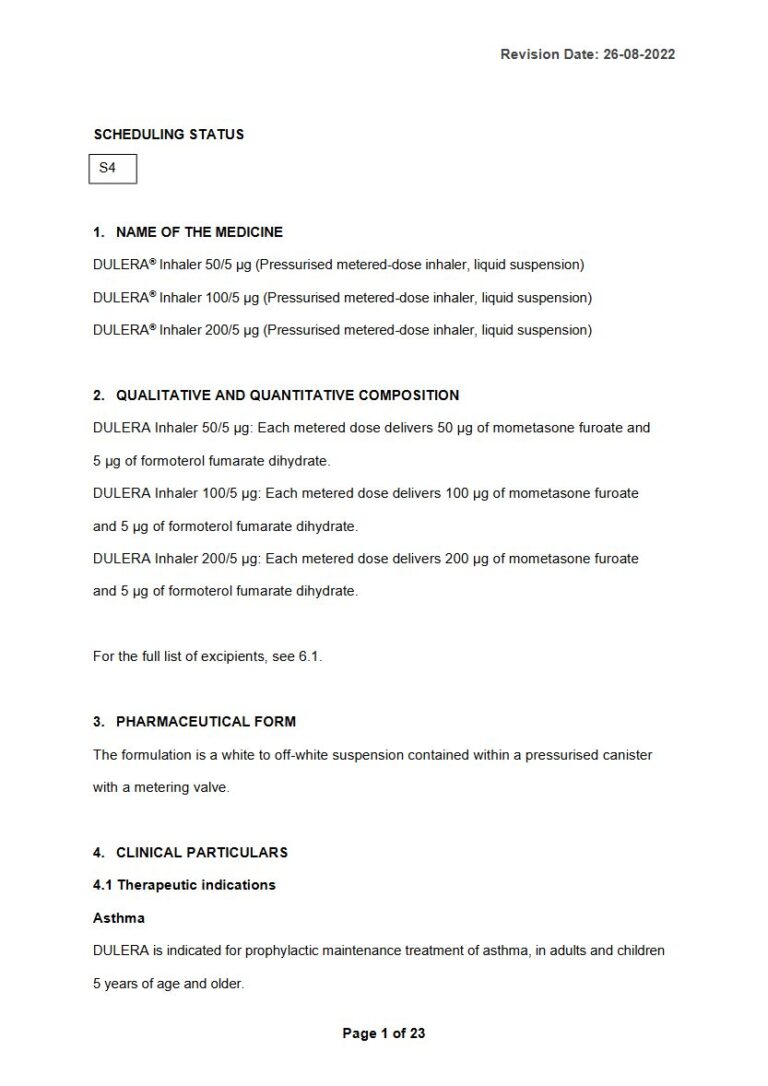
4.1 Therapeutic indications
Asthma
DULERA is indicated for prophylactic maintenance treatment of asthma, in adults and children 5 years of age and older. DULERA should be used for asthmatic patients not adequately controlled with inhaled corticosteroids and 'as needed' inhaled short acting beta 2 -agonists. DULERA may also be used in patients already adequately controlled on both inhaled corticosteroids and long-acting beta 2 -agonists, separately.
Chronic Obstructive Pulmonary Disease (COPD)
DULERA 200/5 u03bcg is indicated for the prophylactic twice-daily maintenance treatment of airflow obstruction in patients with chronic obstructive pulmonary disease (COPD), including chronic bronchitis and/or emphysema. Efficacy has not been demonstrated for more than 26 weeks in COPD.
4.2 Posology and method of administration
DULERA should be administered by oral inhalation only. After each dose, patients are advised to rinse their mouth with water and spit out the contents, without swallowing. This helps to reduce the risk of candidiasis.
Dosage
Asthma
Adult and adolescent patients aged 12 years and older
DULERA should be administered as two inhalations twice daily (morning and evening) by oral inhalation. When choosing the starting dosage strength of DULERA, consider the patientu2019s disease severity based on their previous asthma therapy, including the inhaled corticosteroid dosage, as well as the patientu2019s current control of asthma symptoms and risk of future exacerbation. For patients whose asthma is currently controlled, the recommended dose for DULERA treatment based on prior asthma therapy is provided in Table 1.
Table 1: Recommended Dosages for DULERA
Previous Therapy Recommended Dose Maximum Recommended Daily Dose
Inhaled low dose corticosteroids DULERA 50/5 u03bcg, 2 inhalations twice daily 200/20 u03bcg
Inhaled medium dose corticosteroids DULERA 100/5 u03bcg, 2 inhalations twice daily 400/20 u03bcg
Inhaled high dose corticosteroids DULERA 200/5 u03bcg, 2 inhalations twice daily 800/20 u03bcg
For patients who have not previously received inhaled corticosteroids but are recommended to be at the lowest dose of mometasone in the combination, the recommended starting dose must be decided by the medical practitioner depending upon asthma severity. The maximum daily recommended dose is two inhalations of DULERA 200/5 u03bcg twice daily for patients 12 years of age and older. If symptoms arise between doses, an inhaled short-acting beta 2 -agonist should be used for immediate relief.
Paediatric patients aged 5 to less than 12 years
For patients aged 5 to less than 12 years, the dosage is two inhalations of DULERA 50/5 u03bcg twice daily (morning and evening) by oral inhalation. The maximum recommended daily dosage is 200/20 u03bcg. If symptoms arise between doses, an inhaled short-acting beta 2 -agonist should be taken for immediate relief.
All patients aged 5 years and older
Patients should be regularly reassessed by a doctor. If a previously effective dosage regimen of DULERA fails to provide adequate control of asthma, the therapeutic regimen should be re-evaluated and additional therapeutic options, e.g., replacing the current strength of DULERA with a higher strength, adding additional inhaled corticosteroid, or initiating oral corticosteroids should be considered. After asthma stability has been achieved, it is desirable to titrate to the lowest effective dosage.
Chronic Obstructive Pulmonary Disease (COPD)
The dosage for the majority of patients with COPD is 2 inhalations of DULERA 200/5 u03bcg twice daily. Two inhalations of DULERA 100/5 u03bcg, twice daily may be considered in some patients.
Method of administration
DULERA should be administered by oral inhalation only. Shake well before use. The cap from the mouthpiece of the actuator should be removed before using DULERA. The DULERA canister should only be used with the DULERA actuator. The DULERA actuator should not be used with any other inhalation medicinal product. Actuators from other products should not be used with the DULERA canister. The canister should not be removed from the actuator because the correct amount of medication may not be discharged; the dose counter may not function properly; reinsertion may cause the dose counter to count down by 1 and discharge a puff.
4.3 Contraindications
Hypersensitivity to mometasone furoate, formoterol fumarate or to any of the excipients.
Active treated/untreated or quiescent tuberculous infections of the respiratory tract.
4.4 Special warnings and precautions for use
Exacerbations
In a 26-week, randomised, double-blind, post-marketing clinical trial consisting of 11 729 patients ages 12 years and older, who received DULERA or mometasone furoate monotherapy, there were no asthma-related intubations or asthma-related deaths in either treatment arm. These results are consistent with three other, similarly designed, post-marketing clinical trials evaluating other ICS/LABA and ICS treatments for asthma, two in 23 360 patients aged 12 years and older (combined n=23 360), and one in 6 208 paediatric patients aged 4 to 11 years (n=6 208). There were no asthma-related intubations or asthma-related deaths in the paediatric trial and none of the 4 studies showed an increased risk of serious asthma events in ICS/LABA. Therefore, these findings are considered applicable to the ICS/LABA class.
DULERA should not be initiated in patients during rapidly deteriorating or potentially life-threatening episodes of asthma or COPD. DULERA has not been studied in patients with acutely deteriorating asthma or COPD. The doctor or healthcare provider should reassess asthma or COPD therapy if symptoms persist, if after dosing has been increased to maintain control, asthmatic episodes or deterioration of COPD are not responsive to bronchodilators, or the patient exhibits decreased lung function (e.g., decreased peak flow), the underlying condition may have deteriorated. In such cases, consideration should be given to the need for additional oral corticosteroid or alternative therapies.
Acute asthma or COPD episodes
DULERA is not indicated for rapid relief of bronchospasm or other acute episodes of asthma or COPD. In the event of an acute attack, a short-acting beta 2 -agonist should be used. A short acting beta 2 -agonist should be available at all times. Patients must be informed of the need to seek medical treatment immediately if their asthma or COPD deteriorates suddenly.
Excessive use of DULERA and use with other long-acting beta 2 -agonists
DULERA should not be used in conjunction with another long-acting beta 2 -agonist. In patients with asthma, the dose of DULERA should be individualised to the patient's needs and should be at the lowest possible dose to fulfil the therapeutic objective. The dose of DULERA should not be increased beyond the maximum recommended dose for asthma or COPD (see 4.2). There is no evidence that supports that the administration of DULERA in amounts greater than recommended doses, increases efficacy.
Oropharyngeal Candidiasis
During clinical trials with DULERA, oral candidiasis which is associated with the use of inhaled glucocorticosteroids, occurred. The infection may require treatment with appropriate antifungal therapy and in some patients, discontinuation of DULERA may be necessary. To reduce the occurrence of oropharyngeal candidiasis, after dosing with DULERA, advise patients to rinse their mouth with water and spit out the contents without swallowing.
Immunosuppression
Use DULERA with caution, if at all, in patients with untreated fungal, bacterial, systemic viral infections or ocular herpes simplex (see 4.3). Advise patients who are receiving corticosteroids or other immunosuppressant medicines of the risk of exposure to certain infections (e.g., chickenpox, measles), and of the importance of obtaining medical advice if such exposure occurs. This is of particular importance in children.
Transferring from systemic corticosteroid therapy
Particular care is needed for patients who are transferred from systemic active corticosteroids to DULERA, because deaths due to adrenal insufficiency have occurred in asthmatic patients during and after transfer from systematic corticosteroids to less systemically available inhaled corticosteroids. After withdrawal from systemic corticosteroids, a number of months is required for recovery of hypothalamic-pituitary-adrenal (HPA) axis function. During periods of stress including trauma, surgery, infection or a severe asthma attack, patients transferred from systemic corticosteroids will require supplementary treatment with a short course of systemic corticosteroids, which is gradually tapered as symptoms subside. It is recommended that such patients carry a supply of oral corticosteroids and a warning card indicating their need and recommended dosage of systemic corticosteroids during stressful periods. Periodic testing of adrenocortical function, particularly measurement of early morning plasma cortisol levels, is recommended.
In patients with asthma, transfer of patients from systemic corticosteroid therapy to DULERA may unmask pre-existing allergic conditions previously suppressed by systemic corticosteroid therapy. If this occurs, symptomatic treatment is recommended.
Systemic effects of corticosteroids
Systemic effects of inhaled corticosteroids such as mometasone in DULERA may occur, particularly at high doses prescribed for prolonged periods. Possible systemic effects include adrenal suppression, growth retardation in children and adolescents, decrease in bone mineral density, cataracts and glaucoma. It is important that the dose of DULERA is titrated in patients with asthma to the lowest dose at which effective control of asthma is maintained. Cases of cataracts and glaucoma have been reported with use of mometasone furoate, such as in DULERA. Visual disturbance may be reported with systemic and topical (including intranasal, inhaled and intraocular) corticosteroid use. If a patient presents with symptoms such as blurred vision or other visual disturbances, the patient should be considered for referral to an ophthalmologist for evaluation of possible causes of visual disturbances, which may include cataract, glaucoma or rare diseases such as central serous chorioretinopathy (CSCR), which have been reported after use of systemic and topical corticosteroids.
Adrenal suppression
When using inhaled DULERA, there is a possibility for clinically significant adrenal suppression, especially after treatment with higher than recommended doses. This must be considered during periods of stress or elective surgery, when additional systemic corticosteroids may be needed.
Inhalation induced bronchospasm
When using DULERA, the potential for inhalation induced bronchospasm should be kept in mind. If this occurs, DULERA should be discontinued immediately, and alternative therapy substituted.
Concomitant conditions
DULERA should be used with caution in patients with ischaemic heart disease, cardiac dysrhythmias (especially third-degree atrioventricular block), severe cardiac decompensation, idiopathic sub-valvular aortic stenosis, severe hypertension, vascular aneurysm (e.g., aorta or cerebrum), pheochromocytoma, hypertrophic obstructive cardiomyopathy, hyperthyroidism and known or suspected prolongation of the QT interval (QTc > 0,44 sec), (see 4.5).
Hypokalaemia and hyperglycaemia
Potentially serious hypokalaemia may occur as a result of beta 2 -agonist therapy, such as in DULERA. Hypokalaemia may increase susceptibility to cardiac dysrhythmias. Particular caution is advised in patients with severe asthma or COPD, as hypokalaemia may be potentiated by hypoxia and concomitant treatment (see 4.5). It is recommended that serum potassium levels be monitored in such situations. Due to the hyperglycaemic effect of beta 2 -stimulants, including formoterol as in DULERA, additional blood glucose monitoring is recommended in diabetic patients.
Pneumonia and other lower respiratory tract infections
Doctors should remain vigilant for the possible development of pneumonia in patients with COPD, as the clinical features of pneumonia and exacerbations of COPD frequently overlap. In COPD patients, lower respiratory tract infections including pneumonia, have been reported following the inhaled administration of corticosteroids, such as in DULERA.
Specific populations
Paediatric population < 5 years of age: The safety and efficacy of DULERA have not been established in children less than 5 years of age.
Paediatric population 5 years to less than 12 years of age
The safety and effectiveness of DULERA 50/5 u03bcg two inhalations twice daily, has been established in 851 patients with asthma, aged 5 to less than 12 years, in clinical trials up to 24 weeks of treatment duration. Patients in this age-group demonstrated efficacy and safety results similar to those observed in patients aged 12 years and older who were treated with DULERA (see 4.8).
Adolescent population 12 to 17 years of age
The safety and efficacy of DULERA have been established in 151 patients 12 to 17 years of age, across 5 clinical trials up to 52 weeks in duration. Patients in this age-group demonstrated efficacy and safety results similar to those observed in patients 18 years of age and older. In addition, in a 26-week post-marketing trial consisting of 5 868 patients treated with DULERA, similar safety and efficacy results were observed in 491 adolescent patients (ages 12 to 17 years), compared to 4 578 adult (18 to u2264 64 years of age) and 799 geriatric (u2265 65 years of age) patients who were treated with DULERA.
4.5 Interaction with other medicines and other forms of interaction
No formal interaction studies have been performed with DULERA. The interactions of the DULERA combination are expected to reflect those of the individual components.
Interactions with strong CYP3A4 inhibitors:
Co-administration with strong CYP3A4 inhibitors (e.g., ketoconazole, itraconazole, clarithromycin, ritonavir, cobicistat-containing products), may lead to increased exposure to corticosteroids, and therefore the potential for increased risk of systemic corticosteroid side effects. Consider the benefit of co-administration versus the potential risk of systemic corticosteroid effects, in which case patients should be monitored for systemic corticosteroid side effects.
Adrenergic agents:
Concomitant administration of other sympathomimetic agents may potentiate the undesirable effects of formoterol.
Xanthine derivatives and diuretics:
Concomitant treatment with xanthine derivatives or non-potassium sparing diuretics may potentiate the possible hypokalaemic effect of beta 2 - agonists (see 4.4).
Monoamine oxidase inhibitors, tricyclic antidepressants and medicines known to prolong the QTc interval:
Formoterol as in DULERA, should be administered with caution to patients being treated with medicines such as quinidine, disopyramide, procainamide, phenothiazines, macrolides, azole antifungals, monoamine oxidase inhibitors including linezolid and tricyclic antidepressants, or any medicine known to prolong the QTc interval, because the action of adrenergic agonists on the cardiovascular system may be potentiated by these agents. Medicines that are known to prolong the QTc-interval have an increased risk of ventricular dysrhythmias (see 4.4).
Beta-adrenergic receptor antagonists:
Beta-adrenergic blockers may weaken or antagonise the effect of formoterol. Therefore DULERA should not be given with beta-adrenergic blockers (including eye drops).
Halogenated hydrocarbons (Inhalation medicines used in anaesthetics):
There is an elevated risk of dysrhythmias in patients receiving concomitant anaesthesia with halogenated hydrocarbons.
4.6 Fertility, pregnancy and lactation
Safety in pregnancy and lactation has not been established. Infants born of mothers who received corticosteroids during pregnancy are to be observed carefully for hypoadrenalism.
Formoterol may inhibit labour due to a relaxant effect on uterine smooth muscle.
4.7 Effects on ability to drive and use machines
DULERA may cause dizziness. Patients experiencing dizziness should avoid driving and use of machines.
4.8 Undesirable effects
Asthma
Adult and adolescent patients 12 years and older
In four trials ranging from 12 to 52 weeks involving 1 132 patients with asthma receiving DULERA 50/5 u03bcg, DULERA 100/5 u03bcg or DULERA 200/5 u03bcg, the most frequent treatment-related adverse reactions were dysphonia (1,4 %), oral candidiasis (1,2 %) and headache (1,2 %). These and other undesirable effects reported from these clinical trials are listed in the table below.
All ADRs are listed by class and frequency.
Table 2: Adverse reactions reported during clinical trials for DULERA
Very common (u2265 1/10); Common (u2265 1/100 to u02c2 1/10); Uncommon (u2265 1/1 000 to u02c2 1/100); Rare (u2265 1/10 000 to u02c2 1/1 000)
System Organ Class Adverse Event Frequency
Infections and infestations Oral candidiasis Pharyngitis Common Uncommon
Immune system disorders Hypersensitivity reactions with the following manifestations: Bronchospasm * Rare
*Reported in a 52-week study
u2020 As measured by a u2265 1 point change in the Lens Opacities Classification System, Version III (LOCS III). No incidences of appearance of posterior subcapsular cataracts were reported.
In a 26-week, randomised, double-blind, post-marketing clinical trial consisting of 11 729 patients aged 12 years and older, who received at least one dose of DULERA (100 u03bcg/5 u03bcg or 200 u03bcg/5 u03bcg) or mometasone furoate monotherapy (100 u03bcg or 200 u03bcg), safety outcomes were generally comparable to those observed in earlier clinical trials; no new safety signals were identified. There were no asthma-related intubations (endotracheal) or asthma-related deaths in patients treated with DULERA. The overall incidence of serious adverse events was low (2,3 %).
Paediatric patients 5 years to less than 12 years of age
The safety data for paediatric patients 5 years to less than 12 years of age are primarily based on a clinical trial of 24 weeks treatment duration with a 2-week safety follow-up. A total of 181 patients with asthma (92 male and 89 female) who were receiving any ICS/LABA therapy at trial entry, were randomised to either DULERA 50/5 u03bcg (n=91) or mometasone furoate MDI 50 u03bcg (n=90), each administered as 2 inhalations twice daily. Common treatment-emergent adverse events that occurred in patients treated with DULERA with an incidence of u2265 3 % included influenza, upper respiratory tract infection and headache. To further evaluate the safety profile of DULERA, 50 u03bcg mometasone furoate 2 inhalations twice daily from the trial was pooled with the same dose in a 12-week placebo-controlled clinical trial consisting of 578 patients with asthma. The most common treatment-emergent adverse events occurring in patients treated with DULERA with an incidence of u2265 3 % were influenza and upper respiratory tract infection. Overall, the safety profile for paediatric patients is similar to that observed in patients aged 12 years and older; there were no new safety signals or apparent dose-related adverse events.
COPD
In two clinical trials ranging from 26 to 52 weeks, involving 2 251 patients with COPD and receiving DULERA 100 u03bcg/5 u03bcg or 200 u03bcg/5 u03bcg, the following additional adverse reactions were reported with uncommon frequency (u2265 1/1 000 to < 1/100): Oral pain, diabetes mellitus, dysgeusia, somnolence and pruritus.
Post-marketing experience
The following side effects have been reported in post-marketing use and the frequencies are unknown: Hypokalaemia; hyperglycaemia, angina pectoris, cardiac dysrhythmias (e.g., atrial fibrillation, ventricular extrasystoles, tachydysrhythmia), hypersensitivity reactions (e.g., rash, angioedema and anaphylactic reaction), asthma aggravation (e.g., cough, dyspnoea, wheezing and bronchospasm), and vision blurred.
Reporting of suspected adverse reactions
Reporting suspected adverse reactions after authorisation of the medicine is important. It allows continued monitoring of the benefit/risk balance of the medicine. Healthcare professionals are asked to report any suspected adverse reactions to SAHPRA via the u201c6.04 Adverse Drug Reaction Reporting Formu201d, found online under SAHPRAu2019s publications: https://www.sahpra.org.za/Publications/Index/8.
4.9 Overdose
Mometasone furoate
Inhalation or oral administration of excessive doses of corticosteroids may lead to suppression of HPA axis function.
Formoterol fumarate
Excessive formoterol fumarate is likely to lead to effects that are typical of beta 2 -adrenergic stimulants: Nausea, vomiting, headaches, tremor, drowsiness, palpitations, tachycardia, ventricular dysrhythmias, metabolic acidosis, hypokalaemia, hyperglycaemia, hypertension.
Treatment
DULERA: Supportive and symptomatic treatment is indicated. In serious cases, patients should be hospitalised. Use of cardio-selective beta-blockers may be considered, but only under supervision of a doctor and with extreme caution, since the use of beta-adrenergic blocker medication may provoke bronchospasm. Adrenal function monitoring should be included as part of management.
