
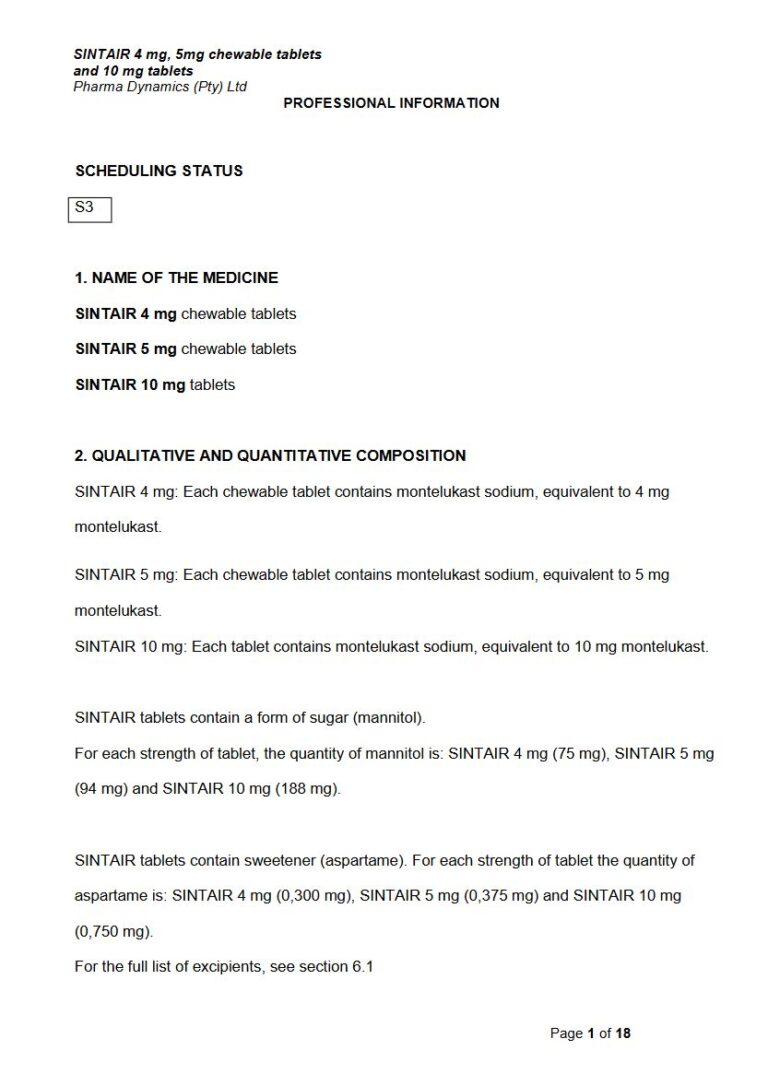
Sintair 4 Mg/5 Mg/10 Mg Chewable Tablets
PDF Leaflet Revision Date: 17 August 2022
Clinical Summary
Quick overview from the medicine insert
Indication
Prophylaxis and chronic treatment of atopic asthma.
Dosage (summary)
4 mg for 2-5 years, 5 mg for 6-14 years, 10 mg for 15 years and older, once daily in the evening.
Special Populations
- Elderly
- Renal impairment
- Hepatic impairment
Pregnancy & Breastfeeding
Not recommended during pregnancy or lactation; potential congenital defects reported.
Key Drug Interactions
- Phenobarbitone
- Gemfibrozil
- CYP inducers/inhibitors
Contraindications
- Hypersensitivity to montelukast
- Children under 2 years
- Pregnancy
- Lactation
Common side effects
- Headache
- Dizziness
- Upper respiratory infection
- Abnormal dreams
Counselling Points
- Take daily as prescribed
- Continue during asthma control
- Report neuropsychiatric symptoms
Serious warnings
- Not for acute asthma attacks
- Risk of neuropsychiatric events
- Eosinophilia risk
Important Disclaimer
The Sintair 4 Mg/5 Mg/10 Mg Chewable Tablets professional information leaflet below is the property of Pharma Dynamics and is provided on Medinsert exactly as issued, with no.. alterations or editorial changes. We make every effort to keep content current by updating documents as soon as new versions become available. Medinsert serves as a trusted access point for healthcare professionals, but does not replace official sources or clinical judgement. For more details, please read our full disclaimer. read more>>
 Healthcare Professionals Only
This content is for registered healthcare professionals
Sign in or create a free account to read the full package insert.
Free for HPCSA-registered professionals. Powered by Medinsert.
Clinical Particulars
Section 4 of the official insert — extracted exactly as issued, no alterations
4.1 Therapeutic indications
u2022 SINTAIR 4 mg chewable tablets are indicated in paediatric patients 2 to 5 years of age for the prophylaxis and chronic treatment of atopic asthma.
u2022 SINTAIR 5 mg chewable tablets are indicated in paediatric patients from 6 years of age for the prophylaxis and chronic treatment of atopic asthma.
u2022 SINTAIR 10 mg tablets are indicated in adults and children 15 years of age and older for the prophylaxis and chronic treatment of atopic asthma.
u2022 In asthmatic adults in whom SINTAIR is indicated, SINTAIR may provide some symptomatic relief of seasonal allergic rhinitis.
4.2 Posology and method of administration
u2022 SINTAIR 4 mg / 5 mg are chewable tablets.
u2022 SINTAIR should be taken once daily in the evening.
u2022 SINTAIR tablets may be taken with or without food.
u2022 Patients should be advised to continue taking SINTAIR while their asthma is controlled, as well as during periods of worsening asthma.
Treatment for atopic asthma:
Paediatric patients 2 to 5 years : One SINTAIR 4 mg chewable tablet daily.
Paediatric patients 6 to 14 years : One SINTAIR 5 mg chewable tablet daily.
Adults and children 15 years of age and older : One SINTAIR 10 mg tablet daily.
Treatment of patients with both atopic asthma and seasonal allergic rhinitis:
Adults and children 15 years of age and older : One SINTAIR 10 mg tablet, daily. In chronic asthma the dose is given in the evening.
SINTAIR has not been studied in children with both of these conditions.
Treatment for asthma: SINTAIR can be added to a patientu2019s existing treatment regimen.
Special populations
No dosage adjustment is necessary for paediatric patients, the elderly, patients with renal insufficiency, patients with mild to moderate hepatic impairment, or for patients of either gender.
Missed dose
Doctors should advise patients who forget to take SINTAIR to take a dose as soon as possible and then continue with the normal dose. Patients should not take a double dose to compensate for the missed dose.
4.3 Contraindications
u2022 Hypersensitivity to montelukast or to any of the ingredients of SINTAIR
u2022 Pregnancy and lactation (see section 4.6)
u2022 SINTAIR 4 mg: Safety and efficacy have not been established in children under the age of 2 years.
u2022 SINTAIR 5 mg: Safety and efficacy have not been established in children under the age of 6 years.
u2022 SINTAIR 10 mg: Safety and efficacy have not been established in children under the age of 15 years.
4.4 Special warnings and precautions for use
SINTAIR is not indicated for use in the reversal of bronchospasm in acute asthma attacks, including status asthmaticus. The efficacy of SINTAIR has not been established for the treatment of acute asthma attacks. Patients should be advised to have appropriate rescue medication available. During acute exacerbations of asthma, therapy with SINTAIR can be continued.
Eosinophilic conditions:
Patients on therapy with SINTAIR may present with eosinophilia, sometimes presenting with clinical features of vasculitis consistent with Churg-Strauss syndrome, a condition which is often treated with systemic corticosteroid therapy. These events have been associated with the reduction of oral corticosteroid therapy. Medical practitioners should be on the alert for patients presenting with eosinophilia, vasculitic rash, worsening of pulmonary symptoms, cardiac complications, and/or neuropathy. Patients who develop these symptoms should be reassessed and their treatment regimens evaluated.
Neuropsychiatric events:
Neuropsychiatric events have been reported in some patients taking SINTAIR. These include agitation, aggression, anxiousness, hostility, dream abnormalities, hallucinations, depression, insomnia, irritability, restlessness, suicidal ideation and behaviour (including suicide), and tremor. Patients and health care professionals should be aware of the potential for neuropsychiatric events. Patients should be instructed to inform their health care professionals if these events occur. Health care professionals should carefully evaluate the risks and benefits of continuing treatment with SINTAIR if such events occur.
Hypersensitivity to aspirin:
Patients with a known hypersensitivity to aspirin should continue avoiding aspirin and NSAIDs while taking SINTAIR. Although SINTAIR is effective in improving airway function in asthmatics, it has not been shown to reduce the bronchoconstrictor response to aspirin or other non-steroidal anti-inflammatory drugs (NSAIDs) in aspirin-sensitive asthmatic patients.
Hepatic function impairment:
The metabolism of montelukast may be decreased in patients with mild to moderate hepatic function impairment and clinical evidence of cirrhosis. The half-life may be slightly prolonged; however, dosage adjustment is not necessary. Data are not available in patients with severe hepatic impairment.
Patients should be advised to take SINTAIR daily as prescribed, even if they are asymptomatic, as well as during periods of worsening of asthma, and to contact their medical practitioners if their asthma is not well controlled. Medical attention should be sought if more than the prescribed maximum number of inhalations of short-acting bronchodilator treatment for a 24-hour period is needed.
SINTAIR should not be used as mono-therapy for the management and treatment of exercise- induced bronchospasm. Patients should continue with their usual inhaled beta-agonists as prophylaxis and have a short-acting inhaled beta - agonist available for rescue, if they experience exacerbations of asthma after exercise.
SINTAIR should not be substituted abruptly for inhaled or oral corticosteroids. The dose of the corticosteroid may be tapered gradually under medical supervision. To ensure safe and appropriate use, patients should be advised to read [the precautions section in] the patient information leaflet.
Porphyria:
SINTAIR is considered to be unsafe in patients with porphyria because montelukast is considered to be probably porphyrinogenic.
Information on excipients of SINTAIR :
SINTAIR tablets contain mannitol and may have a laxative effect. SINTAIR tablets contain aspartame as a sweetener, which is metabolised to phenylalanine, and may be hazardous to patients with phenylketonuria.
4.5 Interactions with other medicines
SINTAIR may routinely be used together with medicines used in the prophylaxis and chronic treatment of asthma. Montelukast, as in SINTAIR, does not significantly change the pharmacokinetics of theophylline, warfarin, digoxin, fexofenadine, oral contraceptives (containing 1 mg norethindrone and 35 u03bcg ethinyl estradiol), prednisone or prednisolone.
Concurrent use of SINTAIR and phenobarbitone results in significant decreases (approximately 40 %) in the area under the curve for montelukast, as a result of induction of hepatic metabolism. No dosage adjustment is necessary. However, clinical monitoring is recommended when potent hepatic enzyme inducers (such as ritonavir, phenytoin, phenobarbitone or rifampicin) or potent hepatic enzyme inhibitors (such as ketoconazole, itraconazole or voriconazole) are used with SINTAIR.
In vitro studies have shown that SINTAIR is a potent inhibitor of CYP 2C8. However, data from an interaction study involving montelukast and rosiglitazone (a probe substrate representative of medicines primarily metabolised by CYP2C8) demonstrated that montelukast did not significantly inhibit CYP2C8 in vivo . Therefore, SINTAIR is not anticipated to alter the metabolism of medicines metabolised by this enzyme (e.g. paclitaxel, rosiglitazone and repaglinide).
In vitro studies have shown that montelukast, as in SINTAIR, is a substrate of CYP2C8, and to a less significant extent, of 2C9, and 3A4. In a medicine-medicine interaction study involving montelukast and gemfibrozil (an inhibitor of both CYP2C8 and 2C9) gemfibrozil increased the systemic exposure of montelukast by 4,4-fold. No routine dosage adjustment of SINTAIR is required upon co-administration with gemfibrozil or other potent inhibitors of CYP 2C8, but the medical practitioner should be aware of the potential for an increase in adverse reactions.
Based on in vitro data, clinically important medicine interactions with less potent inhibitors of CYP 2C8 (e.g. trimethoprim) are not anticipated. Co-administration of montelukast with itraconazole, a strong inhibitor of CYP 3A4, resulted in no significant increase in the systemic exposure of montelukast, as contained in SINTAIR.
4.6 Fertility, pregnancy and lactation
SINTAIR should not be used during pregnancy or lactation (see section 4.3).
Pregnancy
Congenital limb defects have been reported in the babies of women treated with montelukast, as in SINTAIR, during pregnancy.
4.7 Effects on ability to drive and use machines
SINTAIR may cause side effects such as dizziness or drowsiness, which may affect the ability to drive. Patients should therefore be advised not to drive or operate machinery until their individual susceptibility is known.
4.8 Undesirable effects
Tabulated summary of adverse reactions
System Organ Class Frequency Side effects
Infections and Infestations Frequent Upper respiratory infection
Blood and lymphatic system disorders Less frequent Increased bleeding tendency, agranulocytosis, systemic eosinophilia, vasculitis consistent with Churg-Strauss syndrome, porphyria
Immune system disorders Less frequent Hypersensitivity reactions including anaphylaxis, angioedema
Metabolism and nutrition disorders Less frequent Pancreatitis
Psychiatric disorders Less frequent Abnormal dreams, hallucinations, agitation including aggressive behaviour, anxiousness, depression, insomnia, irritability, restlessness, disturbance in attention, memory impairment, disorientation, nervousness, [hyperventilation], malaise, somnambulism, suicidal thinking and behaviour (suicidality), tremor
Nervous system disorders Frequent Less frequent Headache, dizziness
Paraesthesia, hypoesthesia, drowsiness, seizure
Ear and labyrinth disorders Frequent Vertigo
Cardiac disorders Less frequent Palpitations, chest pain
Respiratory, thoracic and mediastinal disorders Frequent Less frequent Congestion (nasal), cough, influenza
Epistaxis, shortness of breath, hyperventilation
Gastrointestinal disorders Frequent Less frequent Dyspepsia, gastroenteritis (infectious), pain (dental), diarrhoea, thirst, abdominal pain, nausea, vomiting
Dry mouth
Hepatobiliary disorders Frequent Less frequent Elevated hepatic enzymes; alanine aminotransferase (ALT) and aspartate aminotransferase (AST)
Hepatitis (including cholestatic, hepatocellular, and mixed-pattern liver injury), hepatic eosinophilic infiltration
Skin and subcutaneous tissue disorders Frequent Less frequent Rash
Pruritus, urticaria, bruising, angioedema, erythema nodosum, erythema multiforme
Musculoskeletal, connective tissue and bone disorders Less frequent Arthralgia, myalgia, muscle cramps (spasm)
Renal and urinary disorders Less frequent Pyuria
General disorders and administrative site conditions Frequent Less frequent Pyrexia, oedema
Asthenia, fatigue, trauma
Reporting of suspected adverse reactions
Reporting suspected adverse reactions after authorisation of the medicine is important. It allows continued monitoring of the benefit/risk balance of the medicine. Health care providers are asked to report any suspected adverse reactions to SAHPRA via the online service for adverse drug reaction reporting by following the link: https://www.sahpra.org.za/Publications/Index/8 . An email can be sent directly to the company, [email protected] to ensure safety of the product.
4.9 Overdose
Signs and symptoms: Headache, vomiting, abdominal pain, hyperkinesia, mydriasis, somnolence and thirst.
Management of overdose: It is not known whether Montelukast, as in SINTAIR, is dialysable by pertinoneal or haemodialysis. Treatment is symptomatic and supportive.
