
Nicorette Quickmist 1 mg Oromucosal spray
PDF Leaflet Revision Date: 22 January 2024
Clinical Summary
Quick overview from the medicine insert
Indication
Treatment of tobacco dependence in adults.
Dosage (summary)
Up to 4 sprays/hour; max 64 sprays/24 hours.
Onset of Action / Duration
Onset: a few minutes, Duration: varies.
Special Populations
- Renal impairment
- Hepatic impairment
- Cardiovascular disease
- Diabetes mellitus
Pregnancy & Breastfeeding
Use only if benefits outweigh risks; avoid during breastfeeding.
Key Drug Interactions
- May enhance effects of adenosine
- CYP1A2 metabolized drugs
Contraindications
- Hypersensitivity to nicotine
- Children under 18
- Non-smokers
Common side effects
- Headache
- Nausea
- Throat irritation
- Hiccups
Counselling Points
- Use with behavioral support
- Monitor for allergic reactions
- Avoid use in non-smokers
Serious warnings
- Risk of severe toxicity in children
- Caution in cardiovascular disease
Important Disclaimer
The Nicorette Quickmist 1 mg Oromucosal spray professional information leaflet below is the property of Johnson & Johnson and is provided on Medinsert exactly as issued, with no.. alterations or editorial changes. We make every effort to keep content current by updating documents as soon as new versions become available. Medinsert serves as a trusted access point for healthcare professionals, but does not replace official sources or clinical judgement. For more details, please read our full disclaimer. read more>>
 Healthcare Professionals Only
This content is for registered healthcare professionals
Sign in or create a free account to read the full package insert.
Free for HPCSA-registered professionals. Powered by Medinsert.
Clinical Particulars
Section 4 of the official insert — extracted exactly as issued, no alterations
4.1 Therapeutic indications
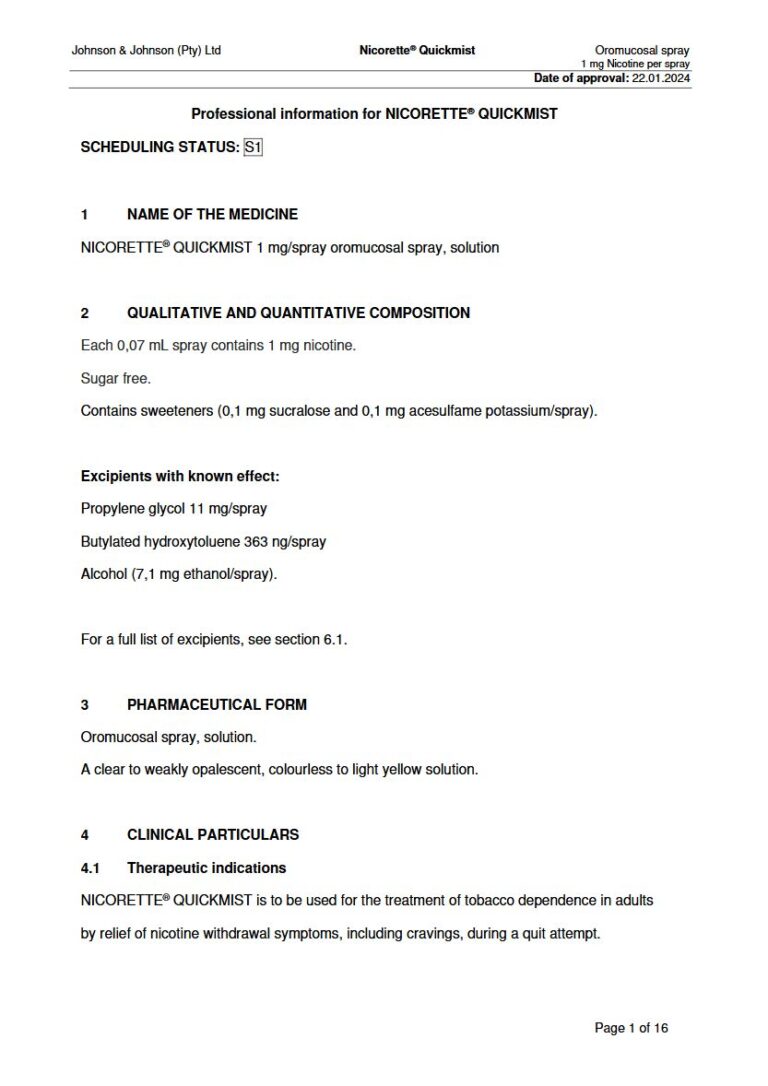
NICORETTE u00ae QUICKMIST is to be used for the treatment of tobacco dependence in adults by relief of nicotine withdrawal symptoms, including cravings, during a quit attempt. Permanent cessation of tobacco use is the eventual objective. NICORETTE u00ae QUICKMIST should preferably be used in conjunction with a behavioural support program.
4.2 Posology and method of administration
Posology Patients should stop smoking completely during the course of treatment with NICORETTE u00ae QUICKMIST. Adults and elderly The following chart lists the recommended usage schedule for NICORETTE u00ae QUICKMIST during full treatment (Step I) and during tapering (Step II and Step III). Up to 4 sprays per hour may be used. Do not exceed 2 sprays per dosing episode and do not exceed 64 sprays (4 sprays per hour, over 16 hours) in any 24-hour period.
Step I: Weeks 1 u2013 6 Use 1 or 2 sprays when cigarettes normally would have been smoked or if cravings emerge. If after a single spray, cravings are not controlled within a few minutes, a second spray should be used. If 2 sprays are required, future doses may be delivered as 2 consecutive sprays. Most smokers will require 1 u2013 2 sprays every 30 minutes to 1 hour.
Step II: Weeks 7 u2013 9 Start reducing the number of sprays per day. By the end of week 9 patients should be using HALF the average number of sprays per day that was used in Step I.
Step III: Weeks 10 u2013 12 Continue reducing the number of sprays per day so that patients are not using more than 4 sprays per day during week 12. When patients have reduced to 2 u2013 4 sprays per day, oromucosal spray use should be discontinued.
Example: If an average of 15 cigarettes per day are usually smoked, 1 u2013 2 sprays should be used at least 15 times during the day. To help stay smoke free after Step III, patients may continue to use NICORETTE u00ae QUICKMIST in situations when they are strongly tempted to smoke. One spray may be used in situations where there is an urge to smoke, with a second spray if one spray does not help within a few minutes. No more than four sprays per day should be used during this period. Regular use of NICORETTE u00ae QUICKMIST beyond 6 months is generally not recommended. Some ex-smokers may need treatment with NICORETTE u00ae QUICKMIST longer to avoid returning to smoking. Any remaining NICORETTE u00ae QUICKMIST should be retained to be used in the event of sudden cravings.
Paediatric population Do not administer NICORETTE u00ae QUICKMIST to persons under 18 years of age. There is no experience of treating adolescents under the age of 18 with NICORETTE u00ae QUICKMIST.
Method of administration After priming, point the spray nozzle as close to the open mouth as possible. Press firmly the top of the dispenser and release one spray into the mouth, avoiding the lips. Subjects should not inhale while spraying to avoid getting spray into the respiratory tract. For best results, do not swallow for a few seconds after spraying. Patients should not eat or drink when administering NICORETTE u00ae QUICKMIST. Behavioural therapy advice and support will normally improve the success rate.
4.3 Contraindications
- Hypersensitivity to nicotine, or any of the excipients of NICORETTE u00ae QUICKMIST listed in sections 2 and 6.1.
- Children under the age of 18 years.
- Those who have never smoked.
4.4 Special warnings and precautions for use
NICORETTE u00ae QUICKMIST should not be used by non-smokers. The benefits of quitting smoking outweigh any risks associated with correctly administered nicotine replacement therapy (NRT). A risk-benefit assessment should be made by an appropriate healthcare professional for patients with the following conditions:
- Cardiovascular disease: Dependent smokers with a recent myocardial infarction, unstable or worsening angina including Prinzmetalu2019s angina, severe cardiac dysrhythmias, recent cerebrovascular accident and/or who suffer with uncontrolled hypertension should be encouraged to stop smoking with non-pharmacological interventions (such as counselling). If this fails, NICORETTE u00ae QUICKMIST may be considered but as data on safety in this patient group are limited, initiation should only be under close medical supervision.
- Diabetes mellitus: Patients with diabetes mellitus should be advised to monitor their blood sugar levels more closely than usual when smoking is stopped and NRT is initiated as reduction in nicotine-induced catecholamine release can affect carbohydrate metabolism.
- Allergic reactions: Susceptibility to angioedema and urticaria.
- Renal and hepatic impairment: NICORETTE u00ae QUICKMIST should be used with caution in patients with moderate to severe hepatic impairment and/or severe renal impairment as the clearance of nicotine or its metabolites may be decreased with the potential for increased adverse effects.
- Pheochromocytoma and uncontrolled hyperthyroidism: As nicotine causes release of catecholamines, NICORETTE u00ae QUICKMIST should be used with caution in patients with uncontrolled hyperthyroidism or pheochromocytoma.
- Gastrointestinal (GI) disease: Swallowed nicotine may exacerbate symptoms in patients suffering from oesophagitis, gastritis or peptic ulcers and oral NRT preparations should be used with caution in these conditions.
- Seizures: Potential risks and benefits of nicotine should be carefully evaluated before use in subjects with a history of epilepsy as cases of convulsions have been reported in association with nicotine.
- Paediatric population: Danger in children: Doses of nicotine tolerated by adult and adolescent smokers can produce severe toxicity in small children that may be fatal. Products containing nicotine should not be left where they may be misused, handled or ingested by children (see section 4.9 Overdose).
- Transferred dependence: Transferred dependence is rare and is both less harmful and easier to break than smoking dependence.
- Stopping smoking: Polycyclic aromatic hydrocarbons in tobacco smoke induce the metabolism of medicines metabolised by CYP 1A2 (and possibly by CYP 1A1). When a smoker stops smoking, this may result in slower metabolism and a consequent rise in blood levels of such medicines. This is of potential clinical importance for products with a narrow therapeutic window, e.g. theophylline, clozapine and ropinirole.
The plasma concentration of other medicines metabolised in part by CYP1A2 e.g. imipramine, olanzapine, clomipramine and fluvoxamine may also increase on cessation of smoking, although data to support this are lacking and the possible clinical significance of this effect for these medicines is unknown. Limited data indicate that the metabolism of flecainide and pentazocine may also be induced by smoking.
Excipients: NICORETTE u00ae QUICKMIST contains small amounts of ethanol (alcohol), less than 100 mg per dose (1 or 2 sprays). NICORETTE u00ae QUICKMIST contains 11 mg propylene glycol in each spray which is equivalent to 150 mg/mL. Due to the presence of butylated hydroxytoluene (BHT), NICORETTE u00ae QUICKMIST may cause local skin reactions (e.g. contact dermatitis), or irritation to the eyes and mucous membranes. Care should be taken not to spray the eyes whilst administering the spray.
4.5 Interaction with other medicines and other forms of interaction
No clinically relevant interactions between nicotine replacement therapy and other medicines has definitely been established. However, nicotine may possibly enhance the haemodynamic effects of adenosine, i.e. increase in blood pressure and heart rate and also increase pain response (angina-pectoris type chest pain) provoked by adenosine administration (see section 4.4, Stopping smoking).
4.6 Fertility, pregnancy and lactation
Women of childbearing potential/ contraception in males and females In contrast to the well-known adverse effects of tobacco smoking on human conception and pregnancy, the effects of therapeutic nicotine treatment are unknown. Thus, whilst to date no specific advice regarding the need for female contraception has been found to be necessary, the most prudent state for women intending to become pregnant is to be both non-smoking, and not using NRT.
Whilst smoking may have adverse effects on male fertility, no evidence exists that particular contraceptive measures are required during NRT treatment by males.
Pregnancy Smoking during pregnancy is associated with risks such as intra-uterine growth retardation, premature birth or stillbirth. Stopping smoking is the single most effective intervention for improving the health of both pregnant smoker and her baby. The earlier abstinence is achieved the better. Nicotine passes to the foetus and affects its breathing movements and circulation. The effect on the circulation is dose dependent. Therefore, the pregnant smoker should always be advised to stop smoking completely without use of nicotine replacement therapy. The risk of continued smoking may pose greater hazard to the foetus as compared with the use of nicotine replacement products in a supervised smoking cessation programme. The use of NICORETTE u00ae QUICKMIST by the pregnant smoker should only be initiated after advice from a health care provider.
Lactation Nicotine passes freely into breast milk in quantities that may affect the child even with therapeutic doses. NICORETTE u00ae QUICKMIST should therefore be avoided during breastfeeding. Should smoking cessation not be achieved, use of NICORETTE u00ae QUICKMIST by breastfeeding smokers should only be initiated after advice from a healthcare professional. Women should take the product just after having breastfed and leave as long a time as is possible (2 hours is suggested) between taking the mouth spray and the next feed.
Fertility Smoking increases the risk for infertility in women and men. In vitro studies have shown that nicotine can adversely affect human sperm quality. In rats, impaired sperm quality and reduced fertility has been shown.
4.7 Effects on ability to drive and use machines
NICORETTE u00ae QUICKMIST has no or negligible influence on the ability to drive and use machines.
4.8 Undesirable effects
Effects of smoking cessation Regardless of the means used, a variety of symptoms are known to be associated with quitting habitual tobacco use. These include emotional or cognitive effects such as dysphoria or depressed mood, insomnia, irritability, frustration or anger, anxiety, difficulty concentrating, and restlessness or impatience. There may also be physical effects such as decreased heart rate, increased appetite or weight gain, dizziness or presyncopal symptoms, cough, constipation, gingival bleeding or aphthous ulceration, or nasopharyngitis. In addition, and of clinical significance, nicotine cravings may result in profound urges to smoke.
NICORETTE u00ae QUICKMIST may cause adverse reactions similar to those associated with nicotine given by other means and these are mainly dose dependent. Allergic reactions such as angioedema, urticaria or anaphylaxis may occur in susceptible individuals. Local adverse effects of administration are similar to those seen with other orally delivered forms. During the first few days of treatment irritation in the mouth and throat may be experienced, and hiccups are particularly common. Tolerance is normal with continued use.
Daily collection of data from trial subjects demonstrated that very commonly occurring adverse events were reported with onset in the first 2 u2013 3 weeks of use of NICORETTE u00ae QUICKMIST and declined thereafter.
Adverse reactions identified from clinical trials and during post-marketing experience are as follows:
Immune system disorders: Frequent: hypersensitivity Frequency unknown: allergic reactions including angioedema and anaphylaxis
Psychiatric disorders: Less frequent: abnormal dreams
Nervous system disorders: Frequent: headache, dysgeusia, paraesthesia Frequency unknown: seizure
Eye disorders: Frequency unknown: blurred vision, increased lacrimation
Cardiac disorders: Less frequent: palpitations, tachycardia Frequency unknown: atrial fibrillation
Vascular disorders: Less frequent: flushing, hypertension
Respiratory, thoracic and mediastinal disorders: Frequent: hiccups, throat irritation Less frequent: bronchospasm, rhinorrhoea, dysphonia, dyspnoea, nasal congestion, oropharyngeal pain, sneezing, throat tightness
Gastrointestinal disorders: Frequent: nausea, abdominal pain, diarrhoea, dry mouth, dyspepsia, flatulence, salivary hypersecretion, stomatitis, vomiting Less frequent: eructation, gingivitis, glossitis, oral mucosal blistering and exfoliation, oral paraesthesia, dysphagia, oral hypoesthesia, retching Frequency unknown: dry throat, gastrointestinal discomfort, lip pain
Skin and subcutaneous tissue disorders: Less frequent: hyperhidrosis, pruritus, rash, urticaria Frequency unknown: erythema
General disorders and administration site conditions: Frequent: burning sensation, fatigue Less frequent: asthenia, chest discomfort and pain, malaise
Reporting of suspected adverse reactions Reporting suspected adverse reactions after authorization of NICORETTE u00ae QUICKMIST is important. It allows continued monitoring of the benefit/risk balance of NICORETTE u00ae QUICKMIST. Healthcare professionals are asked to report any suspected adverse reactions via the u201c6.04 Adverse Drug Reactions Reporting Formu201d, found online under SAHPRAu2019s publications: http://www.sahpra.org.za/Publications/Index/8
4.9 Overdose
When used as directed, symptoms of overdose with nicotine may occur in patients with low pre-treatment nicotine intake or if other sources of nicotine are used concomitantly. Symptoms of overdose are those of acute nicotine poisoning and include nausea, vomiting, increased salivation, abdominal pain, diarrhoea, sweating, headache, dizziness, disturbed hearing and marked weakness. At high doses, these symptoms may be followed by hypotension, weak and irregular pulse, breathing difficulties, prostration, circulatory collapse and general convulsions.
Paediatric population Doses of nicotine that are tolerated by adult smokers during treatment may produce severe symptoms of poisoning in children and may prove fatal. Suspected nicotine poisoning in a child should be considered a medical emergency and treated immediately.
Management of an overdose All nicotine intake should stop immediately, and the patient should be treated symptomatically. If excessive amount of nicotine is swallowed, activated charcoal reduces the gastrointestinal absorption of nicotine. The acute minimum lethal oral dose of nicotine in man is believed to be 40 to 60 mg.
